Best Master's in Communication Programs in Missouri
Compare 19 accredited Communication programs in Missouri at 12 schools, with graduate earnings, cost, debt, and completion data from IPEDS and the U.S. College Scorecard.

Northwest Missouri State University prices its online strategic communication master's at $12,210 total, while Saint Louis University charges $1,450 per credit. The ranked programs here mix campus, online, and hybrid formats, from Avila's and Webster's online tracks to Missouri State's hybrid MA. Missouri does not license PR, corporate communication, or media careers, so cost and format drive most decisions. Employers pay for portfolio work and graduates who can explain data and strategy, not the school name. The GRE remains the most variable admissions hurdle; several programs here waive it outright.
Key Points
- Saint Louis University posts a 79.5 percent graduation rate and requires no GRE.
- Missouri State University pairs a roughly $11,200 assistantship stipend with a tuition and fee waiver.
- Public relations and media careers in Missouri need no state license, unlike speech teaching.
Missouri's Top Master's in Communication Programs, Ranked by Value
Saint Louis University leads this Missouri list on outcomes: its 79.5 percent graduation rate is the highest of the nine schools, and the program does not require GRE scores while offering assistantships with stipends and tuition scholarships. The public options at Missouri State, Northwest Missouri State and Mizzou cost far less per credit, and deadlines and admission rules vary by school, so confirm each on the program's admissions page before you apply.
Saint Louis University
#1Saint Louis, MO · ~$26,000/yr (est.)
Best for: Aspiring doctoral applicants wanting a thesis track
Saint Louis University offers a flexible, generalist 30-credit M.A. in Communication on its St. Louis campus. Students pick a thesis, an applied project or comprehensive exams, and can tailor electives toward health, intercultural, organizational or strategic communication. Its graduation rate of about 79.5 percent is the highest on this list, though at $1,450 per credit it is a premium-priced option.
- 30 credit hours at $1,450 per credit
- 3.0 GPA minimum and 3 letters of recommendation (minimum)
- No entrance exam required; GRE scores not needed
- Thesis, applied project or comprehensive exam completion
- Graduate assistantships with stipends and tuition scholarships
- Health communication focus, one of 8 concentration options
- Tailored program of study with thesis or capstone option
- Aimed at corporate communication careers
- Intercultural communication coursework
- Thesis required for this track
- 10 total courses and a $0 application fee
University of Missouri
#2Columbia, MO · ~$14,000/yr (est.)
Best for: Research-minded applicants at the flagship campus
The University of Missouri in Columbia is the state's flagship public option, with a 30-credit M.A. in Communication built around research methods and a required introductory seminar. Students choose a thesis with an oral defense or a non-thesis route with a project and comprehensive exams, and funded assistantships are available. About 74.9 percent of students graduate, second highest on this list.
- 30 credit hours; thesis and non-thesis options
- 3.0 GPA minimum (a B average)
- Statement of purpose, writing sample and 3 recommendation letters
- GRE optional
- Fall admission only; stated deadline is January 15, so confirm your entry year
- No more than 12 hours of research credit; 8 years to finish
- International applicants: TOEFL 80 iBT or IELTS 5.5
University of Missouri-St Louis
#3Saint Louis, MO · $15,000 – $20,000/yr (est.)
Best for: Communication undergraduates on an accelerated pathway
UMSL's 30-credit M.A. in Communication takes a social-behavioral science approach, with a 15-credit core in theory and research methods plus applied courses in strategic, interpersonal, mass and health communication. Students finish with a thesis or an internship. A graduation rate of about 56.6 percent is mid-range, but the accelerated pathway is a real advantage for its own undergraduates.
- 30 credits (36 without thesis or internship) with a 15-credit core
- Regular admission GPA of 3.25; probationary admission possible with added evidence
- Bachelor's in communication or a related field required
- 4 concentration options; on-campus format
- Accelerated M.A. lets UMSL undergraduates count up to 12 graduate credits toward both degrees
- International applicants need TOEFL iBT 100
Avila University
#4Kansas City, MO · ~$11,000/yr (est.)
Avila University in Kansas City runs its M.A. in Strategic Communication fully online in eight-week courses with several start dates a year and no GRE requirement. The concentrations lean toward business: marketing, project management and strategic human resources. Its graduation rate is about 52.4 percent.
- $19,500 total tuition ($650 per credit), 30 credits in about 14 months
- 2.8 GPA minimum; no GRE required
- Courses include integrated and digital marketing communication
- Capstone with a real-world client and a built-in portfolio
- Project management concentration courses
- Capstone required
- $0 application fee
- Strategic human resources concentration
- Thesis or capstone option
- 5 start dates a year across spring, summer and fall
Webster University
#5Saint Louis, MO · ~$14,000/yr (est.)
Webster University's St. Louis-based M.A. in Strategic Communications is 100 percent online and built for working professionals, finishing in as little as 18 months. Coursework covers crisis communication, branding, social media and analytics, taught by faculty with backgrounds at companies such as Anheuser-Busch and McDonald's. Its graduation rate is about 64.4 percent, and Scorecard data shows a median first-year earnings figure of $55,445 for completers.
- 100% online; as little as 18 months
- Crisis communication, branding and strategic planning coursework
- Grad-to-Grad scholarship of up to $2,000
- Median earnings of $55,445 one year after completion (College Scorecard)
Missouri State University
#6Springfield, MO · ~$8,000/yr (est.)
Missouri State University in Springfield pairs low public tuition with a theory-and-research M.A. in Communication that includes service-learning and internships. Students can specialize in conflict, organizational communication, or communication and culture. Assistantships can include tuition waivers and a stipend, and its graduation rate is about 57.9 percent.
- 33 credit hours with thesis, seminar paper or professional project options
- Traditional and accelerated master's pathways
- Probationary admission for applicants showing high promise
- Writing samples and letters can go to the Director of Graduate Studies when they cannot be uploaded
- Graduate assistantships with tuition waivers and stipends
- Median earnings of $45,092 one year after completion (College Scorecard)
- Conflict concentration, one of 3 options
- Service-learning and internships
- Careers in consulting and HR
- Organizational communication concentration
- Balances theory and practice
- Prepares for consulting careers
- Communication and culture concentration
- Prepares for consulting, HR and PR roles
Drury University
#7Springfield, MO · ~$8,000/yr (est.)
Drury University in Springfield offers a 30-credit M.A. in Communication in hybrid and asynchronous online formats, taken one or two courses at a time over about 24 months. No GRE is required, and total tuition is about $15,000. Students can start with a 12-credit Communication and Organizational Leadership Certificate that may later count toward the master's. Its graduation rate is about 61.8 percent.
- 30 credits, 10 courses, about 24 months, cohort-based
- Roughly $15,000 total tuition
- No entrance exam required
- Fully online option; fall or spring start
- Portfolio-based capstone
- 12-credit certificate can later apply toward the master's
Northwest Missouri State University
#8Maryville, MO · $5,000 – $10,000/yr (est.)
Northwest Missouri State University in Maryville delivers its M.A. in Strategic Communication 100 percent online in seven-week terms. At about $12,210 total, it is one of the lowest-cost options here, and in-state and out-of-state students pay the same tuition. Its graduation rate is about 54.2 percent.
- $12,210 total ($407 per credit), 30 credits in about 12 months
- 2.5 GPA minimum
- 4 start dates a year
- Same in-state and out-of-state tuition
- Capstone required
Park University
#9Parkville, MO · under $5,000/yr (est.)
Park University's 36-credit M.A. in Communication and Leadership is offered online and on campus, with asynchronous classes and part-time study for working professionals. It combines communication theory, research methods and organizational leadership. Its graduation rate of about 38.4 percent is the lowest on this list, and Scorecard data shows median first-year earnings of $60,192.
- 36 credit hours; part-time study available
- Asynchronous online classes plus on-campus option
- Ethnographic and quantitative research, cross-cultural communication and leadership
- Median earnings of $60,192 one year after completion (College Scorecard)
Cost & outcomes by school
Federal data for the highest-earning Communication programs, independent of the ranking above. Earnings are this field's master's graduates four years after completing, where the Scorecard reports them.
| School | Earnings | Tuition / yr | Debt | Grads/yr | Format |
|---|---|---|---|---|---|
| Webster University MO | $65,188 | $13,736 | $48,635 | 14 | Online or campus |
| University of Central Missouri MO | $59,861 | $10,296 | — | 10 | Hybrid |
| Missouri State University MO | $55,039 | $8,204 | — | 15 | Hybrid |
| Park University MO | — | $4,783 | — | — | Hybrid |
| Northwest Missouri State University MO | — | $8,096 | — | — | Online |
| Avila University MO | — | $10,800 | — | — | Online |
| Missouri University of Science and Technology MO | — | $14,944 | — | — | Online |
| Maryville University MO | — | $16,246 | — | — | Online |
| Drury University MO | — | $8,115 | — | 12 | Hybrid |
| University of Missouri MO | — | $13,681 | — | — | Campus |
| University of Missouri-St Louis MO | — | $15,480 | — | 5 | Campus |
| Saint Louis University MO | — | $25,590 | — | 9 | Campus |
Sources: U.S. Department of Education. Tuition and graduates: IPEDS. Earnings and debt: College Scorecard, this field's master's graduates; a dash means no figure is reported.
What Earned a Spot on This Missouri List
A famous name and a strong outcome are not always the same thing, and this list leans toward the second. Programs earn their place on what students pay and what graduates get back, not on reputation.
The inputs are simple: published graduate tuition for master's programs in Missouri, average net price after aid, institution-wide graduation rate, and, where College Scorecard publishes them, program-level earnings and debt for communication graduates.
One caution applies throughout. Graduation rates and net price describe the whole university, not the master's in communication program alone. Treat them as context for the school's overall track record, then check program-specific costs and outcomes directly.
Online and Hybrid Master's in Communication Options in Missouri
Strategic communication has become the area where Missouri universities have moved most decisively online. Missouri's online master's in communication options sort into three formats.
- Fully online: Avila University, Webster University and Northwest Missouri State University. Northwest's program runs in seven-week courses, and Avila's runs in eight-week courses.
- Hybrid: Missouri State University, Drury University and Park University. Drury also lists a fully online option.
- Campus: Saint Louis University, the University of Missouri and the University of Missouri-St Louis.
Working professionals will likely prefer the online and hybrid formats, which allow part-time study or one or two courses at a time. Students who want graduate assistantships and in-person networking should look at the campus programs, or at Missouri State, which lists assistantships with tuition waivers.
Out-of-state online students should compare in-state and out-of-state tuition before applying, with particular attention to the most affordable master's in communication programs. Northwest states that its rate is the same for everyone. Public campus programs such as Missouri State and the University of Missouri charge noticeably more to nonresidents.
Related Articles
Which Missouri Communication Master's Programs Skip the GRE?
If you are hunting for master's in communication programs with no GRE required in Missouri, a few schools answer the question plainly and others leave it open.
- No entrance exam: Drury states outright that no GRE is required. Avila says the same for its strategic communication master's and describes admission as test optional, with a 2.8 GPA floor. Saint Louis University also lists no entrance exam and a test-optional policy alongside a 3.0 GPA minimum.
- Unclear from the published page: Missouri State's current graduate communication page links to entrance requirements without stating a testing rule. Older graduate catalogs described a GRE or MAT submission paired with GPA alternatives, but there is no confirmation those terms still apply in 2026.
- No testing policy published: UMSL, Webster, Northwest Missouri State, and Park publish GPA thresholds and application materials rather than an exam requirement. Mizzou lists the GRE as optional.
Before you register and pay for the GRE, email the graduate admissions office and get the current policy in writing. Testing rules change quietly, and a program page is not always the latest word.
Missouri Communication Master's Tuition Comparison: The Five Lowest-Cost Programs
Annual tuition figures come from federal data and can differ from current per-credit rates, so use the per-credit column to estimate a full program price. Net price is an institution-wide average after aid, not a quote for any one master's program. Always confirm the current rate and fees with each school before you budget.
| School | Format | In-state tuition (annual) | Out-of-state tuition (annual) | Net price (institution average) | Per-credit rate and credit hours |
|---|---|---|---|---|---|
| University of Missouri-St Louis | Campus | $15,480 | $36,792 | $15,071 | $697 resident, $1,658 nonresident, $1,046 Midwest Student Exchange; 30 credits (36 if coursework replaces thesis or internship) |
| Avila University | Online | N/A | N/A | $16,053 | $650 per credit; 30 credits; $19,500 total program tuition |
| Northwest Missouri State University | Online | $8,096 | $8,096 | $16,244 | $407 per credit, same for in-state and out-of-state; 30 credits; $12,210 total program tuition |
| Missouri State University | Hybrid | $8,204 | $14,990 | $17,613 | $414 per credit resident; credit hours not confirmed; 9 resident credits cost $4,947 with fees |
| University of Missouri | Campus | $13,681 | $32,581 | $20,268 | Per-credit rate not confirmed; 30 credits |
Graduate Assistantships and Funding for Missouri Communication Students
Missouri State University offers the clearest funded path among the schools here. Its communication assistantships can be renewed for up to two years and pair a stipend of roughly $11,200 over nine months with a tuition and fee waiver, a package the program values at more than $35,000 across the degree. The waiver covers up to 12 credit hours in fall and spring. General 2026-27 stipends run from $10,096 at the lowest level to $16,356 at the highest, and half-time appointments pay half.
UMSL works differently. Half-time (.50 FTE) assistants may receive a tuition scholarship for up to 9 credits in fall and spring, or 6 in summer. It is not guaranteed, and quarter-time appointments get none. Communication-specific stipend figures are not listed, so ask the department directly.
Drury University competes on price instead, at $472 per credit and about $15,000 for the full program.
Apply early for communication graduate assistantships at Missouri programs. Missouri State's deadline is February 1, and you must be admitted or have an application under review.
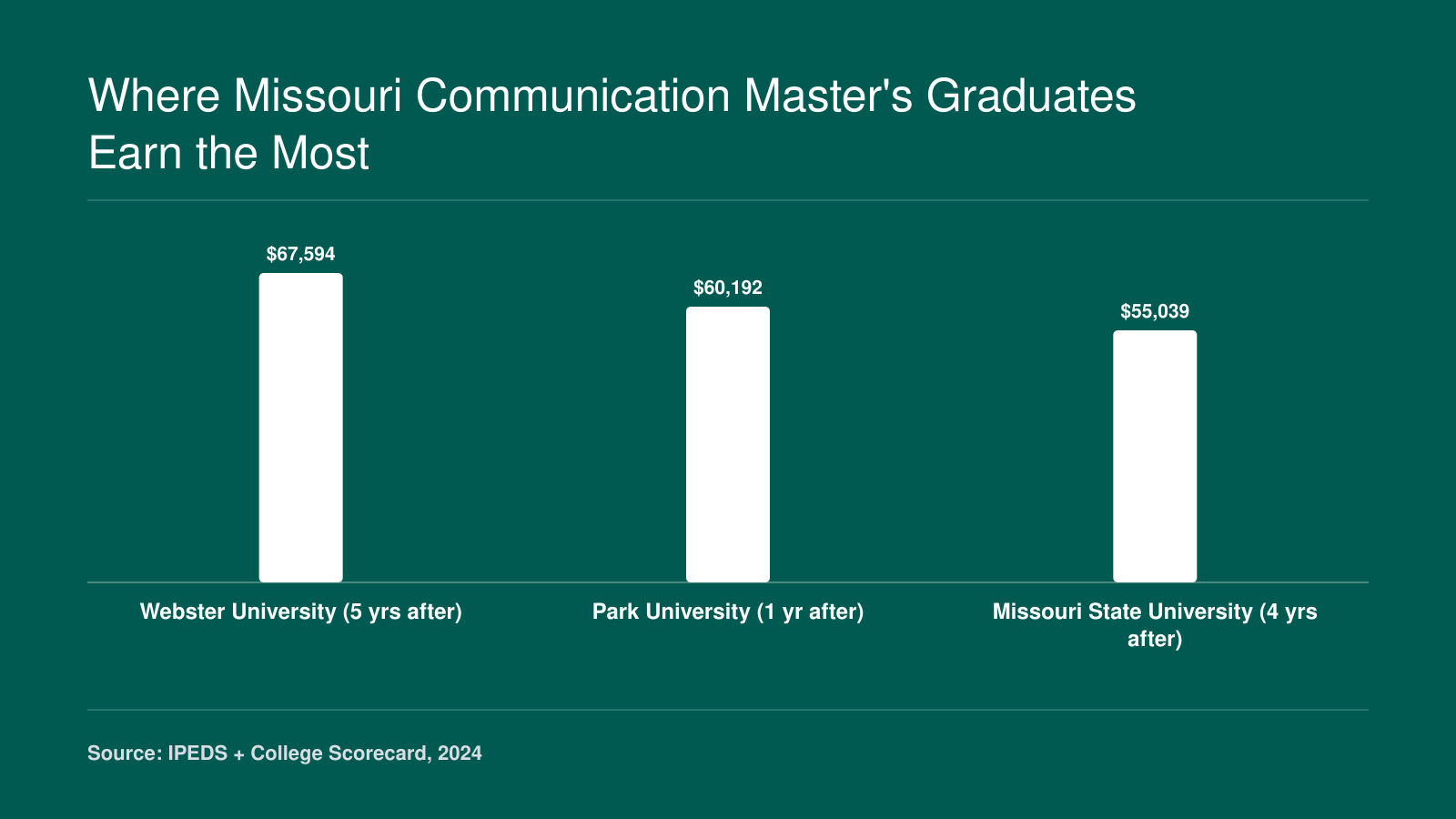
Where Missouri Communication Master's Graduates Earn the Most
Only program-level earnings are charted here, and each bar carries its own measurement window, so the figures are not a like-for-like comparison. Saint Louis University and the University of Missouri have no published program-level earnings figure for their communication master's, so they appear without a number rather than borrowing an institution-wide figure.
Credentials and Accreditation for Communication Careers in Missouri
Quick Answers Before You Apply
Can you earn an accelerated master's in communication in Missouri in about a year?
Do Missouri communication master's programs accept students whose bachelor's is in another field?
How long do you have to finish a master's in communication at the University of Missouri?
Compare Communication programs on the data that matters
Explore more Communications & Media specializations or browse every graduate field.
All Communications & Media programs