Master's in Communication Programs With No GRE Required
Compare 530+ accredited no-gre Communication programs at 360+ schools, with graduate earnings, cost, debt, and completion data from IPEDS and the U.S. College Scorecard.

The GRE costs $220 and weeks of prep, yet a growing share of communication master's programs, Master's in Strategic Communication With No GRE Required included, no longer ask for it. UNC's digital communication M.A., Rutgers' media program, and Gonzaga's Master's in Organizational Communication With No GRE Required degree all admit applicants on their transcripts, writing samples, and work history instead.
For professionals juggling a job, that shift removes a real barrier. Admissions committees here weigh a 3.0 GPA, recommendation letters, and evidence of graduate-level writing over a single test score, a standard that rewards the experience you already have.
Key Points
- No-GRE admissions weigh GPA, experience, and writing samples over standardized scores.
- Some programs deliver courses fully asynchronously, while others require scheduled class meetings.
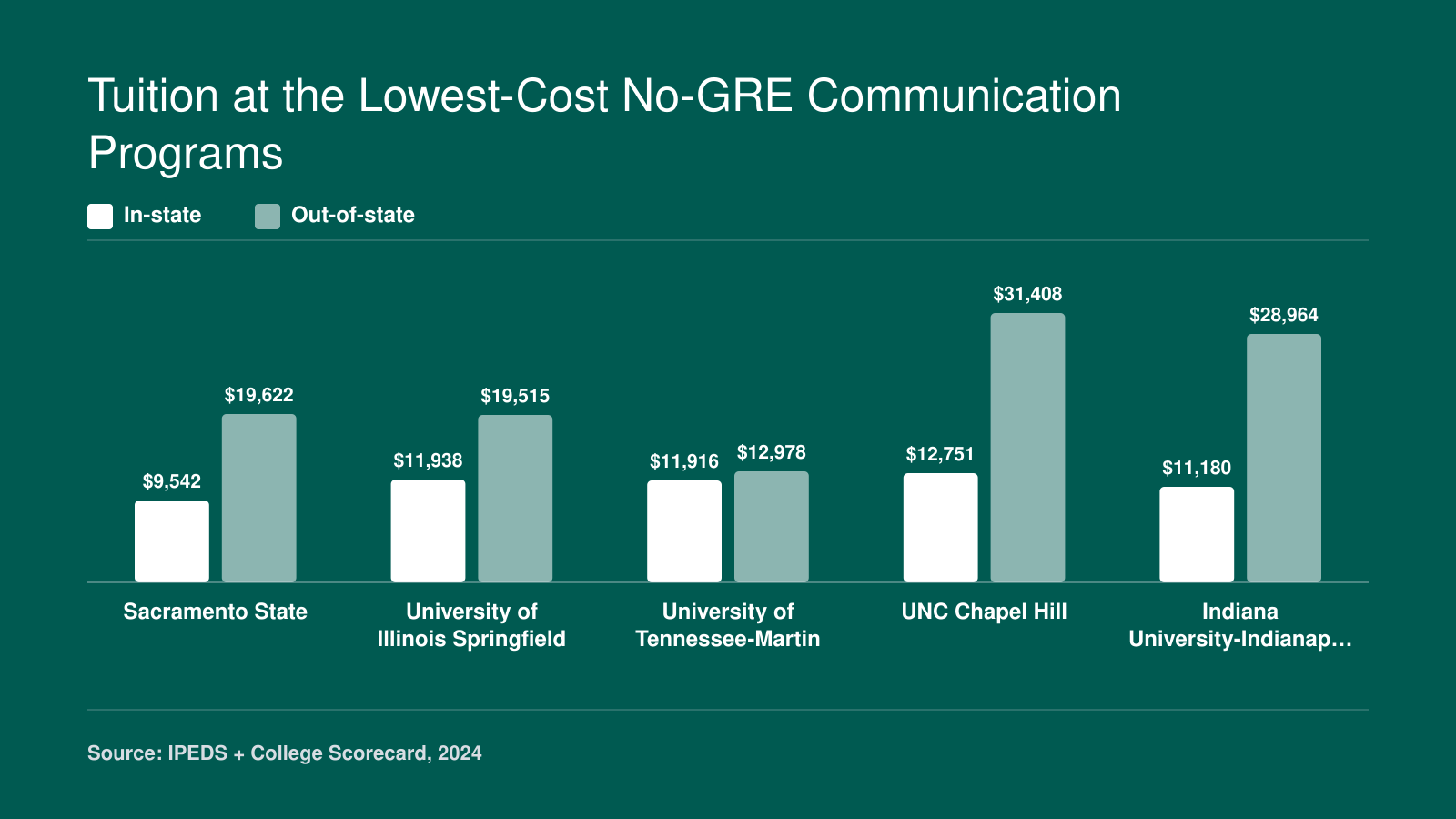
- In-state and out-of-state tuition can differ by over $18,000 at one school.
Best Master's in Communication Schools With No GRE Requirement
These programs earn a place here by removing or minimizing the GRE requirement first, then pairing that access with strong student retention, clear degree completion paths, and established communication curricula. Cost and post-graduate earnings are considered as secondary factors, not as the only reason a school appears. Because policies can shift, confirm the current GRE policy on each program's admissions page before applying.
University of North Carolina at Chapel Hill
#1Chapel Hill, NC · ~$13,000/yr (est.)
Best for: Mid-career media professionals seeking digital leadership
UNC-Chapel Hill offers an online M.A. in Digital Communication for mid-career professionals ready to lead, with GRE scores waived among its admissions requirements. The 30-credit part-time curriculum combines digital media theory with project-based learning and culminates in a thesis, supported by a small cohort capped at 20 students. Applicants should expect a three-year professional experience requirement and a 3.0 GPA threshold along with two required on-campus experiences.
- No entrance exam required; test optional
- 30 total credit hours, 9 sequential courses
- Part-time, 2.5 years typical
- Cohort capped at 20 students
- Two required on-campus experiences
- Three years professional experience required
- 3.0 GPA minimum
- Asynchronous courses with live options
North Carolina State University at Raleigh
#2Raleigh, NC · $12,000 – $33,000/yr (est.)
Best for: Aspiring researchers seeking funded campus study
NC State's campus-based M.S. in Communication is built around 36 credit hours with nine hours of methods and theory plus electives in public relations, organizational communication, and digital media. The program does not require GRE scores and admits a small cohort of 15 to 20 students, with full- and part-time options and a thesis track. Graduate assistantships can cover tuition and health insurance, adding practical teaching and research experience for students aiming at leadership or doctoral study.
- No GRE required for admission
- 36 total credit hours
- Thesis track available
- Full-time and part-time options
- Graduate assistantships cover tuition
- 15 to 20 students admitted yearly
- Electives in PR, organizational, digital media
Rutgers University
#3New Brunswick, NJ · ~$23,000/yr (est.)
Best for: Working adults needing flexible online options
Rutgers' Master of Communication and Media blends six specializations, including Digital Media, Health Communication, Public Relations, and Strategic Leadership, within a 36-credit curriculum. The no-GRE program serves working professionals through on-campus, online, or hybrid formats and recently expanded its fully online option, with a reduced online tuition rate aligned more closely to in-state costs. Rolling admissions and live or asynchronous evening classes make it particularly accessible for students balancing employment, and the program reports that 86 percent of students graduate within 24 months.
- No GRE required; test optional
- Six concentrations available
- 36 total credit hours
- Complete in 24 months or less
- On-campus, online, and hybrid options
- Fully online asynchronous and synchronous
- Rolling admissions for fall start
- 86% graduate within 24 months
Gonzaga University
#4Spokane, WA · ~$22,000/yr (est.)
Gonzaga's online Master of Arts in Communication and Leadership Studies emphasizes strategic communication, digital storytelling, crisis management, and ethical influence for corporate, nonprofit, and public sector roles. The asynchronous format lets students pace coursework while staying connected to faculty and peers, and optional immersions or study abroad add experiential depth. Concentrations are available but not required, with six options such as Digital Media Strategies; the program does not require GRE scores.
- No GRE required
- Asynchronous online classes
- Six concentration options
- Digital Media Strategies concentration available
- Alumni at Google, Amazon, Microsoft
- Optional immersions and study abroad
George Washington University
#5Washington, DC · ~$36,000/yr (est.)
GW's Master of Arts in Media and Strategic Communication is a Washington, DC-based program that connects media effects, public opinion, and persuasion with campaign design and data analysis. The 36-credit curriculum includes core courses, skills training, electives, and a capstone choice of thesis, media project, or strategic communication project, with a concentration in climate and sustainability communication available. GRE scores are not required, and the program's flexible deadlines are suited to professionals advancing in media relations, public affairs, or PR consulting.
- No entrance exam required; test optional
- 36 total credit hours
- Thesis, media, or strategic project capstone
- Climate and sustainability communication focus
- Located in Washington, DC
- Elective-driven curriculum
Washington State University
#6Pullman, WA · ~$15,000/yr (est.)
Washington State University offers multiple paths in communication, including a campus-based M.A. in Communication and an online M.A. in Health Communication and Promotion. Both routes de-emphasize the GRE: the campus program is test optional, while the online health communication track states no GRE is required and uses an in-state tuition rate for all students. Students can choose thesis or non-thesis options on the campus track, while the online professional track includes a capstone portfolio and weekly online office hours.
- Test optional
- Thesis and non-thesis options
- 27 total credit hours
- 3.0 GPA minimum
- Funding via assistantships and fellowships
- Small cohorts with close mentorship
- No GRE required; no entrance exam
- 30 total credit hours, 10 courses
- $672 per credit, in-state tuition for all
- 100% online courses
- Capstone portfolio project
- Starts fall, spring, and summer
Stony Brook University
#7Stony Brook, NY · ~$14,000/yr (est.)
Stony Brook's online M.S. in Science Communication prepares students for professional science communication through a 33-credit curriculum of six required courses and five electives. GRE scores are optional rather than required, and admission requires a 3.0 cumulative GPA, three recommendations, a personal statement, and two writing samples. A Climate Communication concentration lets students take designated climate courses, including up to two in the School of Marine and Atmospheric Sciences.
- No entrance exam required; GRE optional
- 33 total credit hours
- Fully online option available
- Climate Communication concentration available
- 3.0 GPA minimum
- Three letters of recommendation required
- Two writing samples required
Saint Louis University
#8Saint Louis, MO · ~$26,000/yr (est.)
Saint Louis University's M.A. in Communication is a 30-credit generalist degree with electives across health, intercultural, interpersonal, organizational, media, rhetoric, and strategic communication. GRE scores are not required, and students choose among a thesis, applied project, or comprehensive exam to finish the degree. Graduate assistantships with stipends and tuition scholarships are available, and the eight concentration options make it suitable for students tailoring the degree toward corporate communication, higher education, or doctoral preparation.
- No entrance exam required; test optional
- 30 total credit hours
- Three degree completion options
- Eight concentration options
- Health Communication concentration
- Careers in corporate communications
- Graduate assistantships available
- Admission is test optional
- Intercultural Communication concentration
- 10 total courses
- $0 application fee
- No GRE required
University at Albany
#9Albany, NY · ~$14,000/yr (est.)
The University at Albany's M.A. in Communication offers focused concentrations in Interpersonal and Intercultural Communication, Organizational Communication, and Political Communication, built on core theory and research methods. The curriculum culminates in a guided research project or practicum internship, with rolling admissions and no GRE requirement. A combined BA/MA option supports Albany undergraduates, and graduates are prepared for roles such as public relations manager, communications director, or digital marketing strategist.
- No GRE required; test optional
- Rolling admissions
- Guided research or practicum capstone
- Internships at major organizations
- Organizational Communication concentration
- Research or practicum capstone
- Combined BA/MA option
- Prepares for PR manager roles
- Political Communication concentration
- Three start dates per year
- Internships at NYS Assembly
- Writing sample required
Calvin University
#10Grand Rapids, MI · ~$11,000/yr (est.)
Calvin University's Master of Media and Strategic Communication is a campus-based program that pairs strategic thinking with hands-on media production through the student-run Skylight Media Agency. The no-entrance-exam curriculum covers AI, social media, and emerging trends, with evening classes designed for working professionals. Full-time students can finish in one year and part-time students in two, and competitive tuition makes it an accessible no-GRE option.
- No entrance exam required; test optional
- $693 per credit; $22,000 total program tuition
- 1-year full-time, 2-year part-time
- Students run Skylight Media Agency
- Evening classes for working professionals
- AI and social media emphasis
Cost & outcomes by school
Federal data for the highest-earning Communication programs, independent of the ranking above. Earnings are this field's master's graduates four years after completing, where the Scorecard reports them.
| School | Earnings | Tuition / yr | Debt | Grads/yr | Format |
|---|---|---|---|---|---|
| Washington State University WA | $86,450 | $14,845 | $26,714 | 41 | Campus |
| University of West Georgia GA | — | $6,046 | — | — | Online |
| Mississippi Valley State University MS | — | $8,385 | — | — | Campus |
| University of North Florida FL | — | $10,364 | — | — | Hybrid |
| Florida State University FL | — | $10,553 | — | — | Online or campus |
| Bowie State University MD | — | $10,854 | — | — | Campus |
| Avila University MO | — | $10,800 | — | — | Online |
| Coastal Carolina University SC | — | $10,764 | — | — | Campus |
| Calvin University MI | — | $11,113 | — | — | Campus |
| CUNY City College NY | — | $11,402 | — | — | Campus |
Sources: U.S. Department of Education. Tuition and graduates: IPEDS. Earnings and debt: College Scorecard, this field's master's graduates; a dash means no figure is reported.
Cost, debt & payoff
Median earnings of this field's master's graduates (4 yrs after completing) vs. their median federal loan debt · U.S. College Scorecard
Across these programs the median graduate earns about $68,264 and finishes with roughly $33,774 in debt — a ratio that clears a common rule of thumb (keep debt below first-year salary). Tuition and debt vary widely school to school, so check the per-school figures in the table above before you shortlist.
What Communication Programs Look for Instead of GRE Scores
No-GRE admissions still weigh a mix of academic history and evidence you can do graduate-level work.
- Minimum GPAA 3.0 undergraduate GPA is a common floor: UT Austin, Georgetown, Ohio, and New Mexico State's standard path list it. UT Austin grants conditional admission below 3.0 only in extenuating circumstances.
- Lower-GPA and conditional routesSouthern Utah reviews applicants below 2.70 case by case, and Avila sets unconditional admission at 2.75 with conditional admission at 2.5.
- Work experienceA strong work record can offset a lower GPA: New Mexico State's alternative pathway qualifies with five years of relevant full-time work and a 2.5 GPA, while Ohio prefers three years of work experience.
- Writing samples and recommendationsIowa asks for two writing samples and three recommendation letters; Ohio requires two letters.
- Statement of purpose or portfolioOregon asks for a personal statement or portfolio instead of publishing a minimum GPA, making the narrative and examples central to the review.
Synchronous, Asynchronous, or Residency: How These Programs Deliver Classes
Logging in whenever you like and logging in at a set hour are very different commitments, and the No-GRE master's programs here split along that line.
Fully asynchronous online master's in communication programs have no scheduled meetings. Drake's six-week courses1, the University of North Dakota's professional track, and the University of Tennessee, Knoxville2 all work this way. Purdue is mostly asynchronous, with coursework paced to instructor-posted schedules.3
Some programs add live elements. UNC Chapel Hill's courses are mostly asynchronous, with a few Zoom lectures that are recorded, so you need not attend at a specific time. Ohio University's two certificates include a virtual one-day seminar, optional but highly recommended.4 Rutgers offers both asynchronous and live Zoom classes, which run weeknights, Monday through Thursday, 6 to 9 p.m.
The program pages reviewed here do not document an on-campus residency requirement, though that does not prove none exists. A "Both" format label in the ranking usually means an online and an on-campus option exist, not a hybrid schedule.
Before you apply, confirm whether live sessions fall in the evening and in which time zone.
Related Articles
Tuition at the Lowest-Cost No-GRE Communication Programs
No GRE does not have to mean a premium price. Some of the least expensive no-GRE options in the data are public universities, and in-state versus out-of-state tuition can differ by more than $18,000 at the same school. Average net price after aid is institution-wide, not a quote for this degree, so focus on the tuition bars.
Thesis, Capstone, or Coursework-Only: Choosing a Path and Timeline
The culminating requirement is the last piece of your degree: a research thesis, an applied capstone, or no final project at all, much like the technical communication master's thesis vs capstone decision. A thesis suits future PhD candidates and research roles, while a capstone suits practitioners. Courses-only tracks, which some programs pair with exams, offer the least friction. Florida State lets students choose among all three.1
Credit loads mostly run 30 to 36. UT Tyler and North Dakota require 30, Hartford 33,2 and Sacred Heart and Ball State 36. Oregon's online Immersive Media Communication program is the outlier at 46 credits,3 though it is designed as a one-year degree, an accelerated master's in communication.
Timelines vary. Sacred Heart states 12 to 24 months, Florida State usually runs four semesters,1 and Oregon is built for 12 months.3 Part-time pacing is rarely spelled out, so ask admissions directly.
If you're aiming for PR, corporate, or agency work, favor a capstone. UT Tyler's non-thesis route ends in a digital portfolio, and North Dakota's capstone yields a portfolio-ready professional product, which gives you work to show employers.
A Program-Level Earnings Snapshot
From Organizational Communication to Journalism: Picking a Specialization
Rutgers and Gonzaga each list six concentration options, a reminder that most communication master's degrees package specializations inside a broader degree rather than offering them standalone. The concentrations in the programs here fall into four clusters.
- Strategic communication and PR: George Washington's Media and Strategic Communication and Calvin's Media and Strategic Communication suit people headed into advocacy, agency work, or corporate communications roles like communication director or PR manager.
- Master's in Organizational Communication and leadership: Gonzaga's Communication and Leadership Studies fits working professionals aiming at management, marketing manager, or director-level positions.
- Digital and visual media: UNC's Digital Communication and Gonzaga's Digital Media Strategies concentration lean toward content, social, and multimedia roles.
- Journalism and science communication: Stony Brook's Science Communication and NC State's track geared to nonprofit, PR, and government work serve those translating complex topics for public audiences.
If you want visual communication or journalism graduate programs specifically, look for them as concentrations within these degrees rather than as separate programs.
Communication programs by state
Your No-GRE Communication Master's Questions, Answered
Do you need the GRE for a master's in communication?
What GPA do you need for a communication master's without the GRE?
Which schools offer online master's in communication with no GRE?
How long does a master's in communication take without the GRE?
What can you do with a master's in communication?
Can a school bring back its GRE requirement after waiving it?
What do application fees and deadlines typically look like for these programs?
Can international applicants skip the GRE, and do they still need TOEFL or IELTS scores?
Compare Communication programs on the data that matters
Explore more Communications & Media specializations or browse every graduate field.
All Communications & Media programs