Master's in Organizational Communication Programs With No GRE Required
Compare 50+ accredited no-gre Organizational Communication programs at 40+ schools, with graduate earnings, cost, debt, and completion data from IPEDS and the U.S. College Scorecard.

A master's in organizational communication typically runs 30 to 36 credits, and a growing share of programs no longer ask for GRE scores. That spares applicants months of test prep and a registration fee of roughly $220.
The exam is only one gate, though. Most admissions committees still weigh undergraduate GPA, a writing sample, a statement of purpose, and professional experience, so a waiver shifts the work rather than removing it.
The real difference between programs now comes down to cost, delivery format, and how much applied training they offer.
Key Points
- For 2027, Florida State, West Virginia, Ohio University offer online no-GRE programs.
- Seton Hall and Albany remain campus-based no-GRE options in 2027.
- During 2027 admissions, committees weigh academic history, writing samples, and experience.
Top No-GRE Organizational Communication Master's Programs
These schools all meet the practical test for this list: the master's in organizational communication either waives the GRE, treats scores as optional, or states that no entrance exam is required. Policies can vary by term and applicant background, so confirm the current GRE requirement with the program before you apply.
Florida State University
#1Tallahassee, FL · ~$11,000/yr (est.)
Best for: Working professionals wanting applied behavioral leadership
Florida State builds its online master's around a blend of organizational communication and behavior analysis, which gives the degree a practical leadership and performance-management focus. The program is designed for working professionals, with a 33-credit structure, three start terms per year, and a capstone portfolio that connects coursework to workplace application. Its no-exam admission path and fully online delivery are strong fits for mid-career learners who want to keep working.
- No entrance exam required
- 33 total credit hours
- Fully online program
- Three start terms per year
- 3.0 GPA minimum
- Capstone portfolio required
- Behavior analysis and communication focus
Seton Hall University
#2South Orange, NJ · ~$37,000/yr (est.)
Best for: New York metro professionals preferring evening classes
Seton Hall's campus-based master's offers an organizational communication track within its M.A. in Communication, with weekly evening classes that fit working professionals near the New York metro area. The curriculum emphasizes decision-making, employee relations, and digital interaction, and qualified applicants may receive GRE or MAT waivers. Rolling admissions and scholarship opportunities make the program accessible for students who want an on-campus cohort.
- 36 total credit hours
- Evening classes once per week
- Rolling admissions
- Test optional for GRE and MAT
- Thesis required
- Scholarships available
- On-campus program in South Orange
West Virginia University
#3Morgantown, WV · ~$11,000/yr (est.)
Best for: Online learners wanting cohort-based structure
West Virginia University's online Master of Arts in Communication Studies includes a Corporate and Organizational Communication concentration that requires no GRE or prior communication background. The 30-credit, asynchronous program uses a cohort model and a capstone case study, and courses are taught by the same faculty who teach on-campus doctoral students. That structure appeals to working professionals who want a structured online cohort rather than a self-paced path.
- 30 total credit hours
- Asynchronous online classes
- No GRE or GMAT required
- No prerequisites in communication
- Cohort-based structure
- Capstone case study project
- Taught by on-campus PhD faculty
Ohio University
#4Athens, OH · ~$10,000/yr (est.)
Ohio University's online M.A. in Organizational Communication is built for working professionals who want a flexible, no-GRE pathway with multiple concentrations. The 30-credit program can be completed in 18 to 24 months, with asynchronous seven-week courses and optional stackable graduate certificates. Its applied focus supports students moving into leadership, strategic messaging, and organizational effectiveness roles.
- Crisis Communication concentration
- 30-credit online curriculum
- No GRE required for admission
- Asynchronous 7-week courses
- Strategic Communication Management concentration
- 18-24 month completion
- Stackable graduate certificates
- Canvas learning platform
University at Albany
#5Albany, NY · ~$14,000/yr (est.)
University at Albany's campus-based M.A. in Communication includes an Organizational Communication concentration that examines workplace culture, leadership, and strategic messaging. The 33-credit program is test-optional, with rolling admissions and fall, spring, or summer starts, and culminates in a capstone research project or practicum. Students who want in-person mentoring and internship placements near New York state government and major employers may find it a practical fit.
- 33 total credit hours
- No entrance exam required
- Test optional
- Rolling admissions
- Three start dates per year
- 3 recommendation letters minimum
- $75 application fee
Cost & outcomes by school
Federal data for the highest-earning Organizational Communication programs, independent of the ranking above. Earnings are this field's master's graduates four years after completing, where the Scorecard reports them.
| School | Earnings | Tuition / yr | Debt | Grads/yr | Format |
|---|---|---|---|---|---|
| West Virginia University WV | $78,276 | $11,412 | $39,224 | 154 | Online |
| Florida State University FL | $77,547 | $10,553 | $31,020 | 62 | Online |
| Tarleton State University TX | — | $7,527 | — | — | Hybrid |
| The University of Texas at Tyler TX | — | $8,480 | — | — | Online |
| California State University-Sacramento CA | — | $9,542 | — | — | Campus |
| University of Oklahoma OK | — | $9,353 | — | — | Campus |
| University of North Dakota ND | — | $13,677 | — | — | Online |
| University at Albany NY | — | $13,808 | — | — | Campus |
| Ball State University IN | — | $12,342 | — | 14 | Campus |
| Central Connecticut State University CT | — | $14,562 | — | 8 | Campus |
| University of Colorado Boulder CO | — | $16,634 | — | 5 | Campus |
| Seton Hall University NJ | — | $37,470 | — | 1 | Campus |
Sources: U.S. Department of Education. Tuition and graduates: IPEDS. Earnings and debt: College Scorecard, this field's master's graduates; a dash means no figure is reported.
Cost, debt & payoff
Median earnings of this field's master's graduates (4 yrs after completing) vs. their median federal loan debt · U.S. College Scorecard
Across these programs the median graduate earns about $77,547 and finishes with roughly $39,224 in debt — a ratio that clears a common rule of thumb (keep debt below first-year salary). Tuition and debt vary widely school to school, so check the per-school figures in the table above before you shortlist.
What Admissions Committees Weigh Instead of GRE Scores
Without GRE scores, committees lean on academic history, writing, and experience.
- Bachelor's degreeA bachelor's degree from a regionally accredited institution is the baseline; any major is typically accepted.
- GPAA 3.0 is a common benchmark, but lower GPAs can qualify. The University of Southern Indiana accepts a 2.5 with conditional admission, and Ohio University allows applicants below 3.0 to earn a 3.0 in the first eight graduate credits.
- Professional experienceOhio University Online prefers about three years but does not require it; NMSU counts five years of relevant full-time experience toward a 2.5 GPA option.
- Statement and writing sampleA goals statement or writing sample lets reviewers gauge clarity, fit, and communication ability.
- Recommendations and resumeTwo or three letters are common; Colorado State asks for three professional recommendations, and USC accepts two to three.
- Prerequisite courseworkThe bachelor's degree is the main prerequisite; published admission pages do not list a fixed set of undergraduate communication courses.
Per-Credit Tuition, Net Price, and Graduate Debt Compared
Per-credit figures below are calculated from each program's published in-state and out-of-state total tuition, divided by the credit total shown. Net price is an institution-wide average from IPEDS and College Scorecard, not a program-specific quote; at public universities it often reflects in-state students, so out-of-state learners should watch the out-of-state total instead. Florida State and West Virginia publish median program-level debt, while the other programs do not report that figure; no separate technology or online fee was published for these programs. Ohio University has the lowest out-of-state total among the programs below, and Seton Hall charges the same flat rate for all students, removing the residency penalty.
| School | Credits | In-state per credit | Out-of-state per credit | Published total in-state | Published total out-of-state | Net price (institution-wide) | Median program debt |
|---|---|---|---|---|---|---|---|
| Florida State University | 33 | $320 | $809 | $10,553 | $26,707 | $11,297 | $31,020 |
| West Virginia University | 30 | $380 | $985 | $11,412 | $29,538 | $15,634 | $39,224 |
| University at Albany | 33 | $418 | $832 | $13,808 | $27,468 | $17,167 | |
| Ohio University | 30 | $324 | $590 | $9,720 | $17,712 | $21,637 | |
| Seton Hall University | 36 | $1,041 | $1,041 | $37,470 | $37,470 | $31,446 |
Related Articles
Live Sessions, Self-Paced Courses, and Campus Visits: Format Breakdown
Delivery format now varies more from program to program than the degree title does. Most of the programs here are no GMAT or GRE master's programs and run online, including Florida State, West Virginia, and Ohio University, while Seton Hall and Albany are campus-based.
Asynchronous vs. live
Ohio University and West Virginia teach asynchronously, and Ohio has no required live sessions (weekly deadlines still apply). New Mexico State's Accelerated Master's in Organizational Communication courses are asynchronous in 8-week terms with Fall, Spring, and Summer starts. Kansas offers both synchronous and asynchronous courses.1 Nebraska at Omaha uses SyncFlex, so you join in person or by Zoom, with classes Monday through Thursday, 6:00 to 8:40 PM.2
Residencies and immersions
Gonzaga's course is hybrid with a 3-day immersion, which you can attend on campus or by synchronous Zoom, plus online work before and after.3 Ohio, New Mexico State, and Murray State require no campus residency.
State authorization
Some universities cannot enroll online students from every state. Published program pages rarely list those exclusions, so confirm eligibility for your home state with the admissions office before you pay an application fee.
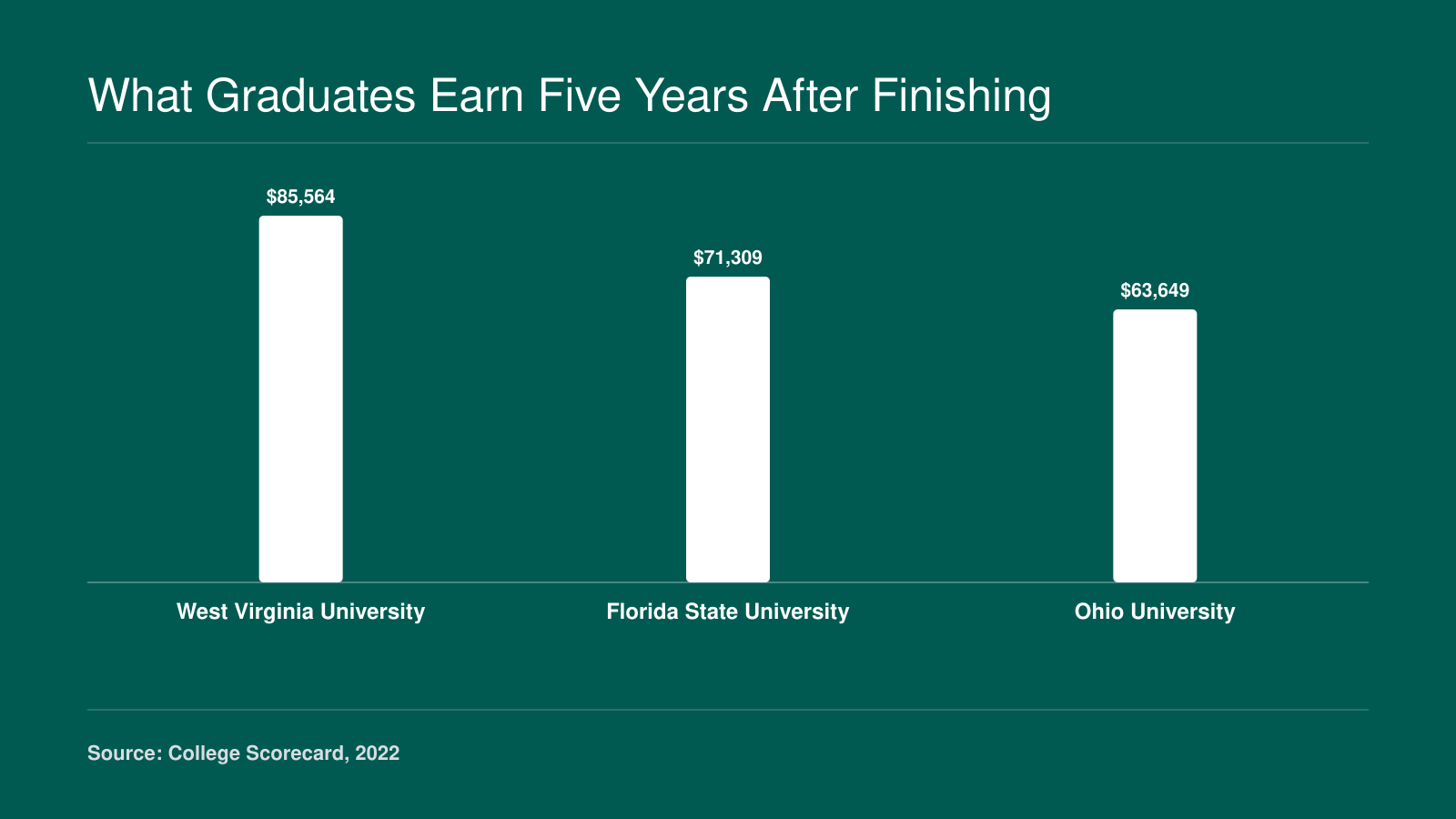
What Graduates Earn Five Years After Finishing
Program-level earnings are most complete five years after finishing. Graduates commonly move into internal communications, HR and change management, corporate communications, and training and development roles across corporate, nonprofit, government, healthcare, and higher education settings. At West Virginia University and Florida State University, roughly 97% to 98% of graduates were employed one year after finishing. Seton Hall and the University at Albany do not publish a program-level median earnings figure and are not shown.
MA, MS, or Communication Management: Picking the Right Degree Structure
Theory track or applied track
No national rule separates the MA from the MS, so read the requirements rather than the letters. In practice, MA programs often build around theory, methods, and electives with a research exit: the University of Colorado's 30-credit Communication M.A. ends in either a 6-credit thesis or a comprehensive exam3, and Louisville pairs a 15-credit core with 12 elective credits and a thesis or non-thesis route4. George Mason attaches just 3 credits to its capstone or thesis proposal5. Communication management degrees tilt applied. UNF's 36-credit M.S. runs a 15-credit core, 12 credits in an outside concentration (Business, Public Health, Leadership, Nonprofit Management, or Public Management), and 6 credits of thesis or applied research project1. Towson's M.S. also totals 36 units, with 15 in required courses2.
Names overlap, course lists don't
"Organizational communication," "strategic communication management," and "communication leadership" frequently describe similar coursework and overlap with organizational leadership master's programs. NMSU's 36-credit online M.A. carries an organizational communication emphasis and allows up to 18 credits outside the department, which is how students assemble change management, training, or crisis focus areas.
Transfer caps are tight: 6 credits at Towson2, Louisville4, and NMSU; 9 at Colorado3 and Texas A&M-Corpus Christi6.
Shortlist two or three programs above, compare them against the affordable organizational communication master's programs, and request each curriculum sheet before applying.
Organizational Communication programs by state
Quick Answers Before You Apply
Before you apply, here are the practical questions prospective students ask most often. Policies vary by school, so always confirm the latest details with the program's graduate admissions office.
Is the GRE ever required for a master's in organizational communication?
When are application deadlines for no-GRE organizational communication programs?
Can international students apply to these no-GRE programs?
Compare Organizational Communication programs on the data that matters
Explore more Communications & Media specializations or browse every graduate field.
All Communications & Media programs