Best Master's in Journalism Programs in Texas
Compare 8 accredited Journalism programs in Texas at 5 schools, with graduate earnings, cost, debt, and completion data from IPEDS and the U.S. College Scorecard.

Texas holds two of the country's largest media markets in Dallas-Fort Worth and Houston, yet only a handful of its universities offer a master's in journalism. That scarcity makes cost the deciding question.
Annual tuition and fees run from $11,688 for Texas residents at UT Austin to $58,100 at private Baylor. Program-level earnings, the figure that would justify either bill, remain largely unpublished, so net price and format carry unusual weight.
Key Points
- UT Austin's M.A. in Journalism and Media requires 30 credit hours and makes the GRE optional.
- Program-level journalism earnings are largely unpublished, so judge cost and fit before chasing salary promises.
- UNT Mayborn assistantships may cover 3 to 9 credit hours of tuition each long semester.
Top Master's in Journalism Programs in Texas: Our Ranked List
Four Texas universities make this list, covering seven master's options in total, from career-changer professional tracks to research-focused and international degrees. Graduation rates shown are institution-wide figures, not results for any single journalism program. ACEJMC accreditation is noted only where it is confirmed for a specific degree, and it is often limited to undergraduate programs.
The University of Texas at Austin
#1Austin, TX · ~$12,000/yr (est.)
Best for: Career changers wanting intensive newsroom training
The University of Texas at Austin pairs a professional track for career changers with a research-oriented track, and it adds dual-degree options. Its School of Journalism and Media connects students to the Knight Center for Journalism in the Americas, the Center for Media Engagement, and the Dallas Morning News Innovation Endowment. The institution-wide graduation rate is about 89%. ACEJMC reaccredited the unit in 2022, but its listing covers only the undergraduate B.J., so it does not establish accreditation for the graduate degrees.
- 30 credit hours: 18 required core, 12 elective
- Built for students entering journalism from other fields
- Required summer internship earns course credit
- Full-time, in-person over two semesters
- Fall admission only; apply by December 1
- Sits alongside Ph.D. and professional tracks in the graduate program
- Faculty with distinguished research records
- No spring admissions
- Dual degree programs available
Baylor University
#2Waco, TX · ~$44,000/yr (est.)
Best for: Aspiring foreign correspondents building area expertise
Baylor University in Waco offers a traditional M.A. in Journalism with four focus areas and a thesis or major project. It also offers a Master of International Journalism that combines reporting with area studies, a language requirement, and an internship. The institution-wide graduation rate is about 80%. Baylor's ACEJMC listing (reaccredited 2022) is undergraduate only, so no graduate journalism degree there is confirmed as accredited.
- 30 credit hours: 27 coursework plus 3 for thesis or major project
- Four focus areas: public relations, news-editorial, advertising, critical studies
- Measurement or statistics course required
- Nine leveling hours for applicants from other majors
- Maximum 12 hours per semester
- 36 credit hours across 12 courses
- No entrance exam required
- Specializations in economics, environmental studies, or political science
- Proficiency in one foreign language
- Internship in international journalism and a graduation portfolio
University of Houston
#3Houston, TX · $10,000 – $19,000/yr (est.)
Best for: Students planning doctoral study or teaching
The University of Houston offers an M.A. in Mass Communication Studies with a Journalism and Mass Communication concentration. It leans toward research and theory, with a thesis or comprehensive-exam path, which suits students considering doctoral study or teaching as well as media careers. The institution-wide graduation rate is about 65%. ACEJMC status for this program was not confirmed in our research.
- Concentration in Journalism and Mass Communication
- Thesis and non-thesis (comprehensive exam) options
- Required quantitative and qualitative research methods courses
- GRE required and 3.0 GPA minimum, per the program listing
- Offered through the College of Liberal Arts and Social Sciences
University of North Texas
#4Denton, TX · $9,000 – $16,000/yr (est.)
The University of North Texas runs its journalism master's through the Mayborn School of Journalism in Denton, inside the Dallas-Fort Worth media market. The school states that it offers the only nationally accredited journalism master's in Texas, and ACEJMC's listing (reaccredited 2023) explicitly includes the M.A. in Journalism. Evening classes and some online courses suit working professionals. The institution-wide graduation rate is about 61%.
- 36 credit hours with a required 6-hour thesis
- ACEJMC-accredited M.A. in Journalism
- Full-time and part-time options
- Classes held late afternoons and evenings
- Foreign language requirement
- Internships across the DFW media market
- Listed with a thesis or non-thesis option
- Individualized degree plans
- Core courses in media ethics and research
- Career interests include broadcast, investigative, and sports journalism
Cost & outcomes by school
Federal data for the highest-earning Journalism programs, independent of the ranking above. Earnings are this field's master's graduates four years after completing, where the Scorecard reports them.
| School | Earnings | Tuition / yr | Debt | Grads/yr | Format |
|---|---|---|---|---|---|
| University of Houston TX | — | $10,051 | — | — | Campus |
| Texas A&M University-College Station TX | — | $11,748 | — | — | Campus |
| University of North Texas TX | — | $9,091 | — | 16 | Campus |
| The University of Texas at Austin TX | — | $12,006 | — | 12 | Campus |
| Baylor University TX | — | $43,578 | — | 10 | Campus |
Sources: U.S. Department of Education. Tuition and graduates: IPEDS. Earnings and debt: College Scorecard, this field's master's graduates; a dash means no figure is reported.
Online and Hybrid Master's in Journalism Options in Texas
Online master's in journalism programs let you earn the degree from home instead of commuting to a campus newsroom. If you're comparing Master's Programs in Texas, be ready to adjust expectations: not every ranked program is campus-based, the University of North Texas lists online and hybrid formats, while the programs at The University of Texas at Austin, Baylor University, and the University of Houston are campus-based.
That format carries a real trade-off. Campus programs put you inside student media and the Austin, Dallas-Fort Worth, and Houston news markets, with direct access to faculty and internships that working reporters juggling a job often cannot reach. UNT eases the strain by scheduling classes in late afternoons and evenings, a practical middle ground for students who work during the day.
Which Ranked Texas Master's in Journalism Programs Waive or Make the GRE Optional
Some ranked Texas journalism master's programs are no-GRE master's programs, while others still require the test , so confirm the rule before you schedule a test.
- The University of Texas at Austin: The GRE is optional for the MA in Journalism and Media. If you submit scores, they are reviewed. Applicants choose among professional, research, and dual-degree tracks. The professional track, built for career changers, ends in a portfolio of work produced during the degree. The research track requires a thesis.
- University of Houston: The university catalog lists the GRE as required for the Mass Communication Studies MA, along with a 3.0 minimum GPA.
- Baylor University: Baylor's official program pages do not clearly publish a current GRE policy for the journalism MA, so don't assume a waiver.
- University of North Texas: UNT's official pages for the MA in Journalism likewise do not state a clear GRE policy.
Testing rules have shifted often since 2020. Confirm the policy for your specific admission cycle with each program's graduate office before you apply.
Application Deadlines and Requirements for Ranked Texas Journalism Master's Programs
Requirements vary by school, so confirm every detail on each program's admissions page. Published fall deadlines are firm only for UT Austin; the other schools here do not state a 2026 date in the sources reviewed.
- Bachelor's degreeEvery program expects a bachelor's degree from an accredited institution. Baylor's catalog prefers a journalism or related degree and lists nine hours of leveling courses for other majors.
- Deadline and GPAUT Austin admits for fall only. Applications open September 1 and close December 1 at 11:59 p.m. CT, with no separate priority or funding deadline published. UT Austin publishes no minimum GPA, while the University of Houston catalog lists a 3.0 minimum. UNT and Baylor deadlines were not confirmed, so check their pages.
- Recommendations and transcriptsUT Austin requires names and emails for three recommenders plus official transcripts from every senior college attended. Other schools' letter counts were not confirmed.
- Statement, clips and test scoresExpect a statement of purpose and supporting materials, which UT Austin collects through MyStatus after you submit. Ask each program whether it wants writing samples or clips. UT Austin makes the GRE optional, while the University of Houston catalog lists it as required.
- Program-specific requirementsUNT's 36-hour MA requires a 6-hour thesis and 6 undergraduate credit hours of a foreign language other than English. Check the English proficiency test requirement for international applicants with each school's graduate admissions office.
- Selectivity contextInstitution-wide undergraduate admit rates are about 27% at UT Austin, 51% at Baylor, 72% at UNT, and 74% at the University of Houston. They describe undergraduate selectivity only, not graduate journalism admissions.
Related Articles
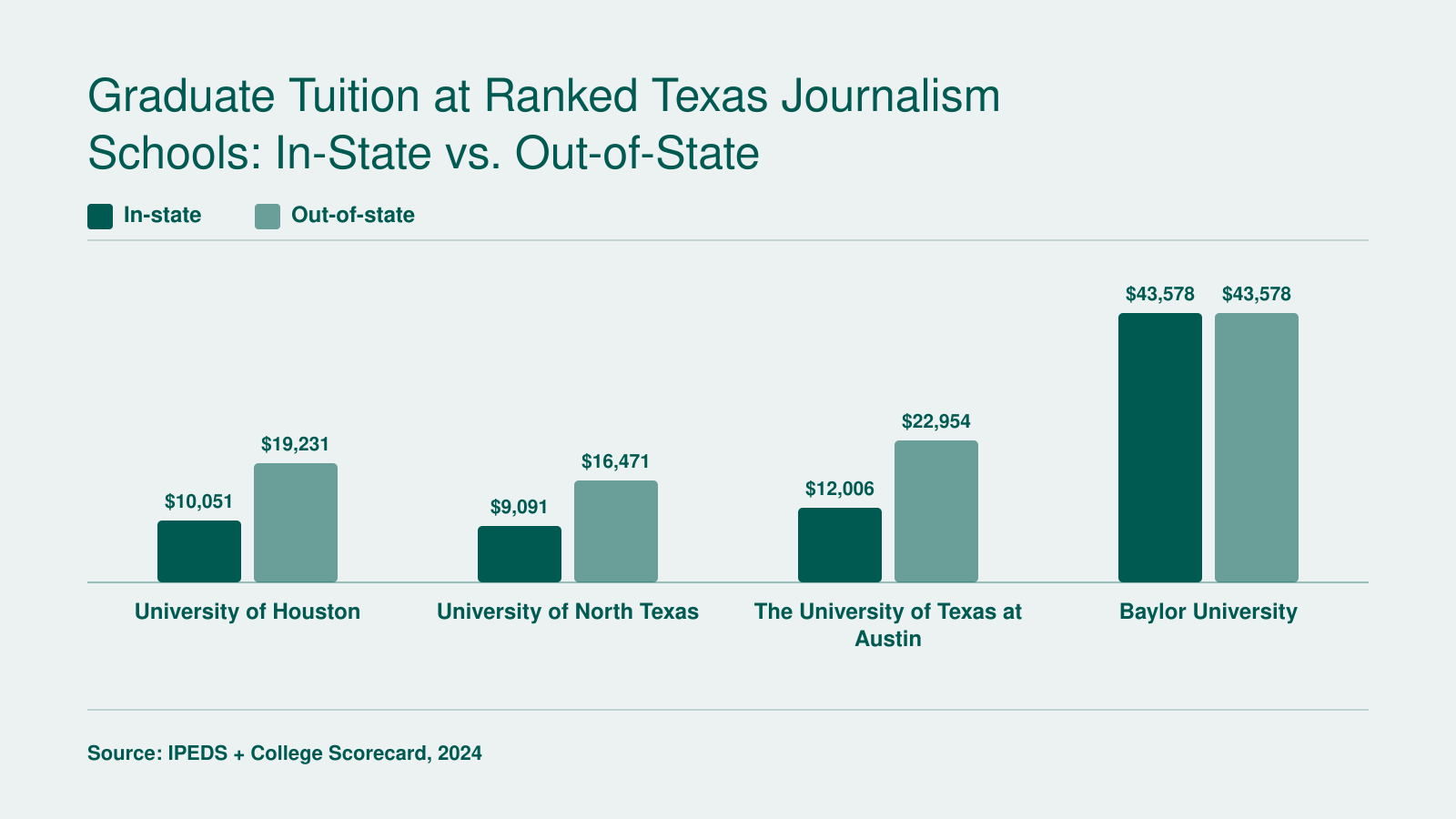
Graduate Tuition at Ranked Texas Journalism Schools: In-State vs. Out-of-State
These figures show annual graduate tuition and fees, not total program cost, so multiply by the semesters your track requires and add living costs. At the public schools here, residency changes the bill by roughly $7,000 to $11,000 a year. Baylor, as a private school, charges every student the same rate.
Master's in Journalism Costs and Texas Licensure or Certification
The real cost of a master's in journalism in Texas is the program's required credit hours multiplied by the tuition rate, plus fees. UT Austin's M.A. in Journalism and Media requires 30 credit hours. At 2026 graduate rates of roughly $1,344 per credit for residents and $1,978 for nonresidents, tuition alone lands near $40,300 and $59,300. The university lists per-credit tuition but not one combined figure for college and student-service fees. UNT requires at least 36 hours, and students without a journalism background may need up to 12 more leveling hours.
On annual graduate tuition, UNT is the lowest-priced option here for Texas residents (about $9,100) and for out-of-state students (about $16,500). The University of Houston is close behind for residents. Baylor charges everyone roughly $43,600. Average net price after aid ranges from about $14,300 at Houston to $41,100 at Baylor. Those figures cover each whole institution rather than journalism students specifically, so treat them as rough guides.
Texas does not require a state license to work as a journalist. The credential that matters is for teaching: Texas teacher certification programs from the Texas Education Agency let teachers take on high school journalism assignments under an English Language Arts 6-12 or 9-12 certificate2 that includes at least 6 journalism credit hours3. The Texas Education Agency also offers the TExES Journalism 7-12 exam1.
Career Outcomes for Texas Journalism Master's Graduates
Earnings data for journalism master's graduates in Texas are thinner than they should be; plan around that gap instead of assuming it away. Program-level median earnings have not yet been published for the journalism master's degrees at UT Austin, Baylor, the University of Houston, or the University of North Texas, so no credible salary figure exists for any of them. Anyone quoting one is estimating.
Part of the reason is cohort size. Recent graduating classes were in the single digits at UT Austin and Baylor, and under two dozen at UNT. Medians drawn from groups that small would swing wildly year to year anyway.
What is documented is borrowing. Campus-wide median graduate debt sits near $18,200 at Houston, $19,300 at UNT, $20,500 at UT Austin, and $23,000 at Baylor. On a standard ten-year plan, balances in that range mean a payment in the low hundreds monthly against a newsroom salary.
How We Rank the Best Journalism Master's Programs in Texas
IPEDS, the federal postsecondary data system, supplies graduate tuition and delivery format (campus, online, or hybrid) for the programs here. College Scorecard supplies net price, graduate debt, program-level earnings, and graduation rates.
The limits matter. Net price and graduation rate describe the whole institution, not the journalism master's alone, so read them as context rather than a verdict on one program. Earnings appear only where Scorecard publishes program-level figures. Where it doesn't, we say so instead of estimating.
Every eligible Texas journalism master's program we identified appears in the ranking. No school was left off to flatter another, so the list is comprehensive rather than cherry-picked.
Frequently Asked Questions About Master's in Journalism in Texas
What is the difference between an M.A. and an M.J. in journalism?
Which Texas journalism master's programs are nationally accredited?
Can you earn a journalism master's in Texas without a journalism bachelor's degree?
Compare Journalism programs on the data that matters
Explore more Communications & Media specializations or browse every graduate field.
All Communications & Media programs