Best Master's in Communication Programs in Michigan
Compare 8 accredited Communication programs in Michigan at 6 schools, with graduate earnings, cost, debt, and completion data from IPEDS and the U.S. College Scorecard.

Michigan communication master's programs vary more than their shared degree title suggests. Calvin's one-year program lists about $22,000 in total tuition, Grand Valley's runs 36 credits over two years, and average net price across these schools spans roughly $15,300 to $23,000 a year.
Focus splits too: strategic communication at Calvin, a pre-Ph.D. track at Michigan State, hybrid delivery at Western Michigan. Program-level earnings data is scarce, so price and format are easier to compare than payoff.
Key Points
- Michigan State's Online MA in Strategic Communication lets working professionals study without leaving their jobs.
- Grand Valley State graduates earned a median of $48,689 after one year and $74,663 after four.
- Several schools publish no GRE policy, so confirm requirements on each admissions page before applying for 2027.
Top Master's in Communication Programs in Michigan for 2027
The right Michigan communication master's is the one that balances what you will pay against what the school delivers: average net price, institution-wide completion, and how flexible the format is. Five Michigan universities returned usable data, so this list stops there rather than padding with schools we cannot support. Net price is a federal average, not a quote, and graduation rates describe the whole university, not the communication program.
Michigan State University
#1East Lansing, MI · $22,000 – $42,000/yr (est.)
Best for: Pre-Ph.D. students wanting thesis research training
Michigan State University graduates about 81% of its students institution-wide, and its average net price is roughly $19,700. Federal data list graduate tuition near $21,432 for in-state students and $41,508 for out-of-state students. The traditional Strategic Communication track is published at $726.50 per credit in-state and $1,427.50 out-of-state, and MSU also runs a separate online strategic communication M.A. at a flat per-credit rate, so confirm current rates with the department. The M.A. in Communication is the research-heavy option on this list, with a thesis route for future doctoral students and a career-oriented route for professionals.
- 30 credit hours with a faculty-advised plan
- Two tracks: pre-Ph.D. thesis or career-oriented
- Thesis or capstone option
- Nonprofit fundraising specialization available
- Six concentration options, small class sizes
- Interpersonal communication concentration
- Thesis required for this focus
- Faculty mentors guide a self-designed curriculum
- Prepares for doctoral study or a career
- Organizational communication concentration
- Thesis or final-examination route
- Career outcomes in government, nonprofit and for-profit sectors
- Pre-Ph.D. track prepares for doctoral study
Calvin University
#2Grand Rapids, MI · ~$11,000/yr (est.)
Best for: Faith-minded media professionals studying in the evenings
Calvin University graduates about 74% of its students institution-wide, and average net price is roughly $22,992. As a private school it publishes one rate for everyone, $693 per credit, with a total program tuition of about $22,000 to $24,000. The Master of Media and Strategic Communication is built for working professionals, with evening classes and a student-run agency that handles real client work. It has no entrance exam, and it takes one year full time or about two part time.
- One year full time, about two years part time
- No entrance exam required; test optional
- Students run the Skylight Media Agency for real clients
- Evening classes for working professionals
- Faith and ethics foundation with AI and social media emphasis
- 4+1 option for Calvin undergraduates
Grand Valley State University
#3Allendale, MI · $20,000 – $25,000/yr (est.)
Best for: Part-time students targeting management roles
Grand Valley State University graduates about 67% of its students institution-wide, with an average net price near $16,300. Federal data list graduate tuition around $20,030. The Master of Science in Communication is a career-focused, face-to-face program in Grand Rapids with evening courses. Federal data on a small group of 12 completers show median earnings of about $48,689 one year out and $74,663 four years out, so treat those as directional.
- 36 credit hours, about two years, part time possible
- Rolling admissions with fall, winter, spring and summer starts
- Evening courses at the Grand Rapids campus
- Competitive assistantships and scholarships available
- Combined degree options
- $30 application fee
Western Michigan University
#4Kalamazoo, MI · $20,000 – $25,000/yr (est.)
Western Michigan University graduates about 58% of its students institution-wide, and its average net price is roughly $15,300, the lowest on this list. Federal data list graduate tuition near $19,154 in-state and $28,732 out-of-state. The Master of Arts in Communication is a hybrid, 30-credit program with a cohort capped at about 15 students and seven electives for customizing toward public relations, training, HR or teaching. Program materials cite regional average salaries around $74,000, which is a regional figure, not a guarantee.
- 30 credit hours across 10 courses, 7 electives
- Hybrid format: in-person and online
- Full-time and part-time options
- Cohort limited to about 15 students
- Rolling admission, fall and spring entry
- Teaching assistantships may include stipend and tuition remission
Central Michigan University
#5Mount Pleasant, MI · ~$17,000/yr (est.)
Central Michigan University graduates about 59% of its students institution-wide, and its average net price is roughly $17,600. Federal data list graduate tuition at about $16,737 for in-state and out-of-state students alike. The M.A. in Communication is an on-campus, research-oriented program where graduate assistantships can carry a stipend and tuition waiver. Credit requirements differ by source (30 on the program page, 33 in the 2025-26 bulletin), so confirm with the department.
- Credit requirement listed as 30 or 33 depending on source
- Comprehensive exam or 6-credit thesis option
- On-campus, full-time enrollment, spring and fall starts
- Rolling admissions; March 1 assistantship deadline
- Students present research at national conferences
- About a quarter of graduates pursue Ph.D. programs
Cost & outcomes by school
Federal data for the highest-earning Communication programs, independent of the ranking above. Earnings are this field's master's graduates four years after completing, where the Scorecard reports them.
| School | Earnings | Tuition / yr | Debt | Grads/yr | Format |
|---|---|---|---|---|---|
| Wayne State University MI | $87,918 | $17,960 | $33,381 | 10 | Campus |
| Grand Valley State University MI | $74,663 | $20,030 | — | 14 | Campus |
| Calvin University MI | — | $11,113 | — | — | Campus |
| Central Michigan University MI | — | $17,187 | — | 7 | Campus |
| Western Michigan University MI | — | $20,103 | — | 7 | Hybrid |
| Michigan State University MI | — | $21,772 | — | 6 | Campus |
Sources: U.S. Department of Education. Tuition and graduates: IPEDS. Earnings and debt: College Scorecard, this field's master's graduates; a dash means no figure is reported.
Online and Hybrid Master's in Communication Options in Michigan
Flexibility and funding pull in opposite directions: an online master's in communication format lets you keep your job; campus enrollment is where assistantships and close faculty mentoring happen.
Fully online and hybrid
Michigan State's Online MA in Strategic Communication is the clearest fully online choice among the programs below: 30 credits across 10 courses, 100% asynchronous, with no set meeting times and no required campus visits. Most students finish in 12 to 18 months while working full-time, picking focus areas such as digital media, media analytics, or organizational leadership. Western Michigan's Master's in Communication is hybrid, mixing in-person and online coursework so students can build a schedule around work. It runs 30 credits with seven electives and keeps cohorts small; public relations appears there as a career path rather than a formal concentration.
Campus-based options
Michigan State's MA in Communication1, Grand Valley State's MS in Communication, Central Michigan's MA, and Calvin's Master of Media and Strategic Communication are campus programs, though Calvin and Grand Valley schedule evening courses aimed at working professionals. Published pages do not always specify whether online sessions are live or self-paced, or whether distance students pay a different per-credit rate, so ask admissions directly.
If you are targeting PR or corporate communication while employed, online or hybrid fits best. If you want research training and a funded assistantship, choose campus.
Which Michigan Master's in Communication Programs Waive or Make the GRE Optional?
Do Michigan communication master's programs still require the GRE? Where a policy is published, the answer is mostly no; these often align with Master's in Communication Programs With No GRE Required, though several schools simply say nothing.
- Michigan State University: GRE waived for the 2023-24 review period; no current requirement is stated. Minimum 3.0 in the last two years of undergraduate study (below a 3.2 cumulative, strong GRE scores can help). Requires a bachelor's degree, three recommendation letters, and a statement of purpose. Fall deadline: April 1.
- Western Michigan University: Graduate test not required, which puts it among No-GRE master's programs. Minimum 3.0 in the last two years of bachelor's work. Fall deadline: August 15, with rolling admission.
- Central Michigan University: No published policy on the GRE. GPA of 3.0 based on at least 15 CMU credits, though applicants who fall short may be considered if they show preparation for graduate work. Fall deadline: August 31.
- Calvin University: No published policy found on the GRE, GPA floor, prerequisites, or deadline.
- Grand Valley State University: No published policy found on the GRE, GPA floor, prerequisites, or deadline.
The Pattern
Where a stance is stated, the GRE is waived or not required, and 3.0 is the typical GPA floor. Deadlines run from April to late August, so Michigan State's early date is the one most likely to catch applicants off guard. Policies change between cycles, so confirm every detail with each admissions office before you apply.
Related Articles
Cost, Funding, and Certification for Michigan Master's in Communication Students
Paying for a master's in communication in Michigan means weighing sticker tuition, residency, and whether an assistantship offsets the bill. The spread is real, and a Michigan master's degree cost comparison shows it depends heavily on where you live.
Tuition and Net Price
Central Michigan University charges $17,187 for the program regardless of residency. Grand Valley State University is similarly flat at about $20,030. Western Michigan University runs $20,103 in-state and $29,681 out-of-state, while Michigan State University shows the widest gap: $21,814 versus $42,844. Calvin University, a private school, lists $22,000 in total program tuition with no residency split, and its net price of $22,992 is the highest here. Western Michigan's $15,273 net price is the lowest, a useful benchmark against the Most Affordable Master's in Communication Programs nationwide.
Assistantships and Scholarships
- Central Michigan: Full-time assistantships pay at least $11,000 a year, cover 20 credits annually for two years, and involve teaching two intro sections each semester. The regular deadline is March 1.
- Western Michigan: Assistantships require 20 hours a week and waive 9 credits per semester. The school publishes no dollar stipend. Apply by February 1 with a 3.0 GPA. The Thurgood Marshall Fellowship (deadline February 15) runs one to two years.
- Grand Valley: Lists competitive assistantships and communication scholarships.
Certification
Michigan has no state license for communication professionals. Graduates instead pursue voluntary credentials, chiefly the Accreditation in Public Relations (APR) from PRSA. The 2026 application fee is $495 for members of participating organizations and $745 for nonmembers.1 IABC also offers a voluntary certification, so confirm its current requirements directly. Michigan's PRSA chapters sit in the East Central District and offer networking, events, and workshops.2
A Cost-Saving Move
Choose an in-state public program, then prioritize one with an assistantship that waives tuition. That combination can cut your cost far more than any scholarship search.
Earnings Snapshot for Michigan Communication Graduates
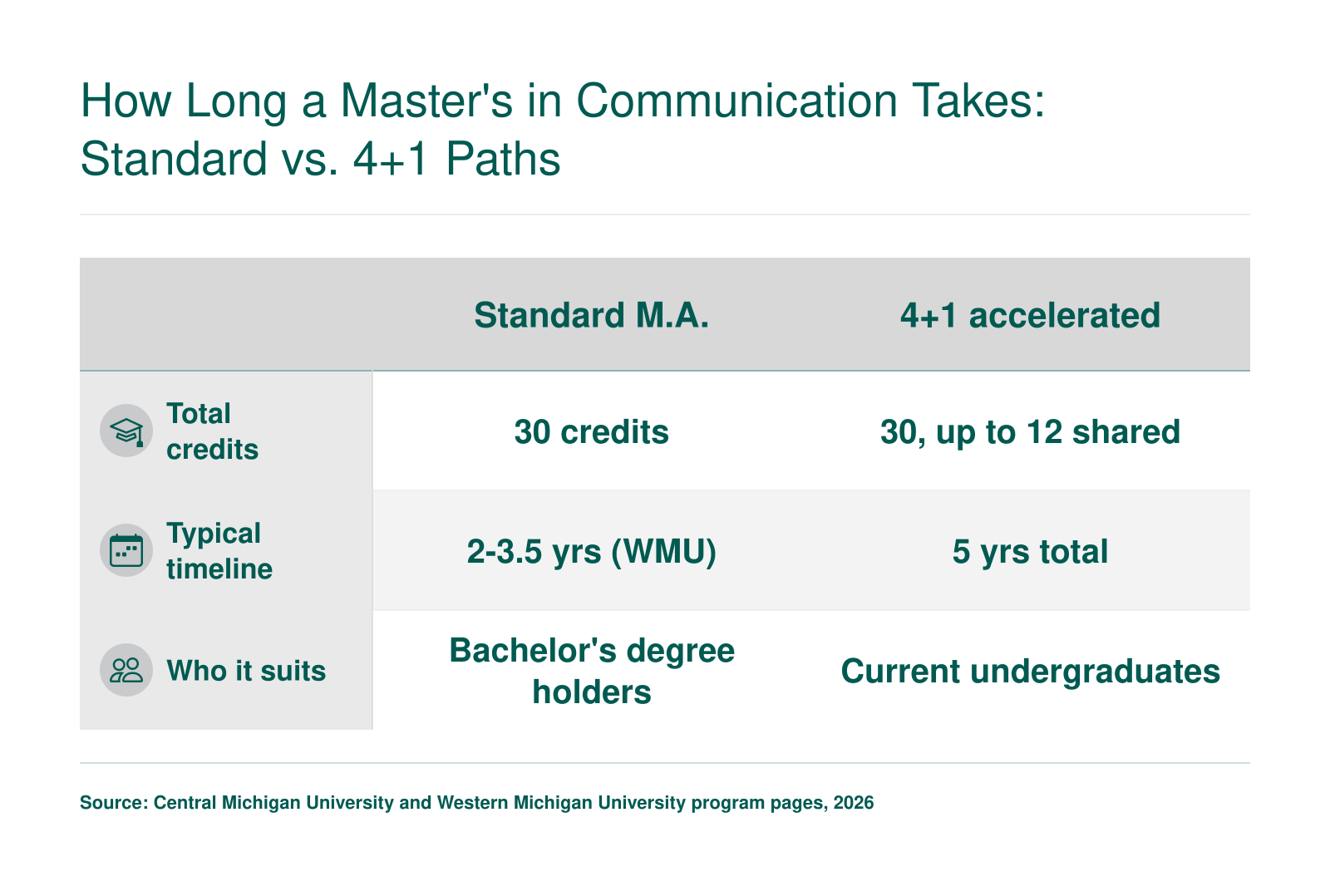
How Long a Master's in Communication Takes: Standard vs. 4+1 Paths
The thesis track generally suits readers eyeing a PhD or research roles. A non-thesis route built on a capstone, project, or comprehensive exam suits PR, strategic communication, and corporate careers, so confirm which options each program offers. Central Michigan and Western Michigan both list 30 credits, and Western Michigan puts completion at 2 to 3.5 years depending on pace. Both also offer 4+1 accelerated paths for their own undergraduates.
Picking Your Program: Cost, Format, and Graduate Earnings Side by Side
Grand Valley State University's master's in communication graduates earned a median of $48,689 one year after finishing and $74,663 four years out, the only program-level earnings figures available for the schools here. Use that kind of number as your benchmark, and treat its absence elsewhere as a question to put to each department.
Step 1: Filter by format
Western Michigan University lists a hybrid format with in-person and online components. Michigan State University, Calvin University, Grand Valley State University, and Central Michigan University run campus programs. Cut anything that doesn't fit your work schedule first; if you need a faster timeline, compare Accelerated Master's in Communication Programs.
Step 2: Compare tuition against funding
Calvin publishes a $22,000 total tuition figure ($693 per credit) for a one-year program. Central Michigan describes assistantships with a stipend and tuition waiver, and Grand Valley State notes competitive assistantships. Sticker price and net cost can differ sharply, so weigh them together; if you're targeting a specialized path, compare master's in strategic communication cost.
Step 3: Check earnings and debt
Program-level debt figures are not published for these programs, so don't assume any. Grand Valley's earnings reflect graduates from the 2022 reporting window and a small group of completers, so read them as a signal, not a promise.
The return-on-investment ratios, from Michigan State at 2.89 down to Western Michigan at 2.05, describe each institution as a whole. They give context about the school, not a guarantee for this degree.
Your next step
Shortlist two or three programs. Confirm GRE policy and deadlines, then ask each department how many assistantships it awards before you apply.
Compare Communication programs on the data that matters
Explore more Communications & Media specializations or browse every graduate field.
All Communications & Media programs