Best Master's in Sustainability Programs in Missouri
Compare 7 accredited Sustainability programs in Missouri at 6 schools, with graduate earnings, cost, debt, and completion data from IPEDS and the U.S. College Scorecard.
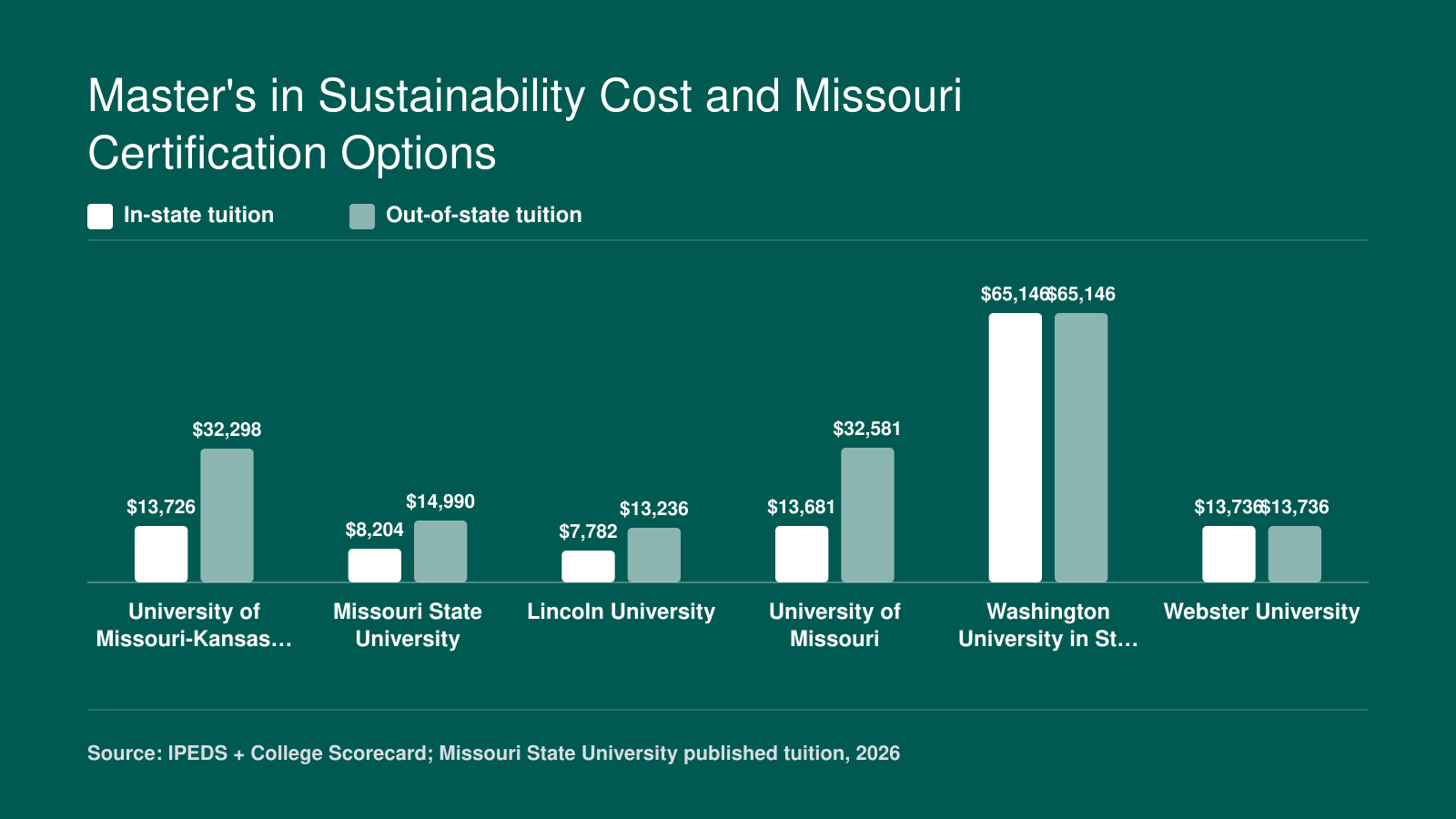
Missouri sustainability master's degrees carry sharply different price tags. Published in-state tuition runs from about $7,800 to $65,100 a year, and formats split between fully online, hybrid, and on-campus coursework.
Every eligible Missouri program, campus and online, appears in one ranked list. Choosing well means matching the degree's emphasis, cost, and capstone to the sustainability role you actually want, because program titles range from environmental engineering to sustainable agriculture.
At the public campuses, residency changes the bill enough to shift the value calculation before financial aid enters.
Key Points
- Missouri State lists $394 per credit for residents and $786 for nonresidents (2025-2026).
- Webster University's sustainability master's is built for remote study, while most others here stay on campus.
- Ask each school for recent capstone hosts and its GRE policy before applying for 2027.
Top Master's in Sustainability Programs in Missouri for 2027
Missouri offers a mix of sustainability-adjacent master's degrees, from engineering and natural resources to management and sustainable agriculture. Program titles vary, so read each card for what the degree actually emphasizes. Graduation rates on the cards are school-wide figures, not rates for the individual program.
Washington University in St Louis
#1St. Louis, MO · ~$65,000/yr (est.)
Best for: Engineers moving into energy management
Washington University in St. Louis approaches sustainability through engineering. Its Master of Engineering pathway in Energy and Environmental Management combines technical core courses with project management, business, policy and social science. Students connect with campus centers focused on the environment, water innovation and regional climate action. This is the most technical and highest-priced option here, so it suits students who want an engineering credential behind their sustainability work.
- Energy and Environmental Management concentration
- 30 credit hours, finished in 12 to 16 months full-time
- Part-time study available
- 2.7 GPA minimum
- Up to 6 credits of independent study, research or internship
- Joint MEng/MBA option
- Fall career fair hosted by the department
University of Missouri
#2Columbia, MO · ~$14,000/yr (est.)
Best for: Science-minded students pursuing natural resources research
The University of Missouri in Columbia is HLC-accredited and offers a research-oriented route through its School of Natural Resources. The MS in Natural Resources is not titled sustainability, but its emphases, including Soil, Environmental and Atmospheric Sciences, cover closely related ground. Public in-state tuition makes it the most affordable research-focused option for Missouri residents. A new institute focused on Missouri fisheries, wetlands and aquatic systems adds regional relevance.
- Emphasis in Soil, Environmental and Atmospheric Sciences
- Seven emphasis areas, including Water Resources and Agroforestry
- Catalog lists a 3.0 undergraduate GPA for admission
- Small classes and student research opportunities
- Personalized advising with a professional orientation
- Housed in the Anheuser-Busch Natural Resources Building
University of Missouri-Kansas City
#3Kansas City, MO · $14,000 – $32,000/yr (est.)
Best for: Aspiring urban geoscientists who like fieldwork
UMKC's Master of Science in Environmental and Urban Geosciences is a hands-on, science-driven degree built around the problems cities and regions face. Students work through the Center for Applied Environmental Research on projects with government agencies and private firms. Coursework spans hydrogeology, climate change, GIS and land-use planning. It fits students headed for consulting, planning or natural resource management in the Kansas City area.
- Climate change and hydrogeology focus
- GIS and remote sensing training
- Projects through the Center for Applied Environmental Research
- Field courses and excursions
- Internships with local organizations and agencies
- Research opportunities in Jordan, Mexico and Spain
Webster University
#4Saint Louis, MO · ~$14,000/yr (est.)
Webster University offers two relevant master's degrees, both with online options, which makes it the most flexible choice for working professionals. The MS in Sustainability Management is built around organizational strategy and ends with a consulting project for a real company. The MS in Environmental Management is labeled a STEM program on Webster's own page, though we could not confirm a federal STEM listing. Webster's Missouri listing noted its Gateway location is not accepting applications, so confirm your delivery option before applying.
- Fully online option available
- Capstone required, with a consulting project for a real company
- Case studies, internships and projects
- Coursework on the Circular Economy and the triple bottom line
- Optional emphasis in environmental sustainability
- Grad-to-Grad scholarship of up to $2,000
- Offered on the St. Louis campus and online
- Two-year program with evening classes once a week
- Labeled a STEM program on Webster's program page
- Dual MBA/MS degree option
- Taught by practicing environmental managers
Missouri State University
#5Springfield, MO · ~$8,000/yr (est.)
Missouri State University in Springfield offers a Master of Professional Studies in Environmental Management designed for working adults. The 33-credit program can be completed fully online, with seated classes available. Its core draws on business, law and psychology, which suits students aiming for management or director roles. It carries lower in-state tuition than most programs on this list, but we could not confirm accreditation or STEM status from official program pages.
- 33 total credit hours
- Fully online option, with seated classes also available
- Core courses in business, law and psychology
- Focus in environmental management
- Career paths include manager, director and sustainability leader
- Scholarships and financial aid available
Lincoln University
#6Jefferson City, MO · ~$8,000/yr (est.)
Lincoln University in Jefferson City offers the most agriculture-focused option here, a Master of Science in Sustainable Agriculture. Small classes and access to conventional and certified organic research farms give students close faculty mentoring. It suits students headed for production agriculture, government work or a PhD, rather than corporate sustainability roles.
- 24-month program, full-time or part-time
- Thesis and non-thesis tracks
- Classes of 5 to 25 students
- Certified organic research farm and labs
- 2.8 GPA minimum and three letters of recommendation
- Fall and spring starts
- Up to 9 transfer credits
Cost & outcomes by school
Federal data for the highest-earning Sustainability programs, independent of the ranking above. Earnings are this field's master's graduates four years after completing, where the Scorecard reports them.
| School | Earnings | Tuition / yr | Debt | Grads/yr | Format |
|---|---|---|---|---|---|
| Lincoln University MO | — | $7,782 | — | — | Campus |
| Missouri State University MO | — | $8,204 | — | — | Online |
| University of Missouri MO | — | $13,681 | — | — | Campus |
| University of Missouri-Kansas City MO | — | $13,726 | — | — | Campus |
| Webster University MO | — | $13,736 | — | — | Online |
| Washington University in St Louis MO | — | $65,146 | — | 13 | Campus |
Sources: U.S. Department of Education. Tuition and graduates: IPEDS. Earnings and debt: College Scorecard, this field's master's graduates; a dash means no figure is reported.
How We Rank Missouri Sustainability Master's Programs
A low sticker price can hide weak completion odds in sustainability master's programs, and a big name can come with debt that outpaces early sustainability salaries. Our ranking weighs that tradeoff using published graduate tuition, average net price after aid, institution-wide completion rates, and College Scorecard program earnings and debt where published. Graduation rate and net price are school-wide figures, not program-specific, and net price is an approximate average. Campus and online formats are ranked together, so delivery mode does not tilt the comparison. Only Missouri master's programs that meet our ranking criteria appear below.
Online and Hybrid Sustainability Master's Options in Missouri
Which Missouri sustainability master's can a working professional actually finish from home? Two of the programs here are built for remote study, the same focus as the Best Online Master's in Sustainability Programs guide, while the others are campus-based or hybrid.
Programs you can finish remotely
Webster University's Master of Science in Environmental Management offers a fully online option. It centers on corporate sustainability, an area many students also explore through an MBA in Sustainability, covering the circular economy, triple bottom line reporting, and EU regulatory frameworks, and ends with a capstone consulting project tied to a real company, so plan for coordinated work with an outside partner even as a remote student.
Missouri State University's Master of Professional Studies in Environmental Management is also available fully online, drawing core courses from business, law, and psychology for a policy and management focus. The program publishes a 33-credit requirement, and seated classes remain an option if you prefer a mix.
Campus-based and hybrid choices
If your interest runs toward energy, water, or the physical sciences, the campus programs fit better. The University of Missouri's MS in Natural Resources concentrates on soil, environmental, and atmospheric science, with a thesis track, a non-thesis option, and supervised teaching. Lincoln University lists hybrid course options for its sustainable agriculture degree alongside thesis and non-thesis paths.
Which Missouri Sustainability Master's Programs Waive the GRE?
Policies below come from official graduate admissions pages. Where a school publishes nothing specific to its sustainability program, we say so rather than guess.
- Washington University in St LouisGRE: no policy found for the engineering master's. Minimum GPA: 2.7 listed. Deadline: confirm on the program page.
- University of MissouriGRE: no sustainability-specific policy published. The Graduate Application page sends applicants to the individual program. GPA minimum and deadlines: not published there.
- University of Missouri-Kansas CityGRE, minimum GPA and deadlines: none found for the geosciences program. Ask the department directly.
- Webster UniversityGRE, minimum GPA and deadlines: none found for the sustainability management program. Confirm before applying.
- Missouri State UniversityGRE: program-specific. The Graduate College does not generally require it, but about half of programs do. Only the program director can waive it, and not when the Graduate College imposes it. GPA and deadlines: not published.
- Lincoln UniversityGRE: no policy found. Minimum GPA: 2.8. Fall and spring starts. Deadlines: confirm with the department.
- Common application materialsExpect a statement of purpose, letters of recommendation (Lincoln asks for at least three), a resume and transcripts. Check each program page for exact requirements.
Related Articles
Master's in Sustainability Cost and Missouri Certification Options
Residency changes the bill at the public schools here. Missouri State's program lists $394 per credit for residents and $786 for nonresidents (2025-2026), which works out to $13,002-$25,938 across its 33 credit hours, tuition only. Its 2026-2027 full-time estimates are $4,947 in-state and $8,646 out-of-state for 9 credits. Course fees and program length can move the real total. WashU and Webster, both private, charge one rate regardless of residency. Net price after aid is an approximate institution-wide average, not a program figure, so treat it as a rough guide. Missouri has no state license for sustainability professionals. Graduates commonly pursue LEED AP or the ISSP-SA and CSP credentials, which are voluntary. No published source we reviewed confirms that any program here is formally aligned with them, so ask each department before assuming a course sequence counts toward eligibility.
Career Outcomes and ROI for Missouri Sustainability Graduates
A sustainability master's usually leads to roles like sustainability coordinator, environmental consultant, energy analyst, or ESG analyst, and Missouri's published outcome data covers only a few of the schools here.
What the program-level numbers show
Federal program data is thin, and small graduating classes make it noisy. Webster University's graduates show median earnings of $89,758 five years after finishing and $81,807 one year after, with about 82 percent working one year out. University of Missouri graduates in the natural resources program show $51,152 one year after finishing and $54,427 five years after. No program-level earnings are published for Washington University in St Louis, University of Missouri-Kansas City, Missouri State University, or Lincoln University, so treat those schools on their curriculum and connections rather than a salary figure. Program-level debt is also not reported, so we leave it out.
Who hires
Missouri State publishes a 2026 list of employers of its environment graduates, including the Missouri Department of Conservation, the Department of Natural Resources, MoDOT, and Mead & Hunt. That list does not separate master's hires. Its OEWRI internships cover water, energy efficiency, and waste. The University of Missouri Career Center reports 95.4% successful outcomes within six months for 2025 graduates, but that figure covers the whole university, not sustainability master's students.
Is a Master's in Sustainability Worth It? Common Questions
Salary figures here come from job-listing aggregators and vary by role, employer, and experience. Treat them as rough guides rather than guarantees, and confirm current tuition with each school.
Is a master's in sustainability worth it in Missouri?
What can I do with a sustainability master's degree?
Can I keep working full time while earning a sustainability master's in Missouri?
Does a sustainability master's need special accreditation?
Compare Sustainability programs on the data that matters
Explore more Science & Engineering specializations or browse every graduate field.
All Science & Engineering programs