Best Master's in Sustainability Programs in Colorado
Compare 13 accredited Sustainability programs in Colorado at 8 schools, with graduate earnings, cost, debt, and completion data from IPEDS and the U.S. College Scorecard.

Colorado's sustainability master's market splits between CU Boulder's professional MENV and Colorado State's science-heavy ecosystem degrees. Campus, hybrid, and fully online tracks broaden the choice.
Published in-state graduate tuition runs from about $10,383 at the University of Colorado Denver to $61,398 at the University of Denver; GRE requirements are mostly optional, matching the profile of Master's in Sustainability Programs With No GRE Required; certification varies by employer.
Outcomes diverge. Reported median earnings four years after graduation range from about $67,000 at Western Colorado to $88,000 at the University of Denver.
Key Points
- Rankings favor federal graduate earnings, debt, and graduation data over prestige.
- Several Colorado programs are test-blind; others publish no GRE policy.
- Published graduate tuition per credit guides budgets better than average net price.
Top 8 Master's in Sustainability Programs in Colorado
This list ranks Colorado sustainability master's programs by verifiable outcomes: federal graduate earnings and debt data where published, cost, and institution-wide graduation rate. Graduation rate and net price are institution-wide figures, not program-specific, so they compare overall school strength rather than a single degree track. The programs below span Boulder, Denver, Fort Collins, Golden, and Gunnison across campus, online, and hybrid formats.
University of Colorado Boulder
#1Boulder, CO · $15,000 – $20,000/yr (est.)
Best for: Career changers wanting applied environmental capstones
Boulder's Master of the Environment is an interdisciplinary professional degree built around specializations such as renewable energy, sustainable food systems, urban resilience, and environmental policy. Students complete cohort-based coursework and a nine-month capstone with partner organizations, and the university's location drives ties to federal laboratories, utilities, and regional clean-energy work. It suits students who want applied problem solving over a traditional research thesis.
- 48 total credit hours
- Concentration in Environmental and Natural Resources Policy
- Nine-month capstone with partner organizations
- Fall 2027 cycle: opens Aug. 1, priority Jan. 15, domestic final Apr. 15
- Careers span conservation, consulting, energy, and policy
- Renewable and Sustainable Energy concentration
- Two-year campus format
- Faculty from inside and outside academia
- Peer mentoring program
- Workshops, field trips, and seminars
- Urban Resilience and Sustainability concentration
- 21-month track tailored for working professionals
- No thesis option; admission not based on research
- Applied capstone with sponsoring organization
- Sustainable Food Systems concentration
- Interdisciplinary professional master's degree
- Hands-on, applied training
- Top Green College recognition
University of Denver
#2Denver, CO · ~$42,000/yr (est.)
Best for: Policy-minded students focused on energy sustainability
The University of Denver's environmental policy and management program pairs a broad environmental-policy foundation with an Energy and Sustainability concentration. The 48-credit degree emphasizes energy finance, policy, green building, and water, and can be completed on campus. It fits policy-minded students who want to work at the intersection of regulation, energy, and sustainability strategy.
- Energy and Sustainability concentration
- 48 total credit hours including 4-credit capstone
- 2.5 minimum undergraduate GPA for admission
- TOEFL 80 or IELTS 6.5 for English proficiency
- Coursework covers energy finance, renewable energy, green building, and water
- Taught by professional practitioners
Colorado State University-Fort Collins
#3Fort Collins, CO · ~$14,000/yr (est.)
Best for: Researchers drawn to ecosystem science collaboration
Colorado State's ecosystem sustainability master's trains students in ecosystem science and then applies that lens to integrated social and ecological challenges. The program emphasizes working alongside researchers, resource users, and decision-makers, with assistantship funding often available. It suits students, including recent graduates and working professionals, who want a research-intensive path into sustainability science and resource management.
- Core competencies in ecosystem science
- Collaborative work with researchers, resource users, and decision-makers
- GTA, GRA, and GSA appointments available
- Western Regional Graduate Program resident-rate eligibility
- No published fixed deadline in available materials
Regis University
#4Denver, CO · ~$24,000/yr (est.)
Regis offers two online sustainability-related master's paths: a sustainable development practice degree and an environmental studies specialization within a broader arts degree. The sustainable development practice program costs $679 per credit and supports military families, Peace Corps Coverdell Fellows, and dual-degree FastForward students. It is designed for working adults who need fully online study and practical project management skills.
- 36 total credit hours
- $679 per credit hour
- Fully online format
- FastForward dual degree eligible
- Coverdell Fellows for Returned Peace Corps Volunteers
- Military benefits and veteran funding options
- Environmental Studies concentration
- Field studies in grassland, stream, and montane ecosystems
- Choice of externship or research project
- Faculty-directed environmental research experience
- Explores ethics in environmental biology
University of Colorado Denver/Anschutz Medical Campus
#5Denver, CO · $5,000 – $10,000/yr (est.)
CU Denver's environmental sciences master's blends physical, natural, and social science with lab, field, and classroom work. Seven concentrations range from Climate Systems and Water Systems to Environmental Health and Geospatial Analysis. With rolling admission, part-time options, and proximity to federal agencies like the EPA and USGS, it suits students balancing work with graduate study in an urban setting.
- 36 total credit hours
- Seven concentration options including Climate Systems, Water Systems, and Geospatial Analysis
- No entrance exam; GRE optional
- Rolling admissions with February 1 priority deadline
- Full-time or part-time study; fall start
- Thesis or community practicum to finish
- Minimum 3.0 GPA and two letters of recommendation
- $50 application fee
Western Colorado University
#6Gunnison, CO · ~$16,000/yr (est.)
Western's Master of Environmental Management combines sustainability, conservation, policy, and natural resource management with a hands-on project built with agencies, nonprofits, and businesses. Students can study in Gunnison or through a distance track, and five stackable certificates allow specialization in areas like Ecosystem Restoration and Forests, Fire & Fuels. It is a fit for students who want applied field training plus an online or residential pathway, without a GRE requirement.
- $33,184 total program tuition at $847 per credit
- 36 total credit hours over two years
- Fully online option available; hybrid delivery
- No GRE required
- Five stackable certificates including Ecosystem Restoration and Forests, Fire & Fuels
- Residential and distance learning pathways
- Annual Headwaters Conference and Community Forum
Colorado School of Mines
#7Golden, CO · ~$22,000/yr (est.)
Colorado School of Mines' Environment, Resources and Energy Policy master's is built for the energy transition, blending environmental law, resource economics, and quantitative policy analysis. Students can complete the non-thesis program in three semesters online or on campus, with no GRE requirement. It suits policy-minded graduates aiming for regulators, energy companies, or consultancies.
- Three-semester completion
- Spring entry; apply by Jan. 2, 2027
- Fully online option available
- No GRE required
- No thesis or capstone required
- Training in stakeholder engagement and regulatory risk assessment
- Career ties to EPA, Department of Energy, and consultancies
- Two letters of recommendation
Naropa University
#8Boulder, CO · ~$22,000/yr (est.)
Naropa's Environmental Leadership track sits within an online Master of Arts in Leadership shaped by contemplative education. The 30-credit program emphasizes environmental policy, ecological justice, facilitation, and conflict transformation, with a capstone tied to real-world challenges. It fits working professionals seeking a values-driven, justice-centered route to sustainability leadership and nonprofit work.
- 30 total credit hours
- Two-year full-time format with part-time options
- Rolling admissions
- Fully online with synchronous and asynchronous options
- Capstone required
- Environmental policy and ecological justice focus
- Optional virtual or campus intensives
- Built for working professionals
Cost & outcomes by school
Federal data for the highest-earning Sustainability programs, independent of the ranking above. Earnings are this field's master's graduates four years after completing, where the Scorecard reports them.
| School | Earnings | Tuition / yr | Debt | Grads/yr | Format |
|---|---|---|---|---|---|
| Western Colorado University CO | — | $15,550 | — | — | Hybrid |
| University of Colorado Boulder CO | — | $16,634 | — | — | Campus |
| Colorado School of Mines CO | — | $22,100 | — | — | Hybrid |
| Naropa University CO | — | $22,412 | — | — | Online |
| University of Colorado Denver/Anschutz Medical Campus CO | — | $9,298 | — | 16 | Campus |
| Colorado State University-Fort Collins CO | — | $14,125 | — | 10 | Campus |
| Regis University CO | — | $24,300 | — | 10 | Online |
| University of Denver CO | — | $42,173 | — | 10 | Campus |
Sources: U.S. Department of Education. Tuition and graduates: IPEDS. Earnings and debt: College Scorecard, this field's master's graduates; a dash means no figure is reported.
Online and Hybrid Master's in Sustainability Programs in Colorado
Where the formats land
Delivery format is now the first filter for many Colorado applicants comparing sustainability master's programs, and the programs below split sharply between fully in-person, hybrid, and online-only designs. University of Colorado Boulder's Masters of the Environment, University of Denver's MS in Environmental Policy and Management, and University of Colorado Denver/Anschutz Medical Campus's MS in Environmental Sciences are campus-based. CU Boulder's newer sustainable business and sustainable engineering degrees are both fully in-person and designed as full-time, nine-month programs. Regis's Master of Sustainable Development Practice and Naropa's MA in Leadership are online, with Naropa offering synchronous and asynchronous sections plus optional virtual or campus intensives. Western Colorado's Master of Environmental Management and Colorado School of Mines' environment and energy policy program are hybrid, each with a fully online option.
CSU's online vs. on-campus split
Colorado State's catalog separates the online P.S.M. in Ecosystem Science and Sustainability from the on-campus M.S. in Ecosystem Sustainability, a split that matters when weighing Best Online Master's in Sustainability Programs. The P.S.M. is open to on-campus and distance learners, designed for as little as three semesters, but the online version is not fully asynchronous: it requires a five-day field experience in August 2026 and a 400-hour internship.
Part-time and per-credit notes
Part-time enrollment is stated at CU Denver's MS in Environmental Sciences and Naropa's MA in Leadership; Naropa's 30-credit program typically takes two years full-time. The sources do not establish a separate online per-credit rate; Western lists $847 per credit and Regis lists $679 per credit for its online format.
Which Colorado Master's in Sustainability Programs Waive the GRE?
The GRE is largely irrelevant for sustainability admissions in Colorado, but the exact policy depends on the program, so check each one before you register for a test.
CU Boulder MENV
The Master of the Environment is effectively test-blind: neither the GRE nor the GMAT is considered, making it one of the No-GRE master's programs, and submitting scores does not help your application. You need a four-year bachelor's degree from an accredited institution, and there are no required prerequisite courses. At least one year of professional experience or applicable training is recommended rather than required. A 3.0 cumulative GPA appears on program materials as a continuing-enrollment benchmark, not a published admissions floor.
CSU Ecosystem Science and Sustainability
The coursework-based P.S.M. in Environmental Science does not require the GRE, and a waiver is available.1 CSU lists a 3.0 minimum GPA with 3.5 preferred,2 and expects an undergraduate degree in a related field;3 an unrelated degree may mean additional science coursework before you qualify.
CU Boulder Sustainable Business and Sustainable Engineering
Neither program publishes a clear testing policy in available admissions information. Do not assume they are test-optional.
One practical tip
Email the program coordinator to confirm any waiver in writing before you pay for an exam. Plan on strong letters and a focused statement of purpose regardless.
Master's in Sustainability Cost in Colorado, Financial Aid, and Certification
The table below lists the lowest-cost entries among the programs shown, with published in-state and out-of-state graduate tuition and format. Actual billed totals vary with fees and credit load. For Colorado State's online Ecosystem Science and Sustainability P.S.M., published pricing runs $733 to $933 per credit; over 36 credits that is roughly $26,388 to $33,588 before mandatory fees, while the campus M.S. appears in the table. Funding commonly includes assistantships, departmental scholarships, and employer tuition benefits. All institutions named here are regionally accredited by the Higher Learning Commission. Colorado has no state license for sustainability work, and voluntary credentials such as LEED AP or ISSP are not uniformly documented in these program pages.
| School | Format | In-State Graduate Tuition | Out-of-State Graduate Tuition |
|---|---|---|---|
| University of Colorado Denver/Anschutz Medical Campus | Campus | $9,298 | $27,154 |
| Western Colorado University | Hybrid | $15,550 | $15,550 |
| Regis University | Online | $24,300 | $24,300 |
| Colorado State University-Fort Collins | Campus | $14,125 | $30,813 |
| University of Colorado Boulder | Campus | $16,634 | $38,802 |
MENV vs. Sustainable Business vs. Sustainable Engineering vs. CSU Ecosystem Degrees
These four degrees train for different jobs, and the labels hide how far apart they sit.
What each degree actually is
- CU Boulder MENV: A 48-credit, 21-month professional degree on campus, built around five applied specializations: Environmental and Natural Resources Policy; Renewable and Sustainable Energy; Sustainability in the Outdoor Industry; Sustainable Food Systems; and Urban Resilience and Sustainability. There is no thesis. Instead, students spend 12 months on a 9-credit capstone with an external partner organization.
- CU Boulder MS Sustainable Business: A 30-credit, nine-month, in-person management degree, an accelerated master's in sustainability program launching in Fall 20261, culminating in a 3-credit team capstone on real-world client work.
- CU Boulder MS Sustainable Engineering: Same 30-credit, nine-month structure and the same 3-credit capstone1, but technical in orientation rather than managerial.
- CSU Ecosystem Science and Sustainability: The P.S.M. requires at least 36 credits, no thesis, a required internship of roughly 400 hours, and a choice of Carbon Management, Watershed Science, or Sustainable Food Systems2. The M.S. in Ecosystem Sustainability takes a research path: 30 credits with research and thesis credits, plus coursework in ecosystem science, management, quantitative methods, and communication.
How CU Boulder and CSU differ
The MENV is interdisciplinary and client-facing; CSU's ecosystem degrees are science-driven, grounded in carbon, water, and food systems coursework, and overlap with environmental science master's programs in Colorado.
Policy and nonprofit backgrounds fit the MENV. Business undergrads fit Sustainable Business. Engineers fit Sustainable Engineering. Field and lab scientists fit CSU, the P.S.M. for practice, the M.S. for research.
Related Articles
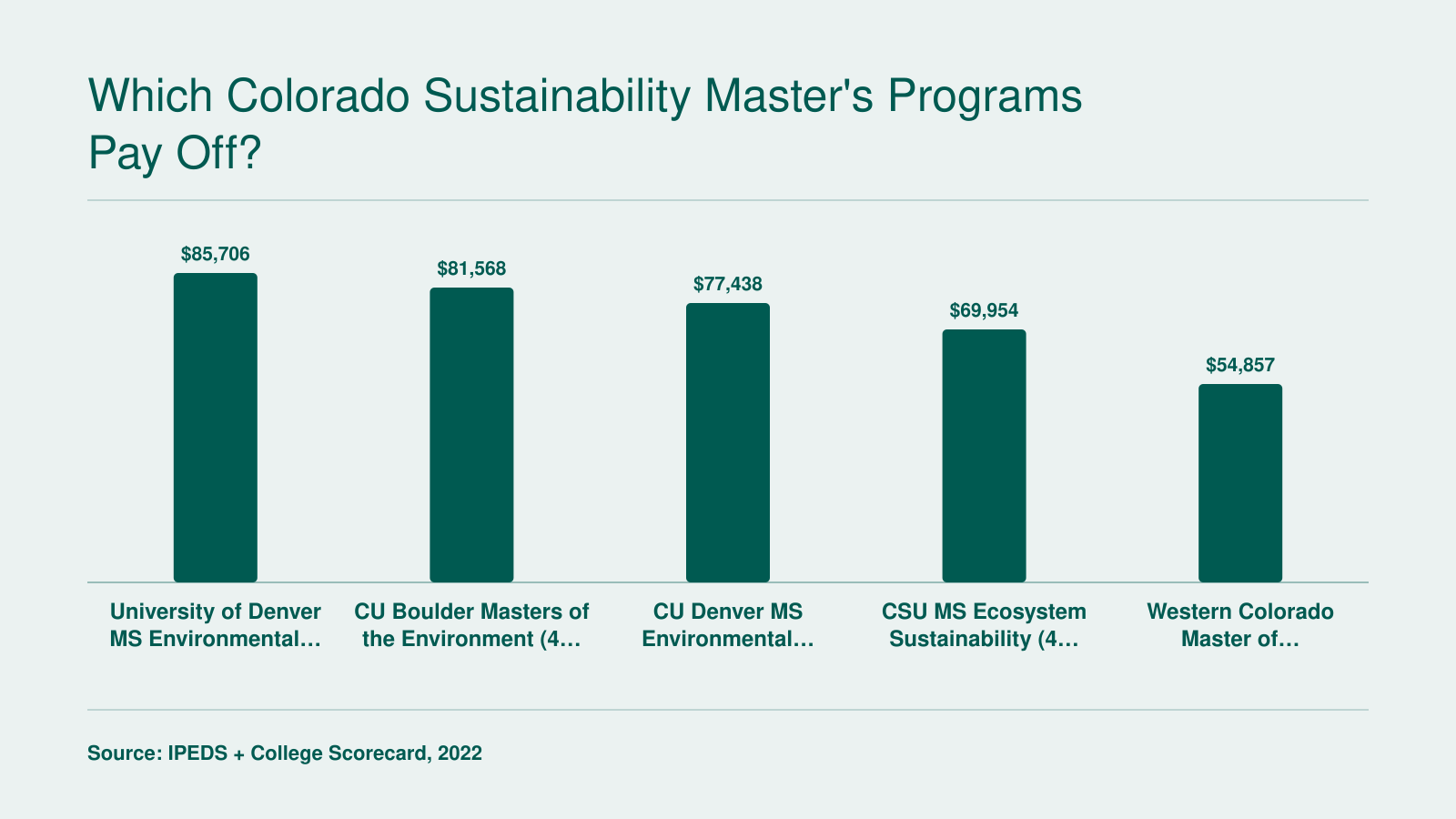
Which Colorado Sustainability Master's Programs Pay Off?
Program-level median earnings differ widely among Colorado sustainability master's degrees. The chart compares earnings at the four- or five-year mark, the window each program reports. For return on investment, median debt where available ranges from $22,600 at Colorado State University to $57,931 at CU Boulder, with DU at $41,000 and Western at $39,488.
Frequently Asked Questions About Sustainability Master's in Colorado
Below are answers to common questions about selecting a sustainability master's in Colorado, including program fit, part-time study, and international student eligibility. Use these alongside the rankings and cost tables above.
What is the best sustainability master's program in Colorado?
Are there part-time sustainability master's programs in Colorado?
Can international students on an F-1 visa enroll, and which Colorado sustainability master's programs are STEM-designated for OPT?
Compare Sustainability programs on the data that matters
Explore more Science & Engineering specializations or browse every graduate field.
All Science & Engineering programs