Accelerated Master's in Sustainability Programs
Compare 410+ accredited fastest Sustainability programs at 320+ schools, with graduate earnings, cost, debt, and completion data from IPEDS and the U.S. College Scorecard.
Sharing credits between a bachelor's and a master's can cut a full year from the standard path. Wisconsin-Madison lists a 30-credit, one-year master's at $1,100 per credit, and Brown offers a fifth-year option to its own undergraduates.
The tension is cost against pace. Total program tuition runs from about $33,000 at a public flagship to well above $60,000 at private schools, so a faster degree is not automatically a cheaper one.
The programs here are ordered by shortest timeline. Most still require early planning, since applications often close before senior year.
Key Points
- Virginia Tech graduates report a median $91,116 five years after completion.
- Loyola Chicago lists $1,260 per credit for its 30-credit program.
- Apply before senior year to keep shared-credit tuition savings.
Best Accelerated Sustainability Master's Schools: 2027 Ranked List
For students who need a faster route into sustainability work, these ten schools offer accelerated options worth comparing. The entries highlight the degree or degrees at each school that fit a shorter timeline, along with the details that shape cost and fit.
University of Wisconsin-Madison
#1Madison, WI · ~$12,000/yr (est.)
Best for: Environmental contamination cleanup specialists
Wisconsin's accelerated path is built around environmental remediation and management, with a 4+1 route that can add a master's in one year. Students take 30 credits shaped with industry experts and get project-management and communication training alongside soil and groundwater science.
- Complete in one additional year beyond a bachelor's
- 30 credit hours built with industry experts
- Focus on soil and groundwater contamination
- Project management and communication training included
- No thesis or capstone required
- Up to 6 credits transferable
University of California-Berkeley
#2Berkeley, CA · ~$16,000/yr (est.)
Best for: Experienced professionals pursuing climate leadership
UC Berkeley's sustainability option is a one-year Master of Climate Solutions aimed at professionals with work experience. The curriculum crosses climate science, economics, policy, and management, and a yearlong capstone pairs students with partner organizations.
- Complete in one year of in-person study
- Built for professionals with at least three years of work experience
- Yearlong capstone with partner organizations
- Blends climate science, economics, policy, and management
- Concurrent MBA/MCS degree option
- Equity and climate justice integrated into projects
University of Michigan
#3Ann Arbor, MI · $29,000 – $58,000/yr (est.)
Best for: Interdisciplinary sustainability systems thinkers
Michigan offers an interdisciplinary Master of Science in Environment and Sustainability with seven specializations. Undergraduates can use an accelerated track, and students can add dual degrees or certificates.
- 42 credit hours across seven specializations
- Accelerated master's track for U-M undergraduates
- Specializations include Sustainable Systems and Environmental Justice
- Dual degree options available
- 100% online certificate option
- Four graduate certificate programs
Cornell University
#4Ithaca, NY · ~$30,000/yr (est.)
Cornell has several short sustainability routes: a 12-month environmental and sustainability policy degree and a one-year professional studies program with concentrations that include environmental management and sustainable systems. Both lean on Cornell's policy, economics, and natural-resources strengths, with capstone work built in.
- 12-month STEM-designated degree
- Capstone required
- Merit scholarships considered automatically at admission
- Coursework blends economics, law, data analysis, and management
- Built for sustainability policy and ESG careers
- 30 credit hours, one-year format
- Capstone project instead of thesis
- STEM-designated master's degree
- 3.5 GPA minimum
- 3 letters of recommendation minimum
- Starts fall with March 31 priority deadline
- Course-based, not research-focused
- Faculty advisor maps course of study
- Alumni at Finger Lakes Land Trust and WCS-Laos
- Take courses across Cornell
Brown University
#5Providence, RI · $65,000 – $70,000/yr (est.)
Brown's on-campus sustainable energy degree combines energy systems science, policy, and economics in one year. Students choose among energy generation, materials for energy, or energy and environmental policy focus areas.
- Complete in one year on campus
- 8 total credit hours
- Three focus areas: energy generation, materials for energy, energy and environmental policy
- No thesis or capstone required
- Fifth-year master's for Brown undergraduates
- Covers electrification and decarbonization
Carnegie Mellon University
#6Pittsburgh, PA · ~$51,000/yr (est.)
Carnegie Mellon's regenerative and sustainable design degree takes a two-year, research-based route through ecological theory, computational design, and materials. Accelerated pathways let students combine it with architecture degrees.
- Two-year, four-semester campus program
- Yearlong thesis with faculty mentorship
- 4+1 and 5+1 accelerated pathways
- Double count up to 48 units
- STEM-eligible program
- Design Fabrication Lab and Applied Architectural Robotics Lab
University of Southern California
#7Los Angeles, CA · ~$72,000/yr (est.)
USC's fully online sustainability management master's is designed for working professionals, with a one- or two-year pace. The curriculum connects sustainability to strategy, finance, supply chains, and reporting.
- Fully online option available
- Complete in 12 or 24 months
- 24 total credit hours
- Three start dates per year
- ESG integration across business models
- Courses in sustainable finance, reporting, and supply chains
- Ideal for working professionals and career pivots
Virginia Polytechnic Institute and State University
#8Blacksburg, VA · ~$19,000/yr (est.)
Virginia Tech's online natural resources master's centers on sustainability and sustainable development. It offers accelerated and dual-enrollment options plus an optional short global study experience.
- Fully online option available
- Concentration in Sustainability and Sustainable Development
- Five core sustainability and leadership courses
- Optional 10-day global study trip
- Low student-to-instructor ratio
- Military benefits accepted
- Accelerated and dual enrollment options
- Graduate certificates available
University of Miami
#9Coral Gables, FL · ~$47,000/yr (est.)
Miami pairs a science-driven sustainable development master's with an urban sustainability and resilience option. Both are one-year, 30-credit routes, and the urban track emphasizes professional and geospatial skills.
- 30 credit hours, one-year full-time or part-time options
- No entrance exam required
- Thesis or capstone option
- STEM-designated program
- GIS and spatial data analysis coursework
- Focus on food, water, and energy security
- One-year professional science route
- STEM-designated with 36-month OPT extension
- Additional certificates in geospatial technology
- Research assistantships available on campus
Syracuse University
#10Syracuse, NY · $45,000 – $50,000/yr (est.)
Syracuse's joint master's brings together the Maxwell and Whitman schools for a one-year, 30-credit sustainability organizations and policy degree. The emphasis is leadership, policy, management, and ESG strategy.
- 30 total credit hours
- One-year program
- 12 credits from each school
- STEM-designated program
- Competitive merit scholarships available
- Prepares for sustainability manager, policy analyst, and ESG strategist roles
Cost & outcomes by school
Federal data for the highest-earning Sustainability programs, independent of the ranking above. Earnings are this field's master's graduates four years after completing, where the Scorecard reports them.
| School | Earnings | Tuition / yr | Debt | Grads/yr | Format |
|---|---|---|---|---|---|
| Catawba College NC | — | $7,188 | — | — | Online |
| University of North Carolina Asheville NC | — | $8,293 | — | — | Campus |
| Westminster College PA | — | $9,000 | — | — | Online |
Sources: U.S. Department of Education. Tuition and graduates: IPEDS. Earnings and debt: College Scorecard, this field's master's graduates; a dash means no figure is reported.
Cost, debt & payoff
Median earnings of this field's master's graduates (4 yrs after completing) vs. their median federal loan debt · U.S. College Scorecard
Across these programs the median graduate earns about $70,670 and finishes with roughly $38,500 in debt — a ratio that clears a common rule of thumb (keep debt below first-year salary). Tuition and debt vary widely school to school, so check the per-school figures in the table above before you shortlist.
How 4+1 and 3+2 Sustainability Pathways Work
Accelerated sustainability pathways reward students who commit early: you trade some undergraduate flexibility for a faster, less expensive route to a affordable master's in sustainability. In a typical 4+1 format, you apply as a junior, then take approved graduate courses during your senior year and count them toward both degrees.
Shared-credit allowances often sit in the 6-to-12-credit range, while totals for a master's in sustainability commonly run 30 to 36 graduate credits. At Arizona State University, the Master of Sustainability Solutions requires 30 graduate credits overall, and accelerated students may share up to 12 of those credits with the bachelor's. The university describes the combined path as five years total, with the master's finished in about one additional year after the bachelor's. A related accelerated food systems track follows a similar model, using designated 500-level sustainability courses that are shared between the two degrees.
Grade Rules and Shared Credits
Shared credits are not automatic. Most programs require a minimum grade, often a B or better, in any graduate course taken during the bachelor's before it can be applied to the master's. That makes the junior-year decision more consequential: a low grade in a shared course can force you to retake or replace the credit later.
Cost Snapshot: The Most Affordable Accelerated Options
Shared or double-counted credits drive the savings in an accelerated program because a course that counts toward both degrees can be billed at the undergraduate rate rather than the graduate rate. Loyola Chicago lists $1,260 per credit for its 30-credit Environmental Science and Sustainability MS and bills accelerated students at the undergraduate rate before conferral; Colorado State shares up to 9 senior-year credits at undergraduate rates and then applies a $115 per-credit graduate differential after admission. Public in-state rates can be far lower than private pricing: Vermont charges $484 per credit in-state while Tufts charges $1,634 per credit, though Vermont's out-of-state rate is $1,375.
| School | In-state graduate tuition | Out-of-state graduate tuition | Net price |
|---|---|---|---|
| Florida International University | 11334 | 24439 | 9288 |
| University of Michigan | 28886 | 57776 | 13138 |
| University of California-Berkeley | 15866 | 30968 | 13481 |
Related Articles
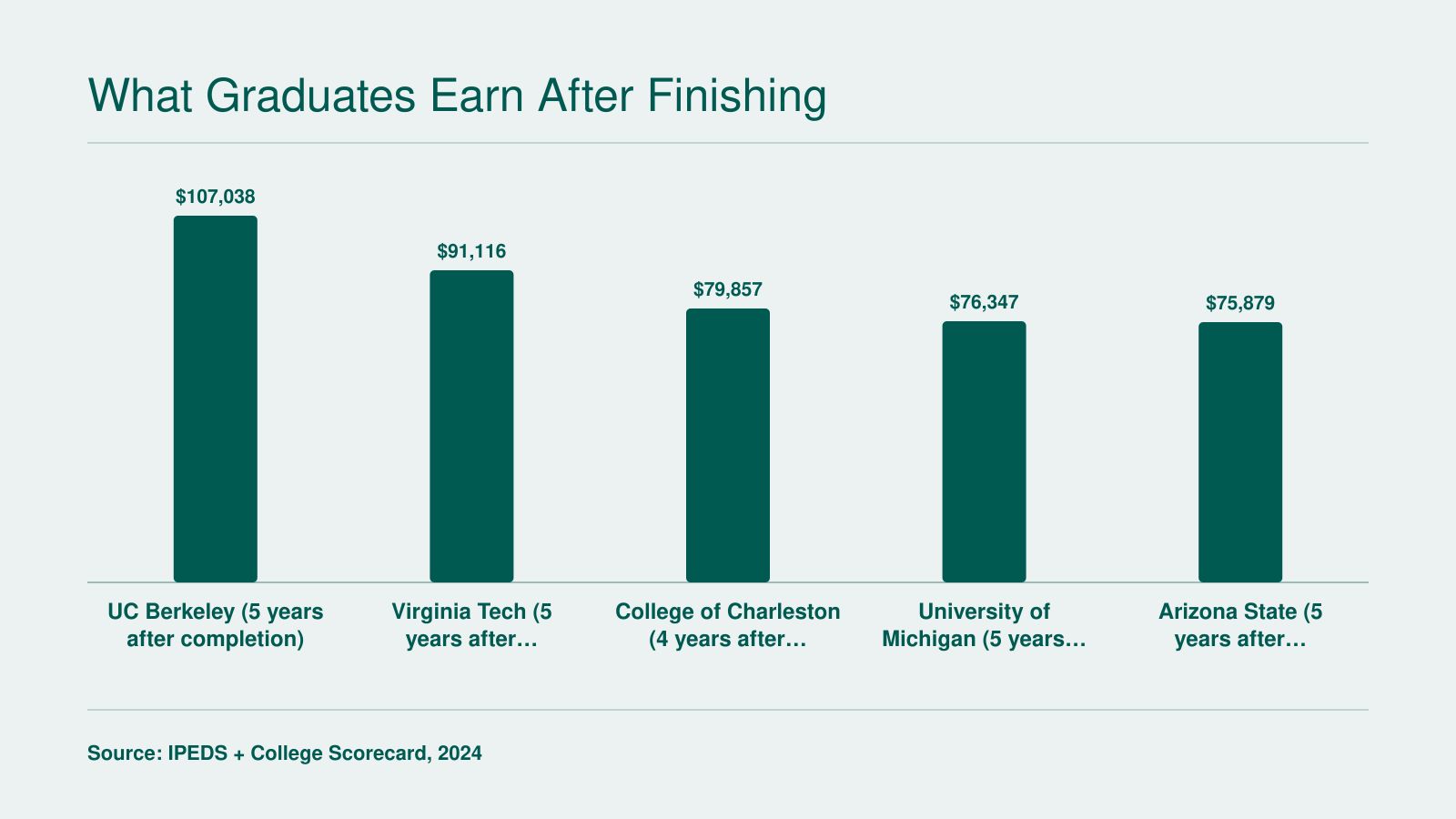
What Graduates Earn After Finishing
Program-level median earnings vary by measurement window. Virginia Tech graduates report a median $91,116 five years after completion with median program debt of $38,924, while University of Michigan graduates report $76,347 five years after completion with $35,377 in debt. The chart below compares each school's reported figure, labeled by time window.
Admissions Checklist for Accelerated Sustainability Programs
Requirements vary by program, so use these items as a starting checklist rather than a universal standard.
- Check GPA thresholds by programMinimums differ: Arizona State's accelerated MSUS and Michigan Tech's Sustainable Communities MS require a 3.0, Kansas' Environmental Assessment PSM requires 3.2, and Florida Atlantic expects a B average.
- Confirm credit standing and timingMost pathways expect a junior-year application. ASU's MSUS requires 75+ credits and six upper-division major credits before applying, with 90 credits before graduate coursework; FAU's environmental science track applies in the last semester of junior year.
- Review prerequisite courseworkCheck for statistics, environmental science, or economics preparation. RIT's Sustainable Systems MS, for example, requires calculus, statistics, and two physical science courses, while ASU's accelerated MSUS adds no separate prerequisites beyond upper-division major credits.
- Gather faculty recommendations and a statementLetter counts range from one ASU School of Sustainability faculty reference to two or three, typically with at least one academic voice; ASU's Sustainability MS requests a statement of 600 words or fewer.
- Know transfer and residency rulesMichigan Tech's accelerated Sustainable Communities MS is open only to students completing the bachelor's at Michigan Tech, which limits transfer eligibility; other institutions may require a minimum number of credits earned on campus.
- Prepare international-student documentationNon-native English speakers generally need proof of proficiency, Michigan Tech lists TOEFL 4.5 or IELTS 6.5, and RIT requires F-1 students to enroll full-time at 9+ credits, so check program-level rules before applying.
Online, Campus, and Hybrid Formats, Plus Capstone Requirements
Format describes how you actually attend: fully online from anywhere, on campus in person, or a hybrid blend of the two. It determines where you live and how the extra graduate year fits your schedule.
How the Formats Break Down
Most of the programs ranked here are campus-based, including the research-heavy options at Michigan, Carnegie Mellon, and Miami. A couple run fully online, such as USC's Master of Sustainability Management and Virginia Tech's Master of Natural Resources, while Harvard Extension and the University of Alberta use hybrid models that pair mostly online coursework with limited on-campus time.
Watch one wrinkle: the undergraduate half of a 4+1 or 3+2 pathway is often campus-only even when the master's is delivered online. The University of South Dakota's accelerated B.S./M.S., for example, is based at the Vermillion main campus, so the acceleration happens in person before any online graduate study.
Match the Capstone to Your Goal
- Thesis: Best if you're aiming for a PhD or research role. Carnegie Mellon requires one; ASU's M.S. and South Dakota's thesis track center on it.
- Applied capstone: Fits corporate ESG and consulting. UC Berkeley and Alberta build in team or project capstones.
- Internship: Colorado State replaces the thesis with a 400-hour, 4-credit placement, strong preparation for industry hiring.
Sustainability programs by state
Frequently Asked Questions About Accelerated Sustainability Master's
How many credits can you transfer into an accelerated sustainability master's?
Are accelerated sustainability master's programs cheaper than a traditional master's?
Can transfer or international students join an accelerated sustainability pathway?
What happens if you leave the accelerated program before finishing the master's?
Compare Sustainability programs on the data that matters
Explore more Science & Engineering specializations or browse every graduate field.
All Science & Engineering programs