Best Master's in Sustainability Programs in Rhode Island
Compare 5 accredited Sustainability programs in Rhode Island at 3 schools, with graduate earnings, cost, debt, and completion data from IPEDS and the U.S. College Scorecard.

A master's in sustainability in Rhode Island means studying energy systems, coastal ecology, and environmental policy in a state where offshore wind farms, shoreline erosion, and storm resilience planning are everyday public concerns.
Only a few schools here offer this degree, and they differ sharply in format and price: Brown's one-year energy program, URI's public environmental science and management master's, and RISD's humanities-based studies degree.
The real tension is cost against fit, since private tuition runs far above the public rate.
Key Points
- Brown offers a one-year energy transition master's program.
- No fully online sustainability master's exists among ranked programs.
- University of Rhode Island charges $875 per graduate credit.
Best Master's in Sustainability Schools in Rhode Island, Ranked
Prospective sustainability students in Rhode Island can choose from a one-year energy transition program at Brown, a broad environmental science and management master's at the University of Rhode Island, or a humanities-focused nature-culture-sustainability degree at RISD. Each path suits a different kind of graduate student, and the three schools below are ordered by their value for those goals.
Brown University
#1Providence, RI · $65,000 – $70,000/yr (est.)
Best for: Early-career researchers targeting energy transitions
Brown's Sustainable Energy Sc.M. is a one-year campus program that blends science, engineering, policy, and economics for students who want to work on climate change from inside energy systems. The curriculum pairs core work in sustainable energy, energy transitions, and climate systems modeling with a choice of concentration in generation and power systems, materials for energy, or energy and environmental policy. There is no thesis or capstone, and graduates move into renewable energy, decarbonization, and climate roles as staff scientists, program managers, and policy leads, or continue to a Ph.D.
- One-year, on-campus degree with no thesis or capstone
- Core work blends sustainable energy science, policy, and economics
- Three concentrations: generation and power, materials, policy
- Electives available across Brown, including IBES and Watson Institute
- Pathway to Ph.D. and renewable energy careers
University of Rhode Island
#2Kingston, RI · ~$18,000/yr (est.)
Best for: Working professionals wanting flexible environmental management
The University of Rhode Island's Master of Environmental Science and Management is an interdisciplinary, interdepartmental degree built for working professionals who want to advance in private firms, government agencies, or nonprofits. Students can choose among concentrations including Conservation Biology, Wetland, Watershed, and Ecosystem Science, Sustainable Systems, Environmental Policy and Management, and Remote Sensing and Spatial Analysis, and can study full time over 1.5 to 2 years or part time over 3 to 4 years. The degree starts in fall, spring, and summer, emphasizing practical expertise for career advancement.
- Conservation Biology pairs science with real management practice
- Full-time completion in 1.5 to 2 years
- Part-time path available over 3 to 4 years
- Starts fall, spring, and summer
- Wetland, Watershed, and Ecosystem Science concentration
- Interdisciplinary environmental science training
- Three start dates each year
- Designed for government, nonprofit, and private-sector roles
- Sustainable Systems concentration includes managed ecosystem study
- Requires 12-16 credits in natural sciences
- Part-time pathway available
- Built for career advancement in sustainability fields
Rhode Island School of Design
#3Providence, RI · $60,000 – $65,000/yr (est.)
Best for: Humanities-oriented scholars exploring environmental cultures
Rhode Island School of Design offers a Nature-Culture-Sustainability Studies master's built around interdisciplinary environmental humanities and social sciences. Students pursue self-directed research with faculty in areas such as Anthropocene studies, climate change cultures, green urbanisms, and sustainable design futures. The program fits students who want a scholarly, humanities-oriented approach to sustainability rather than a technical or management track.
- Interdisciplinary environmental humanities and social sciences
- Focus areas include Anthropocene studies, climate change cultures, green urbanisms, and sustainable design futures
- Self-directed pathways of research with faculty
- Four concentration options
Cost & outcomes by school
Federal data for the highest-earning Sustainability programs, independent of the ranking above. Earnings are this field's master's graduates four years after completing, where the Scorecard reports them.
| School | Earnings | Tuition / yr | Debt | Grads/yr | Format |
|---|---|---|---|---|---|
| University of Rhode Island RI | — | $18,028 | — | — | Campus |
| Brown University RI | — | $69,948 | — | — | Campus |
| Rhode Island School of Design RI | — | $62,688 | — | 21 | Campus |
Sources: U.S. Department of Education. Tuition and graduates: IPEDS. Earnings and debt: College Scorecard, this field's master's graduates; a dash means no figure is reported.
Online and Hybrid Sustainability Master's Options in Rhode Island
An Online Master's in Sustainability does exist: URI's Master of Environmental Management is delivered online and accelerated. Most programs on this page are campus-based, but URI's online accelerated Master of Environmental Management, an Accelerated Master's in Sustainability, offers a remote option for working students. The University of Rhode Island's Master of Environmental Science and Management is the first listing to check: it offers full-time and part-time options, with fall, spring, and summer starts. Brown University's sustainable energy master's is a one-year campus cohort, and Rhode Island School of Design's Nature-Culture-Sustainability Studies program is campus-centered as well.
The trade-off is real. Campus programs in Providence and Kingston connect you to fieldwork, labs, and local agencies that a fully online format cannot match. For working professionals in Rhode Island, URI's online accelerated Master of Environmental Management is a practical alternative to a campus schedule.
Which Rhode Island Master's in Sustainability Programs Waive or Make the GRE Optional?
Many environmental and sustainability master's programs now treat the GRE as optional rather than a hard filter. The table below reflects each school's current graduate admissions page, so you can see exactly where the Rhode Island programs stand.
| School | Program | GRE Policy | Source/Notes |
|---|---|---|---|
| Brown University | Master of Public Affairs (MPA) | GRE general test not required; submitting scores is encouraged. GRE subject test not required. | Official Brown Graduate Programs admissions page lists GRE Subject: Not required and GRE General: Not required, but score submission is encouraged. |
| University of Rhode Island | Biological and Environmental Sciences | GRE scores are not required to apply. | Official URI admission page states GREs are not required; high GRE scores may provide supplementary evidence for applicants with a GPA between 2.0 and 3.0. |
| University of Rhode Island | Master of Environmental Science and Management (MESM) | GRE is not required. | Official URI catalog admission information states the GRE is not required for the MESM program. |
| Rhode Island School of Design | Graduate programs; no specific sustainability or environmental master's degree identified | GRE results are not required as part of the graduate application process. | Official RISD graduate application page states GRE results are not required; it does not identify a specific sustainability or environmental master's degree. |
Related Articles
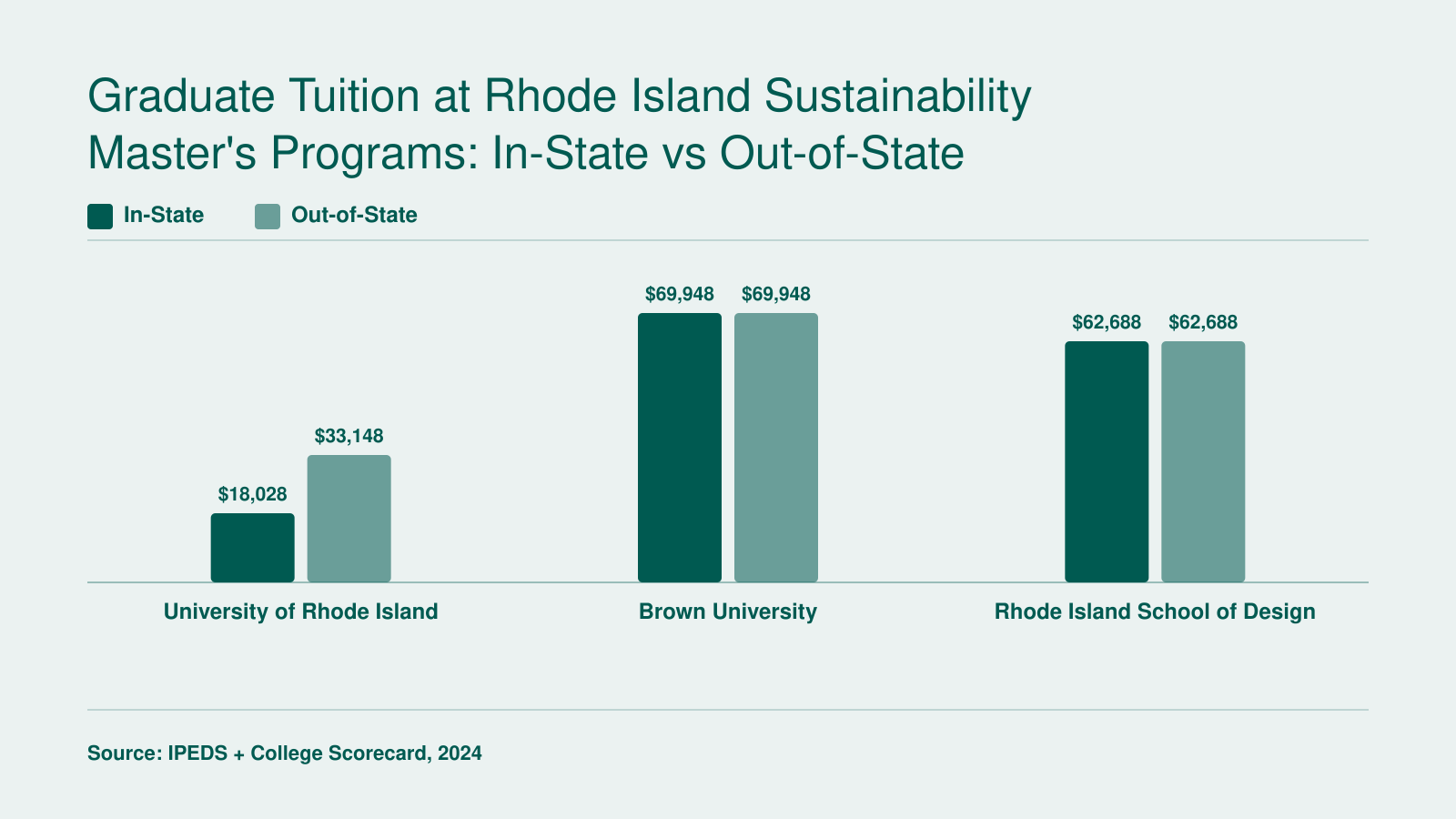
Graduate Tuition at Rhode Island Sustainability Master's Programs: In-State vs Out-of-State
All figures are published graduate tuition and fees, not total cost of attendance. The University of Rhode Island, as the public option here, reports separate in-state and out-of-state rates. Brown University and Rhode Island School of Design, both private, charge one graduate tuition regardless of residency.
Cost of a Sustainability Master's in Rhode Island, Financial Aid, and Licensure or Certification
Sticker price and what students actually pay for a Master's in Sustainability are drifting further apart at Rhode Island's graduate schools, so build your own total before comparing.
At the University of Rhode Island, multiply the $875 per-credit rate by the credits your program requires (confirm that number with the department), then add fees. The 2026-27 in-state figures run $17,116 in tuition and $2,142 in mandatory fees. Estimated living costs in Kingston are $20,528 on campus and $32,200 off campus. Brown prices by course load: a standard eight-course year lists $74,560 in tuition, $1,596 in fees, and about $26,667 in living expenses in Providence.12
The net price figures, roughly $21,440 at URI and $25,184 at Brown, are institution-wide averages after aid, not quotes for any one affordable master's in sustainability.
Funding routes
- URI assistantships: about 20 hours a week, with a 100% tuition waiver and a 40% standard-fee waiver.
- URI fellowships and Graduate School Tuition Scholarships: stipend or tuition support, with credit-load rules.
- Brown: most master's students are self-supported, though some departments offer partial or full funding and merit scholarships.
- Employers: ask about tuition benefits.
No state license is typically required to work in sustainability, but some credentials help.
Rhode Island Licensure and Certification for Sustainability Professionals
Sustainability Master's Degree Salary and Career Outcomes in Rhode Island
A sustainability master's prepares you for jobs that turn environmental goals into projects, policies, and budgets, and in Rhode Island that work clusters in a few places: state agencies, offshore wind, coastal resilience, and nonprofits. The three schools here point toward different parts of that market.
Brown's one-year Sustainable Energy master's targets renewable energy and decarbonization roles, including staff scientists and program managers, and it can lead to Ph.D. study. The University of Rhode Island's Master of Environmental Science and Management is built for working professionals and points toward private-sector, government, and nonprofit careers. It runs full-time or part-time. Rhode Island School of Design's Nature-Culture-Sustainability Studies master's suits students drawn to environmental humanities and social science research, so expect roles in advocacy, communication, and policy-adjacent work.
For a quick ROI read, start with what you pay for the credential. Program tuition is about $69,948 at Brown, $62,688 at RISD, and $18,028 in-state or $33,148 out-of-state at URI. Weigh each price against the job you want and the salary range posted for that role.
Admission Requirements and Application Deadlines for Rhode Island Sustainability Master's Programs
Use these published requirements as a starting checklist; confirm directly with each program.
- Core materialsBachelor's degree, transcripts, statement of purpose, resume/CV, recommendation letters, and English proficiency for international applicants.
- Brown statement and recommendationsBrown asks for a 1,000–1,500-word statement and three recommendations, or two for fifth-year applicants.
- English proficiencyBrown lists minimum TOEFL iBT 90 for exams on or before January 20, 2026, or IELTS 7.0 where required.
- Application deadlinesFor Fall 2027, Brown Sustainable Energy: priority February 1, final and international April 1, fifth-year May 1. Environmental Engineering: fall priority February 1, final April 1; spring priority September 15, spring final November 1.
- Prerequisites and GRENo complete mandatory undergraduate course list is published; Sustainable Energy emphasizes thermodynamics and technology analysis. GRE not required for Sustainable Energy, recommended, not required, for Environmental Engineering.
- University of Rhode IslandCurrent deadlines and prerequisites were not present in the sources reviewed; verify with the program.
Frequently Asked Questions About Sustainability Master's Programs in Rhode Island
Prospective students comparing the best master's in sustainability programs in Rhode Island usually ask how Brown and URI differ, how long each path takes, and whether assistantships reduce the bill. Below are concise answers based on published program details for 2026-2027.
How do Brown and URI compare for a sustainability master's on cost, format, and focus?
Can I finish a Rhode Island sustainability master's in under two years or part time?
Do Rhode Island sustainability programs offer assistantships that cover tuition?
Is an environmental management master's different from a sustainability master's in Rhode Island?
Compare Sustainability programs on the data that matters
Explore more Science & Engineering specializations or browse every graduate field.
All Science & Engineering programs