Best Master's in Sustainability Programs in Massachusetts
Compare 25 accredited Sustainability programs in Massachusetts at 13 schools, with graduate earnings, cost, debt, and completion data from IPEDS and the U.S. College Scorecard.
Massachusetts pairs dense research capacity with binding state climate targets, but sticker price and program format vary widely. A one-year MIT degree reserved for mid-career applicants sits next to Harvard's part-time hybrid master's, which students can stretch over as many as five years.
Campus and online formats appear side by side. Programs are ordered by verifiable outcomes such as net price, graduation rates and program completions, not name recognition.
The better-known school is not always the better value, and employers hiring for climate roles often weigh applied experience as heavily as the credential.
Key Points
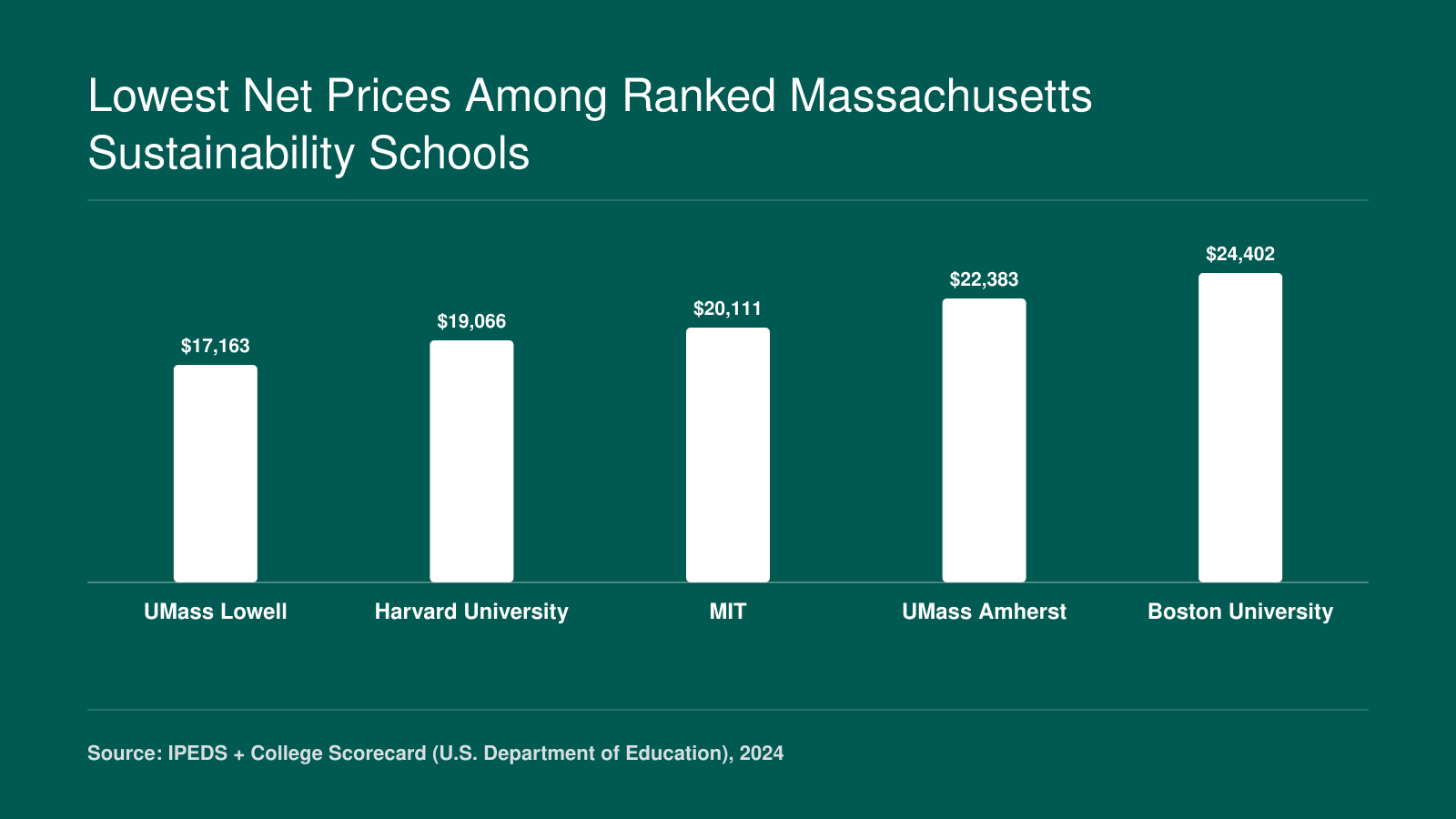
- UMass Lowell has the lowest average net price here at $17,163, ahead of Harvard and MIT.
- Harvard Extension's sustainability master's is hybrid: 11 of 12 courses online, at least one on campus.
- Where schools publish a GRE policy, it is mostly not required, and Boston University won't consider scores.
The 10 Best Master's in Sustainability Programs in Massachusetts
These Massachusetts programs range from one-year professional degrees to part-time hybrid options. Graduation rates cited below are institution-wide, not specific to any one program, and STEM status is noted only where a school publishes it.
Harvard University
#1Cambridge, MA · $55,000 – $60,000/yr (est.)
Best for: Working professionals studying mostly online
Harvard Extension School's sustainability master's (a Master of Liberal Arts in Extension Studies) is built for working professionals, with 11 of 12 courses online and one short campus residency. Tuition is $3,580 per course, and Harvard graduates 98% of its students institution-wide. Students finish with a thesis or capstone and can stack graduate certificates along the way.
- Hybrid format: 11 of 12 courses online plus one short campus residency
- 12 total courses, completed in anywhere from 2 to 5 years
- $3,580 per course tuition
- Two concentration options
- Thesis or capstone option
- Stackable graduate certificates, such as corporate sustainability
- No environmental science background required
- Prerequisite courses count toward the degree
Boston University
#2Boston, MA · $65,000 – $70,000/yr (est.)
Best for: Thesis-minded students designing a custom path
Boston University offers three distinct sustainability-related master's paths in Boston, from a research-oriented earth and environment degree to a hybrid innovation program. The university graduates 89% of its students institution-wide, and listed graduate tuition is $66,670. The energy and environmental analysis degree is described as STEM-eligible.
- Campus-based, 32 credit hours, two-semester program
- Thesis required, defended in an oral presentation
- Two concentration options
- Covers sustainability, energy and environmental policy
- Accepts up to 8 transfer credits
- Faculty advisor needed before admission
- Full-time, on-campus program
- Described as a STEM-eligible master's degree
- Model scenarios, analyze data and design policy
- Graduates become consultants and utility managers
- Hybrid, with a fully online option available
- $29,700 total program tuition
- 32 credit hours across 8 courses
- Completion in 8 to 16 months
- Focus on ESG investing and impact
- Full-time and part-time options
Tufts University
#3Medford, MA · ~$51,000/yr (est.)
Best for: Aspiring planners wanting client-based field projects
Tufts' MS in Sustainability in Medford is a STEM-designated, 36-credit degree built around systems thinking, quantitative reasoning, GIS and field projects with real clients. Students can focus on areas such as climate, energy, food, water or biodiversity. Tufts graduates 94% of its students institution-wide, and listed graduate tuition is $49,574.
- STEM designated program
- 36 credit hours across 11 courses
- Nine concentration options
- Field projects with actual clients
- Internship or capstone experience
- Full-time and part-time options
- Electives from other Tufts schools
- Prerequisite courses required
University of Massachusetts-Amherst
#4Amherst, MA · $15,000 – $20,000/yr (est.)
UMass Amherst's MS in Sustainability Science is a one- or two-year professional master's housed in Environmental Conservation, with more than 200 graduates since its 2011 founding. Graduate tuition is $15,091 in-state and $33,407 out-of-state, and the university graduates 83% of its students institution-wide. It is the lowest-cost option here for Massachusetts residents.
- One-year, full-time option; alternate pathways for working professionals
- Focus on how cities and communities become more sustainable
- Four-credit practicum in a real professional setting
- Core courses in environmental systems, economics and political science
- Solar energy startup innovation work
- Community renewable energy solutions
- Building efficiency design projects
- Open to any bachelor's degree
- Dual degree available with Regional Planning
- Land-grant university with 150+ years of research
- Complete in one or two years
- Campus used as a living laboratory
- Capstone required
- Careers in industry and government
- One- or two-year professional master's format
- Network of peers and colleagues
- Careers in industry, academia and government
Brandeis University
#5Waltham, MA · $60,000 – $65,000/yr (est.)
Brandeis' Master of Arts in Global Sustainability Policy and Management, at the Heller School in Waltham, ties its curriculum to the UN's 17 Sustainable Development Goals. It can be finished in 9 to 12 months. The university graduates 86% of its students institution-wide, and listed graduate tuition is $60,033.
- Complete in 9 to 12 months
- Curriculum aligned with the 17 UN SDGs
- Capstone required
- Practicum placement, which can be waived
- Nine-month option with no practicum
- Electives across five skill areas
Clark University
#6Worcester, MA · ~$51,000/yr (est.)
Clark University in Worcester offers two STEM-designated sustainability master's programs, one in environmental science and policy and one in sustainable food systems. International students can work up to 36 months on Optional Practical Training under the STEM extension, according to the school. Clark graduates 77% of its students institution-wide, and listed graduate tuition is $49,750.
- Three tracks: 10-unit, 12-unit research and 12-unit practice
- Fall or spring start
- STEM designated program
- Internships, studio courses and field work
- Monitoring and evaluation and project management skills
- STEM-designated master's program
- Focus on food security and justice
- Housed in the Sustainability and Social Justice department
- Scholarships available
Wheaton College (Massachusetts)
#7Norton, MA
Wheaton's 4+1 M.S. in Environmental Science in Norton is open to current Wheaton undergraduates only, who earn the master's about a year after the bachelor's. The final terms run mostly online and asynchronous, with a mentored field research project in the summer. Wheaton graduates 73% of its students institution-wide.
- Open to current Wheaton students only
- 32 credits across 8 courses; two taken in senior year
- Hybrid, with asynchronous online classes
- Thesis required, with mentored field research
- ArcGIS training
- Full-time and part-time options
Endicott College
#8Beverly, MA · $15,000 – $20,000/yr (est.)
Endicott College in Beverly pairs a part-time, fully online M.S. in Applied Behavior Analysis with a sustainability concentration. It suits working professionals who want a behavior-science route into climate and corporate sustainability work, and program tuition is listed at $30,400. Endicott graduates 76% of its students institution-wide.
- Fully online, part-time, 27-month program
- 40 credit hours
- $30,400 total program tuition
- Four sustainability electives, including environmental justice and emissions control
- Three start dates per year
- Thesis required
University of Massachusetts-Lowell
#9Lowell, MA · ~$16,000/yr (est.)
UMass Lowell's M.S. in Environmental Studies is a 30-credit, STEM-designated degree with options in environmental engineering sciences, atmospheric science and environmental geoscience. Graduate tuition is $15,714 in-state and $28,398 out-of-state, and the university graduates 65% of its students institution-wide. It is a low-cost, technical route for non-engineers.
- Designed for students without an engineering degree
- Covers air pollution control, hydrology and site remediation
- Thesis or non-thesis track, 30 credits
- STEM designated, F-1 visa eligible
- Research in forecasting and climate modeling
- On-campus weather station
- Teaching and research assistantships
- Funding priority deadline January 15
- Ground-penetrating radar equipment
- On-campus research reactor
- Hands-on research with faculty
- Train as environmental geoscience consultants
Massachusetts Institute of Technology
#10Cambridge, MA · ~$62,000/yr (est.)
MIT's one-year M.S. in Sustainability Studies and Planning in Cambridge is reserved for mid-career professionals in planning, policy and design. Admission requires work experience and prior contact with a faculty advisor, and a thesis is required. MIT graduates 96% of its students institution-wide, and listed graduate tuition is $61,990.
- One-year, campus-based program
- Reserved for mid-career students; work experience required
- Thesis required
- 36 core units and 30 elective units
- No MCP core required
- Faculty letter of recommendation required
Cost & outcomes by school
Federal data for the highest-earning Sustainability programs, independent of the ranking above. Earnings are this field's master's graduates four years after completing, where the Scorecard reports them.
| School | Earnings | Tuition / yr | Debt | Grads/yr | Format |
|---|---|---|---|---|---|
| University of Massachusetts-Amherst MA | $68,841 | $17,410 | — | 14 | Campus |
| Lasell University MA | — | $12,150 | — | — | Hybrid |
| Endicott College MA | — | $15,534 | — | — | Online |
| University of Massachusetts-Lowell MA | — | $16,434 | — | — | Campus |
| Northeastern University MA | — | $26,020 | — | — | Campus |
| Northeastern University MA | — | $29,174 | — | — | Campus |
| Wheaton College (Massachusetts) MA | — | — | — | — | Hybrid |
| Harvard University MA | — | $57,248 | — | 182 | Hybrid |
| Clark University MA | — | $50,975 | — | — | Campus |
| Brandeis University MA | — | $60,153 | — | — | Campus |
| Massachusetts Institute of Technology MA | — | $62,396 | — | — | Campus |
| Boston University MA | — | $67,626 | — | — | Campus |
Sources: U.S. Department of Education. Tuition and graduates: IPEDS. Earnings and debt: College Scorecard, this field's master's graduates; a dash means no figure is reported.
Lowest Net Prices Among Ranked Massachusetts Sustainability Schools
UMass Lowell has the lowest average net price at $17,163, followed by Harvard at $19,066 and MIT at $20,111. The two public campuses do not sweep the bottom: UMass Amherst ($22,383) sits above both private Cambridge schools, whose large institutional aid brings their averages down. Net price is an institution-wide average after grants and scholarships, so it only approximates what a graduate student will pay. For graduate sticker price, check the in-state and out-of-state tuition listed on each program's page.
Online and Hybrid Master's in Sustainability Options in Massachusetts
Harvard Extension School's sustainability master's program lets students take 11 of its 12 courses online,1 but it is hybrid, not fully online. At least one course must be on campus,1 and the thesis track adds a three-week on-campus proposal course.1 Online work is mostly asynchronous,2 and about 80% of students work full time.2 The next start is Spring 2027, with registration open November 5, 2026 through January 19, 2027.2 For readers outside Boston comparing master's programs in Massachusetts, it is the strongest fit around a job, though some travel is unavoidable.
Other formats worth checking
- Endicott College: The sustainability concentration sits inside an Applied Behavior Analysis M.S. It has a fully online option and three start dates a year, so confirm the focus matches your goals.
- Tufts University: One listing offers full-time, part-time daytime, and part-time evening study with fall entry.3 Another describes the program as on-campus, so confirm with admissions.
- Northeastern University: The Public Policy concentration in Sustainability and Climate Change is Boston-only and cannot be completed fully online.4 On-campus courses start after 5 p.m.4
- Wheaton College: Its 4+1 uses asynchronous online classes, but it is open to current Wheaton students only.
- UMass Amherst: The one-year program is campus-based, though it mentions alternate pathways for working professionals.
Does online cost less?
Harvard Extension quotes $3,580 per course.2 None of the schools here publishes a separate online tuition rate in the program details reviewed, so ask admissions before assuming a discount.
Related Articles
Which Massachusetts Master's in Sustainability Programs Waive or Make the GRE Optional
The statewide pattern is clear: where a school publishes a policy, the GRE is mostly not required, and Boston University goes further by stating that scores will not be considered. Tufts is the main exception, since applicants whose degree is not from a U.S. or Canadian institution must submit scores. Harvard Extension School publishes no GRE policy on its requirements page, so confirm details on each admissions page, because policies and deadlines change each cycle.
| School | GRE Policy | Application Deadline | Prerequisites |
|---|---|---|---|
| Harvard Extension School (Master of Liberal Arts in Sustainability) | No published policy. | Not listed | Two admissions courses: ENVR 101 Proseminar and Analytical Methods in Sustainability. Before ENVR 101, pass an online critical-reading and writing test or earn a B or higher in EXPO 42b. |
| Tufts University (MS in Sustainability) | Not required for applicants with a U.S. or Canadian degree by enrollment; required for other applicants. | Priority fall: January 15. Regular fall: April 15. | Basic algebra and graphing skills, shown by a quantitative GRE score of 153 or above, college algebra with a B- or higher within five years, an 80% or higher on the UEP math screening exam, or a non-credit UEP math preparation course. |
| Boston University (MS in Earth & Environment) | Waived: GRE scores will not be considered. | Not listed | Not listed |
| Northeastern University (MS in Environmental Science and Policy) | Not required. | Not listed | Not listed |
| UMass Amherst (MS in Sustainability Science) | Not required. | Fall: February 1 | No specific coursework stated; transcripts from all colleges attended are required. |
| Brandeis University (MA in Global Sustainability Policy and Management) | Not required; scores may be submitted as a supplemental credential. | Fall 2026 Round 1: January 15. Later deadlines: March 1 and April 15, then rolling. | Bachelor's degree from a regionally accredited U.S. institution or a comparable foreign degree; no specific coursework stated. |
Massachusetts' 2021 climate law, the Next-Generation Roadmap, sets legally binding net-zero statewide emissions for 2050 and requires a 50% cut below 1990 levels by 2030. That long-term mandate is fueling demand for sustainability professionals across the state.
Cost, Earnings Payoff, and Certifications for Massachusetts Sustainability Master's Graduates
Tuition vs. Earnings for the Highest-Earning Programs
For programs in this ranking with published program-level earnings, the payoff varies sharply against tuition. Harvard's sustainability master's reports a median of $84,831 four years after finishing, while graduate tuition is $57,248. UMass Amherst's Sustainability Science program reports $74,899 four years after finishing, with in-state tuition at $17,410. Clark University's Environmental Science & Policy program reports $69,057 five years after finishing, with tuition at $50,975. Harvard also reports median program debt of $41,000 and an estimated monthly payment of $466, a useful frame for a higher-tuition option.
Certification Paths Employers Actually Value
Massachusetts does not generally license sustainability professionals as a distinct occupation. Employers more often look for credentials. LEED Green Associate has open eligibility; the 2026 exam fee is $250, or $200 for USGBC members and $100 for students. LEED AP with Specialty requires an active LEED Green Associate and being at least 18; the 2026 fee is $350, or $250 for members.1 A combined Green Associate and AP specialty exam costs $550, or $400 for members.1 All LEED credentials are administered by USGBC and GBCI. Other recognized options include ISSP Sustainability Associate or CSP from ISSP, GBCI WELL AP from GBCI, and HERS Rater for green-building work. The HERS rater path is an energy performance credential rather than a sustainability license. ISSP and HERS eligibility rules and fees vary, so verify current details before registering.
Frequently Asked Questions About Master's in Sustainability Programs in Massachusetts
Which Massachusetts universities offer accredited sustainability master's programs?
What careers can you pursue with a sustainability master's degree?
How long does a master's in sustainability take in Massachusetts?
Compare Sustainability programs on the data that matters
Explore more Science & Engineering specializations or browse every graduate field.
All Science & Engineering programs