Best Master's in Sustainability Programs in Connecticut
Compare 7 accredited Sustainability programs in Connecticut at 6 schools, with graduate earnings, cost, debt, and completion data from IPEDS and the U.S. College Scorecard.

Public or private: in Connecticut, that choice largely sets the price of a sustainability master's. Southern Connecticut State University lists graduate tuition of $14,930, while Wesleyan University charges $69,702.
The work itself is close to home. Coastal resilience planning along Long Island Sound, state energy policy, and corporate ESG reporting across the Hartford, New Haven and Stamford corridor all call for environmental managers.
Residency also matters. UConn's $22,872 in-state rate nearly doubles to $44,784 for out-of-state students.
Key Points
- Southern Connecticut State University lists the lowest graduate tuition at $14,930.
- University of Connecticut's energy and environmental management master's is confirmed fully online.
- Yale environmental management graduates report median earnings near $75,985.
Ranked: Best Master's in Sustainability Programs in Connecticut
This list ranks Connecticut master's programs in sustainability and environmental management, including campus and online options. We compare graduate tuition, delivery format, and required hands-on experiences such as internships and capstones. The programs below span Yale's environmental management degree, UConn's fully online energy and environmental management master's, and public administration and environmental science paths.
Yale University
#1New Haven, CT · ~$50,000/yr (est.)
Best for: Aspiring climate and energy policy leaders
Yale's Master of Environmental Management is a two-year, 48-credit campus program in New Haven. Students choose from nine concentrations, including Climate Change Science and Solutions, which requires 18 credits of specialized coursework across more than 100 YSE and university-wide courses. The program builds in a required 10-12 week summer internship or research project and a three-credit capstone with a faculty adviser. Yale reports an institution-wide graduation rate of about 96%, and graduate tuition is $67,250 for both in-state and out-of-state students.
- Two-year, 48-credit campus program in New Haven
- Climate Change Science and Solutions concentration requires 18 credits
- Choose from more than 100 YSE courses plus courses across Yale
- Required 10-12 week summer internship or research project
- Capstone course or independent project with faculty adviser, at least 3 credits
- Capstone options include ENV 953, ENV 959, and MGT 524
- Nine concentration options available
- Professional Skills Modules and learning communities built into the curriculum
University of Connecticut
#2Storrs, CT · ~$23,000/yr (est.)
Best for: Working professionals seeking fully online study
UConn's Master of Energy and Environmental Management is a fully online, asynchronous 30-credit degree. In-state graduate tuition is $21,044 and out-of-state is $43,712, making it one of the more flexible and value-oriented online options on this list. The program requires a three-credit internship or practicum, with only nine required credits leaving room for electives in environmental law, GIS, and remote sensing. UConn's institution-wide graduation rate is about 83%.
- Fully online asynchronous 30-credit master's program
- Requires 27 credits of coursework plus a 3-credit internship or practicum
- Only 9 required credits; choose electives in environmental law, GIS, remote sensing
- Internship options include NRE 5830 and NRE 5850
- NRE 5850 requires NRE 5200, NRE 5220, and LAW 7812 first
- Concurrent graduate certificates may transfer credit toward the MEEM
- Application deadlines: July 1 fall, December 1 spring, April 1 summer
University of New Haven
#3West Haven, CT · ~$20,000/yr (est.)
Best for: Coastal and environmental health specialists
The University of New Haven's M.S. in Environmental Science is a campus program in West Haven with fieldwork along Long Island Sound. Graduate tuition is $47,332, and students complete a research project, thesis, or internship while pursuing concentrations such as Environmental Health and Management. The program is STEM-designated, which can help international students extend Optional Practical Training eligibility. The school's institution-wide graduation rate is about 63%.
- Campus program with fieldwork along Long Island Sound
- Combine ecology, geoscience, chemistry, and environmental law
- Option to add a 12-credit GIS certificate
- Complete a research project, thesis, or internship
- STEM-designated, supporting international student OPT eligibility
- General concentration requires 38 total credit hours
- Rolling admissions with fall and spring starts
- Marine Science Center at Canal Dock supports coastal research
- Thesis or capstone option available for completion
Wesleyan University
#4Middletown, CT · $65,000 – $70,000/yr (est.)
Wesleyan's Master of Arts in Earth and Environmental Sciences is a two-year campus program in Middletown that emphasizes close faculty mentorship and independent research. Graduate tuition is $70,342 for both in-state and out-of-state students. Students work on fieldwork in geology, ecology, and environmental chemistry, with an optional planetary science concentration. Wesleyan's institution-wide graduation rate is about 93%.
- Two-year campus program in Middletown, Connecticut
- Small department with close faculty mentorship and research projects
- Coursework in geology, ecology, environmental chemistry, and planetary geology
- Independent fieldwork and research design are central to the degree
- Five-year combined BA/MA option available
- Prepares students for PhD study or environmental consulting roles
Southern Connecticut State University
#5New Haven, CT · ~$15,000/yr (est.)
Southern Connecticut State University's M.P.A. with an Environmental Policy concentration is a 36-39 credit campus program in New Haven. In-state graduate tuition is $13,438 and out-of-state is $27,378, the lowest public in-state price on this list. The program includes a six-credit internship, a three-credit capstone, and a 3.0 GPA minimum. SCSU's institution-wide graduation rate is about 50%.
- 36-39 credit campus program in New Haven
- Environmental policy concentration adds 9 credits in energy, coastal policy, GIS, and economics
- Core includes a 6-credit internship; 3 credits waived with managerial experience
- 3-credit capstone required to graduate
- 3.0 cumulative GPA minimum required
- Concentration electives include energy, climate change, and sustainability
Hartford International University for Religion and Peace
#6Hartford, CT · ~$18,000/yr (est.)
Hartford International University for Religion and Peace offers an online Master of Arts in Inter-Religious Studies with a Religion and Ecology concentration. The program integrates ecological science, eco-psychology, and eco-spiritual traditions, with a thesis or capstone option. It prepares students for climate-focused ministry, environmental advocacy, and community organizing. The school's small interreligious community supports customized study paths.
- Online program centered on religion and ecology concentration
- Draws on ecological science, eco-psychology, and eco-spiritual practices
- Thesis or capstone project option
- Advanced standing for graduates of partner eco-spirituality programs
- Prepares for climate-focused ministry, advocacy, and faith-based earth care
Cost & outcomes by school
Federal data for the highest-earning Sustainability programs, independent of the ranking above. Earnings are this field's master's graduates four years after completing, where the Scorecard reports them.
| School | Earnings | Tuition / yr | Debt | Grads/yr | Format |
|---|---|---|---|---|---|
| Southern Connecticut State University CT | — | $14,930 | — | — | Campus |
| Hartford International University for Religion and Peace CT | — | $18,200 | — | — | Online |
| University of New Haven CT | — | $19,916 | — | — | Campus |
| University of Connecticut CT | — | $22,872 | — | — | Online |
| Yale University CT | — | $49,500 | — | — | Campus |
| Wesleyan University CT | — | $69,702 | — | — | Campus |
Sources: U.S. Department of Education. Tuition and graduates: IPEDS. Earnings and debt: College Scorecard, this field's master's graduates; a dash means no figure is reported.
Online and Hybrid Master's in Sustainability Options in Connecticut
Working professionals are driving demand for flexible environmental degrees, a focus of the Best Online Master's in Sustainability Programs, yet Connecticut's offerings still lean heavily toward the classroom.
Which Connecticut programs are fully online?
Only one is confirmed: the University of Connecticut's Master of Energy and Environmental Management, one of the UConn graduate programs online. It is asynchronous with no synchronous coursework and no required on-campus residency. It runs 30 credits (27 of coursework plus a 3-credit internship or practicum) and includes the Sustainable Environmental Planning and Management concentration. Three UConn units jointly offer it: Agriculture, Health, and Natural Resources; Liberal Arts and Sciences; and the School of Law.
Campus-based options
Yale, Wesleyan, the University of New Haven, and Southern Connecticut State University are campus programs. Southern's 30-credit M.S. in Environmental Studies allows part-time study, but its field work, labs, and seminars mean it should not be treated as a no-residency degree. Hartford International lists its Religion and Ecology track as online, though sync and residency details are not confirmed.
Planning tip
Part-time online study usually stretches completion to two or three years. UConn does not publish a standard pace, so ask the program office about typical course loads before you commit.
Which Connecticut Master's in Sustainability Programs Waive or Make the GRE Optional?
Test scores are not the gatekeeper they once were in Connecticut sustainability admissions. The two programs with clear published policies both put the GRE aside, a pattern common among master's in sustainability programs with no GRE required, and neither sets a hard score floor, which shifts the weight of your application onto coursework, work history, and your statement of purpose.
- Yale School of the Environment, Master of Environmental Management: GRE, GMAT, or LSAT scores are optional rather than required, placing it among no-GRE master's programs. Applications are due December 1 for guaranteed consideration, with all materials submitted electronically by 11:59 PM that day. Yale sets no minimum GPA (an undergraduate degree is required, and introductory biological, physical, and social science coursework plus college mathematics is preferred), and the application fee is waived for all applicants.
- University of Connecticut, Master of Energy and Environmental Management: GRE and GMAT scores are not required. Deadlines fall on July 1 for fall, December 1 for spring, and April 1 for summer. There is no formal GPA minimum, though successful candidates typically meet a recommended 3.0 cumulative average. The application fee is $75 and non-refundable.
For the remaining schools here, no published GRE or GMAT policy was available on official admissions pages, so contact the department directly before assuming either way.
Related Articles
Cost, Net Price, and Connecticut Licensure or Certification for Sustainability Master's Graduates
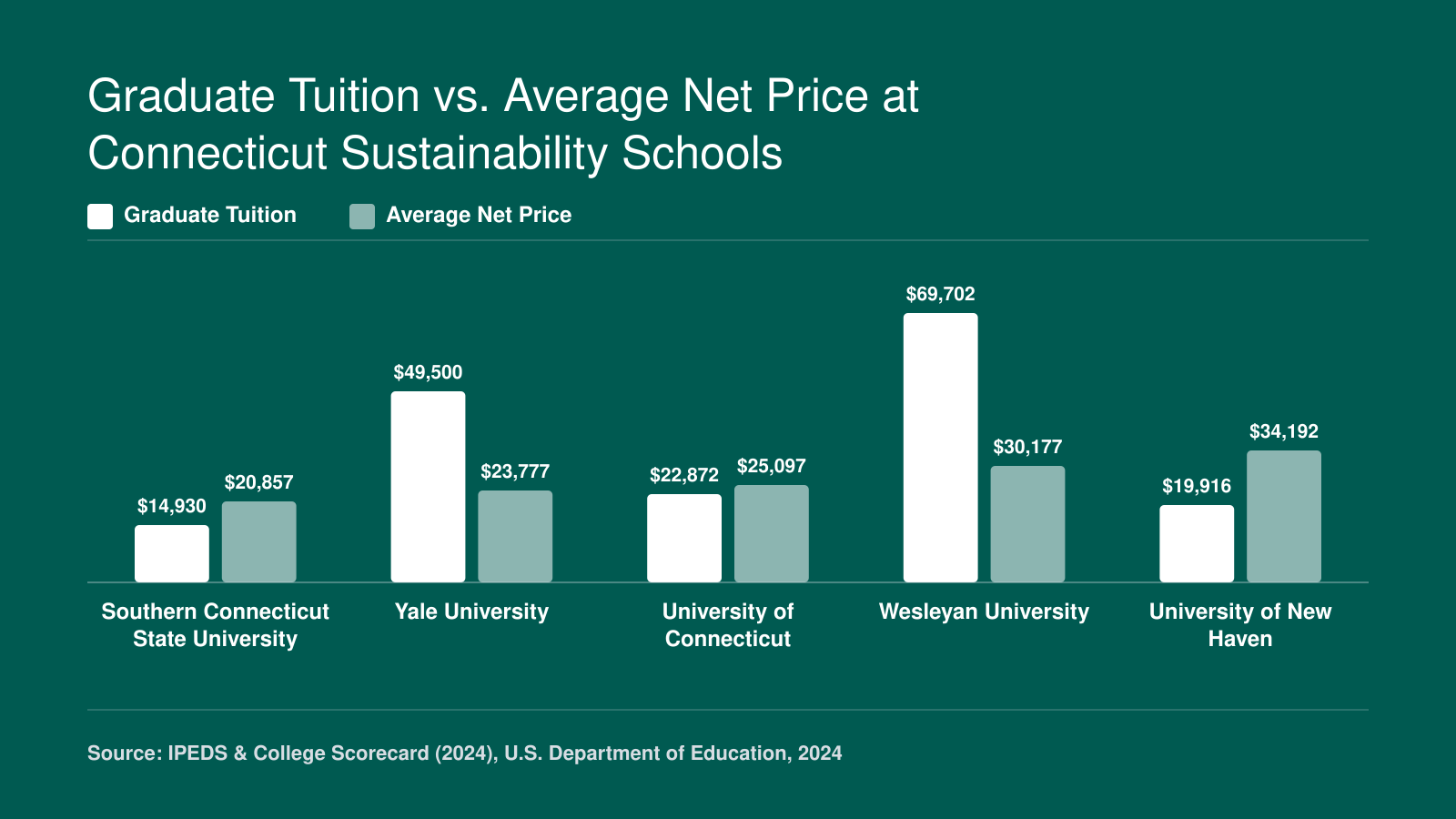
Southern Connecticut State University has the lowest published graduate tuition among the sustainability master's programs on this list, at $14,930. Private options climb to $49,500 at Yale and $69,702 at Wesleyan, while UConn lists $22,872 in-state and $44,784 out-of-state.1 That public-private gap is the single largest cost factor.
UConn's online Master of Energy and Environmental Management lists 30 required credits. One directory shows $925 per credit, which implies about $27,750 before fees. UConn's official 2025-26 graduate schedule, however, lists higher in-state and out-of-state per-credit rates plus required fees,1 so use $27,750 as a planning estimate, not a final bill. University of New Haven's 2026-27 graduate rate is $1,185 per credit, but its environmental science program does not publish a clean total-credit cost.
For students targeting the most affordable master's in sustainability programs, published tuition is not the same as net price. SCSU's institution-wide average net price after grants and scholarships is $20,857, and Yale's is $23,777. Those are campus-wide averages, not quotes for a specific sustainability program. No Connecticut license is required to work in sustainability, but credentials like LEED accreditation or AICP certification can strengthen earning power.
Graduate Tuition vs. Average Net Price at Connecticut Sustainability Schools
This chart compares published graduate tuition with each school's average net price. Net price is institution-wide and largely reflects undergraduate and financial-aid patterns, so read it as directional for graduate budgets.
Connecticut Credentials Sustainability Graduates Pursue
Career Outcomes and ROI for Connecticut Sustainability Master's Graduates
What do graduates of environmental science master's programs in Connecticut actually earn, and what jobs do they land? The clearest published picture comes from Yale School of the Environment, where graduates of the Master of Environmental Management reported median earnings of about $75,985 one year after completing the program, rising to roughly $100,347 at four years and $95,750 at five years. Typical federal debt at graduation sat near $41,000, with median monthly payments around $466 over a standard repayment plan.
What Jobs You Can Get
Yale's six-month survey of its Class of 2025 grouped reported outcomes across academics, government, nonprofit, and private-sector tracks.2 Graduates took roles such as Research Assistant, Forest Manager, Financial Analyst, ESG Lead, and Consultant.2 Connecticut employers in that cohort included the Connecticut Agricultural Experiment Station (Agricultural Research Technician), CREW Carbon (Carbon Removal Associate Scientist), and Yale School Forests.2 Summer placements reached the Connecticut Public Utilities Regulatory Authority and the City of New Haven.
Is It Worth It?
At Yale, earnings that climb past $95,000 within five years against roughly $41,000 in debt point to a manageable payoff. Comparable graduate-outcome data isn't published for the other programs here, so weigh each one's net price against your own career target.
How We Rank the Best Master's in Sustainability Schools in Connecticut
Our ranking is built on numbers the federal government publishes about each school, not on reputation or marketing. We look at graduate tuition and fees, average net price, institutional graduation rates, and, where the federal data reports them, median earnings and debt for graduates of the specific degree program. Campus, hybrid, and fully online formats sit on the same list, because a Connecticut sustainability employer rarely cares which one you chose.
Two limits are worth naming. Earnings and debt figures are not published for every sustainability program, so some entries are judged on cost and completion alone. And net price is reported institution-wide rather than by department, which means it describes the school you are paying, not the exact degree you are enrolling in.
FAQs About Master's in Sustainability Programs in Connecticut
How long does a master's in sustainability take in Connecticut?
Can I transfer graduate credits into a Connecticut sustainability master's program?
Is a Master of Environmental Management the same as a master's in sustainability?
Compare Sustainability programs on the data that matters
Explore more Science & Engineering specializations or browse every graduate field.
All Science & Engineering programs