Best Master's in Sustainability Programs in Washington
Compare 6 accredited Sustainability programs in Washington, with graduate earnings, cost, debt, and completion data from IPEDS and the U.S. College Scorecard.
A master's in sustainability in Washington State (not Washington, D.C.) is a graduate degree in environmental science, resource management, planning, or sustainable business.
Clean-energy utilities, forestry employers, salmon-recovery programs, and state climate offices all hire here, and they favor GIS, permitting, and policy skills. Published in-state tuition at the public universities runs about $13,000 to $19,000.
The harder call is matching a program's focus to the sector you actually want to work in.
Key Points
- Washington public programs here list graduate tuition from about $13,000 to $19,000.
- STEM designated sustainability tracks can extend OPT work authorization for international students.
- Several programs here make the GRE optional for 2027 applicants.
The Best Master's in Sustainability Programs in Washington State
These Washington programs range from environmental science and resource management to sustainable business. We compared net price, graduation outcomes, and program structure across campus, hybrid, and online options. STEM designation matters for international students' OPT eligibility, so we note it where published.
University of Washington-Tacoma Campus
#1Tacoma, WA · $19,000 – $33,000/yr (est.)
Best for: Prospective students targeting autumn 2027 launch
UW Tacoma is adding a Master of Science in Environmental Science, with a start date of autumn 2027. The Tacoma campus already runs environmental and sustainability work from ecological restoration to sustainable urban development, so the new degree builds on that foundation. The school graduates about 63% of its students. NWCCU regional accreditation applies, though STEM classification for the new program is not yet published.
- Launching autumn 2027
- Marked as coming soon in the catalog
- Credit totals and admission details still being finalized
- Builds on existing ecological restoration and sustainable urban development strengths
Western Washington University
#2Bellingham, WA · $14,000 – $27,000/yr (est.)
Best for: Community-engaged planning and policy learners
Western Washington University's face-to-face program blends city and regional planning with environmental sustainability in Bellingham. The school graduates about 65% of its students, and among recent completers in this area median earnings one year after finishing were $56,460. The program holds NWCCU regional accreditation; its CIP code is science-related but explicit STEM designation is not separately published.
- 45 total credit hours
- Face-to-face in Bellingham with fall start
- No entrance exam required; test optional
- Application due February 1
- Focus areas include city and regional planning, conservation, community development, and tribal planning
- Emphasis on action research, ethical engagement, and social justice
- Partners with regional agencies, businesses, farms, municipalities, and schools
Washington State University
#3Pullman, WA · ~$15,000/yr (est.)
Best for: Multi-campus natural resource science applicants
Washington State University's interdisciplinary natural resource sciences degree is available at Pullman, Tri-Cities, and Vancouver. The school graduates about 60% of its students, and median earnings one year after finishing were about $56,115 for this program. NWCCU regional accreditation applies; STEM designation is not explicitly established in the directory.
- 30 semester credits
- 9 concentration options
- Thesis and non-thesis options
- GRE waived until further notice
- 3.0 GPA minimum
- Requires a faculty advisor before applying
- Available at Pullman, Tri-Cities, and Vancouver campuses
Central Washington University
#4Ellensburg, WA · ~$13,000/yr (est.)
Central Washington University's resource management program spans anthropology, ecology, economics, geography, history, and sustainability. The school graduates about 54% of its students, and median earnings one year after finishing were about $59,067 in this area. The program is NWCCU-regionally accredited; STEM designation is not separately established.
- 60-credit MS thesis path or 45-credit applied science path
- Core classes capped at 15 students
- Fieldwork with agencies and Tribal organizations
- AASHE STARS Gold rating
- GIS, zooarchaeology, and paleoecology labs
- Graduates often hired before finishing the program
The Evergreen State College
#5Olympia, WA · ~$13,000/yr (est.)
Evergreen's Master of Environmental Studies is a hybrid interdisciplinary path in Olympia, with evening classes and an optional GIS certificate. The school graduates about 41% of its students. NWCCU regional accreditation applies; available data do not establish a STEM designation for this program.
- 72 total credit hours
- Full-time in two years; part-time in three
- Evening classes
- Internships with state agencies and nonprofits
- GIS certificate available
- Thesis required with public presentation
- 11 concentration options
City University of Seattle
#6Seattle, WA · ~$13,000/yr (est.)
City University of Seattle's online MBA in Sustainable Business pairs a standard MBA core with sustainability courses in Seattle or online, including international study options. Prospective students should verify regional accreditation and STEM status directly with the university.
- Same MBA core as other CityU programs
- Sustainability courses online or in Seattle
- Core classes can be taken at international locations
- 4 concentration options
- Advisory committee of local business leaders shaped curriculum
- Global perspective on sustainability best practices
Cost & outcomes by school
Federal data for the highest-earning Sustainability programs, independent of the ranking above. Earnings are this field's master's graduates four years after completing, where the Scorecard reports them.
| School | Earnings | Tuition / yr | Debt | Grads/yr | Format |
|---|---|---|---|---|---|
| City University of Seattle WA | — | $12,533 | — | — | Online |
| Central Washington University WA | — | $13,220 | — | — | Campus |
| The Evergreen State College WA | — | $13,458 | — | — | Hybrid |
| Western Washington University WA | — | $13,878 | — | — | Campus |
| Washington State University WA | — | $14,845 | — | — | Campus |
| University of Washington-Tacoma Campus WA | — | $18,987 | — | — | Campus |
Sources: U.S. Department of Education. Tuition and graduates: IPEDS. Earnings and debt: College Scorecard, this field's master's graduates; a dash means no figure is reported.
Online and Hybrid Sustainability Master's Programs in Washington
Format matters as much as curriculum when you are balancing a job with graduate school. The programs fall into three delivery models. Most are campus-based: University of Washington-Tacoma Campus, Western Washington University, Washington State University, and Central Washington University. The Evergreen State College runs a hybrid Master of Environmental Studies with evening classes, and City University of Seattle offers a fully online sustainability MBA. That leaves one fully online master's in sustainability option in this in-state set.
Online and hybrid formats fit working professionals in utilities, public agencies, and tribal or municipal sustainability offices. Evergreen's evening structure is built for full-time staff who need days free, while CityU's online MBA suits people who travel or live outside the Seattle metro.
For 2026/2027, published dates are uneven. University of Washington-Tacoma Campus lists an autumn 2027 launch for its environmental science master's. Western Washington lists a February 1 deadline for fall entry in its environmental studies and Urban Planning and Environmental Sustainability programs.1 Washington State University accepts fall and spring starts, and Evergreen opens applications in August 2026 for fall.2 CityU starts in fall. Out-of-state online students should not assume in-state pricing; see the cost section below.
Washington Master's Programs That Waive or Make the GRE Optional
Admissions policies for the GRE vary by program and are updated regularly. The table below summarizes what each program's current admissions page states as of October 2026. Confirm the latest requirements with the program office before applying, since policies can change from year to year.
| School | Program | GRE Policy | Other Key Requirements |
|---|---|---|---|
| Western Washington University | College of the Environment graduate programs | Not required; applicants may submit scores for holistic review with no penalty | Bachelor's degree from a regionally accredited U.S. institution or equivalent international degree; minimum 3.0 GPA on the last 90 quarter credits or 60 semester credits; three letters of recommendation; English language proficiency when required by the Graduate School |
| Western Washington University | Master of Arts (M.A.) in Environmental Studies | Optional; submitted scores are considered in whole-person review with no minimum score requirement | Four-year degree in Environmental Studies or a related field; applicants must meet Graduate School requirements and show evidence of superior scholarship |
| Western Washington University | Urban Planning and Environmental Sustainability | Not required; submitted scores may be considered as part of whole-person review | Bachelor's degree in Urban Planning, Public Policy, Environmental Policy, Environmental Studies, Environmental Science, Geography, Political Science, Sociology, Architecture, Natural Resource Management, or a related field; resume; one to two page statement of purpose; three letters of reference; unofficial transcripts from each institution attended |
| Washington State University | Master of Science (M.S.) in Environmental and Natural Resource Sciences | Waived until further notice | GPA equivalent to a U.S. grade of B (3.0) or better; bachelor's degree in a related field; statement of professional goals; official transcripts; names, addresses, emails, and positions of three references for letters of recommendation |
The format you choose matters less than whether the program's focus matches the work you want to do: policy, science, or business sustainability roles reward different coursework.
Related Articles
Master's in Sustainability Cost in Washington and Licensure or Certification
Washington keeps sustainability credentialing role-specific rather than state-licensed, and the cost of master's degree in Washington across its public universities is just as varied.
Tuition and Total Cost
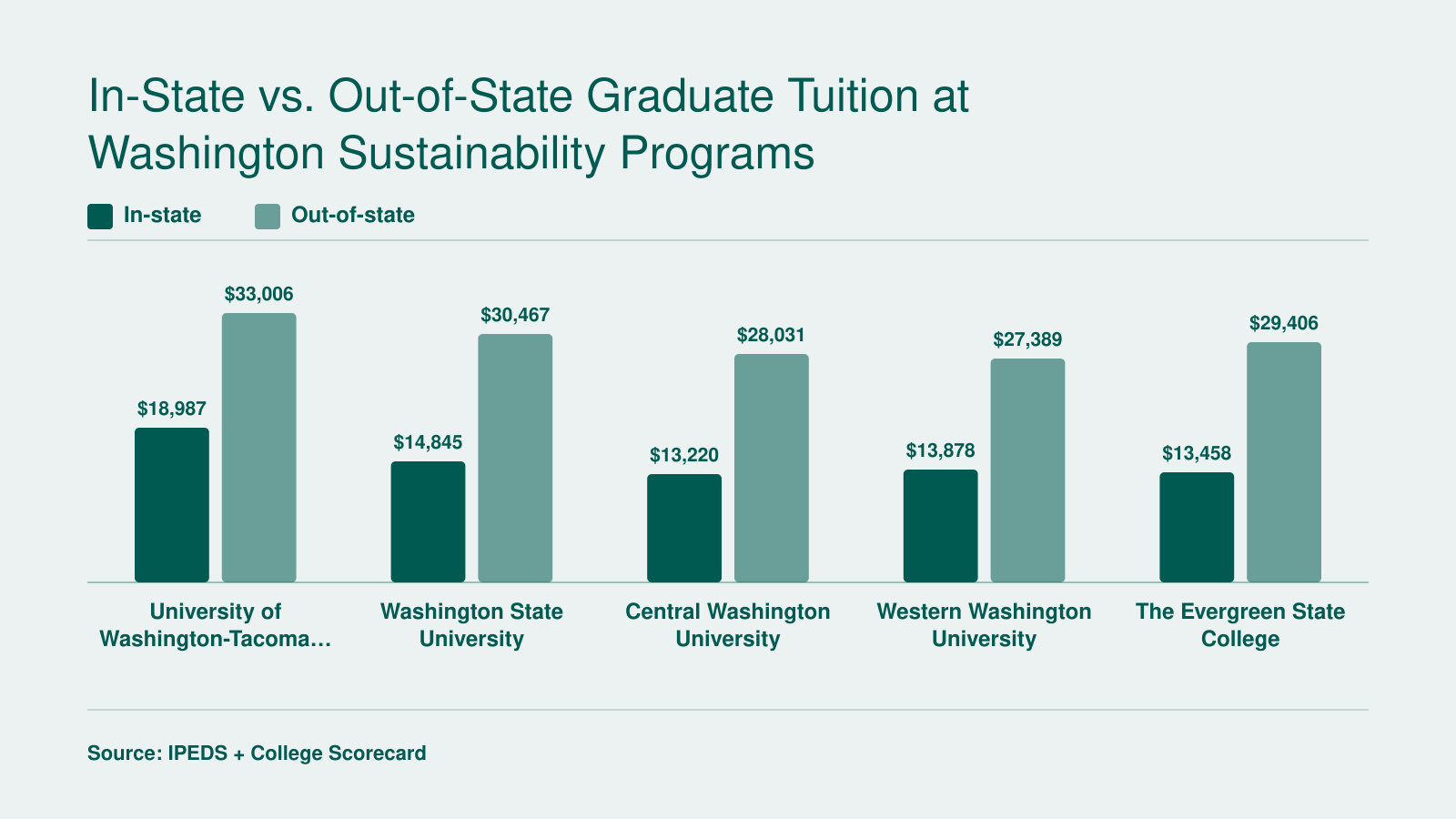
Published graduate tuition for the schools here runs from about $13,000 to $19,000 for Washington residents and from about $27,000 to $33,000 for nonresidents. Credit requirements also vary, from 30 credits at Washington State University to 72 at The Evergreen State College, so total sticker cost can shift by tens of thousands. After aid, the institution-wide average net price lands between roughly $10,000 and $24,000.
Licenses and Certifications
Washington has no state license for sustainability professionals. The credentials that matter depend on the role. LEED AP covers green building and sustainability management. ISSP's Sustainability Associate and Professional pathways fit corporate ESG and reporting. Engineering-track graduates may pursue the Washington PE license through the Department of Licensing. For wetland work, the Society of Wetland Scientists' Professional Wetland Scientist designation is a recognized qualification, not a state-issued license.1
Lowering the Cost
Check assistantships and in-state residency rules at public universities; several programs here charge lower resident rates than nonresident rates. Establishing residency before enrolling or qualifying as an in-state student can reduce total cost, especially in longer credit programs. Also compare any fee-based online option with the Most Affordable Master's in Sustainability Programs, since flat per-credit pricing can remove the resident/nonresident gap.
In-State vs. Out-of-State Graduate Tuition at Washington Sustainability Programs
Research vs. Professional Sustainability Master's: How to Choose
The biggest fork in a sustainability master's is whether you want to produce original research or deliver practical projects. Thesis-based tracks fit students headed for doctoral study or agency science roles; applied capstone and internship routes fit corporate, municipal, and nonprofit sustainability work.
Thesis and research tracks
Central Washington University's Cultural and Environmental Resource Management master's requires a thesis, with fieldwork alongside agencies and Tribal organizations. Evergreen State College's Master of Environmental Studies requires a thesis and public presentation, plus internships with state agencies and nonprofits. Washington State University offers a thesis plan with 4 research credits and a non-thesis or capstone option.1 Western Washington University requires at least 12 credits of thesis or project work.
Assistantships and careers
Assistantships can be the biggest cost lever: according to the WSU Graduate School assistantships page, half-time appointments at 20 hours per week carry a full tuition waiver and health benefits, and quarter-time at 10 hours per week carry a half waiver. Western Washington's teaching assistantships pay up to $6,328 per quarter with full or partial tuition waivers and health insurance, but research assistantship tuition coverage is not guaranteed. Environmental policy concentrations often lead to state agency and nonprofit policy roles; urban sustainability emphases, like Western's, point to municipal planning; resource management tracks, as at Central Washington and WSU, align with land, water, and cultural resource work.
FAQs About Sustainability Master's Programs in Washington
What jobs can you get with a master's in sustainability?
Is a master's in environmental policy and management the same as a sustainability master's?
Can international students get STEM OPT extensions with a Washington sustainability master's?
Compare Sustainability programs on the data that matters
Explore more Science & Engineering specializations or browse every graduate field.
All Science & Engineering programs