Best Master's in Sustainability Programs in Michigan
Compare 8 accredited Sustainability programs in Michigan, with graduate earnings, cost, debt, and completion data from IPEDS and the U.S. College Scorecard.
Great Lakes water stewardship and auto-sector electrification pull in different directions: one hires watershed planners and policy analysts, the other hires energy systems engineers. Michigan utilities add decarbonization work on top of both.
The Michigan sustainability master's programs ranked here include campus and hybrid formats together, with in-state graduate tuition running from roughly $12,196 to $55,670 a year. That spread, more than curriculum, usually decides the question, because only one program in the state currently publishes federal earnings figures for its sustainability graduates.
Key Points
- Northern Michigan University has the lowest sticker price, about $12,196 in-state.
- Only the University of Michigan reports program-level earnings for sustainability master's completers.
- University of Michigan-Dearborn offers the clearest hybrid option, streaming lectures from campus.
Best Master's in Sustainability Programs in Michigan: 2027 Rankings
Nine Michigan master's programs in sustainability and environmental management made this list, spanning campus and hybrid formats. Tuition figures are annual graduate rates listed as in-state first, then out-of-state. Graduation rates describe each school as a whole, not the sustainability program itself.
University of Michigan
#1Ann Arbor, MI · $29,000 – $58,000/yr (est.)
Best for: Interdisciplinary thinkers wanting customizable specializations
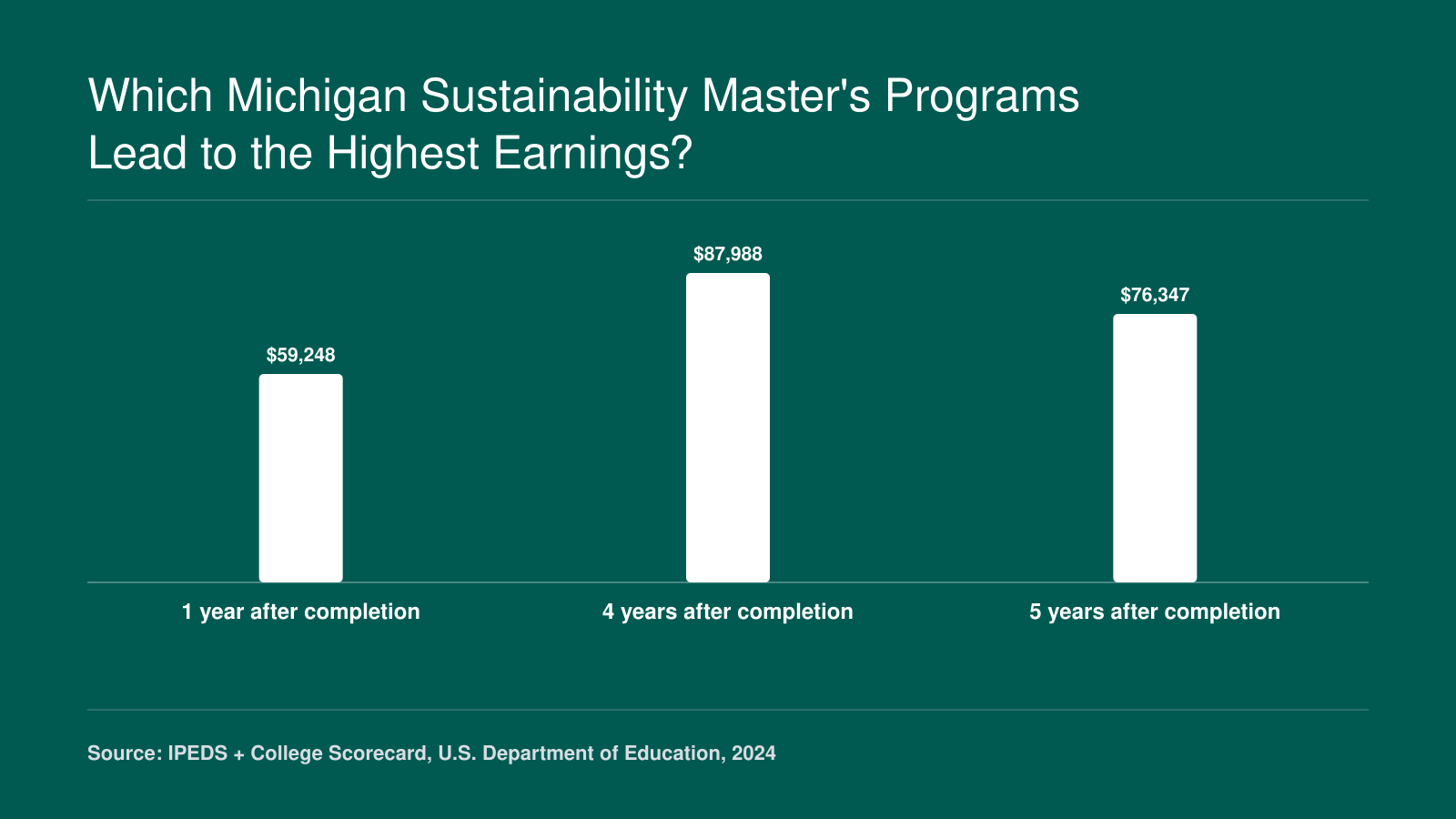
Located in Ann Arbor, the University of Michigan offers a campus-based Master of Science in Environment and Sustainability with seven specializations, from Ecosystem Science and Management to Environmental Justice and Sustainable Systems. Graduate tuition is $28,554 in-state and $57,444 out-of-state, and the university's overall graduation rate is 93%. Scorecard data for the program shows a median of $59,248 one year after completion and $87,988 four years out, based on 215 completers. Students also work on current regional projects with Michigan organizations.
- Campus program, normally two years and 42 credit hours
- Seven specializations, including Environmental Justice and Sustainable Systems
- Dual degree options and an accelerated track for U-M undergraduates
- Four graduate certificates, one available fully online
- GRE is neither required nor accepted for current applicants
Michigan State University
#2East Lansing, MI · $22,000 – $42,000/yr (est.)
Best for: Nonprofit and community planning career builders
Michigan State University in East Lansing houses its Master of Science in Community Sustainability in the College of Agriculture and Natural Resources. Graduate tuition is $21,432 in-state and $41,508 out-of-state, and the university-wide graduation rate is 81%. The 30-credit degree offers a research-heavy Plan A or a project-based Plan B, with a customizable 12-credit focus area. Graduates move into environmental policy, community development, natural resource planning, and nonprofit leadership.
- Campus program with 30 total credit hours
- Plan A for research and doctoral study, Plan B for professional projects
- Customizable 12-credit focus area built with a guidance committee
- Three foundation courses in interdisciplinary inquiry
- Prerequisite courses required, with relevant science experience encouraged
Michigan Technological University
#3Houghton, MI · $25,000 – $30,000/yr (est.)
Best for: Career changers wanting funded agency projects
Michigan Technological University in Houghton offers a Sustainable Communities MS that treats sustainability as a social and policy issue. Graduate tuition is $25,650 for both residents and nonresidents, and the university's graduation rate is 68%. Full-time students can finish in 12 months, no entrance exam is required, and the program carries a STEM designation. Students take on projects with local governments, indigenous communities, and partners such as the National Park Service and U.S. Forest Service.
- Campus program of 30 credit hours, finishable in 12 months
- No entrance exam required, with a 3.0 GPA minimum
- Report option or coursework-only path, with a capstone
- Rolling admissions, two start dates per year, and no application fee
- Designated STEM program with an accelerated option for current students
University of Michigan-Dearborn
#4Dearborn, MI · ~$17,000/yr (est.)
The University of Michigan-Dearborn runs a hybrid Energy Systems and Sustainability Engineering MSE through its College of Engineering and Computer Science. Graduate tuition is $16,726 in-state and $29,950 out-of-state, and the university's graduation rate is 58%. Evening classes, streamed online lectures, and a fully online option suit working engineers. The curriculum covers energy generation and storage, batteries and fuel cells, and energy and environmental policy.
- Hybrid format with a fully online option
- 30 credit hours with late afternoon and evening classes
- No GRE required, with a 3.0 GPA minimum
- Engineering bachelor's degree expected, though non-engineering majors can be admitted with coursework
- Rolling admissions, with scholarships and financial aid available
Wayne State University
#5Detroit, MI · ~$18,000/yr (est.)
Wayne State University in Detroit offers a campus-based Master of Science in Environmental and Sustainability Engineering. Graduate tuition is $15,937 in-state and $34,519 out-of-state, and the university's graduation rate is 58%. The 30-credit degree builds on biology, chemistry, statistics, and water resources, with faculty research on microplastics, groundwater, and urban sustainability. It suits students aiming for environmental consulting or engineering roles.
- Campus program of 30 credit hours with four concentration options
- Thesis or all-coursework path, sometimes with an internship
- No entrance exam required, with a 3.2 GPA minimum
- Prerequisite courses required
- Scholarships, fellowships, and financial aid available
Aquinas College
#6Grand Rapids, MI · ~$13,000/yr (est.)
Aquinas College in Grand Rapids is a private college offering a Master of Sustainable Business, launched in 2010 as the first of its kind in the upper Midwest. Listed graduate tuition is $12,654 for both residents and nonresidents, and the college's graduation rate is 65%. It pairs six conventional business courses with six sustainable business courses in eight-week segments. This is the pick for business-minded students more than scientists or engineers.
- Campus program of 36 credit hours across 12 courses
- Typical completion in 18 to 24 months
- Fall start with eight-week course segments
- Scholarships available
- Six conventional business courses plus six sustainable business courses
Western Michigan University
#7Kalamazoo, MI · $20,000 – $25,000/yr (est.)
Western Michigan University in Kalamazoo offers a Master of Science in Geography with an environmental and resource analysis concentration. Graduate tuition is $19,154 in-state and $28,732 out-of-state, and the university's graduation rate is 58%. Students learn GIS and lab techniques around water quality, land use, and pollution. The training points toward environmental and groundwater analyst roles with state agencies, federal groups, and consulting firms.
- Campus program with an environmental and resource analysis concentration
- No entrance exam required
- Three concentration options
- Assistantships available for MS students
- Accelerated option for undergraduates, with up to 12 credits counting toward graduate credit
- Internships and independent study can be added
Northern Michigan University
#8Marquette, MI · $12,000 – $16,000/yr (est.)
Northern Michigan University in Marquette launched its Master of Science in Sustainability with an inaugural cohort in 2025-2026. Graduate tuition is $11,248 in-state and $14,704 out-of-state, the lowest listed on this page, and the university's graduation rate is 52%. Students choose among five tracks, including Natural Resources Management, Spatial Data Science, and Sustainability Leadership. The program ties into the regional Climate Adaptation Task Force, giving an Upper Peninsula setting for applied work.
- Campus program of 32 credit hours
- Five tracks, including Spatial Data Science and Community Development and Planning
- Thesis or practicum with an agency or organization
- Geospatial analysis training included
- Linked to the regional Climate Adaptation Task Force
College for Creative Studies
#9Detroit, MI · ~$56,000/yr (est.)
The College for Creative Studies in Detroit is a private art and design school offering Design for Sustainability, a STEM-designated graduate program open to designers and non-designers. Graduate tuition is $54,270 for all students, the highest on this page, and the college's graduation rate is 71%. It centers on systems thinking, visual advocacy, and hands-on climate projects. This is a design-led route into sustainability consulting and strategy, not a science or policy degree.
- Campus program with a one-year, 30-credit MA
- Two-year, 60-credit MFA also offered
- STEM-designated graduate program
- Systems thinking, visual advocacy, and ethical decision-making
- Open to designers and non-designers
Cost & outcomes by school
Federal data for the highest-earning Sustainability programs, independent of the ranking above. Earnings are this field's master's graduates four years after completing, where the Scorecard reports them.
| School | Earnings | Tuition / yr | Debt | Grads/yr | Format |
|---|---|---|---|---|---|
| University of Michigan MI | $76,776 | $28,886 | $43,153 | 67 | Campus |
| Northern Michigan University MI | — | $12,196 | — | — | Campus |
| University of Michigan-Dearborn MI | — | $17,126 | — | — | Hybrid |
| Wayne State University MI | — | $17,960 | — | — | Campus |
| Western Michigan University MI | — | $20,103 | — | — | Campus |
| Michigan State University MI | — | $21,772 | — | 18 | Campus |
| Michigan Technological University MI | — | $25,916 | — | — | Campus |
| College for Creative Studies MI | — | $55,670 | — | — | Campus |
Sources: U.S. Department of Education. Tuition and graduates: IPEDS. Earnings and debt: College Scorecard, this field's master's graduates; a dash means no figure is reported.
Most Affordable Master's in Sustainability Programs in Michigan
These schools are ordered from lowest to highest average annual net price, using federal IPEDS and College Scorecard data from 2024. Net price is reported for the whole institution, not for each sustainability program, so use it as a comparison point and confirm graduate tuition with each school. University of Michigan-Dearborn has the lowest net price here and offers a hybrid format.
| School | City | Program | Format | Average Annual Net Price |
|---|---|---|---|---|
| University of Michigan-Dearborn | Dearborn | Energy Systems and Sustainability Engineering, MSE | Hybrid | $9,492 |
| Wayne State University | Detroit | Master of Science in Environmental and Sustainability Engineering | Campus | $12,766 |
| University of Michigan | Ann Arbor | Master of Science in Environment and Sustainability | Campus | $13,138 |
| Northern Michigan University | Marquette | Master of Science in Sustainability | Campus | $14,085 |
| Michigan Technological University | Houghton | Sustainable Communities MS | Campus | $14,182 |
How We Rank Michigan Sustainability Master's Programs
We rank these sustainability master's programs on outcomes you can verify, not reputation. The order reflects graduate tuition and institution-wide net price, graduation rates, and, where federal data publishes it, program-level earnings and debt. When a program does not report earnings, we weigh what the record does show rather than guess.
Sustainability master's degrees have no single programmatic accreditor, so institutional accreditation is the trust signal that matters most. Among accredited graduate programs in Michigan, the University of Michigan and Michigan Technological University both hold accreditation from the Higher Learning Commission, with Michigan Tech accredited since 1928. We confirm each ranked school's institutional accreditor and note program recognition where the record supports it, though no specialized accreditation applies to these degrees.
Two limits deserve a plain statement. Net price is an institution-wide figure, not a sustainability-specific cost, and some programs here lack published earnings data. We treat those gaps as gaps, not conclusions.
Online and Hybrid Master's in Sustainability Options in Michigan
Most Michigan sustainability master's programs are built around campus study, so remote choices are limited when comparing online master's in sustainability programs. University of Michigan-Dearborn's Energy Systems and Sustainability Engineering MSE is the clearest flexible option. It runs as a hybrid program with lectures streamed from campus and a fully online option. Late-afternoon and evening classes are designed for part-time working students. Wayne State's M.A. in Environmental Science is delivered fully online, and taking two courses per semester year-round can finish its 30 credits in under two years.1
Campus programs often include hands-on work that is hard to replicate remotely. Michigan Tech's Sustainable Communities MS includes fieldwork with local stakeholders. Northern Michigan University's program offers a practicum with an organization or agency.
Accelerated Master's in Sustainability Programs reward students who are already enrolled. Michigan Tech lets current undergraduates finish a master's about one year after the bachelor's, applying up to nine approved bachelor's credits. Western Michigan counts up to 12 undergraduate credits toward graduate credit. The University of Michigan offers an accelerated master's for its own undergrads. Its 12-credit online sustainability certificate is useful, but it is not a master's.
If you live outside Michigan, confirm online availability and state authorization for your state before applying.
Related Articles
GRE and Admissions Requirements: Which Michigan Master's Programs Waive It?
Most Michigan sustainability master's programs now count among Master's in Sustainability Programs With No GRE Required, but a few exceptions are worth catching before you apply.
Test Policies
- Not required or not accepted: University of Michigan SEAS no longer accepts the GRE. Michigan Tech's environmental engineering, engineering science, and environmental and energy policy master's programs do not require it, and its Sustainable Communities MS is test optional. Wayne State, Western Michigan, and University of Michigan-Dearborn list no entrance exam.
- Exceptions: Michigan Tech's CEGE department says the GRE is waived, yet asks for a score from anyone seeking assistantships or fellowships. Environmental Engineering Science strongly encourages it.
- No policy found: Michigan State, Northern Michigan, Aquinas, and College for Creative Studies. Confirm with admissions.
Prerequisites
Michigan Tech admits applicants with a 3.0 GPA or higher, and its policy program expects one undergraduate course each in environmental science, statistics, and microeconomics. Wayne State lists a 3.2 minimum. Dearborn lists 3.0 and an engineering bachelor's, or added coursework. SEAS publishes no fixed minimum.
Deadlines
For Fall 2026, SEAS listed Dec. 15 as priority funding and Jan. 15 as final funding. One page adds Apr. 30 as the domestic final deadline, and the sources do not say whether that is a change or just wording. Michigan Tech recommends Jan. 15 for fall and Sept. 15 for spring. Deadlines and test policies change yearly, so check each official page for your cycle.
Cost of a Master's in Sustainability in Michigan, Financial Aid, and Licensure
For students comparing most affordable master's in sustainability programs, in-state and out-of-state tuition can mean two very different bills, and the gap depends on the school. Northern Michigan University has the lowest sticker price here, at about $12,196 in-state against $15,652 out-of-state, a difference of roughly $3,500. Michigan Technological University charges $25,916 either way, so residency changes nothing. At the other end, the University of Michigan runs $28,886 in-state and $57,776 out-of-state, a $28,890 gap.1 University of Michigan-Dearborn ($17,126 vs. $30,350) and Wayne State University ($17,960 vs. $36,542) sit between those extremes, with gaps of about $13,200 and $18,600.
Institution-wide average net price, which is an approximation and not a quote for any one program, runs from about $9,500 at Dearborn to about $14,200 at Michigan Tech.
Funding options
Assistantships with tuition waivers and departmental fellowships are the usual ways to cut a bill, but terms vary by program and year. Confirm them with each department. Midwest Student Exchange eligibility was not confirmed for these programs, so ask before assuming a discount.
Licensure and credentials
Michigan has no state license for sustainability professionals. Voluntary credentials such as LEED AP, ISSP-SA or CSP, and Certified Energy Manager are external to the degree. Western Michigan University's school highlights ISSP-SA for students and early-career professionals.2 Environmental engineer roles in state government do require a Professional Engineer license, per Michigan's Environmental Engineer Licensed Job Specification.
Which Michigan Sustainability Master's Programs Lead to the Highest Earnings?
Among the schools here, only the University of Michigan reports program-level median earnings for sustainability master's completers. The chart shows its figures at each reported time window. Other schools are left out rather than filled in with institution-wide numbers. These are College Scorecard medians for program completers, and each window reflects a different group of graduates.
University of Michigan vs. Michigan Tech: Which Master's Wins on Outcomes?
The choice comes down to a brand-name policy network versus a faster, cheaper technical degree. The numbers show how wide that gap is.
Cost, Earnings and Format
The University of Michigan lists tuition of $28,886 in-state and $57,776 out-of-state for its Master of Science in Environment and Sustainability, a 42-credit, two-year campus program. Median earnings in the federal data run $76,347 five years out, with median debt of $35,377. Michigan Tech's Sustainable Communities MS lists $25,916 for everyone, over 30 credits and about 12 months. It reports no earnings or debt figures for its small graduate group.
Specializations and Experience
SEAS offers areas such as ecological management and design, policy, geospatial analysis, behavioral science, quantitative analysis, and social justice and equity. Its required Capstone is a client-based team project, typically five students, within 15 to 18 months of hands-on learning. Class of 2024 graduates reported a $72,000 median wage, and 2023 employers included Accenture and Apple. Michigan Tech is more applied: a required capstone, fieldwork with local stakeholders, a STEM designation, and careers as analysts, planners, consultants and policymakers. It publishes no named employer partners or placement rates.
Verdict
Choose Michigan for policy-heavy careers, a large alumni network, and documented outcomes. Choose Michigan Tech if you want a quicker, lower-cost technical degree and can accept thinner published results.
Compare Sustainability programs on the data that matters
Explore more Science & Engineering specializations or browse every graduate field.
All Science & Engineering programs