Best Master's in Sustainability Programs in Minnesota
Compare 5 accredited Sustainability programs in Minnesota at 4 schools, with graduate earnings, cost, debt, and completion data from IPEDS and the U.S. College Scorecard.

Minnesota's sustainability master's options are few and sharply different, so the decision turns on format, cost, and career fit rather than brand. The University of Minnesota-Twin Cities runs a 36-credit policy MS with a 16-student incoming class, while Bemidji State University and Minnesota State University-Mankato offer research-driven science degrees.
Campus and online programs are ranked together, including Walden University's fully online MBA in Sustainable Futures.
Listed tuition runs from $10,099 to $22,017, but focus matters more. Policy, lab science, and business training lead to different jobs.
Key Points
- Walden University's MBA with a Sustainable Futures concentration is the fully online option here.
- University of Minnesota-Twin Cities programs do not require the GRE where a policy is published.
- Bemidji State University's Environmental Studies master's has the lowest listed graduate tuition among these schools.
Best Master's in Sustainability Programs in Minnesota: 2027 Rankings
Four Minnesota schools offer a sustainability or environmental management master's that made this list, spanning a policy-focused MS in Minneapolis, two science-oriented MS degrees, and an online MBA concentration. Each card shows what the program teaches, how it is delivered, and what it costs, so you can compare them on more than name recognition.
University of Minnesota-Twin Cities
#1Minneapolis, MN · ~$22,000/yr (est.)
Best for: Policy-minded students targeting climate careers
The University of Minnesota-Twin Cities runs its sustainability master's through the Humphrey School, where the MS in Science, Technology, and Environmental Policy centers on climate, energy, and environmental justice. Cohorts are small (about 16 incoming students), and 93% of graduates are employed or continuing their studies. Graduate tuition is listed at $19,980 in-state and $31,212 out-of-state, and schools offering this program graduate 85% of students institution-wide. Program-level Scorecard data shows median earnings of $52,823 one year after completion and $83,567 four years after.
- Energy and climate policy concentration with Energy Systems and Policy electives
- 36 total credit hours with thesis or professional capstone option
- Core in policy analysis, environmental economics, and statistics
- Median earnings $52,823 one year after completion, $83,567 four years after
- Small cohort of about 16 incoming students
- STEP Seminar Series and international conference travel opportunities
- Urban sustainability concentration within the same MS-STEP degree
- Team capstone projects with faculty
- About 50% of graduates work in government
- Located steps from the state capitol
- Internship not required
- Merit scholarships and financial aid available
Minnesota State University-Mankato
#2Mankato, MN · $10,000 – $20,000/yr (est.)
Best for: Thesis-driven researchers wanting natural science depth
Minnesota State University-Mankato offers a 34-credit MS in Environmental Science that pairs natural science with political science, planning, or geography. The curriculum covers federal and Minnesota environmental regulation, pollutant analysis, and environmental assessment, and it culminates in a required thesis. Graduate tuition is listed at $9,540 in-state and $19,080 out-of-state, and schools offering this program graduate 54% of students institution-wide.
- 34 total credit hours with a required 3 to 6 credit thesis
- Core in global change biology and environmental regulations
- Covers sources and control of air, soil, water, and groundwater pollutants
- EPA-approved lab analysis methods and advanced GIS
- Planning law and land use regulation coursework
- Half of coursework (14 to 16 credits) at the 600 level
- Maximum 9 credits from independent study, internship, or seminar
- Core course prerequisites listed as none
Bemidji State University
#3Bemidji, MN · ~$10,000/yr (est.)
Best for: Out-of-state students seeking flat tuition
Bemidji State University's MS in Environmental Studies blends natural and social science through its Center for Sustainability Studies. Students choose a thesis track or a non-thesis track built around an internship and capstone report. Bemidji charges the same graduate tuition to all students, $9,221 in-state and out-of-state, and schools offering this program graduate 48% of students institution-wide. Graduate assistantships may include a tuition waiver and stipend.
- 30 credits for thesis option, 32 credits for non-thesis with internship
- Sustainability Analytics and Modeling is a required course
- Two concentration options with individualized curriculum
- Electives span environmental law, GIS, remote sensing, and wetlands ecology
- Indigenous environmental knowledge among elective topics
- Statistics competency and final written exam required
- Faculty mentor for research projects
- Assistantships may offer tuition waiver plus stipend
Walden University
#4Minneapolis, MN · ~$11,000/yr (est.)
Walden University, an online institution with a Minneapolis address, offers an MBA with a Sustainable Futures specialization for professionals who want business training with a social and environmental focus. It runs entirely through distance learning and is accredited by the Higher Learning Commission. Graduate tuition is listed at $10,361 for both in-state and out-of-state students. No program-level earnings or institution-wide graduation rate is reported for it in the federal data.
- Sustainable Futures specialization within the MBA
- Fully online option available
- Designed for working professionals
- Focus on social responsibility and building sustainable organizations
- Also offered with an MS in Leadership
- Accredited by the Higher Learning Commission
- Financial aid available
Cost & outcomes by school
Federal data for the highest-earning Sustainability programs, independent of the ranking above. Earnings are this field's master's graduates four years after completing, where the Scorecard reports them.
| School | Earnings | Tuition / yr | Debt | Grads/yr | Format |
|---|---|---|---|---|---|
| Bemidji State University MN | — | $10,099 | — | — | Campus |
| Minnesota State University-Mankato MN | — | $10,449 | — | — | Campus |
| Walden University MN | — | $10,885 | — | — | Online |
| University of Minnesota-Twin Cities MN | — | $22,017 | — | 13 | Campus |
Sources: U.S. Department of Education. Tuition and graduates: IPEDS. Earnings and debt: College Scorecard, this field's master's graduates; a dash means no figure is reported.
Online and Hybrid Master's in Sustainability Programs in Minnesota
Choosing among the online master's in sustainability programs in Minnesota or a hybrid option usually comes down to where you can live and how you learn best. Among the ranked programs, Walden University's sustainability MBA with a Sustainable Futures concentration is fully online. The University of Minnesota-Twin Cities MS in Science, Technology, and Environmental Policy, Minnesota State University-Mankato's Environmental Science MS, and Bemidji State University's Environmental Studies MS are campus based. None are currently listed as hybrid, but delivery formats change, so confirm with each department.
Online master's programs in Minnesota work best for working professionals and students outside the Twin Cities. Campus formats often provide field research, local agency partnerships, and in-person faculty mentoring. Out-of-state online students should compare costs carefully: Walden charges a flat $10,885 online tuition regardless of residency, while Minnesota State Mankato and the University of Minnesota list higher nonresident rates for campus students.
Admissions timelines matter. After that, applications are considered only if space remains. The other programs here also have live admissions pages, so check with each graduate office for current start terms.
Which Minnesota Sustainability Master's Programs Waive the GRE?
Where a policy is published, the University of Minnesota-Twin Cities programs below do not require the GRE. The trend is toward optional or waived testing, with admissions committees relying on holistic review instead. Policies change by admissions cycle, so confirm the current requirement with each program's admissions office before you apply. The other schools ranked here are not listed in this table, so check their graduate admissions pages directly.
| School | Program | GRE Policy | Waiver Criteria or Notes |
|---|---|---|---|
| University of Minnesota-Twin Cities | Earth and Environmental Sciences graduate program | Not required | The department does not require or review GRE scores. |
| University of Minnesota-Twin Cities | Master of Science in Science, Technology, and Environmental Policy (MS-STEP) | Optional | Holistic review with no minimum GRE score. Submitting a score gives no preference in admission or merit-aid decisions. |
| University of Minnesota-Twin Cities | Architecture MS in Sustainable Design | Waived | The admissions page states the GRE requirement is waived for the Architecture MS programs for Fall 2022. Confirm the policy for your entry term. |
Related Articles
What a Master's in Sustainability Costs in Minnesota, Plus Licensure and Certification
The lowest sticker price and the best fit for your career goals rarely land on the same program, so compare both before you commit, especially among the Most Affordable Master's in Sustainability Programs.
Tuition from Lowest to Highest
Listed graduate tuition starts at Bemidji State University's Environmental Studies MS, about $10,099 for residents and nonresidents alike. Minnesota State University-Mankato's Environmental Science MS follows at $10,449 in-state and $19,989 out-of-state. Walden University's online MBA with a Sustainable Futures focus lists $10,885. Among the ranked sustainability master's programs, the University of Minnesota-Twin Cities is highest at $22,017 in-state and $33,249 out-of-state. Treat each school's institution-wide net price as an average across all students, not a quote for your program.
Per-Credit Rates, Fees, and Funding
The Humphrey School's MS in Science, Technology, and Environmental Policy charges $2,081 per credit for residents and $3,107 for nonresidents in 2026-2027. Its banded semester charge for 6 to 15 credits is $12,486 resident and $18,642 nonresident. Residents of Manitoba, North Dakota, South Dakota, and Wisconsin pay resident rates. The page does not state mandatory fees, so confirm them before budgeting. The Sustainable Design M.Sc. lists $35,294 per year over two years, or $70,588 in tuition alone. Confirm whether that is the official 2026-27 rate and what fees apply. Bemidji lists mandatory fees of $33.15 per credit for 2026-27. The University of Minnesota advertises scholarships and financial aid, so ask each program about departmental awards.
Licensure and Certification
Minnesota does not appear to require a state license for most sustainability roles. Voluntary credentials include LEED, ISSP-SA, and ISSP-CSP, and their value depends on the employer. Budget for exam fees, books, software, and thesis or research travel on top of tuition.
Career Outcomes and ROI: What Sustainability Master's Graduates Earn
Career outcomes are a fit question, not a single number. For Minnesota sustainability master's students, the real test is what you can earn early and which employers host interns or capstone work.
What the data shows
The University of Minnesota-Twin Cities publishes the strongest program-level signal here. Graduates of its Master of Science in Science, Technology, and Environmental Policy earned a median of $52,823 one year after finishing and $83,567 four years after finishing, according to BBE News Fall 2024. The school's average net price is $16,778, but the data do not include a published monthly debt payment. Other ranked programs do not publish program-specific earnings, so their ROI depends on affordability and employer ties rather than a starting salary.
Employer ties
UMN connects students to more than 100 internship organizations, including Minnesota GreenStep Cities, the 4-H Climate Youth Lab, and the Solar Commons Project. The 14-week applied capstone in UMN's sustainable systems management program pairs students with sponsors who mentor and attend final presentations; one alumna works as a Sustainability Specialist at the Minnesota Chamber of Commerce's Waste Wise program. Carlson's Sustainable ESG Management specialization points graduates toward green technology, biodiversity, smart cities, and infrastructure roles.
Is it worth it?
For the UMN STEP program, yes. Four-year earnings above $83,000 against a school-wide average net price below $17,000, plus direct Minnesota employer ties, make a solid case. For programs without published earnings, keep costs low and ask for named internship sponsors before enrolling.
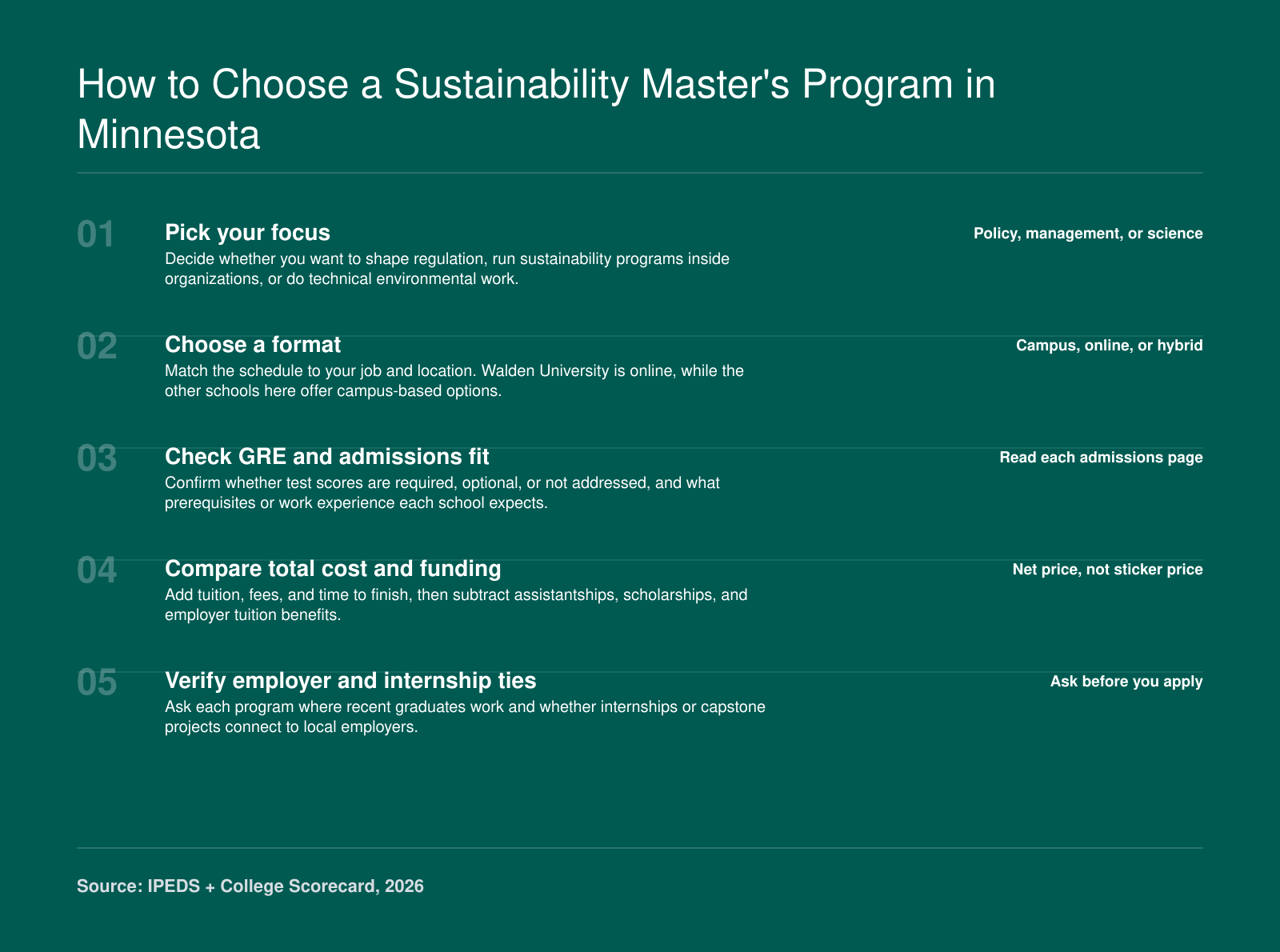
How to Choose a Sustainability Master's Program in Minnesota
Work through these steps in order. Each choice narrows the field for the next, so you compare fewer programs and compare them on the factors that affect your career and your budget.
Frequently Asked Questions About Sustainability Master's Programs in Minnesota
Is a master's in sustainability worth it?
What can you do with a master's in sustainability?
What is the difference between environmental science and sustainability?
Compare Sustainability programs on the data that matters
Explore more Science & Engineering specializations or browse every graduate field.
All Science & Engineering programs