Best Master's in Sustainability Programs in Pennsylvania
Compare 24 accredited Sustainability programs in Pennsylvania at 19 schools, with graduate earnings, cost, debt, and completion data from IPEDS and the U.S. College Scorecard.
Pennsylvania's clean energy sector employed 104,499 workers at the end of 2024, and the state still produces large volumes of natural gas, which keeps energy, regulation, and corporate ESG hiring close to its research universities. That combination suits sustainability study, but the degrees vary widely in cost and focus.
These Master's Programs in Pennsylvania mix campus and online formats and are ordered by graduate outcomes, meaning earnings, net price, and debt, rather than reputation.
A bigger name does not always mean a better return, and several public options cost far less than the private flagships.
Key Points
- Pennsylvania does not license sustainability professionals, so LEED and CEM certifications are optional add-ons.
- Pennsylvania's clean energy sector employed 104,499 workers at the end of 2024, per E2.
- Most programs are campus-based, but Villanova's sustainable engineering master's is flagged online.
The 10 Best Master's in Sustainability Schools in Pennsylvania
Pennsylvania's sustainability master's programs range from Ivy League policy degrees to engineering, design and geography routes, and they differ a lot in format and cost. Sustainability has no single programmatic accreditor, so regional institutional accreditation is the standard credential to look for. Where a school's accreditor is confirmed below, we name it. Figures shown for a program are that program's own, and we leave a figure out when it is not reported.
University of Pennsylvania
#1Philadelphia, PA · ~$48,000/yr (est.)
Best for: Working professionals needing evening classes
The University of Pennsylvania in Philadelphia is accredited by the Middle States Commission on Higher Education, and schools offering this program graduate about 97% of students. Its Master of Environmental Studies with an Environmental Sustainability concentration draws on science, policy, economics and design, with some classes at Wharton and Penn Law. Program-level graduates report median earnings of about $64,831 one year out and $83,058 four years out. The program accepts spring entry and offers an individualized concentration, and no separate programmatic accreditor is identified.
- 12 courses, two years full-time or longer part-time
- Evening classes, 5:15 to 8:15 p.m.
- Six concentration options, plus an individualized path
- Dual degrees in business, law and public health
- Capstone addresses energy grid decarbonization
- Internships and fieldwork opportunities
- Campus format; no fully online option
Carnegie Mellon University
#2Pittsburgh, PA · ~$51,000/yr (est.)
Best for: Designers focused on decarbonization research
Carnegie Mellon in Pittsburgh houses its sustainability master's in the School of Architecture, with a design and computation emphasis rather than a general management one. The Master of Science in Regenerative and Sustainable Design is a two-year, thesis-based campus program covering decarbonization, circular resource flows and social equity. It is STEM-eligible, and graduates move into roles such as sustainability director and building performance analyst. Program-level earnings are not reported.
- Four semesters over two academic years
- Year-long thesis required
- STEM-eligible program
- 147 coursework units minimum
- 4+1 and 5+1 accelerated pathways
- Design Fabrication Lab and Robotics Lab access
- Prerequisite courses required
Lehigh University
#3Bethlehem, PA · ~$29,000/yr (est.)
Best for: Policy-minded students seeking regional nonprofit placements
Lehigh University in Bethlehem offers a policy-centered route through its Master of Arts in Environmental Policy in the College of Arts and Sciences. The curriculum covers legal and political structures and the design and implementation of policy. Most students join the Community Fellowship, which places them with regional public and nonprofit organizations for roughly 700 hours. Program-level earnings and debt are not reported.
- Typically two years, faster with careful planning
- Community Fellowship of roughly 700 hours
- Optional certificates in Environmental Health, Justice, or Policy and Planning
- B.A. to M.A. 4+1 pathway for Lehigh undergraduates
- Placements with public and nonprofit organizations
Villanova University
#4Villanova, PA · $20,000 – $25,000/yr (est.)
Villanova University's Master of Science in Sustainable Engineering is the strongest fully online engineering-based option on this list. It uses a whole-systems, life-cycle approach and welcomes students without engineering degrees. Classes meet in the evenings, and students can attend on campus, synchronously online or asynchronously. Graduates have worked at employers such as Air Products, Dow and Chemours. Program-level earnings are not reported.
- Concentration applies a life-cycle lens to clean power and efficiency
- Fully online option available
- Synchronous and asynchronous delivery
- Evening classes with part-time study
- Concentration: Sustainable Infrastructure and Built Environment
- STEEP framework: social, technological, environmental, economic, political
- Average student age is 30
- Combine online and on-campus study
- Concentration: Sustainable Materials
- Full-time and part-time options
- Team projects, case studies and guest lectures
- Real-world sustainability research
University of Pittsburgh-Pittsburgh
#5Pittsburgh, PA · ~$28,000/yr (est.)
The University of Pittsburgh is a public university with a sustainability master's in the Swanson School of Engineering, housed in the Mascaro Center for Sustainable Innovation. The 30-credit Master of Science in Sustainable Engineering is cohort-based and built around systems thinking and service learning projects. Non-engineering majors are welcome, with faculty help to fill prerequisite gaps. The John C. Mascaro Scholarship offers partial funding. Program-level earnings are not reported.
- 30 total credit hours
- Cohort-based with service learning projects
- Triple bottom line focus
- Two letters of recommendation minimum
- Applications through EngineeringCAS
- Mascaro Scholarship offers partial funding
- Prerequisites in physics, chemistry, math or engineering may be needed
Drexel University
#6Philadelphia, PA · ~$39,000/yr (est.)
Drexel University in Philadelphia is accredited by the Middle States Commission on Higher Education, reaffirmed in 2026, with a further review and site visit planned for 2026-27. Its Master of Science in Environmental Policy builds a base in public policy and economics, then adds a track in environmental science or environmental and occupational health. The program serves full-time and part-time students, and no separate programmatic accreditor is identified. Program-level earnings are not reported.
- Two tracks: environmental science, or environmental and occupational health
- Case study thesis pathway
- Full-time and part-time options
- Fall, winter and spring starts
- Two letters of recommendation minimum
- Careers in government, nonprofits and consulting
Duquesne University
#7Pittsburgh, PA · $25,000 – $30,000/yr (est.)
Duquesne University in Pittsburgh is accredited by the Middle States Commission on Higher Education. Its Master of Science in Environmental Science and Management leans toward regulatory compliance and pollution prevention, with internships at organizations such as the EPA and the Pittsburgh Zoo. Program-level graduates report median earnings of about $60,629 four years after graduating. Assistantships with stipends are available, and no separate programmatic accreditor is identified.
- 36 credits over two years, campus-based
- Three start dates per year with rolling admissions
- Internship or graduate thesis required
- Air, water or solid waste pollution control focus
- Research in water quality and geophysical sensing labs
- Dedicated graduate student success coach
- No application fee
Temple University
#8Philadelphia, PA · $23,000 – $30,000/yr (est.)
Temple University in Philadelphia is a public university whose Professional Science Master's in Sustainability is its main sustainability master's, and it publishes separate Pennsylvania and out-of-state tuition rates. The 30-credit degree can be finished in 12 months full time and ends with a capstone and a structured internship. Temple states that applicants with a bachelor's degree in any field are eligible and that no GRE is required. A graduate certificate can transfer into the master's. Temple lists Middle States accreditation. Program-level earnings are not reported.
- Concentration: Biodiversity and Conservation
- 30 credits, finishable in 12 months full time
- $1,053 per credit for Pennsylvania residents
- Capstone plus structured internship
- Concentration: Climate Justice
- Courses on environmental hazards and water politics
- Field methods in environmental justice
- Out-of-state tuition is $1,449 per credit
- Accredited by the Middle States Commission
- Concentration: Energy Systems and Natural Resources
- Courses in agrivoltaics and drone fieldwork
- Careers in energy policy and consulting
- Accelerated bachelor's plus master's path
Thomas Jefferson University
#9Philadelphia, PA · ~$25,000/yr (est.)
Thomas Jefferson University in Philadelphia offers a hybrid Master of Science in Sustainable Design aimed at the built environment, including energy efficiency, buildings and landscapes. Students work on projects for real clients with faculty who are practicing architects and engineers. The program is STEM-designated and can be completed in about 1.5 to 2 years. Program-level earnings are not reported.
- 33 credits in 1.5 to 2 years
- Hybrid format with a fully online option
- STEM-designated, with possible 24-month OPT extension
- Optional certificates in sustainability leadership, living buildings, resilient communities, green building operations
- Hands-on projects with real clients
- Fall start
West Chester University of Pennsylvania
#10West Chester, PA · $10,000 – $15,000/yr (est.)
West Chester University of Pennsylvania is a lower-cost public option, and its Master of Arts in Geography with a sustainability and environment concentration suits students interested in planning, conservation and GIS. GRE scores are optional, and students without a geography background are welcome, though preliminary coursework may be required. The degree can also lead to Ph.D. study. Program-level earnings are not reported.
- 33 semester hours
- Thesis or nonthesis option
- GRE optional
- Concentration in sustainability and environment
- GIS analysis with business applications
- Resume and career-goal statement required
Cost & outcomes by school
Federal data for the highest-earning Sustainability programs, independent of the ranking above. Earnings are this field's master's graduates four years after completing, where the Scorecard reports them.
| School | Earnings | Tuition / yr | Debt | Grads/yr | Format |
|---|---|---|---|---|---|
| Westminster College PA | — | $9,000 | — | — | Online |
| Shippensburg University of Pennsylvania PA | — | $12,330 | — | — | Campus |
| Juniata College PA | — | $14,700 | — | — | Campus |
| Point Park University PA | — | $16,704 | — | — | Campus |
| Villanova University PA | — | $22,335 | — | — | Online |
| Pennsylvania State University PA | — | $24,650 | — | — | Online |
| Pennsylvania State University-Penn State Erie-Behrend College PA | — | $25,356 | — | — | Online |
| Pennsylvania State University-Penn State Harrisburg PA | — | $25,356 | — | — | Campus |
| Duquesne University PA | — | $27,612 | — | — | Campus |
| University of Pittsburgh-Pittsburgh PA | — | $27,580 | — | — | Campus |
| Lehigh University PA | — | $28,840 | — | — | Campus |
| Drexel University PA | — | $39,261 | — | — | Campus |
Sources: U.S. Department of Education. Tuition and graduates: IPEDS. Earnings and debt: College Scorecard, this field's master's graduates; a dash means no figure is reported.
Online and Hybrid Master's in Sustainability Options in Pennsylvania
Can you earn a Pennsylvania master's in sustainability without relocating? Yes, though most programs here are still campus-based, including Penn, Carnegie Mellon, Lehigh, Pitt, Drexel, Duquesne, Temple and West Chester. Villanova's Master of Science in Sustainable Engineering is flagged online, with part-time study, evening classes, and both synchronous and asynchronous options, plus the chance to combine online and on-campus work. Thomas Jefferson's MS in Sustainable Design (33 credits) is listed as hybrid, with a fully online option.
Penn State graduate programs include the World Campus Renewable Energy and Sustainability Systems MPS, fully online at 33 credits. There is no per-semester minimum, and students can stop out for work or family. Published materials do not say whether sessions are live or self-paced, or whether any residency is required, so confirm that with admissions. Chatham's programs are cohort-based with part-time options, but their delivery format is not clearly established.
Published materials do not confirm whether online students pay the same rate as on-campus students, so check before you compare costs. We cover cost later on this page.
Who benefits from which format
Career changers who need networking usually do better in a hybrid setup. Employed professionals outside Philadelphia and Pittsburgh are better served by a fully online, flexible-pace option.
Pennsylvania's clean energy sector employed 104,499 workers at the end of 2024, according to E2's Clean Jobs Pennsylvania 2025 report. The state added 3,722 of those jobs in 2024, a 3.7% increase, across renewable generation, storage, grid modernization, efficiency, biofuels, and clean vehicles.
Which Pennsylvania Master's in Sustainability Programs Waive or Make the GRE Optional
The GRE is a standardized graduate admissions exam, and whether a Pennsylvania sustainability master's asks for it depends on the school and the specific degree. Policies below come from each program's admissions page and are not uniform, so students considering No-GRE master's programs should verify current requirements.
- GRE optional: Penn State's Energy and Mineral Engineering and Environmental Engineering programs recommend scores but do not require them. Drexel's M.S. in Environmental Engineering is also optional1, and West Chester's geography master's with a sustainability focus lists itself as test optional.
- GRE required: Penn State's Online MPS in Ecosystem Management and Administration, plus Duquesne's M.S. in Environmental Science and Management for applicants whose undergraduate degree is within the last five years2. Duquesne may accept waivers case by case but does not define them, and its pathway program also requires the exam3.
- No published policy: Chatham's admission requirements page does not mention the GRE. The University of Pennsylvania page we reviewed does not state a policy either4, and we could not confirm one for Pitt.
The one stated waiver trigger is at Penn State: the Environmental Engineering program's GRE recommendation is waived for Penn State engineering graduates with a GPA above 3.30. Where scores are skipped, expect a statement of purpose, résumé and recommendation letters to carry the weight. Confirm on the program page, since policies can change by intake.
Related Articles
What a Master's in Sustainability Costs in Pennsylvania, and the Certifications Worth Adding
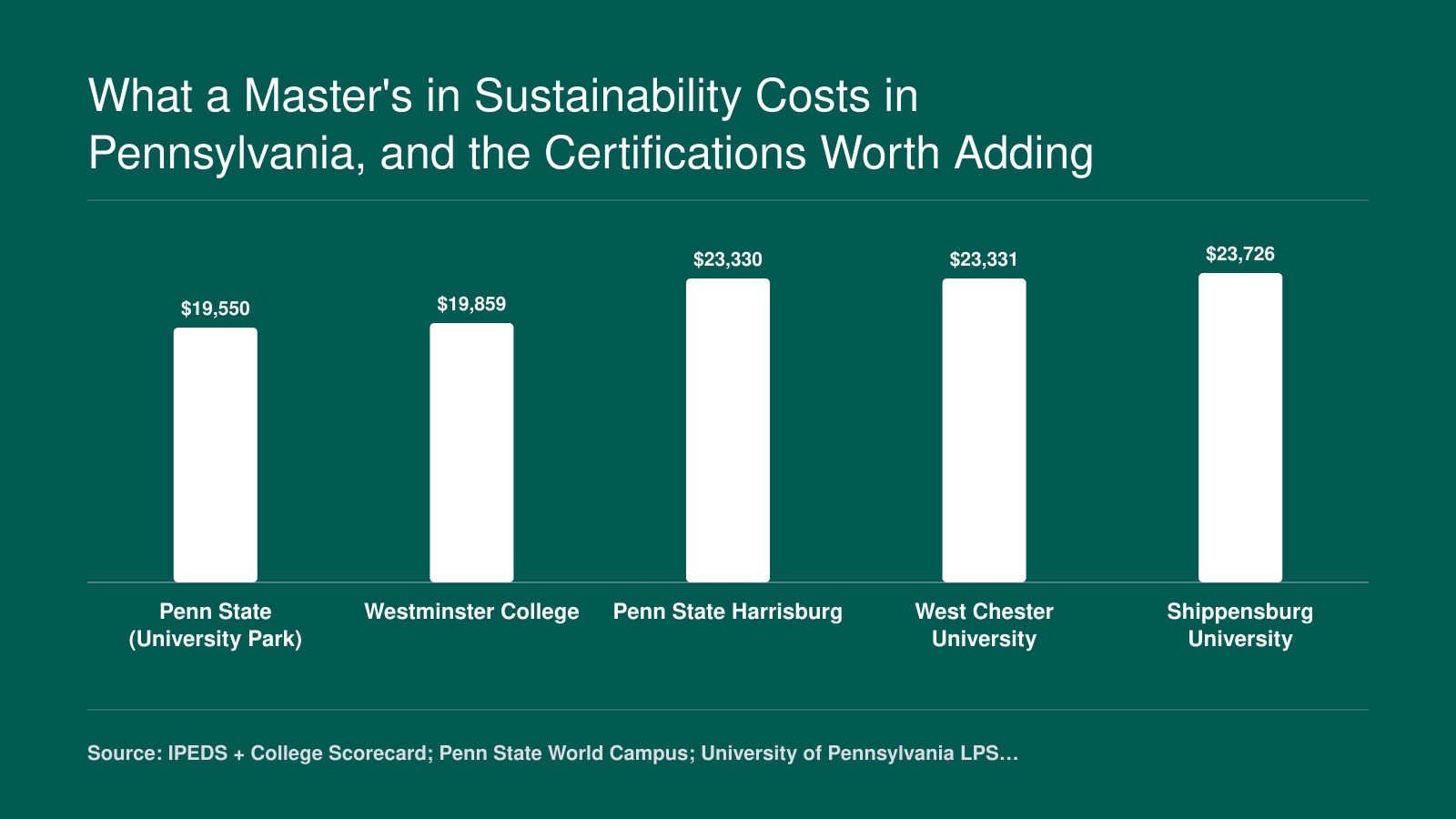
The chart shows average net price after aid at the most affordable schools here. It is an institution-wide figure, not a quote for any one master's program, so use it only to compare schools. Public universities fill most of the low end, and Westminster College is the private school that lands alongside them. For program-level pricing, Penn State World Campus lists its online Renewable Energy and Sustainability Systems MPS (33 credits) at $1,048 per credit for 2026-27 for students taking 11 or fewer credits a semester. The University of Pennsylvania prices its Master of Environmental Studies at $7,152 per course unit, roughly $2,384 per semester-hour equivalent, plus fees. Chatham, Drexel, Pitt, and Duquesne publish no comparable per-credit rate in the sources we reviewed, so confirm costs directly with them. The certification callout that follows covers credentials that can add value to the degree.
Sustainability Credentials in Pennsylvania
Compare Top Pennsylvania Sustainability Master's Programs by Earnings and Debt
Earnings are program-level medians for master's graduates, with the window stated beside each figure, and debt is median federal debt. Programs without published program-level figures are left out rather than filled in with institution-wide numbers. For practical return on investment, Pitt's Mascaro Center pairs its MS in Sustainable Engineering with a project-based capstone (partners include PNC Park and the PA DEP Local Climate Action Program) and a 10-week summer internship at $14.50 an hour, though neither is guaranteed to every student. Penn State and Chatham's Falk School also document employer and community partnerships, without a universal placement requirement.
| School | Program | Median earnings | Median federal debt | Internships and employer ties |
|---|---|---|---|---|
| University of Pennsylvania | Master of Environmental Studies | $83,058 (four years after finishing) | $77,225 | Philadelphia Gas Works internships, Climate Leaders @ Penn Fellowship, Penn Sustainability Consulting, research with city partners |
| Duquesne University | Master of Science in Environmental Science and Management | $60,629 (four years after finishing) | Not reported | Internships or a graduate thesis required, partnership with the Pittsburgh Zoo |
Frequently Asked Questions About Pennsylvania Master's in Sustainability Programs
Deadlines and admissions rules change by term and by program, so treat these answers as a starting point and confirm details on each school's admissions page before you apply.
What can I do with a master's in sustainability in Pennsylvania?
When are application deadlines for fall and spring starts at Pennsylvania sustainability master's programs?
Is a sustainability management master's different from an environmental management master's?
Can I start a sustainability master's in Pennsylvania without a science undergraduate degree?
Compare Sustainability programs on the data that matters
Explore more Science & Engineering specializations or browse every graduate field.
All Science & Engineering programs