Best Master's in Sustainability Programs in Oregon
Compare 6 accredited Sustainability programs in Oregon at 4 schools, with graduate earnings, cost, debt, and completion data from IPEDS and the U.S. College Scorecard.
Which Oregon master's in sustainability fits a working budget and a specific career? The programs ranked here answer that differently. University of Oregon's 57-credit environmental studies degree leans toward research, Oregon Institute of Technology's natural resources MS requires a thesis, and Portland State University's 45-credit Master of Environmental Management ends in an agency project.
Southern Oregon University takes the management route: an online master's in sustainability option, the corporate sustainability MBA, listed at $19,350 in total tuition over 16 months.
Campus and online paths share one list, but focus, not format, usually decides fit.
Key Points
- Portland State's environmental management degree ends with a local agency project.
- Most Oregon sustainability careers need no license but technical roles add credentials.
- Portland State's Leadership for Sustainability lists per-credit tuition and net price.
Best Master's in Sustainability Schools in Oregon: 2027 Rankings
Oregon's master's in sustainability offerings range from interdisciplinary environmental studies to corporate sustainability MBAs, with campus, hybrid, and fully online paths across Eugene, Klamath Falls, Portland, and Ashland. The four schools below stand out for their applied projects, research training, and direct access to Pacific Northwest environmental organizations.
University of Oregon
#1Eugene, OR · ~$19,000/yr (est.)
Best for: Interdisciplinary environmental researchers desiring customized study
The University of Oregon in Eugene offers an interdisciplinary, campus-based master's in Environmental Studies built for students who want to shape their own curriculum. You complete 57 credits across core theory, research methods, and two 12-credit concentration areas, finishing with a thesis or terminal project and public defense. In-state graduate tuition is $16,137 and out-of-state is $44,598. The school's overall graduation rate is 71.7%.
- 2-year, 57-credit interdisciplinary curriculum
- Thesis or capstone option with public defense
- Design two 12-credit concentration areas
- Second-language proficiency required for the MA
- Campus-based in Eugene
Oregon Institute of Technology
#2Klamath Falls, OR · $20,000 – $25,000/yr (est.)
Best for: Applied science learners focused on conservation research
Oregon Tech's Klamath Falls campus offers a campus-based Master of Science in Natural Resources focused on conservation, ecology, and applied environmental research. Students can use the accelerated 3+2 path to earn a bachelor's and master's in five years, then complete a required thesis and defense. In-state graduate tuition is $13,260 and out-of-state is $37,196. The school's overall graduation rate is 53.8%.
- Campus-based in Klamath Falls
- Accelerated 3+2 path to bachelor's and master's
- Thesis required with faculty committee defense
- Coursework in conservation, statistics, ecology, and biology
- 3.0 GPA minimum and two letters of recommendation
- $50 application fee
Portland State University
#3Portland, OR · ~$18,000/yr (est.)
Best for: Portland professionals wanting hands-on agency capstones
Portland State University in downtown Portland offers three sustainability-related master's paths: a campus-based Master of Environmental Management, a campus-based Environmental Science and Management MS, and a hybrid Leadership for Sustainability Education program. All three require 45 credits and give students direct access to Portland-area agencies and organizations. In-state graduate tuition is $11,679 and out-of-state is $31,074. The school's overall graduation rate is 52.7%.
- Hands-on capstone with a local agency
- 45-credit campus program starting fall
- Concentration of your choice
- Prepares for hydrologist, planner, and GIS analyst roles
- Thesis required with original lab or field research
- 45-credit campus program
- Partnerships with U.S. Forest Service
- Prepares for doctoral programs or environmental policy
- Hybrid format with three start dates per year
- Cohort-based theory-to-practice curriculum
- Community-based learning and Learning Gardens Laboratory
- Can add graduate certificates
Southern Oregon University
#4Ashland, OR · ~$18,000/yr (est.)
Southern Oregon University in Ashland offers a fully online MBA with a Concentration in Corporate Sustainability that working professionals can complete in about 16 months. The 45-credit program uses seven-week online terms and focuses on sustainability frameworks, reporting, renewable energy, fair trade, green building, and waste reduction. In-state graduate tuition is $12,762 and out-of-state is $31,887. The school's overall graduation rate is 42.5%.
- Fully online with seven-week terms
- 45 credits, about 16 months
- Concentration in Corporate Sustainability
- Case studies in renewable energy, fair trade, green building, and waste reduction
- Core courses in accounting, finance, marketing, and operations
Cost & outcomes by school
Federal data for the highest-earning Sustainability programs, independent of the ranking above. Earnings are this field's master's graduates four years after completing, where the Scorecard reports them.
| School | Earnings | Tuition / yr | Debt | Grads/yr | Format |
|---|---|---|---|---|---|
| Portland State University OR | — | $17,745 | — | — | Campus |
| Southern Oregon University OR | — | $17,874 | — | — | Online |
| University of Oregon OR | — | $19,474 | — | — | Campus |
| Oregon Institute of Technology OR | — | $22,470 | — | — | Campus |
Sources: U.S. Department of Education. Tuition and graduates: IPEDS. Earnings and debt: College Scorecard, this field's master's graduates; a dash means no figure is reported.
Online and Hybrid Master's in Sustainability Options in Oregon
Oregon State University's Ecampus Environmental Sciences M.S. runs fully online, one of the online master's programs in Oregon with students completing all or nearly all of the 45 credits remotely, so a working professional can finish without relocating. The companion Environmental Sciences PSM is also fully online, as is the Master of Natural Resources aimed at working natural-resources professionals. Southern Oregon University's MBA with a Corporate Sustainability concentration delivers fully online as well, one of the MBA in Sustainability Programs in Oregon. Portland State's Environmental Science and Management programs are campus-based.
PSM vs. MS, in plain terms
The distinction matters more than the delivery label in sustainability master's programs. A PSM is applied and non-thesis: OSU's Environmental Sciences PSM requires a 6-credit internship equivalent to three months full-time, in settings like consulting, land-use planning, NGOs, or government. An MS leans toward research. OSU's online M.S. offers a thesis or a project report (the project can sometimes be embedded in your current job, not a separate internship). Portland State's M.S. is thesis-based; its PSM pairs two graduate certificates with a capstone project or internship.
Note that the internship in OSU's PSM is a real on-the-ground placement, not coursework. For out-of-state readers: online tuition at these public programs still generally follows residency, so nonresidents pay more.
Which Oregon Master's in Sustainability Programs Waive or Make the GRE Optional?
Portland State University's Environmental Science and Management MS, featured in our Best Master's in Environmental Science Programs in Oregon guide, has the most clearly documented admissions path among the schools here. Its admissions page does not mention the GRE at all, neither requiring nor waiving it. Treat that as unconfirmed, not waived, and ask the program directly before paying for the test; an unlisted GRE policy is not the same as a documented Master's in Sustainability Programs With No GRE Required program.
For University of Oregon, Oregon Institute of Technology, and Southern Oregon University, we have no verified GRE policy to report, so check each graduate admissions page.
Prerequisites beyond testing
- Degree: a science-based baccalaureate.
- Coursework: one year each of biology, environmental management, and ecology, plus calculus and statistics.
- References: all materials, including references, are due with the application.
- Still to confirm: the page does not list a minimum GPA, so ask about GPA and statement of purpose expectations.
Deadlines and transfer credit
Portland State opens applications September 1 and closes them January 15 at 9 p.m. Entry is fall only, so there is no rolling admission and no second start term.
Transfer credit is capped at one-third of degree credits, and transferred courses need a B- or better.
Related Articles
What a Master's in Sustainability Costs in Oregon: Residents vs. Nonresidents
The tuition column shows each program's listed graduate tuition, not total program cost. Net price is the institution-wide average after grant aid and is an approximate figure, not a quote, and for a per-credit example Portland State's Leadership for Sustainability Education lists 45 quarter credits with total estimated costs of $29,330 for Oregon residents and $40,940 for nonresidents, which works out to about $651.78 and $909.78 per credit. Funding can reduce these figures through graduate assistantships or tuition remission, and western-state nonresidents should ask whether a program participates in the Western Regional Graduate Program for reduced nonresident tuition.
| School | Program | In-State Graduate Tuition | Out-of-State Graduate Tuition | Net Price | Format |
|---|---|---|---|---|---|
| Portland State University | Master of Environmental Management | $17,745 | $23,334 | $9,552 | Campus |
| Oregon Institute of Technology | Master of Science in Natural Resources | $22,470 | $36,164 | $15,706 | Campus |
| Southern Oregon University | Master of Business Administration with a Concentration in Corporate Sustainability | $17,874 | $20,601 | $16,732 | Online |
| University of Oregon | Environmental Studies | $19,474 | $33,379 | $22,182 | Campus |
Oregon Certification and Licensure for Sustainability Graduates
Career Outcomes and ROI for Oregon Master's in Sustainability Graduates
Portland State University's 45-credit Master of Environmental Management ends with a hands-on project for a local agency or organization, and that is where its career value concentrates. The program points to access to the USFS, USGS, BLM, Oregon DEQ, Portland BES, and The Nature Conservancy. Alumni jobs listed include hydrologist, planner, and GIS analyst, and the program cites 7% projected job growth for 2023 to 2033.
Internships and career support
PSU students can take internships for academic credit, with a faculty advisor and defined learning objectives, or as non-credit professional experience. Typical hosts are federal, state, and local agencies, nonprofits, and consulting firms. The PSU Career Center supports the search, and the university advises starting outreach early because many organizations recruit well ahead of time. A separate Sustainability Internship Program exists, but confirm current eligibility and pay with the department.
Other Oregon options
University of Oregon's Environmental Studies master's offers a thesis or capstone track and a public defense, which suits students heading toward research or doctoral study. Oregon Tech's Natural Resources M.S. is thesis-based and lists financial aid availability. Southern Oregon University's online sustainability MBA ends in a capstone, a better fit for business roles.
Earnings and debt figures at the program level are not available for these schools, so weigh ROI by comparing tuition against the placement pathways above.
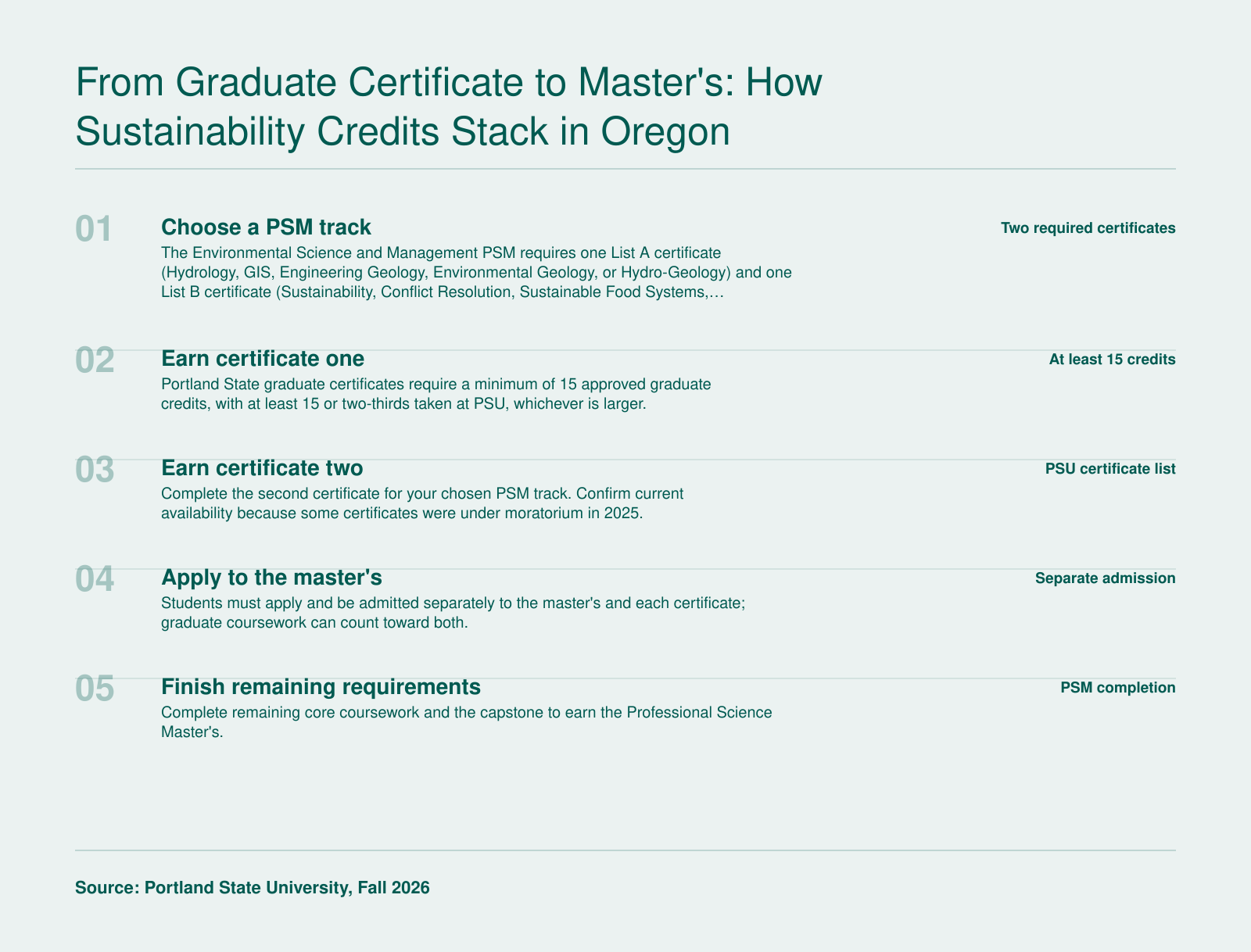
From Graduate Certificate to Master's: How Sustainability Credits Stack in Oregon
Stacking a graduate certificate into a master's is a lower-risk way to test the field before committing to a full degree. Confirm current certificate availability and credit application with an advisor before enrolling.
Frequently Asked Questions About Master's in Sustainability Programs in Oregon
Prospective students often ask how Oregon sustainability programs differ by focus and funding. These answers address the most common questions using the published program information for the schools in this guide.
Which Oregon master's program is best for sustainability management, environmental policy, or natural resources?
Are there fully funded environmental science or sustainability master's programs in Oregon?
Are there environmental humanities master's programs in Oregon?
Compare Sustainability programs on the data that matters
Explore more Science & Engineering specializations or browse every graduate field.
All Science & Engineering programs