Best Master's in Sustainability Programs in New York
Compare 31 accredited Sustainability programs in New York at 22 schools, with graduate earnings, cost, debt, and completion data from IPEDS and the U.S. College Scorecard.

A master's in sustainability in New York can cost about $13,950 in listed resident tuition at Binghamton or $62,588 in total program tuition at Cornell's one-year degree. Prestige alone doesn't show which one pays off.
The programs here are ranked on graduate earnings, cost, and debt rather than reputation, with campus and online options in one list. Format, GRE policy, and STEM designation all change the math.
Sustainability roles span consulting, policy, and corporate operations, so the same degree title can lead to very different pay.
Key Points
- Teachers College offers its M.A. in Sustainability & Education fully online, with two one-week summer sessions.
- NYU's sustainability and global energy master's carries a STEM-eligible code, allowing up to 36 months of OPT.
- City College of New York states that GRE scores are not required for its sustainability master's.
Ranked: Best Master's in Sustainability Programs in New York
The programs at the top of this list pair stronger graduate earnings with a cost and debt profile that holds up against the rest of the state. Formats range from one-year campus degrees to fully online options, and some of the best-fitting programs sit in policy, engineering, or management departments rather than carrying a "sustainability" label.
Columbia University in the City of New York
#1New York, NY · ~$58,000/yr (est.)
Best for: Working professionals needing evening classes
Columbia's Master of Science in Sustainability Management is offered through its School of Professional Studies with the Climate School, and it blends management fundamentals with sustainability science, metrics, climate risk, and policy. Students can attend full time or part time with evening classes. Graduates of the program earned a median of about $98,458 four years after finishing, and the university graduates 96% of its students. Published graduate tuition is $55,184.
- Full-time and part-time options with evening classes
- Taught with the Columbia Climate School
- 200+ environmental and sustainability courses offered each year
- Alumni network of 3,000+ at firms like Google, Patagonia, and Nike
- Scholarships available
- Management coursework paired with sustainability science
Cornell University
#2Ithaca, NY · ~$30,000/yr (est.)
Best for: Policy-focused students seeking STEM designation
Cornell is the Ithaca-based option for students who want a STEM-designated, one-year degree. Its policy-focused Master of Science in Environmental and Sustainability Policy runs 12 months with a required capstone, and total program tuition is $62,588. Two course-based Master of Professional Studies concentrations add more flexible, advisor-guided routes. The university graduates 95% of its students.
- 12-month, STEM-designated degree
- $62,588 total program tuition
- Blends economics, law, data analysis, and management
- Required capstone on a real problem
- Merit scholarships considered automatically at admission
- Program lists entry- to mid-level salaries of $80,000 to $95,000
- Environmental Management concentration among 10 options
- 30 credits, one-year format, fall start
- 3.5 GPA minimum and 3 recommendation letters
- Priority application deadline March 31
- Capstone project instead of a thesis
- Sustainable Systems concentration among 10 options
- Course-based, not research-focused
- Faculty advisor maps your course of study
- Take courses across Cornell
- Alumni at Finger Lakes Land Trust and WCS-Laos
Binghamton University
#3Vestal, NY · $10,000 – $15,000/yr (est.)
Best for: Public-sector students interested in community planning
Binghamton's MS in Sustainable Communities is a campus-based degree that draws on geography, public administration, and environmental studies. It leans toward community, government, and planning work. Published graduate tuition is $11,310 in-state and $24,500 out-of-state, among the lowest on this list. The university graduates 82% of its students.
- Spans geography, public administration, and environmental studies
- Double-degree option with Public Administration
- Accelerated path available for Binghamton undergraduates
- Research with faculty on local community impact
- Careers in government sustainability, conservation, and urban planning
New York University
#4New York, NY · ~$43,000/yr (est.)
NYU's MS in Sustainability and Global Energy Practice is the most flexible format on this list: fully online, on campus, or a blend, with full-time students typically finishing in about 15 months. The 30-credit degree is built around consulting practicums, summer fellowships, and a capstone. Tuition is $2,896 per credit, and the university graduates 88% of its students.
- Sustainability Fundamentals and Practice concentration
- 30 credits, about 15 months full time
- Fully online, on-campus, or blended
- Full-time and part-time options, two start dates per year
- STEM-designated with a required capstone
- Consulting practicums and global field intensives
- Courses available at other NYU schools
- Energy Systems concentration
- Practicums with the UN Foundation
- Can be completed 100% online
- Sustainable Buildings, Urban Systems and Technology concentration
- Faculty drawn from the UN and Fortune 500 firms
- GECS Lab research platform
Rensselaer Polytechnic Institute
#5Troy, NY · ~$64,000/yr (est.)
Rensselaer's professional master's in Ecological Economics, Values, and Policy looks at sustainability through economics, ethics, and science and technology studies. It suits students heading toward regulation, policy, or sustainable development work. A sustainability internship is built into the curriculum. The institute graduates 84% of its students.
- 30 credits across about 10 courses
- Sustainability internship included
- Core coursework in ecological economics and cost-benefit analysis
- Four science, technology, and society electives required
- Open to Rensselaer co-terminal students
Stony Brook University
#6Stony Brook, NY · ~$14,000/yr (est.)
Stony Brook offers its sustainability track inside a Master of Science in Technological Systems Management, with a Resilience and Sustainability concentration focused on energy and environmental systems. All 30 credits can be completed online, which suits mid-career professionals. Published graduate tuition is $11,310 in-state and $26,330 out-of-state, and the university graduates 76% of its students.
- Resilience and Sustainability concentration among 3 options
- 30 credits across 10 courses, all available online
- Five required courses shared across concentrations
- Covers environmental assessment, energy planning, and energy management
- Faculty-supervised master's project
- Technical or scientific background expected
- Can lead into Ph.D. study
University of Rochester
#7Rochester, NY · ~$39,000/yr (est.)
Rochester's option is a Master of Science in Chemical Engineering with a Sustainability, Energy and Environment concentration, so it fits engineers more than generalists. Coursework centers on clean energy and sustainable process design. Published graduate tuition is $38,530, and the university graduates 85% of its students.
- Sustainability, Energy and Environment concentration
- 30 credits, with four core courses totaling 16 credits
- Thesis route (Plan A) or coursework route with oral exam (Plan B)
- 3.3 GPA minimum and 3 recommendation letters
- 4+1 option for undergraduates
- Training in emerging technologies and coding
University at Buffalo
#8Buffalo, NY · $10,000 – $15,000/yr (est.)
Buffalo's MA in Sustainability Leadership is a 30-credit interdisciplinary degree drawing on ecology, ethics, economics, and the humanities. It ends with a six-credit project for a real government, nonprofit, or business partner. Small cohorts get one-on-one mentoring, and admissions are rolling. Published graduate tuition is $11,310 in-state and $24,990 out-of-state.
- 30 credits with a required capstone project
- Rolling admissions and a 3.0 GPA minimum
- Small cohort with one-on-one mentoring
- Customized course plan based on your goals
- Advanced Certificate credits can apply
- Careers in consulting, policy, and corporate leadership
Syracuse University
#9Syracuse, NY · $45,000 – $50,000/yr (est.)
Syracuse's Joint M.S. in Sustainable Organizations and Policy is a one-year, 30-credit program run by the Maxwell School and the Whitman School of Management. Coursework spans policy, business, and supply chain management. It is STEM-designated, and competitive merit scholarships are available. The university graduates 84% of its students.
- One-year, 30-credit program
- 12 credits each from Maxwell and Whitman
- STEM-designated, with up to 36 months of OPT for international students
- Competitive merit scholarships available
- Preparation for ESG, policy analyst, and sustainability manager roles
Clarkson University
#10Potsdam, NY · ~$37,000/yr (est.)
Clarkson's MS in Environmental Science and Engineering runs through its Institute for a Sustainable Environment and includes a Sustainable Systems focus. It is an in-person degree that can be finished in about 18 months. The GRE is encouraged but not required. Published graduate tuition is $36,000, and the university graduates 75% of its students.
- Sustainable Systems focus among 5 options
- 30 credits, as little as 18 months
- Thesis or capstone option
- GRE not required and no minimum GPA
- Automatic admission at a 3.25 GPA for Clarkson undergraduates
- Up to 10 transfer credits
- Fully funded assistantships available
- STEM OPT eligible
Cost & outcomes by school
Federal data for the highest-earning Sustainability programs, independent of the ranking above. Earnings are this field's master's graduates four years after completing, where the Scorecard reports them.
| School | Earnings | Tuition / yr | Debt | Grads/yr | Format |
|---|---|---|---|---|---|
| Columbia University in the City of New York NY | $123,641 | $57,973 | $61,500 | 273 | Campus |
| CUNY City College NY | $79,163 | $11,402 | — | 20 | Hybrid |
| University at Albany NY | — | $13,808 | — | — | Campus |
| Binghamton University NY | — | $13,950 | — | — | Campus |
| Culinary Institute of America NY | — | $21,560 | — | — | Hybrid |
| D'Youville University NY | — | $23,300 | — | — | Online |
| Pace University NY | — | $30,770 | — | — | Campus |
| Adelphi University NY | — | $32,822 | — | — | Campus |
| St. John's University-New York NY | — | $36,227 | — | — | Campus |
| Clarkson University NY | — | $36,856 | — | — | Campus |
| Teachers College at Columbia University NY | — | $37,918 | — | — | Online |
| University at Buffalo NY | — | $14,530 | — | 6 | Campus |
Sources: U.S. Department of Education. Tuition and graduates: IPEDS. Earnings and debt: College Scorecard, this field's master's graduates; a dash means no figure is reported.
How We Rank Sustainability Master's Programs: Earnings, Cost, and Debt
Graduate earnings measured against debt tell you more about a master's in sustainability than reputation does. The rankings here start with federal College Scorecard outcomes: median earnings after completion at the program level and median federal debt at completion. Cost sits alongside those figures, drawn from published graduate tuition and average net price. The net price figure is averaged across the institution, not a personal quote, so your own aid package will differ.
Prestige-based lists reward reputation and selectivity. They say little about what graduates earn relative to what they borrow, and that tradeoff shapes your finances for a decade or more.
The data has limits. Scorecard reports medians only, not ranges, and some small programs have no published earnings yet. Those entries show fewer statistics rather than estimated ones.
Online and Hybrid Sustainability Master's Options in New York
Fully online master's programs in New York are no longer rare in sustainability graduate study, but the label hides real differences in how much time you spend on campus.
Teachers College's M.A. in Sustainability & Education can be completed fully online. Two one-week summer sessions in New York City are optional but highly recommended. NYU's M.S. in Sustainability and Global Energy Practice runs onsite, hybrid, or 100% online, with a required capstone1 but no established residency. It also offers part-time study. Stony Brook's M.S. in Technological Systems Management (Resilience and Sustainability) lists a fully online option and ends with a faculty-supervised master's project.
CUNY City College's M.S. in Sustainability in the Urban Environment is described as hybrid, with classes in Harlem2, yet a fully distance route exists.3 International students on visas may still need to attend in person.3
Most other programs here, including Columbia, Cornell, and Syracuse, are campus-based. Cornell and Syracuse offer one-year formats.
Related Articles
GRE Waivers and Test-Optional Master's Programs in New York
GRE requirements are not uniform across this list, which includes No-GRE master's programs. City College of New York is explicit: its M.S. in Sustainability in the Urban Environment states that GRE scores are not required.1 At Columbia, the M.S. in Sustainability Management admissions page does not state a GRE requirement for the current 2026 cycle, so applicants should ask the program directly.2 NYU's M.S. in Sustainability and Global Energy Practice does not mention the GRE in its admissions materials; NYU's engineering school describes case-by-case waivers, but that does not confirm the sustainability program's policy. Before assuming a waiver anywhere here, check the specific program's admissions page and confirm the current GRE rule for your exact entry term, since requirements can change year to year.
Sustainability Master's Tuition, Fees, and New York Licensure
Public schools here list roughly $11,400 to $14,500 for residents and $20,800 to $29,200 for nonresidents, while private schools list about $23,300 to $58,000, so residency matters most at SUNY and CUNY campuses. Per-credit rates and totals appear only where official tuition pages publish them, and net price is an institution-wide average, not a program cost. New York has no state license for sustainability professionals, though engineering, architecture or accounting duties may require a PE, AIA or CPA. Graduates commonly pursue voluntary credentials such as LEED AP and ISSP-SA, which employers like EY list, but the program pages reviewed do not say any program prepares students for them.
| School | Program | Program-data tuition: in-state or resident | Program-data tuition: out-of-state | Per credit and total (where published) |
|---|---|---|---|---|
| CUNY City College | Sustainability in the Urban Environment MS | $11,402 | $20,832 | $550 resident and $945 nonresident per credit; 30 credits, $16,500 resident and $28,350 nonresident (2026-2027) |
| University at Albany | MS in Environmental and Sustainable Engineering | $13,808 | $27,468 | N/A |
| Stony Brook University | MS in Technological Systems Management | $14,222 | $29,242 | N/A |
| University at Buffalo | MA in Sustainability Leadership | $14,530 | $28,210 | N/A |
| Binghamton University | Sustainable Communities | $13,950 | $27,140 | N/A |
| Columbia University in the City of New York | MS in Sustainability Management | $57,973 | Same (private) | N/A |
| Cornell University | MS in Environmental and Sustainability Policy | $30,160 | Same (private) | $62,588 total program tuition listed |
| University of Rochester | MS in Chemical Engineering (Sustainability, Energy and Environment) | $39,310 | Same (private) | N/A |
| D'Youville University | Health, Wellness, and Climate Administration | $23,300 | Same (private) | N/A; 34 credits |
| Paul Smiths College of Arts and Science | Natural Resources Conservation | $24,748 | Same (private) | N/A; 32 credits |
| New York University | MS in Sustainability and Global Energy Practice | N/A | Same (private) | $2,896 per credit; 30 credits, $86,880 before university fees (2026-2027) |
| Pace University | MS in Environmental Science and Policy | N/A | Same (private) | $1,225 per credit; 36 to 39 credits, $44,100 to $47,775 |
What graduates earn compared with what they borrow says more about a master's program's value than its prestige, and a bigger name is not always the better investment.
STEM-Designated Sustainability Master's and Career-Focused Specializations
NYU's MS in Sustainability and Global Energy Practice is classified under CIP 30.3301, a STEM-eligible code that adds 24 months to the standard post-completion STEM OPT period, giving international graduates up to 36 months of work authorization. Syracuse's joint MS in Sustainable Organizations and Policy and Cornell's MS in Environmental & Sustainability Policy are also presented as STEM-designated, and Clarkson describes its MS in Environmental Science & Engineering as STEM OPT eligible. CUNY City College answers yes on STEM OPT eligibility for its Sustainability in the Urban Environment graduate program but does not publish the specific code.
Specializations stretch across the same list: sustainability leadership at University at Buffalo, resilience and sustainability at Stony Brook, sustainable systems at Clarkson, and energy and environment tracks at the University of Rochester.
Columbia, Binghamton, and Rensselaer do not publish a STEM status. If OPT drives your decision, confirm the code on your I-20 with the program's international student office first.
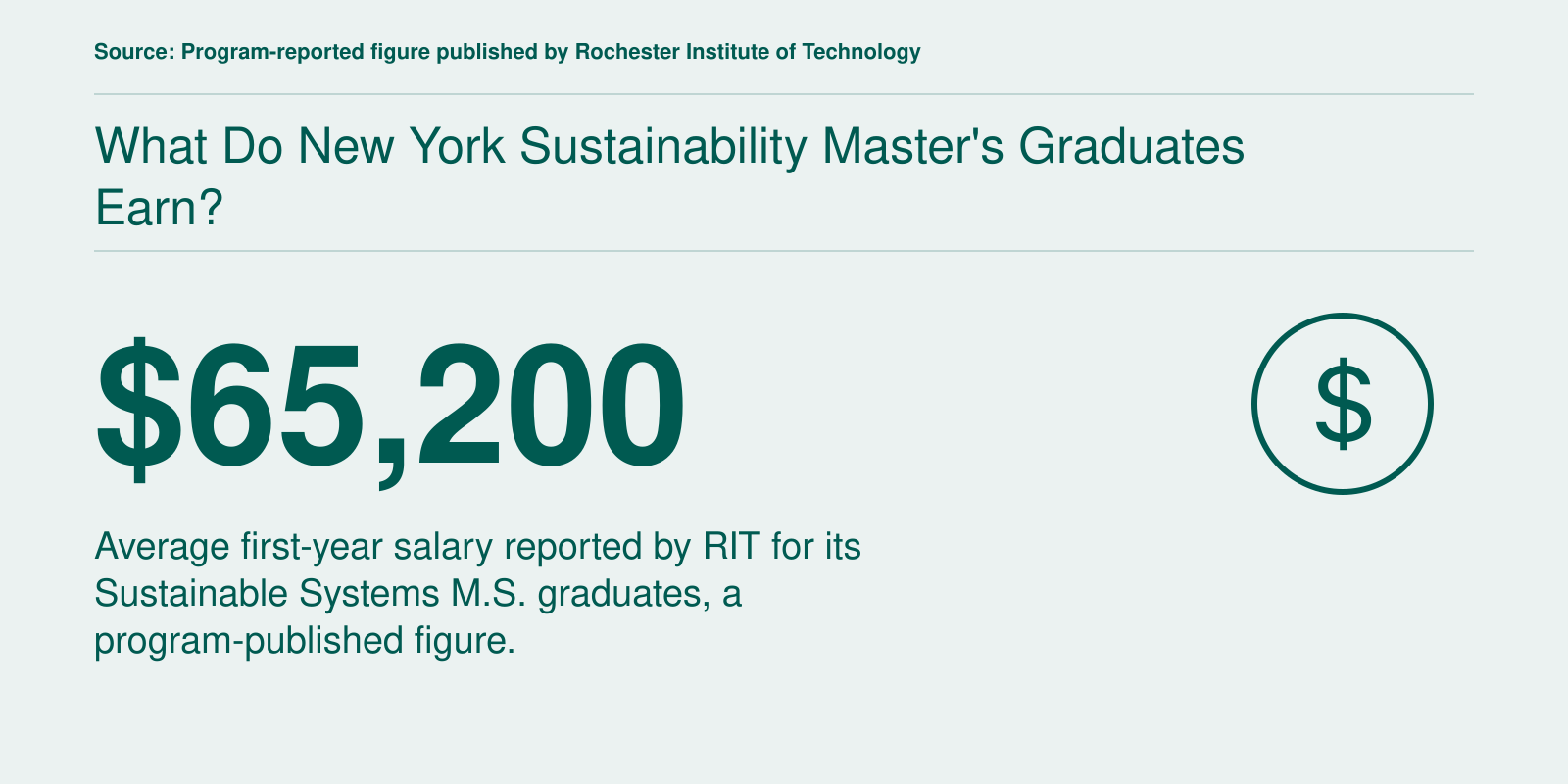
What Do New York Sustainability Master's Graduates Earn?
Program-level earnings for sustainability master's degrees are thin in federal data, so the figure below is the one published by a ranked program itself, measured over the first year after graduation. Treat it as a starting-salary reference, not a New York average. Graduates typically move into corporate ESG and sustainability reporting, city and state climate and energy agencies, utilities and clean energy firms, and nonprofits, and pay varies widely across those paths.
Application Deadlines, Prerequisites, and Accreditation Checklist
Requirements vary by school, so confirm every detail with the admissions office for your entry term.
- Core materialsExpect a bachelor's degree, transcripts, a statement of purpose, recommendations, and a résumé. Columbia charges a $150 fee and asks for a video essay. Hofstra asks for a 1–2 page letter of intent.
- PrerequisitesCity College generally expects an architecture, engineering, or science bachelor's, a 3.0 GPA, and three recommendations, and it does not require the GRE. Buffalo also asks for a 3.0 GPA. NYU favors sustainability interest and data-analysis skills.
- DeadlinesNYU's fall deadline is November 1, 2026 for Fall 2027. Columbia's final fall deadline is June 1, 2027. Buffalo lists January 31 with later applications rolling, and Hofstra is rolling. Verify dates for your term.
- AccreditationNew York schools are regionally accredited through the Middle States Commission on Higher Education. Check each school's status in the Commission's directory. Program-level accreditation is not published for most of these programs.
Compare Sustainability programs on the data that matters
Explore more Science & Engineering specializations or browse every graduate field.
All Science & Engineering programs