Best Master's in Sustainability Programs in South Carolina
Compare 4 accredited Sustainability programs in South Carolina at 3 schools, with graduate earnings, cost, debt, and completion data from IPEDS and the U.S. College Scorecard.

South Carolina's sustainability master's options are few enough to compare in full, and the differences between them are real. Clemson's environmental engineering track is a 31-credit, technical degree. The University of South Carolina and the College of Charleston lean toward management, policy, and coastal science, closer to an MBA in Sustainability than to Clemson's engineering track.
Formats mix campus and online study. Average net price after aid runs from $18,960 to $22,811 a year, a range to weigh against the Most Affordable Master's in Sustainability Programs, but those are institution-wide figures, so actual graduate bills will differ.
Key Points
- USC offers South Carolina's only fully online sustainability master's.
- 2027: most programs here waive the GRE; one Clemson option requires it.
- Clemson posts the lowest in-state tuition among programs compared here.
Best Master's in Sustainability Schools in South Carolina
These South Carolina programs combine sustainability science, policy, and management training. Tuition figures list graduate in-state and out-of-state amounts, while net price is the institution-wide average after aid, not an exact quote for graduate students. Graduation rates shown are also institution-wide.
Clemson University
#1Clemson, SC · $10,000 – $15,000/yr (est.)
Best for: Engineers seeking an online sustainability concentration
Clemson pairs engineering rigor with sustainability through its Environmental Engineering and Science M.S., including a Sustainable Systems and Environmental Assessment concentration. Students can choose thesis or non-thesis paths, and a fully online option makes the degree accessible for working professionals. The curriculum emphasizes systems-level thinking, environmental chemistry, and risk assessment.
- Concentration in Sustainable Systems and Environmental Assessment
- Five total concentration options available
- 30 total credit hours with thesis or non-thesis path
- No entrance exam and $0 application fee
- Fully online option available for working professionals
- 3.0 GPA minimum with prerequisite courses required
- B.S. to M.S. pathway for Clemson undergraduates
- Interdisciplinary framework focused on systems-level thinking
University of South Carolina
#2Columbia, SC · ~$14,000/yr (est.)
Best for: Working environmental managers needing law and policy
The University of South Carolina offers two sustainability-focused graduate paths: a flexible Master of Earth and Environmental Resources Management and an Environmental Law and Sustainability M.S.L. for working managers and executives. The earth and environmental resources degree blends management, finance, policy, and economics with environmental science, while the M.S.L. focuses on climate change, compliance, and carbon reduction. Together, the options serve both technical and policy-oriented students.
- Two concentration options with thesis or capstone
- Interdisciplinary design drawing on management, finance, policy, economics
- Non-thesis option available for working professionals
- Focus on environmental justice and conservation
- Guest speaker events and student group connections
- Financial aid and scholarships available
- 30 total credit hours, no entrance exam required
- Built for environmental managers and executives
- Climate change and carbon reduction focus
- Covers environmental compliance and enforcement
- Builds on an 18-hour certificate program
- Work experience and interview required for admission
- Explores energy generation and storage
College of Charleston
#3Charleston, SC · $16,000 – $21,000/yr (est.)
Best for: Students focused on coastal resilience and planning
The College of Charleston's Master of Science in Environmental and Sustainability Studies is deeply interdisciplinary, with six departments contributing courses in policy, science, economics, and planning. The coastal location supports hands-on work in coastal and wetlands management, environmental hazards, and marine management. Students can add a geospatial certificate, sustainable agriculture focus, or a concurrent public administration path.
- Three concentration options across policy, science, and planning
- Six departments contribute coursework
- Coastal and marine management specialization available
- Public health specialization option available
- Geospatial certificate and accelerated option available
- Sustainable agriculture focus available
- Concurrent public administration path available
- Interdisciplinary training in both science and policy
Cost & outcomes by school
Federal data for the highest-earning Sustainability programs, independent of the ranking above. Earnings are this field's master's graduates four years after completing, where the Scorecard reports them.
| School | Earnings | Tuition / yr | Debt | Grads/yr | Format |
|---|---|---|---|---|---|
| Clemson University SC | — | $12,646 | — | — | Campus |
| University of South Carolina SC | — | $14,134 | — | — | Campus |
| College of Charleston SC | — | $16,300 | — | — | Campus |
Sources: U.S. Department of Education. Tuition and graduates: IPEDS. Earnings and debt: College Scorecard, this field's master's graduates; a dash means no figure is reported.
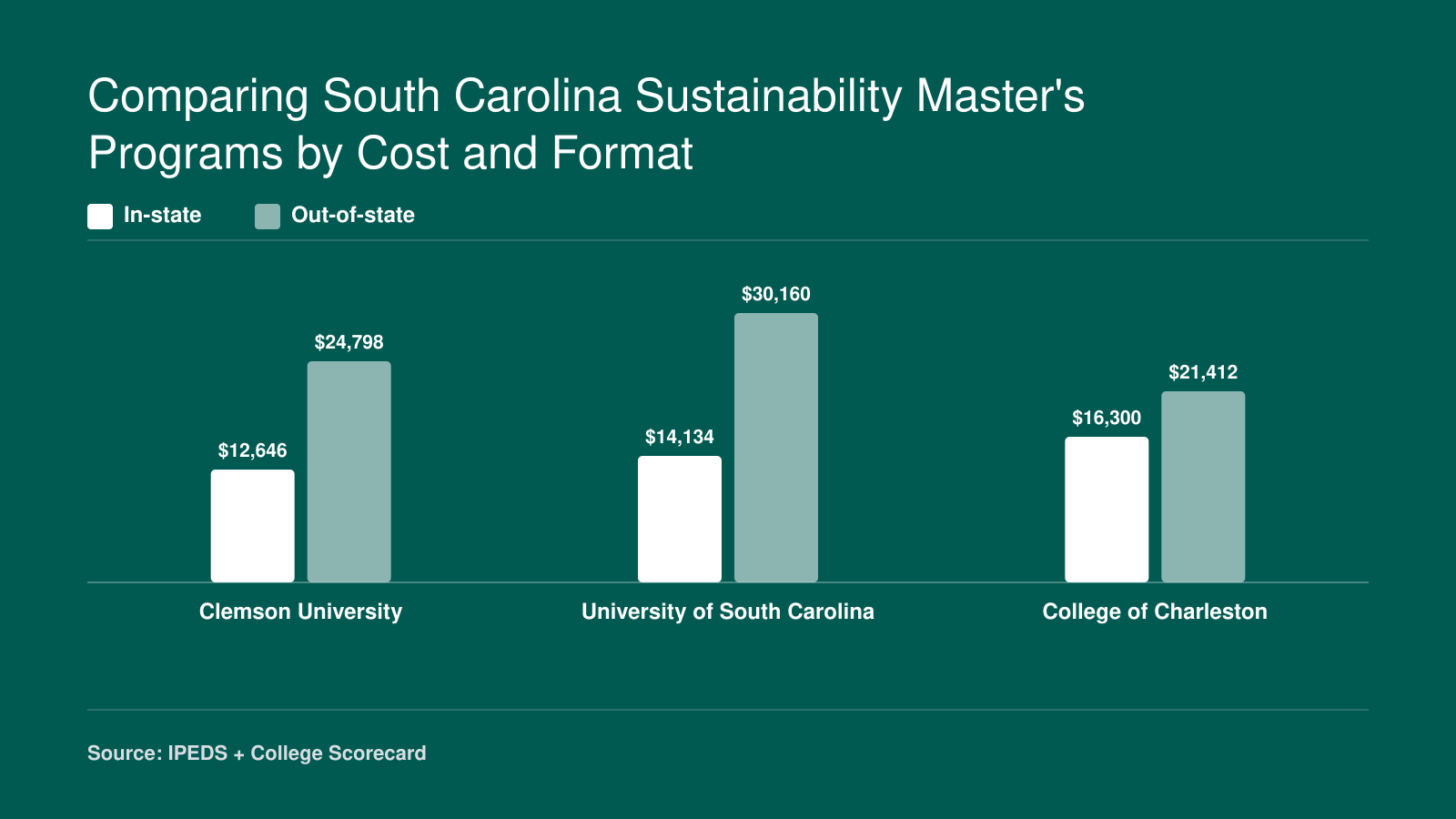
Comparing South Carolina Sustainability Master's Programs by Cost and Format
Annual graduate tuition is one piece of the cost picture, but per-credit rates and required credit hours vary by delivery format, and complete published total degree costs are not available for every program. The lowest in-state figure shown is Clemson University's Environmental Engineering and Science M.S. at $12,646, with an out-of-state premium of $12,152.
Online and Hybrid Sustainability Master's Programs in South Carolina
Fully online and campus-based study both exist among sustainability master's programs in South Carolina, but only one fully online path sits squarely in sustainability. That is the University of South Carolina's Master of Studies in Law (MSL) in Environmental Law and Sustainability: 30 credits, about 18 months, delivered asynchronously, so no scheduled live sessions. The pages reviewed do not describe a residency or field placement, and they do not say whether part-time pacing is allowed.
Clemson offers an online option in its M.S. in Environmental Engineering and Science1, which requires 31 credits, including 21 at the advanced level and one seminar credit.2 Clemson's pages do not say whether classes meet live, and they do not state a part-time track. Online students working full-time may choose an employment-related special project. Clemson's M.S. in Plant and Environmental Sciences is campus-only.3
USC's M.S. in Earth and Environmental Resources Management offers thesis or internship-capstone routes, but its delivery format is not established here. No College of Charleston page confirmed a format.
For working professionals, online master's programs in South Carolina are available. No hybrid program was confirmed. Check each school's tuition page to learn whether online students pay in-state rates.
Related Articles
Which South Carolina Sustainability Master's Programs Waive or Make the GRE Optional?
Most of the sustainability master's programs below do not require GRE scores, but admissions policies vary by program and one Clemson option still lists the GRE as required unless an advisor petitions for a waiver. Deadlines are program-specific, so confirm the current date on the graduate program page before applying.
| Program | GRE Policy | Waiver Conditions | Application Deadline |
|---|---|---|---|
| University of South Carolina, School of the Earth, Ocean and Environment graduate programs | GRE scores are not required for all graduate degree programs | N/A | January 8 for full consideration for assistantships and awards for Summer and Fall semesters |
| University of South Carolina, Environmental Law and Sustainability, MSL | No GRE or LSAT requirements | N/A | July 15; extended to July 31 for Fall 2026 |
| Clemson University, Environmental Engineering and Earth Sciences graduate programs | GRE General Test scores are not required for admission; applicants are not required to report GRE scores | N/A | April 1 is the suggested deadline to apply for the following Fall semester |
| Clemson University, Plant and Environmental Sciences, MS | GRE scores are required for application | A prospective major advisor may petition to waive the GRE requirement. The request must be duly justified and addressed to the Graduate Program Coordinator; waiver requests from the applicant will not be considered. | Rolling admissions; applications are considered year-round for Spring, Summer, and Fall semesters |
| Clemson University, Forestry and Environmental Conservation graduate programs | No published policy | N/A | June 30 for domestic applications; April 15 for international applications |
Cost, Financial Aid, and South Carolina Licensure or Certification for Sustainability Master's Grads
Two funding routes shape what you actually pay: an assistantship that offsets tuition, or scholarships and fellowships that lower the bill without the work commitment. Both exist here, but neither is automatic.
Funding that actually exists
At Clemson, aid is managed by departments and research centers, so ask your graduate coordinator directly rather than wait for a central offer.2 Assistantships carry a reduced academic fee.1 South Carolina residents may qualify for a $5,000 Graduate Incentive award.1 Clemson's summer industry internship grant pays up to $2,500 after 160 logged hours and a 3.0 GPA.3 At the University of South Carolina, assistantships run through departments, typically 20 hours a week for six graduate credits, often pairing a stipend with tuition credit.4
Licensure and credentials
South Carolina does not license sustainability as a profession, so no state license gates most roles. Credentials that carry weight include LEED AP (voluntary)5, ISSP sustainability certifications, and GHG or ESG credentials. Technical paths differ: professional engineer licensure requires the PE exam, and professional geologist licensure through South Carolina LLR requires the ASBOG exam, an accredited curriculum, and five years of experience.
One practical move: ask about assistantship availability before accepting any offer, since remission can cut your total cost more than any scholarship.
Careers and Earnings After a Sustainability Master's in South Carolina
A sustainability master's, including the best online master's in sustainability programs, prepares you to manage the environmental and resource tradeoffs that organizations face, whether that means advising a coastal city on flood risk, auditing a company's emissions, or shaping state environmental policy. What you earn and where you land depend heavily on which program you choose and how you specialize.
What the earnings show
Graduates of the College of Charleston's Master of Science in Environmental and Sustainability Studies report median earnings of about $79,900 four years after finishing. Clemson and the University of South Carolina do not publish program-level earnings for their environmental science programs in South Carolina, so we can only point you to their career outcomes rather than a figure.
Where specializations lead
- Coastal and marine management (College of Charleston): coastal resilience planner, conservation specialist, with alumni at NOAA, the U.S. Army Corps of Engineers, and the Coastal Conservation League.
- Business sustainability (USC MEERM): ESG analyst or sustainability manager, with graduates at agencies like the S.C. Department of Natural Resources and consulting firms.
- Environmental policy and compliance: policy analyst, environmental compliance specialist, and resource manager across government, nonprofit, and private employers.
Accreditation and Admissions Requirements for South Carolina Master's Programs
- Regional accreditationClemson University and the University of South Carolina hold SACSCOC accreditation. No separate programmatic accreditation for the sustainability or environmental master's programs was confirmed in available sources; College of Charleston's current SACSCOC status should be verified directly.
- Bachelor's degree and GPAA bachelor's degree from a regionally accredited institution is the standard starting point. University of South Carolina's general graduate admissions guidance points to a B-equivalent GPA, but program-specific minimums may differ.
- Application materialsTypical submissions include transcripts, letters of recommendation, a statement of purpose, and a resume. University of South Carolina's general guidance references three letters, though individual programs may set their own requirements.
- Standardized testsUniversity of South Carolina's general graduate admissions reference points include a GRE score of 1050 combined verbal and quantitative and 4 analytical writing; confirm whether the sustainability master's program requires or waives the GRE.
- English proficiencyFor international applicants, University of South Carolina's general reference is a TOEFL score of 80 internet-based; individual programs may vary.
- Prerequisite courseworkPublished prerequisite course requirements for the sustainability and environmental master's programs were not specified in available sources; applicants should confirm any statistics or natural science expectations directly with each program.
Sustainability Master's in South Carolina: Common Questions
Choosing a sustainability master's means weighing format, admissions fit, and career goals. These answers draw from program pages and South Carolina Commission on Higher Education approval records, and they focus on the University of South Carolina's online MSL in Environmental Law and Sustainability.
Is USC's proposed Master of Studies in Law in Environmental Law and Sustainability accepting applications?
What is the best master's in sustainability program in South Carolina?
Can I earn a sustainability master's in South Carolina without a science background?
Compare Sustainability programs on the data that matters
Explore more Science & Engineering specializations or browse every graduate field.
All Science & Engineering programs