Best Master's in Special Education Programs in Wisconsin
Compare 13 accredited Special Education programs in Wisconsin at 8 schools, with graduate earnings, cost, debt, and completion data from IPEDS and the U.S. College Scorecard.
A master's that adds special education to a teaching license you already hold is a different purchase from one that delivers initial licensure. Carthage requires a valid Wisconsin license. Concordia University-Wisconsin's track leads to license #2801 directly.
Price splits just as sharply: Carthage's program runs $30,000, while UW-Oshkosh charges $10,051 in-state. Campus, hybrid, and online formats share one list because your licensure starting point and budget usually matter more than delivery.
Districts still lean on emergency licenses, so a full license carries weight.
Key Points
- UW-Superior has the lowest average net price at $12,220, ahead of UW-Whitewater.
- Edgewood University graduates lead earnings at $58,537 four years after finishing.
- Cross-categorical license #2801 is the main pathway; dedicated ABA tracks are scarce.
Ranked: Top Master's in Special Education Programs in Wisconsin
Each program earned its spot by weighing what students pay after aid against what completers earn and owe, then factoring in program size and format. Graduation rates quoted below are institution-wide, so they describe the school as a whole rather than this specific program. Where a school lists more than one track or format, each gets its own entry with a note on how it differs.
Carthage College
#1Kenosha, WI · ~$30,000/yr (est.)
Best for: Licensed teachers adding special education certification
Carthage College in Kenosha offers a campus-based Master of Education built for teachers who already hold a Wisconsin license and want to add special education. The cross-categorical concentration covers assessment, academic and behavioral interventions at elementary and secondary levels, assistive technology, and collaboration with families, and it includes student teaching. Schools offering this program graduate about 64% of students, an institution-wide figure.
- Leads to Wisconsin License #801 as an add-on certification
- Requires a valid Wisconsin teaching license to enroll
- Seven courses in the concentration
- Includes a student teaching component
- Campus-based delivery in Kenosha
- Covers assistive technology and parent and professional collaboration
University of Wisconsin-Whitewater
#2Whitewater, WI · $10,000 – $15,000/yr (est.)
Best for: Aspiring behavior analysts studying online
UW-Whitewater delivers its Master of Science in Education in Special Education fully online, with four concentrations that share one 36-credit structure and differ in focus. The Applied Behavior Analysis track is the one to look at if you want Board Certified Behavior Analyst coursework, while the licensure tracks lead to K-12 cross-categorical credentials. Schools offering this program graduate about 59% of students, an institution-wide figure, and the program shows median earnings of roughly $56,000 four years after completion.
- 36 credit hours, finishable in as little as three semesters
- Designed for UW-Whitewater alumni holding a BSE in Adaptive Education
- Leads to cross-categorical K-12 licensure
- 2801 Teacher Licensure
- Doctoral-level instructors
- Starts spring, summer, or fall
- Prepares for Board Certified Behavior Analyst eligibility
- ABAI verified coursework
- Three start dates per year
- No on-campus requirements
- Doctoral instructors teach courses
- Initial licensure in special education
- Four emphasis areas available within the program
- Personal statement required
- School materials cite a 98% employment rate
- No campus visits required
- Designed for currently licensed teachers or professionals
- Non-licensure track focused on evidence-based practice
- International students evaluated case by case
- Flexible online schedule with no campus requirement
Concordia University-Wisconsin
#3Mequon, WI · ~$13,000/yr (est.)
Best for: Career changers seeking initial licensure
Concordia University-Wisconsin in Mequon offers a Master of Science in Education in Teaching and Learning that leads to initial special education licensure, taught from a Christian worldview. Students can take classes seated or online. The university received state workforce funding to support 15 post-baccalaureate candidates pursuing cross-categorical licensure, with recruitment and student-teaching partnerships aimed at high-need Milwaukee County schools. Schools offering this program graduate about 68% of students, an institution-wide figure.
- Leads to initial special education license #2801
- Seated or online class options
- Christ-centered educational approach
- Prepares teachers for K-12 students with a range of disabilities
- State-funded cohort support for Milwaukee County placements
Wisconsin Lutheran College
#4Milwaukee, WI · $10,000 – $15,000/yr (est.)
Wisconsin Lutheran College in Milwaukee takes a different angle: its MAED is a leadership program for mid-career special education professionals aiming to direct programs rather than enter the classroom. It covers data-driven decision-making, education law, and ethical standards. Schools offering this program graduate about 64% of students, an institution-wide figure.
- 30 total credit hours
- Leads to Director of Special Education/Pupil Services license #5080, K4 to grade 12
- Requires a Wisconsin educator license and documented teaching experience
- Practicum in fall or spring semester
- Exit portfolio and presentation required
- Legal and ethical standards coursework
Alverno College
#5Milwaukee, WI · $10,000 – $15,000/yr (est.)
Alverno College in Milwaukee offers a two-year, campus-based Master of Arts in Education in Cross-Categorical Special Education aimed at aspiring teachers. Coursework spans foundations, literacy, assessment, and advocacy, with field experience modules and a culminating student teaching practicum. Schools offering this program graduate about 49% of students, an institution-wide figure.
- 33 total credit hours, completed within two years
- K-12 special education licensure preparation
- Student teaching and practicum included
- Prepares for the Praxis II and Foundations of Reading exams
- Portfolio assessment requirement
- Integrated field experience modules
University of Wisconsin-Oshkosh
#6Oshkosh, WI · $10,000 – $15,000/yr (est.)
UW-Oshkosh is a public campus with the widest menu of special education tracks on this list, from cross-categorical K-12 licensure to early childhood and Deaf and Hard of Hearing licensure. Each is a 30-credit M.S.E. with a thesis or capstone option and a 3.0 GPA minimum. Schools offering this program graduate about 46% of students, an institution-wide figure.
- 30 total credit hours with thesis or capstone option
- Focus on specific learning disabilities, emotional/behavioral disorders, and intellectual disabilities
- Clinical experiences and student teaching seminar
- Portfolio assessment for licensure
- 3.0 GPA minimum
- Early childhood special education track, birth to grade 3
- Director of Special Education/Pupil Services track
- 15 of 30 credits at the 700 level
- Deficiency admission of up to 18 credits
- Letter of intent writing sample and background check
- Wisconsin licensure in Teaching Deaf and Hard of Hearing
- ASL proficiency required
- Student teaching with deaf and hard of hearing students
- Background check and TB test required
- Licensure and non-licensure paths offered
University of Wisconsin-Superior
#7Superior, WI · $10,000 – $19,000/yr (est.)
UW-Superior's online Master of Science in Education in Special Education is built for working educators, with seven-week courses, multiple start dates, and a pay-per-course structure. School materials list the same tuition for Wisconsin residents and nonresidents, and completion satisfies licensure requirements in Wisconsin, Minnesota, and many other states. No GRE is required. Schools offering this program graduate about 42% of students, an institution-wide figure.
- 30 credit hours, completable in 12 months
- No GRE or entrance exam required
- Licensure track with a 135-hour clinical internship
- Degree-only track substitutes an action research project
- Seven-week courses with four start dates per year
- 2.8 GPA minimum
- TEACH Grant eligible
Edgewood University
#8Madison, WI · $15,000 – $20,000/yr (est.)
Edgewood University in Madison offers hybrid special education master's options with evening and weekend classes, small class sizes, and a capstone requirement. One listing leads to a special education license, while the other is a professional educator degree with a non-licensure special education focus. Schools offering this program graduate about 60% of students, an institution-wide figure.
- Leads to a special education license
- Cross-categorical special education focus
- Two-course research sequence with a capstone project
- Seven concentration options in the broader degree
- Non-licensure special education development
- 33 total credit hours
- Synchronous and asynchronous options
- Three start dates per year
- 2.8 GPA minimum
- Up to 12 transfer credits accepted
- Military benefits and employer reimbursement supported
Cost & outcomes by school
Federal data for the highest-earning Special Education programs, independent of the ranking above. Earnings are this field's master's graduates four years after completing, where the Scorecard reports them.
| School | Earnings | Tuition / yr | Debt | Grads/yr | Format |
|---|---|---|---|---|---|
| Edgewood University WI | $58,537 | $19,656 | — | — | Hybrid |
| University of Wisconsin-Superior WI | $58,070 | $9,658 | $14,500 | 28 | Online |
| University of Wisconsin-Whitewater WI | $56,443 | $10,543 | $33,377 | 43 | Online |
| University of Wisconsin-River Falls WI | — | $10,357 | — | — | Online |
| University of Wisconsin-Oshkosh WI | — | $10,051 | — | 3 | Campus |
| Wisconsin Lutheran College WI | — | $10,440 | — | 1 | Campus |
| Concordia University-Wisconsin WI | — | $13,260 | — | 4 | Online |
| Carthage College WI | — | $30,000 | — | — | Campus |
Sources: U.S. Department of Education. Tuition and graduates: IPEDS. Earnings and debt: College Scorecard, this field's master's graduates; a dash means no figure is reported.
Cost, debt & payoff
Median earnings of this field's master's graduates (4 yrs after completing) vs. their median federal loan debt · U.S. College Scorecard
Across these programs the median graduate earns about $56,443 and finishes with roughly $33,377 in debt — a ratio that clears a common rule of thumb (keep debt below first-year salary). Tuition and debt vary widely school to school, so check the per-school figures in the table above before you shortlist.
Most Affordable Ranked
These are the lowest-cost options among the ranked schools, ordered from cheapest. Costs are the in-state graduate tuition figures from IPEDS and College Scorecard (2024), so they are a starting point for comparison rather than a full program bill. UW-Superior's own program page lists $16,380 in total tuition for its 30-credit online degree, so check each school's per-credit rate and credit count before you budget.
| School | City | Graduate Tuition (In-State) | Program Format |
|---|---|---|---|
| University of Wisconsin-Superior | Superior | $9,658 | Online |
| University of Wisconsin-Oshkosh | Oshkosh | $10,051 | On campus |
| Wisconsin Lutheran College | Milwaukee | $10,440 | On campus |
| University of Wisconsin-Whitewater | Whitewater | $10,543 | Online |
| Alverno College | Milwaukee | $12,018 | On campus |
Online and Hybrid Special Education Master's Programs in Wisconsin
Online coursework does not mean an online practicum: every special education licensure pathway here still puts you in a real classroom.
UW-Whitewater, Concordia University-Wisconsin, and UW-Superior are the online master's in special education options. Concordia also offers seated classes. Edgewood University runs a hybrid format. Carthage, Wisconsin Lutheran, Alverno, and UW-Oshkosh are campus-based.
How field hours work
UW-Superior is the clearest. Its program lists 135 clinical hours1, and for Wisconsin Tier II to IV license holders that means directed student teaching. Teachers holding only an initial Tier I license plus an out-of-state license may instead complete a full semester in a special education classroom, following the host district's calendar. UW-Whitewater's catalog does not state hour totals or an online placement policy, and its evidence-based practice and ABA emphases are meant for already-licensed educators.
UW-Oshkosh places students across a 33-district, 190-plus-school region around Lake Winnebago2. Applying from outside that area is possible and may carry a fee. None of these schools publishes cohort sizes or named special education district partners in the materials we reviewed.
Tip: before you apply, ask each program in writing whether it can place you in your home district.
Which Wisconsin Special Education Master's Programs Waive the GRE?
Standardized test scores play a small role in admissions, but the policies are not uniform among master's in special education programs with no GRE required, and a few schools simply do not publish one.
Concordia University Wisconsin is the clearest case. Its MS in Teaching and Learning with a special education focus states that graduate entrance exams such as the GRE are not required1, and the same holds for the MS in Educational Administration leading to the Director of Special Education and Pupil Services license (DPI #5080)2. Both set a 3.00 undergraduate GPA minimum12, with below-threshold applicants still reviewed case by case12. The director track additionally requires a valid Wisconsin Professional Educator license2.
Among Master's Programs in Wisconsin, UW-Whitewater's online MSE in Special Education does not publish a program-specific GRE requirement or waiver. Its admission criteria instead turn on a 2.75 cumulative undergraduate GPA, or alternatives including 12 graduate credits at a 3.0 GPA, plus a two- to three-page personal statement.
Expect the same replacement package elsewhere: a transcript review, a statement of purpose, references, and often a current teaching license. Deadlines shift by term, so confirm dates directly with each graduate admissions office.
Related Articles
Special Education Master's Cost in Wisconsin and the Licenses It Unlocks
The cheapest route to a Wisconsin special education master's runs through the UW campuses, and residency decides how much you save; it sits among the Most Affordable Master's in Special Education Programs. Average net prices after aid, which are not a guaranteed quote, are lowest at UW-Superior ($12,220), then UW-Whitewater ($14,158) and UW-Oshkosh ($14,305). Graduate tuition shows the gap: UW-Whitewater lists $10,543 in-state against $21,603 out-of-state, and UW-Oshkosh $10,051 against $19,935.
Per-credit rates and totals
UW-Superior's 30-credit online program runs $578 per credit, $17,340 in total, plus a $56 application fee1, and its online rate applies regardless of residency. UW-Whitewater's 36-credit online program charges $666.32 in-state and $1,280.77 out-of-state per credit for 2026-27. Concordia University Wisconsin's 40-credit online track at $655 per credit works out to roughly $26,200.2
Initial versus add-on licensure
Career changers need an initial-licensure track, which runs longer and includes student teaching. Concordia's is one example. Licensed teachers can choose shorter add-on tracks. Both aim at the K-12 Cross-Categorical Special Education license (code 2801) from the Wisconsin Department of Public Instruction.
First-time Tier II candidates must pass the Foundations of Reading Test (passing score 233) and Praxis 5001, with minimum subscores of 157 in reading and language arts, 157 in math, 155 in social studies and 159 in science. DPI requires all testing before you apply. Whether an already licensed teacher must retest depends on the existing license and DPI review.
Wisconsin Special Education Licensure and Portability
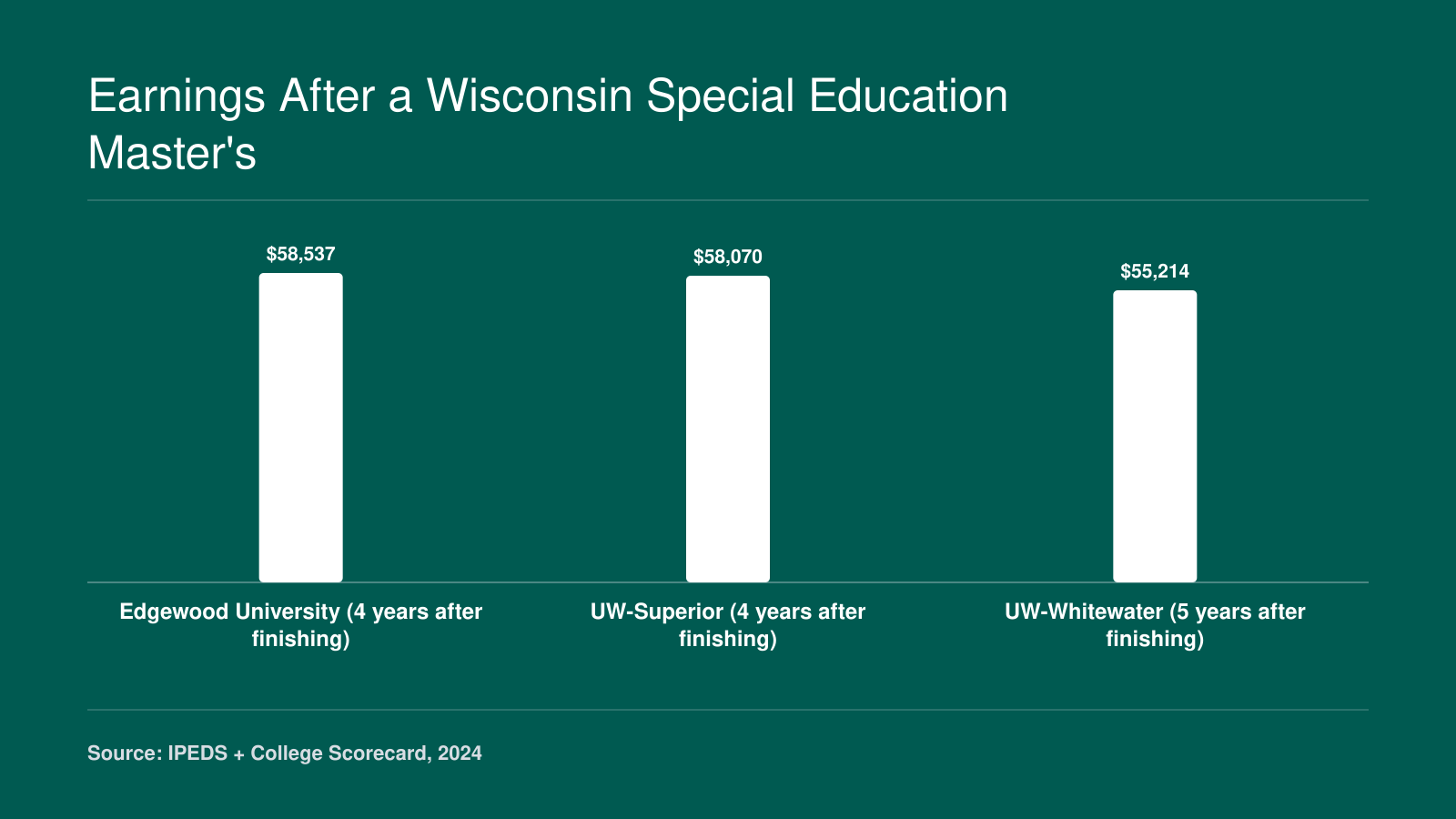
Earnings After a Wisconsin Special Education Master's
Median earnings of graduates vary by only a few thousand dollars among the programs with reported figures, and each bar below shows its own measurement window. Edgewood University leads at $58,537 four years after finishing, while UW-Superior follows closely at $58,070 with median debt of $14,500.
Concentrations: ABA, Early Childhood, and Cross-Categorical Licensure
Cross-categorical licensure is the backbone of Wisconsin's special education master's programs. Dedicated ABA and early childhood tracks are scarce. Concordia University-Wisconsin's initial licensure route and UW-Whitewater's online program both lead to Wisconsin license #2801.1 UW-Oshkosh, Alverno College and Edgewood University prepare candidates for cross-categorical K-12 licensure. Carthage College's concentration leads to license #801 but requires a valid Wisconsin teaching license first.
Behavior analysis appears at UW-Superior, where Behavior Analysis and Intervention coursework sits inside the licensure path alongside a 135-hour field experience.2 UW-Superior also offers a non-licensure path. Its published materials do not describe a BACB-verified course sequence, so do not assume the coursework leads to BCBA exam eligibility. Confirm with the program before enrolling.2 None of the ranked programs lists a special education concentration in Early Childhood Education at the master's level.
Not every option leads to a classroom license. Wisconsin Lutheran College's program leads to a Director of Special Education/Pupil Services license, a leadership route for mid-career professionals among educational leadership master's programs Wisconsin. Edgewood pairs its license with a research capstone.
Portability differs too. BCBA certification is national and travels with you. A Wisconsin teaching license depends on each state's reciprocity rules.
Emergency special education licenses in Wisconsin's cross-categorical area surged 222.5%, from 236 in 2013 to 761 in 2022, according to Wisconsin DPI workforce data. The same data show just 46% of special education teachers remain in public schools by their seventh year.
How to Choose a Wisconsin Master's in Special Education
Transfer rules differ sharply by school. UW-Whitewater requires 36 credits and accepts up to 12 from elsewhere, with approval for each course. UW-Oshkosh requires 30 credits, at least 21 from Oshkosh or a partner institution, and allows up to 9 transfer credits for applicants who already hold a master's. Ask each program directly how it treats credits from other UW System campuses, because policies are set at the program level.
Start with accreditation. Confirm that the Wisconsin Department of Public Instruction (DPI) has approved the specific licensure program, and that the institution holds Higher Learning Commission accreditation (UW-Whitewater does). CAEP or AAQEP status is worth checking on each school's own site, since it was not verifiable for every program.
Then match the track to your situation, whether you are comparing standard or Accelerated Master's in Special Education Programs. Career changers need an initial-licensure path. Working teachers may only need an add-on license, or no license at all. UW-Superior offers both a licensure and a non-licensure master's.
Finally, weigh student-teaching or practicum logistics against your work schedule, and compare completer earnings alongside tuition, not tuition alone.
Compare Special Education programs on the data that matters
Explore more Education & Teaching specializations or browse every graduate field.
All Education & Teaching programs