Best Master's in School Psychology Programs in Wisconsin
Compare 6 accredited School Psychology programs in Wisconsin, with graduate earnings, cost, debt, and completion data from IPEDS and the U.S. College Scorecard.

Annual in-state graduate tuition at Wisconsin's school psychology programs runs from $9,777 at UW-Stout to $12,728 at UW-Milwaukee. That spread is narrow, so price rarely settles the choice alone.
Degree structure matters as much. UW-Stout awards an M.S.Ed. after the first 30 credits of its Ed.S. track, and UW-River Falls folds both into one 66-credit sequence.
That distinction counts because the Wisconsin Department of Public Instruction licenses school psychologists at the specialist or doctoral level. For most students, the master's is a checkpoint, not the finish line. The number worth comparing is the full multi-year bill through internship.
Key Points
- A master's alone does not qualify you for Wisconsin's School Psychologist, PK-12 license (PI 34.061).
- UW-La Crosse offers an online M.S.Ed./Ed.S. track, but only for licensed in-service educators.
- No program here requires GRE scores, so compare total cost and assistantships instead.
Wisconsin's Best Master's in School Psychology Programs, Ranked
These Wisconsin programs are ordered by cost, graduate outcomes, and fit with state licensure. In most of them the master's is the first stage of a specialist-level sequence, since the Ed.S. is what leads to the Wisconsin license. Confirm each program's current NASP status in the NASP directory before you apply.
University of Wisconsin-La Crosse
#1La Crosse, WI · $10,000 – $15,000/yr (est.)
Best for: Wisconsin teachers switching careers
UW-La Crosse offers a Master of Science in Education en route to the Ed.S., with about 700 hours of school practica and a 1,200-hour internship. Graduate tuition is listed at roughly $9,269 in state and $19,966 out of state, and the university graduates about 71% of its students. Program graduates reported median earnings of $61,488 one year after completion. The catalog describes NASP accreditation and Wisconsin DPI approval, and a separate online pathway exists for licensed Wisconsin educators.
- Master of Science in Education en route to the Ed.S. degree
- Combined master's-to-Ed.S. route totals 71 to 73 credits over about 33 months
- 700 hours of school practica and a 1,200-hour internship
- Students spend two days per week in local schools with mentors
- Full-time and part-time options; capstone and portfolio required
- Competitive admission with an on-campus interview
- Prepares graduates for Wisconsin licensure and NCSP certification
University of Wisconsin-Eau Claire
#2Eau Claire, WI · ~$11,000/yr (est.)
Best for: Future doctoral applicants
UW-Eau Claire's Master of Science in Education in School Psychology is the first phase of a three-year sequence leading to the Ed.S. and licensure. It is a campus program in Eau Claire, with graduate tuition listed near $8,954 in state and $20,343 out of state. The university graduates about 64% of its students. The NASP directory lists the specialist program as fully approved/accredited, with a record updated in March 2026.
- 31-credit master's phase of a three-year path to the Ed.S.
- NASP directory lists the specialist program at 68 graduation credits
- Written comprehensive examination required
- Three letters of recommendation minimum
- Criminal background check required
- Coursework in data-based decision-making and culturally responsive practice
University of Wisconsin-Whitewater
#3Whitewater, WI · $10,000 – $15,000/yr (est.)
Best for: Students balancing work and evening classes
UW-Whitewater runs a cohort-based School Psychology master's that begins in summer, with classes scheduled around 4 p.m. to suit working students. Graduate tuition is listed near $9,256 in state and $20,316 out of state, and the university graduates about 59% of its students. The university reports full NASP accreditation and Wisconsin DPI approval, and graduates can apply for the NCSP credential after the internship. Graduate assistantships and scholarships are available.
- 32 credits in the master's phase, leading toward the Ed.S.
- No entrance exam required
- Summer start with cohort-based structure
- Minimum 3.0 GPA and three letters of recommendation
- Prerequisite courses required
- Application deadline listed as January 18, 2027
- Graduate assistantships and scholarships available
- Wisconsin DPI-approved and NASP-accredited per the university
University of Wisconsin-Stout
#4Menomonie, WI · ~$10,000/yr (est.)
UW-Stout in Menomonie awards both an M.S.Ed. and an Ed.S. across three years, ending with a full-time, paid 1,200-hour internship. It has the lowest graduate tuition in this group, listed near $8,071 in state and $17,133 out of state, and the university graduates about 55% of its students. Program graduates reported median earnings of $62,190 one year after completion. The university reports NASP accreditation and Wisconsin DPI License #7062.
- Three-year program; master's awarded after the first 30 credits
- 600+ hours of school-based practicum in year two
- Clinical Services Center and Play Therapy Lab on campus
- Paid full-time 1,200-hour internship in year three
- Requires a bachelor's in psychology or education and a background check
- Priority deadline of January 10 for summer and fall starts
- District partnership tuition listed at $525 per credit
- Leads to DPI License #7062 and NCSP eligibility
University of Wisconsin-River Falls
#5River Falls, WI · $10,000 – $15,000/yr (est.)
UW-River Falls pairs a 34-credit M.S.Ed. with a 32-credit Ed.S., for 66 graduate credits and eligibility for full licensure. Its location near Minnesota makes it relevant to candidates who want mobility across the border. Graduate tuition is listed near $8,654 in state and $18,609 out of state, and the university graduates about 57% of its students. A 2026 secondary source calls the program NASP-approved, so verify that in the NASP directory.
- 34-credit M.S.Ed. plus 32-credit Ed.S., 66 credits in total
- Two practica and two internships in the Ed.S. phase
- Coursework in crisis response, early childhood assessment, and consultation
- Fingerprinting and background checks required
- Meets Wisconsin and Minnesota certification rules
University of Wisconsin-Milwaukee
#6Milwaukee, WI · $13,000 – $26,000/yr (est.)
UW-Milwaukee offers a Master of Science in Educational Psychology with a School Psychology concentration, using a scientist-practitioner model focused on urban schools. It has the highest graduate tuition here, listed near $11,102 in state and $24,533 out of state, and the university graduates about 49% of its students. Program graduates reported median earnings of $54,074 one year after completion. The university says the program is NASP-accredited, with its Ed.S. page giving accreditation through 2027.
- 31 credits of coursework plus a comprehensive exam
- Master's is part of the sequential Ed.S., which is required for licensure
- Fall start, one start date per year
- Three letters of recommendation minimum
- Scientist-practitioner model with multicultural competence training
- District partnership tuition listed at $525 per credit
- Faculty research involvement available
Cost & outcomes by school
Federal data for the highest-earning School Psychology programs, independent of the ranking above. Earnings are this field's master's graduates four years after completing, where the Scorecard reports them.
| School | Earnings | Tuition / yr | Debt | Grads/yr | Format |
|---|---|---|---|---|---|
| University of Wisconsin-Stout WI | $74,326 | $9,777 | $31,805 | 27 | Campus |
| University of Wisconsin-Milwaukee WI | $66,931 | $12,728 | $41,000 | 52 | Campus |
| University of Wisconsin-La Crosse WI | $65,909 | $10,832 | $20,272 | 37 | Campus |
| University of Wisconsin-River Falls WI | — | $10,357 | $33,493 | 26 | Campus |
| University of Wisconsin-Whitewater WI | — | $10,543 | — | 19 | Campus |
| University of Wisconsin-Eau Claire WI | — | $10,665 | — | 25 | Campus |
Sources: U.S. Department of Education. Tuition and graduates: IPEDS. Earnings and debt: College Scorecard, this field's master's graduates; a dash means no figure is reported.
Cost, debt & payoff
Median earnings of this field's master's graduates (4 yrs after completing) vs. their median federal loan debt · U.S. College Scorecard
Across these programs the median graduate earns about $66,931 and finishes with roughly $32,649 in debt — a ratio that clears a common rule of thumb (keep debt below first-year salary). Tuition and debt vary widely school to school, so check the per-school figures in the table above before you shortlist.
Online and Hybrid Master's in School Psychology Options in Wisconsin
Can you earn a school psychology master's program in Wisconsin entirely online? Only partly. The University of Wisconsin-La Crosse offers an asynchronous online M.S.Ed./Ed.S. track, but it is open to licensed in-service educators, and the practicum and internship still happen in a real school. The 1,200-hour internship is required either way.
The La Crosse online track lets students complete fieldwork in the school where they teach, under program supervision. That is the clearest own-site allowance among the schools here. Its on-campus version is in-person, with a longer practicum.
UW-River Falls is the main option for working adults who want a blended schedule. Courses are primarily evening-based, many are hybrid, and some sessions are face-to-face. Third-year practica are placed by faculty in cooperating districts across western Wisconsin and the Twin Cities area. Internship sites are student-sought with faculty help, and living near campus is not required.
UW-Milwaukee's program is on-campus. Its page does not clearly spell out placement rules, so ask the program directly.
Out-of-state online master's in school psychology programs must still satisfy Wisconsin DPI licensure standards, so confirm that before enrolling.
GRE Waivers and Optional Policies for Wisconsin School Psychology Master's Programs
None of the programs below requires GRE scores, so you can skip the test at each school with a published policy. Where an admissions page does not state a policy or detail, the table says so rather than guessing. UW-Whitewater and UW-La Crosse list coursework prerequisites (psychology and statistics) rather than a teaching license, which makes them the most natural fits for career changers. UW-La Crosse's online program is the exception, since it requires a Wisconsin educator license and current Wisconsin employment.
| Program | GRE Policy | Teaching License Required? | Application Deadline | Start Term |
|---|---|---|---|---|
| UW-Milwaukee School Psychology MS/EdS | Not required | Not listed as a requirement | January 3 | Fall |
| UW-Whitewater School Psychology Master's | No longer required | Not listed as a requirement (12 credits of psychology coursework required) | January 18, 2027 (full consideration) | N/A |
| UW-La Crosse School Psychology Graduate Program | Not required | Not listed as a requirement (undergraduate statistics required) | First Friday in December | N/A |
| UW-La Crosse School Psychology Online | No published policy | Yes, Wisconsin educator license and current Wisconsin employment | N/A | N/A |
Related Articles
What a Master's in School Psychology Costs in Wisconsin
One year's tuition and the full program bill are two different numbers. Unlike Accelerated Master's in School Psychology Programs, specialist-level preparation here often runs about three years including internship, so total cost matters more than the annual rate.
In-State vs Out-of-State Tuition
Federal graduate tuition figures put UW-Stout lowest at $9,777 in-state and $18,839 out-of-state per year. UW-Milwaukee is highest at $12,728 in-state and $26,159 out-of-state. River Falls, Whitewater, Eau Claire and La Crosse fall in between. Out-of-state rates roughly double at every school, so residency matters.
Total Program Cost
UW-La Crosse's online MSEd plus EdS, open to Wisconsin-licensed educators with at least a year of K-12 experience, lists 61 credits at $604 each, or $36,844 before fees. UW-River Falls requires 66 credits across its MSE and EdS, but no per-credit rate is published, so ask for a quote before multiplying.
Institution-wide net price averages run from about $14,054 at River Falls to $17,490 at Stout. Treat these as rough averages, not program quotes, especially when comparing Most Affordable Master's in School Psychology Programs nationally.
Debt and Aid
Program-level median debt is reported for some schools: $20,272 at La Crosse, $31,805 at Stout, $33,493 at River Falls and $41,000 at Milwaukee. Whitewater and Eau Claire show none. Whitewater points to assistantships, employment, grants and loans, plus named scholarships such as the Barbara Ann Hersko and Song Family awards, though amounts are not stated.
Wisconsin School Psychology Licensure Requirements: Is a Master's Enough?
Can you become a school psychologist in Wisconsin with just a master's degree? No. The Wisconsin Department of Public Instruction issues the School Psychologist, PK-12 license (PI 34.061) to graduates of an approved program at the education specialist or doctoral level, not to holders of a standalone master's.1
The MS-to-EdS structure
In Master's Programs in Wisconsin, the master's is typically a stepping stone inside a longer specialist sequence. The EdS (or a doctorate) is the licensure-qualifying endpoint. DPI describes the specialist route as at least 60 graduate semester hours and the doctoral route as at least 90.2 Both routes require a supervised, year-long internship of 1,200 hours.1 The sources reviewed do not say how those hours must be split across school settings.
DPI license versus NCSP
The DPI license is state authorization to practice in Wisconsin.3 The Nationally Certified School Psychologist (NCSP) credential comes from NASP and requires a NASP-approved program, a specialist or doctoral degree, the 1,200-hour internship, and an official Praxis School Psychologist score report sent to NASP (code 1549). The test date must fall within 10 years of applying, and graduates of approved programs must apply within 10 years of graduating.
Wisconsin rules also let a valid NCSP holder qualify for the license.1 The sources do not show a separate Wisconsin exam for the regular DPI license. Because most states recognize the NCSP, it makes moving easier.
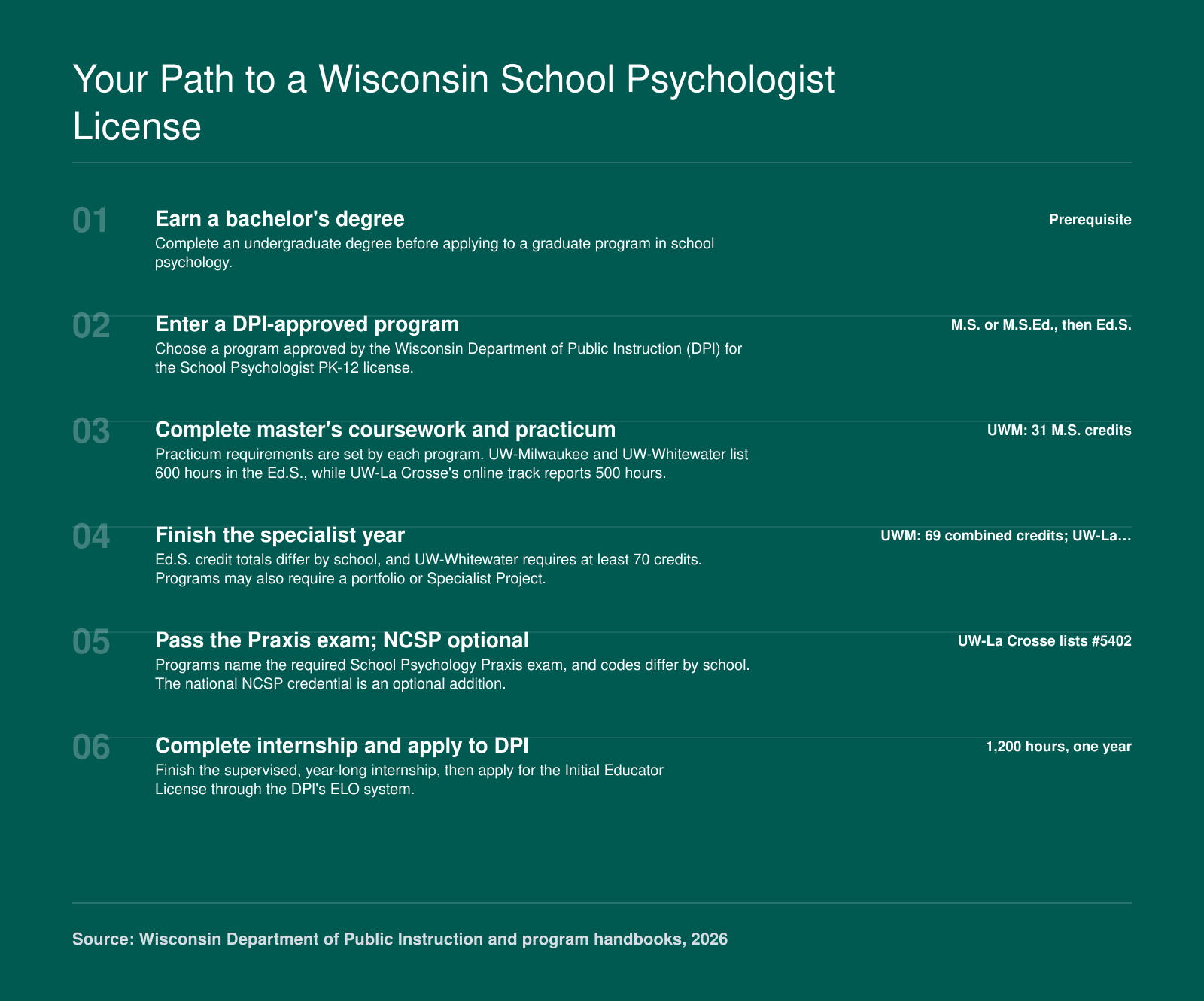
Your Path to a Wisconsin School Psychologist License
Wisconsin licenses school psychologists at the specialist level, so a master's alone does not qualify. Credit totals and practicum hours vary by program, so confirm them with the school you choose.
Common Questions About School Psychology Programs in Wisconsin
Is a master's degree enough to become a school psychologist in Wisconsin?
Can I apply to a Wisconsin school psychology program without a teaching license or K-12 experience?
Are school psychology internships in Wisconsin paid?
Compare School Psychology programs on the data that matters
Explore more Psychology specializations or browse every graduate field.
All Psychology programs