Accelerated Master's in School Psychology Programs
Compare 130+ accredited fastest School Psychology programs at 120+ schools, with graduate earnings, cost, debt, and completion data from IPEDS and the U.S. College Scorecard.

A faster calendar versus a shorter checklist: the two are not the same in school psychology, and conflating them is the first mistake applicants make. Most states and NASP expect specialist-level training, roughly 60 graduate credits plus a 1,200-hour supervised internship, before you can be certified to practice in schools.
That ceiling rarely moves. "Accelerated" almost always means a compressed schedule, denser terms, or summer coursework, not fewer requirements. The credential bar is set by state boards and NASP, not by how aggressively a program paces its calendar.
Key Points
- Most states require specialist-level training beyond a standalone master's.
- NASP requires 1,200 internship hours, at least 600 in schools.
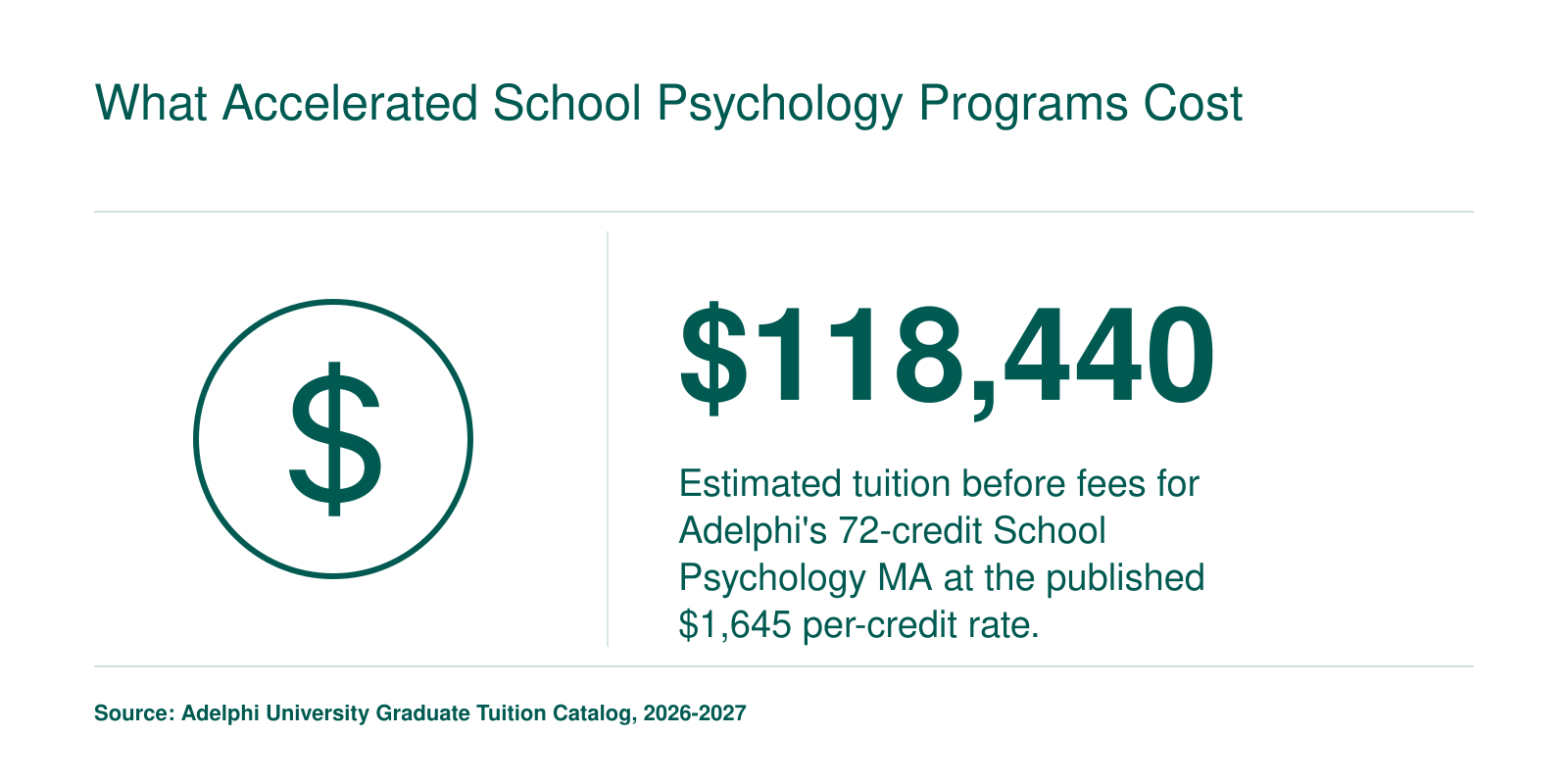
- Adelphi's 72-credit MA totals $118,440 before fees in 2026-2027.
Accelerated Master's in School Psychology Programs
-
#1
University of Toledo
School Psychology
$17,605grad tuition / yr $22,600median federal debt 38grads / yr30 credits1 yearVisit program site →57score -
#2
University of Wisconsin-La Crosse
School Psychology On-Campus Program
$65,909median earnings $10,832grad tuition / yr $20,272median federal debt 37grads / yr31 credits1 yearVisit program site →50score -
#3
University of Wisconsin-Whitewater
School Psychology
$10,543grad tuition / yr 19grads / yrNo GRE required32 credits1 yearVisit program site →50score
How we rank. Each program is scored on graduate figures only: the field's master's earnings and debt, graduate tuition and the number of master's graduates, normalized across all programs in this field. Data comes from the U.S. Department of Education's IPEDS and College Scorecard; no school pays for placement.
Compare the top programs
| Rank | School | Earnings | Tuition / yr | Debt | Grads/yr | Format |
|---|---|---|---|---|---|---|
| 1 | University of Toledo OH | — | $17,605 | $22,600 | 38 | Campus |
| 2 | University of Wisconsin-La Crosse WI | $65,909 | $10,832 | $20,272 | 37 | Campus |
| 3 | University of Wisconsin-Whitewater WI | — | $10,543 | — | 19 | Campus |
Sources: U.S. Department of Education. Tuition and graduates: IPEDS. Earnings and debt: College Scorecard, this field's master's graduates; a dash means no figure is reported.
Cost, debt & payoff
Median earnings of this field's master's graduates (4 yrs after completing) vs. their median federal loan debt · U.S. College Scorecard
Across these programs the median graduate earns about $69,658 and finishes with roughly $41,971 in debt — a ratio that clears a common rule of thumb (keep debt below first-year salary). Tuition and debt vary widely school to school, so sort the ranking by "Most affordable" or "Lowest debt" to weigh cost against outcomes.
What 'Accelerated' Really Means in School Psychology
School Psychology training is rarely a single degree. A standalone master's (an MA, MS, or MSEd) is often only the first half of the path to practice. The credential most states actually require for school psychologist certification is specialist-level: an EdS, a CAGS, or a professional diploma, typically around 60 graduate credits plus an internship.
The Hybrid Master's-to-Specialist Model
Most accredited programs blend the two. Students earn a master's along the way to a specialist credential, so the degree is a milestone rather than the finish line. Fordham's MSEd paired with a Professional Diploma pathway is one example of this master's-plus-advanced-certificate structure. You collect the master's en route, but the specialist credential is what makes you certifiable.
How Programs Actually Shorten the Timeline
Acceleration comes from scheduling, not from cutting the required hours. Common levers include:
- Year-round study: summer terms keep coursework moving instead of pausing.
- Cohort scheduling: a fixed group advances together on a locked sequence.
- Combined BA/MA tracks: undergraduate credits count toward the graduate stage.
- Credit transfer: prior graduate work can trim the load.
Expect roughly two years of coursework plus a full-year internship, versus three or more years part-time.
One caution: true one-year school psychology master's programs rarely qualify you for licensure on their own. Check the comparison table that follows before committing.
Fastest School Psychology Pathways Compared: Length, Credits, and NASP Status
The table below focuses on the shortest published pathways, not on program quality. A shorter calendar time often only means fewer credits or a compressed schedule; it does not by itself make a program portable. When comparing options, weigh the length against NASP approval, because NASP-approved programs provide a clear route to NCSP eligibility and smoother state licensure portability.
| Program | Degree/Credential Awarded | Total Credits | Length (incl. Internship?) | Format | NASP Approved |
|---|---|---|---|---|---|
| Adelphi University: Master of Arts in School Psychology | Master of Arts (MA) | 72 semester credits | No fewer than 3 years full time; third year includes full-time internship | Full-time or part-time; summer attendance required | Yes, specialist level full approval |
| Fordham University: Advanced Certificate in School Psychology | Advanced Certificate (formerly Professional Diploma) | 66 graduate credits | Includes one full academic year of supervised internship; total calendar time not published | Not specified in cited bulletin | Yes, specialist level full accreditation |
NASP Approval, the NCSP, and State Licensure Portability
NASP approval is the most useful credential signal an accelerated school psychology program can carry, because it smooths the path to both national and state credentials.
Why NASP Approval Matters
Graduates of NASP-approved programs have the most direct route to the Nationally Certified School Psychologist (NCSP) credential: finish the program and pass the Praxis School Psychologist exam (5403) with a score of 155 or higher.1 Applicants from non-approved programs have their training reviewed case by case against NASP's minimums. Those minimums are 60 graduate semester hours and a 1,200-hour internship, with at least 600 of those hours in a school setting.1
State Certification vs. the NCSP
These are separate credentials. Your state, usually through its department of education, issues the certificate or license that lets you work in public schools. The NCSP is a national, non-practice credential. NASP itself notes that it does not authorize practice in any state on its own.5
How Portable Is the NCSP?
One 2026 university summary counts 34 states that accept the NCSP as meeting all or part of their certification requirements.2 NASP stresses that recognition varies by state.5 North Carolina accepts a valid NCSP as a route to licensure,6 and South Carolina waives its subject knowledge assessment for NCSP holders.4 Other states keep their own rules, and some still cite the older Praxis 5402 cutoff of 147.3
Before you enroll, confirm your target state's requirements directly with its education department. This matters most if you are considering an out-of-state Online Master's in School Psychology program.
Can You Earn a School Psychology Degree Online? Format and Residency Rules
Let's be direct: a school psychology degree you complete entirely from your laptop barely exists. Most programs marketed as online are hybrid, pairing web-based coursework with required campus visits or live class sessions. The fieldwork, which is the heart of the credential, is always in-person in actual schools.
What Attendance Really Looks Like
Formats vary widely. Mississippi State's online Ed.S. runs coursework remotely but brings students to campus for a two-day residency each summer for skills check-offs, plus monthly professional-development sessions you attend live.1 Stephen F. Austin's program is fully online but synchronous, meaning you log in for scheduled class meetings rather than working at your own pace. Drexel's hybrid Ed.S. holds all school psychology core courses in person and expects students to live within commuting distance of Philadelphia, so distance enrollment outside that region is not really an option.23
Fieldwork Stays Local and In-Person
Practicum and internship happen in schools, on a school-day schedule. At Mississippi State, the 150-hour practicum starts in year two and the 1,200-hour internship (at least 600 hours in schools) can be completed through faculty-assisted local placements in your home area.1 Expect to secure a site near where you live.
One caution before you apply: state authorization rules mean some online programs legally cannot enroll residents of certain states. Confirm your state is approved before committing.
Related Articles
What Accelerated School Psychology Programs Cost
Adelphi University's School Psychology MA shows how accelerated program costs can add up: at the published 2026-2027 rate of $1,645 per credit, the 72-credit program totals an estimated $118,440 before fees. Fees, books, and the 1,200-hour internship year can add to that total. Graduate assistantships are limited but may provide tuition remission, federal loans are available, and paid internships, where available, can offset some costs.
Admission Requirements for Accelerated School Psychology Pathways
- PrerequisitesA bachelor's degree, with psychology, development, learning, and statistics coursework at Temple; Arizona expects a psychology, special education, educational psychology, or related degree.
- GPABaseline commonly around 3.0, but varies: SDSU 2.8 (last 60 units), Southern Maine 2.5 undergrad/3.0 graduate, Temple and UW Tacoma 3.0, Wichita State 3.000, CCNY 3.2 psychology/3.0 overall, George Mason 3.25.
- GRENot universal. Southern Maine requires none; Arizona and UMass make it optional; Wichita State waives it with a 3.000+ undergraduate GPA, otherwise GRE or MAT.
- Application MaterialsTypically a personal statement and letters of recommendation, two at Southern Maine and Wichita State, three at Arizona and UMass. UMass requires an interview; Southern Maine may invite candidates.
- Combined BA/MAOften for current undergraduates only: Rutgers–Camden requires juniors or seniors with at least 80 credits and graduate-director approval. Outside applicants should apply to the master's/EdS route directly.
School Psychologist Median Pay
The 1,200-Hour Internship: Pay, Placement, and Whether It's Worth It
The Hours You Cannot Skip
NASP requires at least 1,200 internship hours for a specialist-level credential, with a minimum of 600 completed in a school setting (one that primarily educates P-12 students and runs a pupil-services unit staffed by at least one credentialed school psychologist). You can complete it full-time over one year or half-time over two, but the total does not shrink. In practice the internship is the final year, and no accelerated master's program meaningfully compresses it. Expect at least two hours of field-based supervision per week.
What Interns Actually Earn
Compensation is site-specific, and NASP does not publish a national stipend figure or a paid-versus-unpaid share. Its 2025-2026 toolkit cites examples ranging from no pay to a small $10,000 stipend to hourly wages. Among individual listings, one program reported ten interns on stipends with a minimum of $366.63 per week; another reported none. Districts like Prince George's County and Montgomery County in Maryland offer stipends, and some universities, such as James Madison, distribute pay monthly. Treat any figure as an example, not a benchmark.
Is It Worth It?
Weigh total cost and the roughly three-year timeline against a school psychologist's steady pay and persistent demand. An accelerated path pays off only when it is a NASP-approved school psychology master's program and satisfies your state's credential requirements. Confirm both before enrolling.
School Psychology programs by state
Compare School Psychology programs on the data that matters
Explore more Psychology specializations or browse every graduate field.
All Psychology programs