Best Master's in Machine Learning Programs in Wisconsin
Compare 5 accredited Machine Learning programs in Wisconsin, with graduate earnings, cost, debt, and completion data from IPEDS and the U.S. College Scorecard.

Machine learning has moved from an elective inside computer science to a degree title of its own, and Wisconsin's offerings show that shift only partway. Milwaukee School of Engineering awards a standalone M.S. in Machine Learning; UW-Madison folds it into a named option within its electrical and computer engineering MS, Marquette places it inside data science, and UW-Milwaukee pairs it with artificial intelligence.
That makes the degree title the first thing to check. Listed tuition runs from $12,325 for Wisconsin residents at UW-Madison to $26,159 for nonresidents at UW-Milwaukee, and similar names can hide very different coursework.
Key Points
- Milwaukee School of Engineering presents its M.S. in Machine Learning as 100% online.
- Check the required course list: some AI master's degrees treat machine learning as one elective.
- Prerequisite math and programming coursework often matters more than GRE scores for 2027 applicants.
Ranked: Best Master's in Machine Learning Programs in Wisconsin
Wisconsin offers a mix of degree types, from a standalone machine learning master's to AI and ML concentrations inside engineering, computer science and data science degrees. Each card labels which type you are looking at, so check that before comparing programs. Graduation rates shown are school-wide figures, not completion rates for the ML program, and net price is an approximate average after aid, so your own cost will vary.
University of Wisconsin-Madison
#1Madison, WI · ~$12,000/yr (est.)
Best for: Engineers wanting an accelerated course-only route
UW-Madison is the flagship option, and its machine learning pathway sits inside the College of Engineering rather than a standalone ML degree. The Electrical and Computer Engineering MS with a named Machine Learning and Signal Processing option is a face-to-face, course-only program built for students heading straight into industry. It is the only program here that adds signal processing to the ML core. It also publishes no GRE requirement and lists the option on the transcript.
- Degree type: ECE master's with a named ML and Signal Processing option, not a standalone ML degree
- 30 credits, course-only, no thesis or capstone required
- 16-month program, with well-prepared students able to finish in as few as 12 months
- Face-to-face, with one fall start per year
- 3.0 GPA minimum and three letters of recommendation
- No GRE required
- Includes a hands-on project or internship
- Coursework covers matrix methods, neural networks and probability theory
Marquette University
#2Milwaukee, WI · ~$25,000/yr (est.)
Best for: Data science students wanting an ML specialization
Marquette is a private Milwaukee university whose machine learning option is a specialization within its MS in Data Science, so this is a data science degree with an ML track. It offers full-time, part-time and part-time online options, plus an optional thesis plan. Marquette takes part in the Northwestern Mutual Data Science Institute, which links Milwaukee-area schools with a regional employer. The program page lists the GRE as an entrance exam, so confirm current requirements before applying.
- Degree type: data science master's with a Machine Learning specialization
- 33 credits, or a 30-credit thesis plan
- 18-credit common core in analytics, data ethics, data at scale and data mining
- ML track adds database systems, AI fundamentals and advanced machine learning
- Two years full time, three years part time, with part-time online options
- Prerequisites: introductory programming and foundational statistics
- 3.0 GPA minimum and three letters of recommendation
- STEM-designated, with 36 months of OPT for international students
Milwaukee School of Engineering
#3Milwaukee, WI · ~$21,000/yr (est.)
Best for: Working professionals who need evening online classes
MSOE is the only Wisconsin school in this ranking whose listed degree is titled Master of Science in Machine Learning, and it is built around working professionals. Classes meet online and synchronously two evenings a week in small cohorts, with access to the school's Rosie supercomputer for projects. Stackable certificates in Applied Machine Learning and Machine Learning Engineering let students build toward the full degree. MSOE has also joined the Northwestern Mutual Data Science Institute, and it lists no GRE requirement.
- Degree type: standalone ML master's, per the school's program listing
- 32 credits, delivered online with synchronous evening classes
- Stackable certificates in Applied ML and ML Engineering, two 4-credit courses each
- Hands-on projects on MSOE's Rosie supercomputer
- Emphasizes deploying production-quality ML and ethical considerations
- 3.0 GPA minimum, with prerequisite courses required
- No GRE required
- Corporate partner application available
University of Wisconsin-Milwaukee
#4Milwaukee, WI · $13,000 – $26,000/yr (est.)
UW-Milwaukee is a public option with in-state tuition well below the private schools on this list. Its machine learning offering is an Engineering MS with an Artificial Intelligence and Machine Learning concentration, not a separately titled AI or ML degree. It is open to applicants with or without an engineering or computer science bachelor's, and classes are mainly in-person evenings with some online courses. UWM is a founding partner of the Northwestern Mutual Data Science Institute.
- Degree type: Engineering MS with an AI and ML concentration
- 30-credit thesis option or 31-credit non-thesis option
- Three semesters full time, five semesters part time
- Evening classes on campus, with some online courses
- No GRE required, and the application fee is waived
- Applicants need not hold an engineering or CS bachelor's
- Rolling admissions
- $2,000 guaranteed scholarship, with additional merit awards offered through Fall 2027
Ottawa University-Milwaukee
#5Brookfield, WI · $10,000 – $15,000/yr (est.)
Ottawa University-Milwaukee, based in Brookfield, offers the most applied computer science route here. Its AI and ML concentration sits inside a Master of Science in Computer Science, so it is a CS degree with an ML focus rather than a standalone ML or AI master's. The degree is available at Ottawa locations including Milwaukee and online, and is aimed at recent graduates and working professionals moving into the field. Federal outcome data for this school is thinner than for the others, so verify details directly.
- Degree type: CS master's with an AI and ML concentration
- Core courses cover cloud system design, scalable architecture and network design
- AI coursework includes neural networks, NLP, computer vision and data mining
- Hands-on work with TensorFlow, Keras and PyTorch
- Available at Ottawa locations including Milwaukee, and online
- Separate cybersecurity concentration also offered
- Higher Learning Commission accredited
- School advertises an average base starting salary of $95,000
Cost & outcomes by school
Federal data for the highest-earning Machine Learning programs, independent of the ranking above. Earnings are this field's master's graduates four years after completing, where the Scorecard reports them.
| School | Earnings | Tuition / yr | Debt | Grads/yr | Format |
|---|---|---|---|---|---|
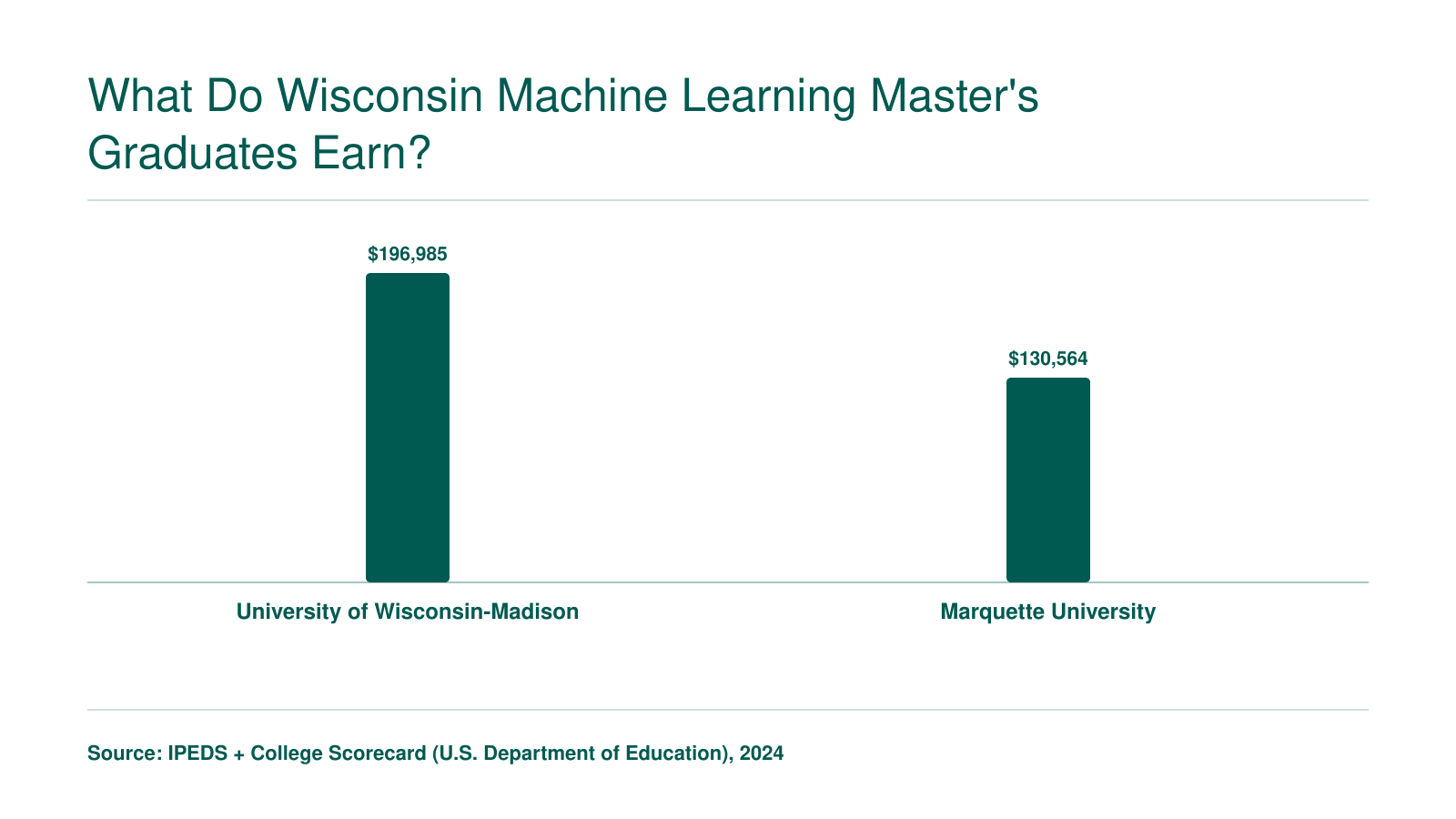
| University of Wisconsin-Madison WI | $196,985 | $12,325 | — | 142 | Campus |
| Marquette University WI | $130,564 | $24,680 | — | 24 | Hybrid |
| Ottawa University-Milwaukee WI | — | $13,002 | — | — | Hybrid |
| University of Wisconsin-Milwaukee WI | — | $12,728 | — | 46 | Campus |
| Milwaukee School of Engineering WI | — | $21,384 | — | — | Online |
Sources: U.S. Department of Education. Tuition and graduates: IPEDS. Earnings and debt: College Scorecard, this field's master's graduates; a dash means no figure is reported.
Online and Hybrid Machine Learning Master's Options in Wisconsin
Live online lectures versus evening classes on campus: that is the practical split between the two most clearly documented machine learning master's formats among master's programs in Wisconsin.
Milwaukee School of Engineering presents its Master's in Machine Learning (M.S.) as 100% online, but it is not self-paced. Courses are synchronous, with two live, two-hour lectures on Microsoft Teams each week on set nights. Full-time students take two courses (8 credits) per term and can finish the 32-credit degree in about two years. Part-time students take one course and typically need about three. MSOE's course schedule also lists some in-person and asynchronous sections, so the mix can shift by term. Its published materials show no campus residency, though local students may meet faculty on campus.
The University of Wisconsin-Milwaukee's M.S. in Artificial Intelligence and Machine Learning runs mainly in person, with evening classes and some online courses. Full-time students can finish in about three semesters, part-time students in about five. It suits Milwaukee-area working professionals better than fully remote learners.
Before assuming any program is fully remote, ask admissions:
- Whether every required course is offered online each term
- Which classes meet live, and at what times
- How online credits count toward full-time status for aid or visas (MSOE limits this in fall and spring)
Which Wisconsin Master's in Machine Learning Programs Waive or Make the GRE Optional
For most applicants the real question is not whether to study for the GRE but whether the math and programming background is already in place. Across these Wisconsin programs, test scores matter far less than prerequisite coursework, a pattern consistent with Master's in Machine Learning Programs With No GRE Required.
GRE Policies
- UW-Milwaukee: The Artificial Intelligence and Machine Learning program does not require the GRE. Minimum GPA is 2.75.
- MSOE: The M.S. in Machine Learning sets a 3.0 GPA bar and reviews applicants below that case by case. General graduate admission asks for a GRE or GMAT score only when the GPA falls under 3.0; the dedicated program page does not state a separate waiver.
- UW-Green Bay: No standardized test is required unless a specific program says otherwise.1 The 2.75 GPA requirement can be met on a cumulative basis, over the last 60 hours, or across 9 graduate credits.1
- UW-Madison and Ottawa University-Milwaukee: No current machine learning admissions policy was established for these schools, so confirm requirements directly.
Prerequisite Coursework
UW-Milwaukee expects linear algebra, multivariable calculus, statistics, and computer literacy, provable through coursework, exams, or a portfolio; applicants may enter with up to 6 prerequisite credits remaining. MSOE wants a technical bachelor's, a year each of calculus and programming, and object-oriented experience in C++ or Python. Those short on programming may add CSC 5120 as a bridge course.
Related Articles
Cost of a Master's in Machine Learning in Wisconsin, Plus Licensure and Certification
Cost here means the per-credit tuition you pay, multiplied by the credits a program requires, plus mandatory fees, minus any scholarships or waivers. Public schools charge Wisconsin residents one rate and out-of-state students another; private schools charge a single rate to everyone.
How the Ranked Schools Compare
At UW-Milwaukee, published graduate figures put in-state tuition and fees well below the out-of-state rate, making it the most affordable master's in machine learning programs option here. UW-Madison follows, with a larger gap between resident and non-resident pricing. The two private schools, Milwaukee School of Engineering and Marquette, charge every student the same rate and land higher overall.
MSOE lists its 2026-2027 tuition at $1,718 per credit. With 32 credits required, that works out to roughly $54,976 in tuition before fees and textbooks. Treat older totals on its pages as outdated once the current per-credit rate is published.
Scholarships and Waivers
UW-Milwaukee is offering support for engineering students enrolling through Fall 2026: a $2,000 guaranteed scholarship per year for full-time study (12 or more credits), plus up to $4,000 in additional merit aid over a two-year master's for heavier course loads.1 The $75 application fee and the GRE are both waived.1 Confirm current terms with the school, since availability and renewal conditions can change.
Licensure and Certification
Wisconsin has no state license for machine learning work. Industry certifications such as Google Cloud's Professional Machine Learning Engineer certification (a $200 exam with no formal prerequisites), AWS Certified Machine Learning, or Microsoft's Azure AI Engineer Associate are optional extras some employers value, not requirements to practice.
What Do Wisconsin Machine Learning Master's Graduates Earn?
Federal data reports program-level median earnings for only some of the schools ranked here. The chart shows those that have a published figure, measured four years after graduates finish. Schools without a program-level number are left out rather than filled in with institution-wide earnings.
Wisconsin Machine Learning Master's FAQ
Which Wisconsin universities offer a true standalone master's in machine learning?
Is an M.S. in Artificial Intelligence the same as a machine learning degree?
Can I keep working full time while earning a machine learning master's in Wisconsin?
Compare Machine Learning programs on the data that matters
Explore more Computers & IT specializations or browse every graduate field.
All Computers & IT programs