Most Affordable Master's in Machine Learning Programs
Compare 150+ accredited most affordable Machine Learning programs at 140+ schools, with graduate earnings, cost, debt, and completion data from IPEDS and the U.S. College Scorecard.

A regional public campus or a flagship hybrid program? The price gap is wide. Texas A&M-Kingsville lists $6,157 in-state for its computer science M.S., while the University of Washington's AI and machine learning master's lists $18,792. Mandatory fees come on top of both.
The programs here mix online, campus, and hybrid formats, including several built for working professionals.
Texas public universities hold much of the low end, but a low sticker price says little about what graduates earn afterward.
Key Points
- 2027 rankings weigh tuition against delivery format and career fit.
- Georgia Tech's online master's charges $227 per credit this fall.
- ROI rankings compare earnings to debt from federal education data.
Best Affordable Master's in Machine Learning Programs Ranked
Our 2026 affordability ranking pairs graduate tuition with machine learning course content, delivery format, and career fit. Graduation rates reflect the institution overall, while net price is an institution-wide average after aid, not a quote for any specific program. We focus on schools where lower tuition can still open doors to ML engineering, AI research, and data science roles.
The University of Texas at El Paso
#1El Paso, TX · $5,000 – $10,000/yr (est.)
Best for: Border-region students seeking AI concentration
This public border-region university combines a 30-credit AI degree with a concentration in machine learning, deep learning, and decision-making. Students choose a thesis for research or a practicum for hands-on industry work, and admission is GRE optional. The campus-based experience offers close faculty collaboration for careers such as machine learning engineer, AI researcher, and data scientist.
- 30-credit AI master's, not a standalone ML degree
- Machine learning, deep learning, and decision-making concentration
- Thesis or hands-on industry practicum option
- GRE optional; requires two recommendation letters
- Java or C++ programming plus probability and statistics required
- Campus-based in El Paso, Texas
New College of Florida
#2Sarasota, FL · $11,000 – $28,000/yr (est.)
Best for: Florida residents wanting paid industry practicum
This small Florida public college runs a two-year, in-person cohort data science master's with a machine learning and AI concentration. The final semester is a full-time paid industry practicum, and the curriculum is built with corporate partners such as the USDA Agricultural Research Service and LexisNexis. Florida resident tuition is a major affordability advantage, but the program is not online.
- Applied data science master's with ML and AI concentration
- Cohort-based with two or three campus days per week
- Paid full-time industry practicum in final semester
- Corporate partners include USDA ARS and LexisNexis
- Fall-only full-time start; not offered online
- Reports 100% job placement and $95,000 median salary
University of Illinois Chicago
#3Chicago, IL · ~$18,000/yr (est.)
Best for: Working professionals needing accelerated online AI
This urban public research university offers an online Master of Engineering focused on AI and machine learning. The 36-credit, nine-course path uses accelerated 8-week terms and covers computer vision, natural language processing, and AI ethics. Students can study full-time or part-time, with a non-thesis project-based format and pay-by-the-course billing.
- 36-credit online engineering master's, not a standalone ML degree
- AI, machine learning, and neural networks focus
- Accelerated 8-week terms; 12-month completion possible
- Covers computer vision, NLP, and AI ethics
- Project-based non-thesis format with leadership development
- Full-time and part-time study options
East Texas A&M University
#4Commerce, TX · ~$7,000/yr (est.)
This Texas public university's MS in Computer Science includes an AI and machine learning track alongside cybersecurity, data science, and robotics. Students may complete the degree fully online or in person in 1.5 to 2 years, choosing between thesis and non-thesis paths. The AI track is two courses, or six semester hours.
- Computer science master's with AI and ML track
- Fully online option plus face-to-face in Commerce
- 1.5 to 2-year completion timeline
- AI track requires two courses, six semester hours
- Thesis option 30 credits; non-thesis 37 credits
- Prerequisites: bachelor's, Calculus I, programming in C++, Java, or Python
University of Washington-Seattle Campus
#5Seattle, WA · ~$19,000/yr (est.)
This large public research university delivers a stackable MS in AI and machine learning for practicing engineers. It requires a core AI/ML certificate, a discipline-specific certificate, and an applied capstone, with part-time and online options. No GRE is required and the program was developed with support from The Boeing Company.
- Engineering-focused artificial intelligence and machine learning master's
- Required AI/ML certificate plus discipline-specific certificate
- Applied capstone required
- Part-time and online options
- No GRE required
- Developed with support from The Boeing Company
Texas A&M University-Kingsville
#6Kingsville, TX · ~$6,000/yr (est.)
This Texas A&M system campus offers a 30-credit computer science master's with an AI and deep learning concentration. Students can add data science or cybersecurity options and choose a thesis or course-only path. Foundation coursework accommodates students entering from non-CS backgrounds.
- 30-credit computer science master's
- AI and deep learning concentration
- Also offers data science and cybersecurity concentrations
- Thesis or course-only path
- Core courses in networking and algorithms
- Foundation courses for non-CS majors
Western Governors University
#7Salt Lake City, UT · ~$9,000/yr (est.)
This national online university uses a competency-based model for an MS in Computer Science with an AI and machine learning concentration. Students progress at their own pace, with many finishing in about 19 months, and the program includes the AWS Certified Machine Learning Engineer certification. Topics include deep learning, NLP, reinforcement learning, and neural networks.
- Online competency-based computer science master's
- AI and machine learning concentration
- 10 courses; many finish in about 19 months
- Includes AWS Certified Machine Learning Engineer certification
- Covers deep learning, NLP, reinforcement learning, and neural networks
- Rolling admissions with 12 start dates per year
Tennessee Tech
#8Cookeville, TN · $10,000 – $15,000/yr (est.)
This Tennessee public university's computer science master's includes a machine learning concentration built on core CS principles. Students choose thesis, project, or course-only paths, with small classes and faculty research in machine intelligence, cybersecurity, and data science. Interdisciplinary projects with engineering and national labs add practical experience.
- Computer science master's with machine learning concentration
- 30 total credit hours
- Thesis, project, or course-only options
- Small class sizes and close faculty interaction
- Interdisciplinary research with engineering departments and national labs
University of North Texas
#9Denton, TX · $9,000 – $16,000/yr (est.)
This North Texas public university offers a face-to-face MS in Artificial Intelligence with a machine learning concentration. The program uses a 30-hour thesis track or a 33-hour course-only track, with 12 hours of ML concentration coursework and six hours of bridge courses as needed.
- AI master's with machine learning concentration
- 30-hour thesis track or 33-hour course-only track
- 12 hours in machine learning concentration
- 6 hours of bridge coursework available
- Requires 3.0 GPA after first semester
- Face-to-face interdisciplinary format
University of Michigan-Dearborn
#10Dearborn, MI · ~$17,000/yr (est.)
This Michigan public university offers a 30-credit MS in Artificial Intelligence that can be completed on campus, fully online, or in a hybrid format. The machine learning concentration is one of four options, with electives in deep learning and data mining. Evening classes and no GRE requirement support working professionals.
- 30-credit AI master's
- Machine learning concentration plus computer vision, intelligent interaction, and knowledge management
- Fully online, campus, or hybrid formats
- No GRE; rolling admissions
- Late afternoon and evening classes
- Electives include deep learning and data mining
- Requires STEM bachelor's with 3.0 GPA; programming, math, statistics
Cost & outcomes by school
Federal data for the highest-earning Machine Learning programs, independent of the ranking above. Earnings are this field's master's graduates four years after completing, where the Scorecard reports them.
| School | Earnings | Tuition / yr | Debt | Grads/yr | Format |
|---|---|---|---|---|---|
| University of Wisconsin-Madison WI | $196,985 | $12,325 | — | 142 | Campus |
| Georgia Institute of Technology GA | $195,622 | $15,962 | $20,500 | 3,014 | Online |
| Carnegie Mellon University PA | $193,154 | $50,975 | $61,305 | 825 | Campus |
| Johns Hopkins University MD | $176,945 | $64,730 | $26,126 | 397 | Campus |
| University of Washington-Seattle Campus WA | $170,194 | $18,792 | $36,600 | 289 | Hybrid |
| Pennsylvania State University PA | $166,387 | $24,650 | $41,000 | 13 | Online |
| Northeastern University MA | $145,909 | $29,174 | $41,000 | 1,133 | Campus |
| George Mason University VA | $142,690 | $17,964 | $26,262 | 515 | Campus |
| Georgia State University GA | $136,876 | $8,664 | $30,750 | 198 | Campus |
| The University of Texas at Dallas TX | $130,924 | $15,168 | $22,374 | 515 | Campus |
| University of Central Florida FL | $123,587 | $8,872 | $29,403 | 202 | Campus |
| University of North Georgia GA | — | $5,416 | — | — | Campus |
Sources: U.S. Department of Education. Tuition and graduates: IPEDS. Earnings and debt: College Scorecard, this field's master's graduates; a dash means no figure is reported.
Cost, debt & payoff
Median earnings of this field's master's graduates (4 yrs after completing) vs. their median federal loan debt · U.S. College Scorecard
Across these programs the median graduate earns about $138,766 and finishes with roughly $37,072 in debt — a ratio that clears a common rule of thumb (keep debt below first-year salary). Tuition and debt vary widely school to school, so check the per-school figures in the table above before you shortlist.
Machine Learning Master's Total Cost With Fees: What Tuition Leaves Out
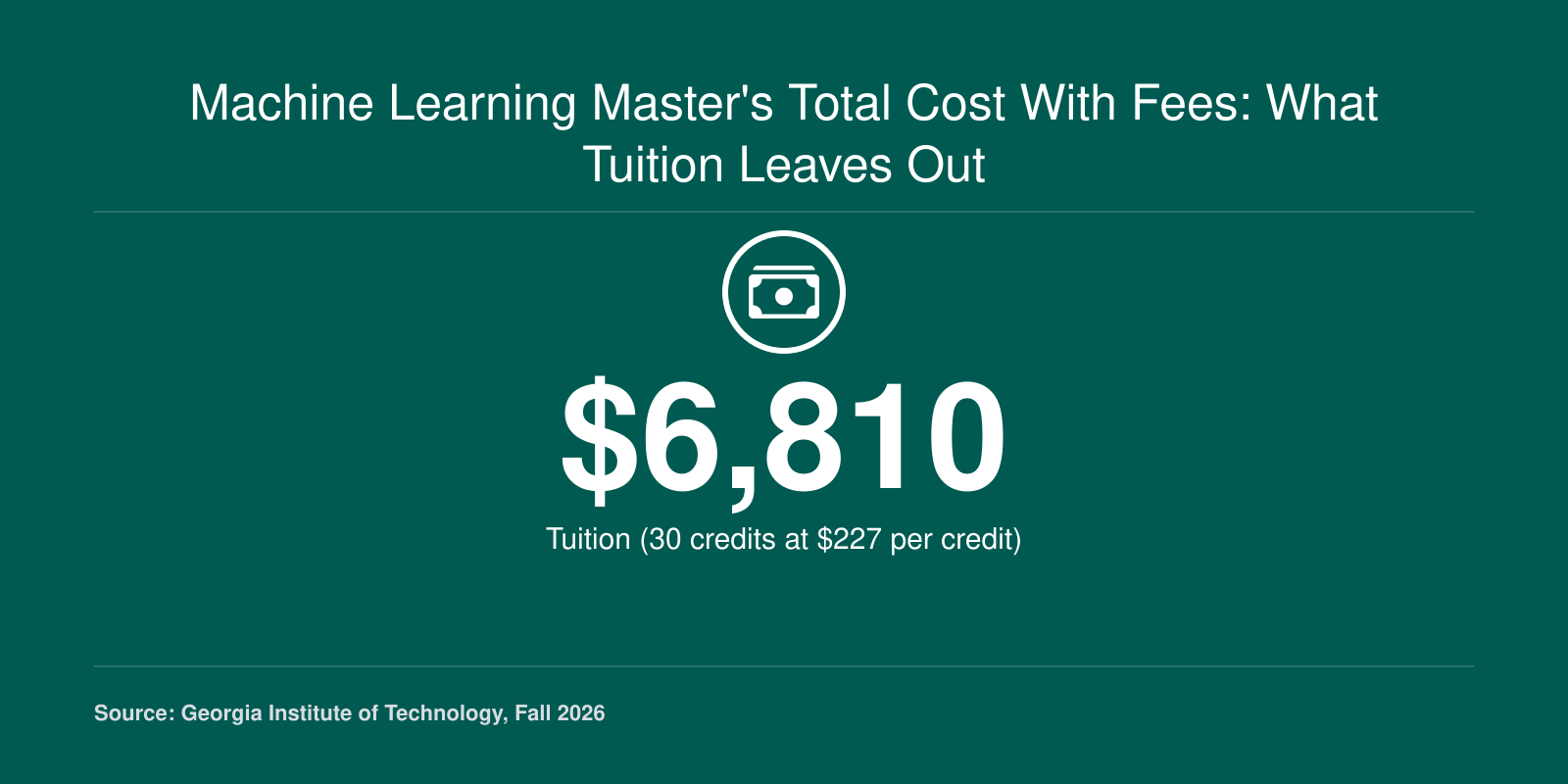
Published tuition doesn't tell the whole story. At Georgia Tech's online M.S. in Computer Science, the Fall 2026 tuition rate is $227 per credit, or $6,810 for the 30 credits required. Students also pay a mandatory online learning fee of $531 per term when enrolled in four or more credits. Over a typical 10-course, 10-term schedule, that adds $5,310, bringing the estimated total to $12,120, roughly 78 percent more than tuition alone. Separate costs for books, software, cloud compute, or online exam proctoring are not itemized in the published fee schedule. At public universities, out-of-state and international students often pay higher per-credit tuition or additional fees, widening the gap further.
Machine Learning vs. AI Master's Degree: Which Fits Your Career?
A dedicated Master's in Machine Learning is not just a rebranded AI degree. The coursework splits in ways that should drive your decision.
Carnegie Mellon's MS in Machine Learning illustrates the mathematical spine: six required core courses covering machine learning, statistics and probability, optimization, graphical models, deep learning, and reinforcement learning,1 plus electives and a required practicum. If you want to engineer models and tune systems, that depth is the point.
An AI master's is broader by design. UT Austin's online MSAI requires only 3 of 30 credit hours, names Machine Learning as its foundational course, and leaves specialization to electives, while Johns Hopkins Engineering for Professionals lists a five-course AI core with algorithms and Python prerequisites2 and allows advisor-approved waivers. These programs add reasoning, robotics, and ethics coursework that a pure ML degree may touch only lightly.
A computer science master's with an ML concentration sits between them: you get a broad CS foundation in algorithms and systems plus some ML electives, but the ML signal on a resume is weaker because the core is not standardized.
Rule of thumb: choose ML for engineering and modeling roles, and AI or CS for broader or research-adjacent paths.
Related Articles
Graduate Earnings, Debt, and ROI: the Best Value Picks
The best value picks are ranked by ROI ratio, which compares earnings to debt from U.S. Department of Education data. Program-level median debt and the 10-year monthly payment appear only where published. Where program-level figures are not reported, the table omits them rather than substituting school-wide averages.
| School | ROI Ratio | Program Median Debt | 10-Year Monthly Payment | Median Earnings 1 Year After Finishing |
|---|---|---|---|---|
| Western Governors University | 5.45x | N/A | N/A | N/A |
| University of Washington-Seattle Campus | 5.37x | $36,600 | $416 | $123,084 |
| University of Maryland-College Park | 4.36x | N/A | N/A | $89,502 |
Online vs. On-Campus ML Master's for Working Professionals
For a working engineer, delivery format matters more than campus address. Asynchronous courses, common in accredited online machine learning master's programs, release lectures and assignments on a schedule you fit around your job, with no fixed class meeting time. UT Austin's online MSAI runs this way: instructor-paced, with on-demand lectures released weekly.1 Synchronous courses require you to log in live, which collides with on-call rotations and standups.
Part-time pacing stretches the calendar. Georgia Tech's OMSCS, where the OMSCS Machine Learning Specialization lives, typically takes about three years part-time.2 UT Austin recommends completion models spanning roughly 1.5 to 3 years.1 CU Boulder's MS-AI is designed for 12 to 24 months at either pace, with up to eight years allowed and 8-week sessions you can skip without penalty.
A longer horizon can add cost. Georgia Tech charges $227 per credit hour for Fall 2026 plus a mandatory online learning fee each semester you enroll ($212 under four credits, $531 at four or more)3, so more terms means more fee payments.
On credentials: Georgia Tech's diploma reads Master of Science in Computer Science, identical to on-campus,2 and CU Boulder's omits any online notation.
Sticker tuition is only the starting number. The real bargain is the program with the lowest total cost after fees and debt that still delivers strong graduate earnings.
Accreditation and Admissions Prerequisites for ML Master's Programs
- Institutional accreditationMachine learning programs fall under institutional accreditation only; no separate machine-learning-specific accreditor exists. Check each school's regional accreditor, commonly SACSCOC, HLC, or WSCUC. Texas A&M-Kingsville, for example, states SACSCOC accreditation.
- Bachelor's degree and GPAA bachelor's degree is standard. Several programs here list a 3.0 minimum (University of Washington and Michigan-Dearborn). At a selective benchmark like Carnegie Mellon's M.S. in Machine Learning, incoming GPA is around 3.9/4.0.
- Math prerequisitesExpect calculus, linear algebra, and probability/statistics. UTEP requires probability and statistics knowledge; Carnegie Mellon requires a year of college-level probability/statistics plus matrix algebra and multivariate calculus.
- Programming prerequisitesPython proficiency and data structures/algorithms are common. UTEP lists Java or C++; Carnegie Mellon recommends Java, Python, and tools like R and scipy-numpy. Non-CS applicants may need bridge coursework.
- GRE and readiness without a CS degreeGRE policies vary: some programs here are test-optional or waive the GRE, while Texas A&M-Kingsville still lists GRE as an entrance exam. Applicants without a CS degree can often show readiness through bridge courses (University of North Texas lists six hours) or MOOCs.
Machine Learning programs by state
Common Questions About Affordable ML Master's Programs
Prospective students often weigh flexibility, prerequisites, and whether employers will value an online degree before committing. Here are concise answers to the questions that come up most when comparing affordable ML master's programs.
Do employers recognize online machine learning degrees?
Can I complete an affordable ML master's part-time while working?
Can I get into an ML master's without a computer science bachelor's degree?
Does employer tuition assistance usually cover an ML master's, and what tax limit applies?
Compare Machine Learning programs on the data that matters
Explore more Computers & IT specializations or browse every graduate field.
All Computers & IT programs