Best Master's in Machine Learning Programs in Maryland
Compare 5 accredited Machine Learning programs in Maryland, with graduate earnings, cost, debt, and completion data from IPEDS and the U.S. College Scorecard.

Public and private options bracket Maryland's machine learning master's market. Johns Hopkins computer science master's graduates posted a median $139,520 one year out; Bowie State's in-state graduate tuition runs $9,218 a year. Federal research labs, defense contractors, and biotech employers cluster from Baltimore to the D.C. suburbs.
Campus and online formats appear on one ranked list. The practical question is not prestige but fit: which pace, location, price point, and admissions policy match your schedule, from Accelerated Master's in Machine Learning Programs to Master's in Machine Learning Programs With No GRE Required. The real filter is whether you can finish the degree while working.
Key Points
- UMD's 30-credit M.P.S. in Machine Learning costs $1,034 per credit in-state.
- Johns Hopkins computer science graduates earned a median $139,520 after one year.
- UMD's professional AI master's can be completed online or on campus.
Best Master's in Machine Learning Programs in Maryland, Ranked
Maryland offers four machine learning master's options in this ranking, spanning a research-focused private university, a flagship public program built for working professionals, an online-first computer science degree, and a lower-cost public option. Graduation rates below describe each school as a whole, not the machine learning program itself. Tuition figures are institution-wide graduate rates, so confirm program-specific pricing with each school.
Johns Hopkins University
#1Baltimore, MD · ~$65,000/yr (est.)
Best for: Thesis-track students pursuing AI research
Johns Hopkins in Baltimore is a campus-based, research-heavy option, and the school graduates about 94% of its students. The AI master's track sits in the Computer Science department and draws on machine learning, text and speech, and vision and robotics. Graduate tuition is $65,230 for in-state and out-of-state students alike, the highest of the four.
- Five AI courses, or four plus a master's project or thesis
- Requires at least one course from each of three core areas
- Machine Learning core includes Deep Learning and Explainable AI Design
- Independent study or thesis work with faculty
- Research access through the Laboratory for Computational Sensing and Robotics
- Graduates have joined Google, Microsoft, Meta, Amazon and Apple
University of Maryland-College Park
#2College Park, MD · ~$18,000/yr (est.)
Best for: Working professionals needing evening classes
The University of Maryland in College Park graduates about 89% of its students. Its Master of Science in Applied Machine Learning is a non-thesis, on-campus program with evening classes. Institution-wide graduate tuition is $11,809 in-state and $41,186 out-of-state, but the program's Science Academy uses a flat rate that does not vary by residency, so confirm the program rate directly.
- 30 credits across 10 courses, non-thesis
- Face-to-face evening classes for working professionals
- Electives in deep learning, natural language processing and computer vision
- Core topics in probability, optimization and data science
- Admission requires a bachelor's degree and a 3.0 minimum GPA
- Can be completed in under two years
Capitol Technology University
#3Laurel, MD · ~$12,000/yr (est.)
Best for: Remote learners wanting year-round start dates
Capitol Technology University in Laurel offers a Computer Science master's with an artificial intelligence area covering machine learning and neural networks, delivered live-online or asynchronously. The school graduates about 43% of its students. Graduate tuition is $27,592 for both in-state and out-of-state students.
- Fully online option, live-online or asynchronous
- 15-credit core plus five courses in an elected area
- AI area includes Machine Learning & Neural Networks and Deep Learning
- Elected areas: AI, Cybersecurity or Software Engineering
- No GRE or GMAT required, 3.0 GPA standard
- Rolling admission with eight-week sessions
Bowie State University
#4Bowie, MD · ~$11,000/yr (est.)
Bowie State University is the most affordable campus option here, with graduate tuition of $9,218 in-state and $19,938 out-of-state. The school graduates about 38% of its students. Its computer science master's offers an AI and machine learning concentration, with ties to NASA Goddard and Fort Meade.
- 30 credit hours with five core courses
- Choose an applied research track or a thesis
- Minimum 2.5 GPA and prerequisite courses required
- Graduate assistantships with tuition waiver and fellowships
- Listed as available online
- $40 application fee
Cost & outcomes by school
Federal data for the highest-earning Machine Learning programs, independent of the ranking above. Earnings are this field's master's graduates four years after completing, where the Scorecard reports them.
| School | Earnings | Tuition / yr | Debt | Grads/yr | Format |
|---|---|---|---|---|---|
| Johns Hopkins University MD | $176,945 | $64,730 | $26,126 | 397 | Campus |
| Bowie State University MD | — | $10,854 | — | 16 | Campus |
| Capitol Technology University MD | — | $12,060 | — | 13 | Online |
| Towson University MD | — | $12,636 | — | 42 | Campus |
| University of Maryland-College Park MD | — | $18,276 | — | 126 | Campus |
Sources: U.S. Department of Education. Tuition and graduates: IPEDS. Earnings and debt: College Scorecard, this field's master's graduates; a dash means no figure is reported.
UMD's Machine Learning Master's Degrees: Applied M.S., M.P.S., and AI M.S. Compared
Searching for UMD's machine learning master's turns up several program pages because they are separate degrees aimed at different students, not one program described three ways. The comparison below draws on UMD's catalog and College of Computer, Mathematical, and Natural Sciences (CMNS) pages. Where an attribute is not published in those sources, the table says so rather than estimating.
| Attribute | M.S. in Applied Machine Learning | Machine Learning M.P.S. | M.S. in Artificial Intelligence |
|---|---|---|---|
| Offering college | CMNS | Not published | CMNS |
| Intended student | ML/AI engineers, data scientists, and data analysts applying ML to real-world problems | Not published | Interdisciplinary AI applicants, including those from nontechnical backgrounds |
| Format | In-person and online versions | Not published | In-person and online versions |
| Credits and length | 30 credits; typical length not published | Not published | 30 credits; typical length not published |
| Curriculum focus | Technical ML: probability and statistics, data science, machine learning, computing systems for ML, algorithms and data structures | Not published | Human-centered AI: shared foundations plus Deep Learning and Applied Ethics of AI |
| Capstone or thesis | Not published | Not published | Non-thesis; specific capstone not published |
| Choose this if | You want a technical, engineering-oriented ML degree. | You are willing to confirm its details directly with UMD, since none are published in the sources reviewed. | You want AI studied alongside ethics and societal impact, or you are coming from outside computing. |
Online and Hybrid Master's in Machine Learning Options in Maryland
Online and hybrid options in Maryland are more limited than the national lists of best online master's in machine learning programs suggest. Johns Hopkins University's AI Master's Track is campus-based. UMD's professional AI master's can be completed online or on campus in College Park,1 while the university's Applied Machine Learning M.S. is available online and in person with evening classes built for working professionals. Capitol Technology University lists a fully online computer science master's with a machine learning concentration and notes that on-campus courses are available for F-1 visa students. Bowie State indicates an online option for its computer science master's with an AI/ML focus, alongside campus delivery. Published details on synchronous versus asynchronous scheduling and separate part-time completion timelines are inconsistent, so confirm those mechanics directly. International students should be especially careful: online enrollment may not satisfy F-1 full-time on-campus requirements, and STEM OPT eligibility depends on the enrolled format, even though these programs sit under a computer and information sciences CIP code. For working professionals, UMD's evening schedule and the online options at Capitol and Bowie provide the most practical fit among Master's Programs in Maryland, but ask about live session times before committing.
Match the degree to your background and your schedule first. The best machine learning master's is the one you can finish, afford, and apply.
Which Maryland Machine Learning Master's Programs Waive or Make the GRE Optional
Admissions pages at the ranked schools vary in how clearly they state GRE rules, so the table notes where no policy is published. Most programs expect calculus, linear algebra, probability and statistics, and Python, though the exact course lists differ. Check each program's current admissions page before applying, since deadlines change by term.
| School | GRE Policy | Key Prerequisites | Minimum GPA | Application Deadline |
|---|---|---|---|---|
| University of Maryland, College Park: Applied Machine Learning, M.S. | GRE optional | Calculus II, linear algebra, and statistics; programming proficiency, preferably Python, MATLAB, or R, shown through coursework or substantial software-development experience | 3.0 on a 4.0 scale | Spring 2027: international September 30, 2026, domestic October 30, 2026. Fall 2027: international February 26, 2027, domestic May 28, 2027 |
| Johns Hopkins University: M.S. in Artificial Intelligence | No published policy | Single-variable and multivariable calculus; one semester each of linear algebra, probability and statistics, and Python; Modern Software Concepts in Python or equivalent | Not published | Not published |
| Johns Hopkins University: M.S.E. in Computer Science, Artificial Intelligence track | GRE not required | Not published | Not published | Spring 2027: October 1. Fall 2027: February 15 |
| University of Maryland, College Park: M.S. in Journalism and Public Affairs, Data Science specialization | GRE not required | Two programming courses, one statistics course, and a computer science background | 3.0 on a 4.0 scale | Not published |
Related Articles
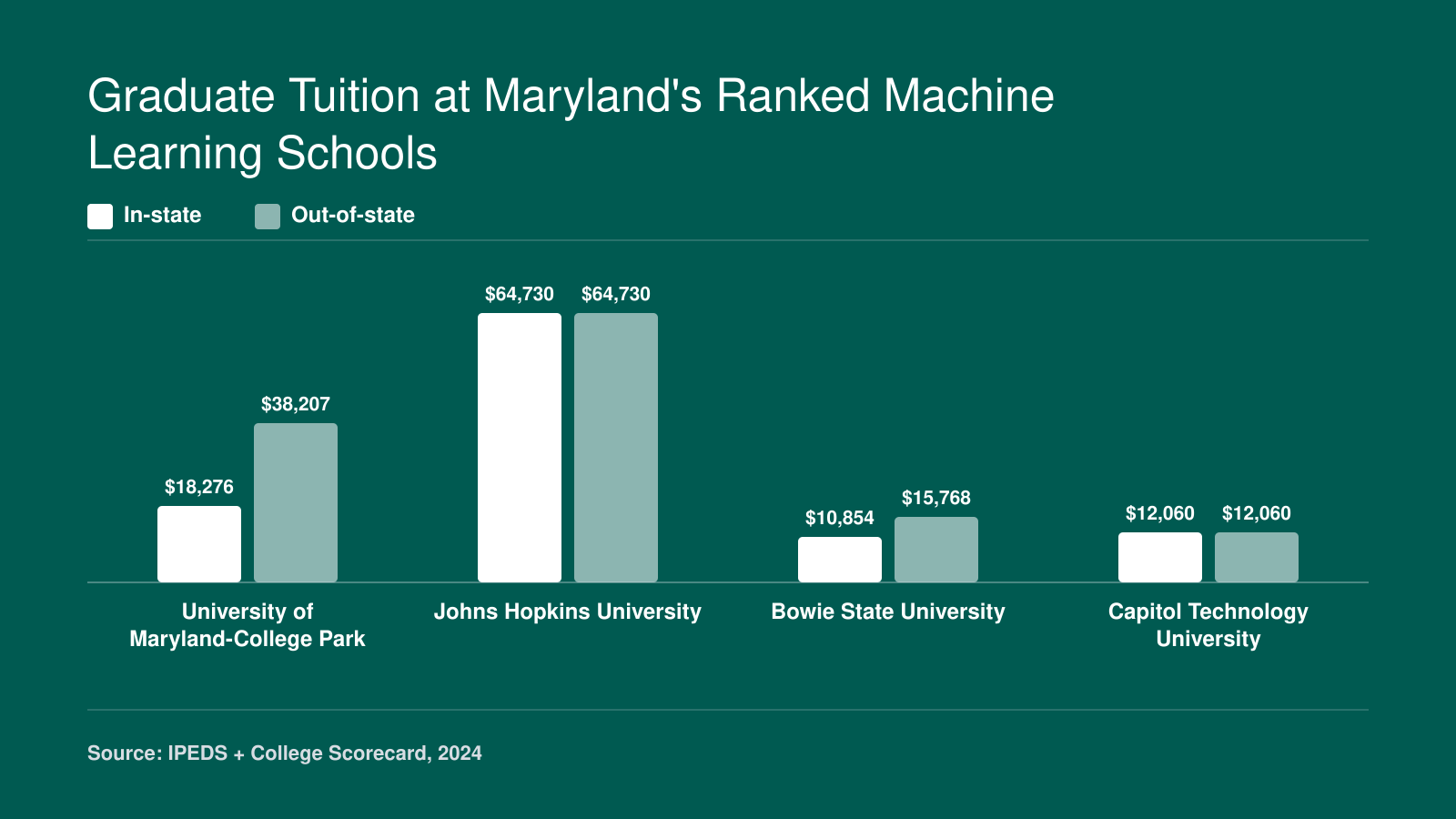
Graduate Tuition at Maryland's Ranked Machine Learning Schools
These are annual graduate tuition and fee figures, not the total cost of a degree, so multiply by the length of your program. The widest gap between resident and non-resident rates is at the University of Maryland-College Park, where out-of-state students pay $19,931 more per year. Johns Hopkins and Capitol Technology University charge one rate regardless of residency.
Master's Tuition and Maryland Certification or Licensure for Machine Learning Graduates
The University of Maryland-College Park's Master's in Machine Learning (M.P.S.) requires 30 credits. The university's standard FY 2026 graduate rates are $1,034 per credit in-state and $2,054 out-of-state. If those standard rates apply, tuition would total about $31,020 for residents and $61,620 for non-residents, before mandatory fees and living costs. Confirm the rate with the program first. The university charges special rates for its M.S. in Applied Machine Learning and M.S. in Artificial Intelligence, and those rates make no resident or non-resident distinction.
Johns Hopkins University is private, so residency does not change the price. Its Data Science M.S.E. lists 2026 tuition of $66,670 per year, or $33,335 per semester, and students typically finish in three to four full-time semesters.
Maryland has no state license or certification for machine learning engineers or data scientists. For many federal and defense roles in the region, a security clearance carries more weight than any credential.
Any net price figure you see for these schools is an institution-wide average across all students. It is not a quote for your program.
Career Outcomes and Earnings for Machine Learning Master's Graduates in Maryland
Federal outcomes data for these programs follows the broader computer science master's category, so treat the figures as a close proxy rather than a machine-learning-only result.
- Johns Hopkins University: Graduates earned a median of $139,520 one year after finishing and $169,587 five years after, against median debt of $26,126. The program reported 296 completions.
- University of Maryland-College Park: Graduates earned a median of $89,502 one year after finishing, with 38 completions reported.
Hopkins pairs a thesis or capstone option with access to the Laboratory for Computational Sensing and Robotics and the Center for Language and Speech Processing, and it reports graduates hired at Google, Microsoft, Meta, Amazon, and Apple. UMD's degrees sit near the AIM institute, TRAILS, and the Center for Machine Learning1, though its M.S. in AI is non-thesis and offers no research track. Bowie State cites connections to NASA and Fort Meade.
Is it worth it? For most students, yes. Even Hopkins's median debt sits well below first-year earnings, and UMD's in-state tuition keeps it among the most affordable master's in machine learning programs, making its payback faster still.
Frequently Asked Questions About Master's in Machine Learning Programs in Maryland
Which Maryland university has the best machine learning master's program?
Can I get a master's in machine learning online in Maryland?
What is the difference between UMD's Applied Machine Learning and Machine Learning M.P.S.?
Can I apply to a Maryland machine learning master's without a computer science degree, and do any schools offer bridge or foundational courses?
Compare Machine Learning programs on the data that matters
Explore more Computers & IT specializations or browse every graduate field.
All Computers & IT programs