Accelerated Master's in Machine Learning Programs
Compare 150+ accredited fastest Machine Learning programs at 140+ schools, with graduate earnings, cost, debt, and completion data from IPEDS and the U.S. College Scorecard.

Can you actually finish a machine learning master's in 12 months? Several programs here are built for it: Carnegie Mellon's 5th-Year MS, the 36-credit online MEng at University of Illinois Chicago with its eight-week terms, and Minnesota's 12-month business analytics cohort. The pace is the price. Three or four graduate courses a term buys an earlier return to the job market.
Formats split across campus, fully online, and hybrid. Tuition, prerequisite coursework, and post-graduation earnings vary far more between these programs than completion time does, even where a Master's in Machine Learning With No GRE Required path is available.
Key Points
- Every ranked school holds regional institutional accreditation.
- Tuition ranges from $525 (Colorado Boulder) to $1,922 per credit (Northeastern).
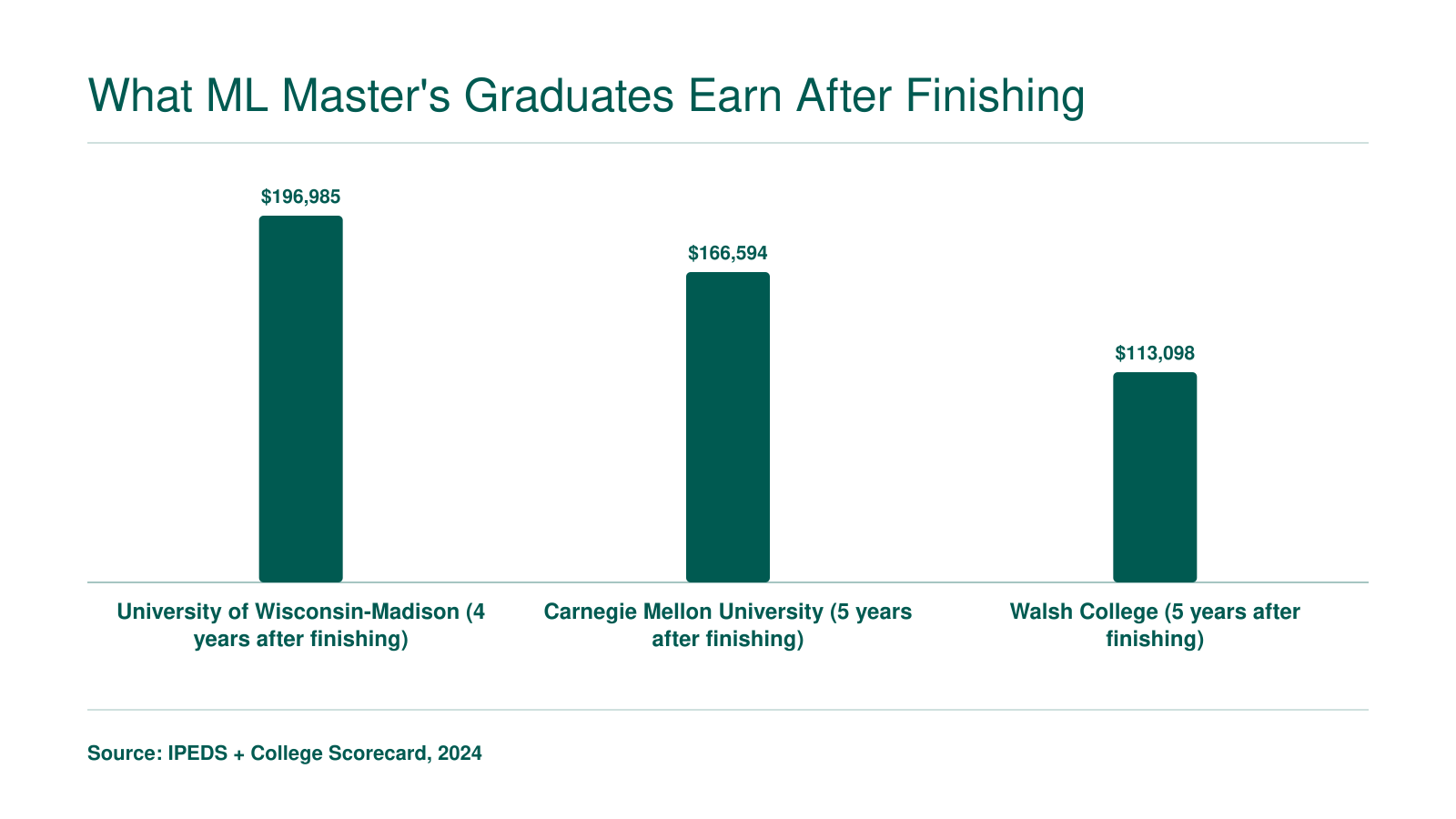
- Median post-graduate earnings span $113,098 to $196,985.
The 10 Best Accelerated Machine Learning Master's Programs
These are the top accelerated or one-year machine learning master's programs in our data, ordered by page rank. Each entry summarizes the delivery format, estimated tuition, and the concentration or classroom feature that sets it apart.
Carnegie Mellon University
#1Pittsburgh, PA · ~$51,000/yr (est.)
Best for: Current CMU undergraduates pursuing ML
Carnegie Mellon's accelerated machine learning master's is a fifth-year option limited to current CMU undergraduates, with three graduate courses double-counted from the bachelor's and no thesis or capstone requirement. The 144-unit program is full time in Pittsburgh and can be completed in 12 months, including a summer practicum. In-state and out-of-state graduate tuition and fees are both about $66,246.
- No thesis or capstone required
- No GRE scores required
- Three graduate courses double-count from the bachelor's
- Summer practicum internship or research
- Open to any CMU major
- 144 units
- Starts fall or spring
University of Wisconsin-Madison
#2Madison, WI · ~$12,000/yr (est.)
Best for: Electrical engineers pursuing signal-processing ML
Wisconsin's Machine Learning and Signal Processing MS sits inside electrical and computer engineering and is a course-only, accelerated master's with no thesis or capstone. The 30-credit program blends machine learning with signal processing and practical coding, and well-prepared students may finish in as few as 12 months. In-state and out-of-state graduate tuition and fees run about $11,603 and $42,103.
- No thesis or capstone required
- 30 total credit hours
- Machine learning plus signal processing concentration
- 3.0 GPA minimum
- Three letters of recommendation required
- Starts fall
- No GRE required
Duke University
#3Durham, NC · ~$67,000/yr (est.)
Best for: Research-bound students wanting AI/ML depth
Duke's MS in Computer Science offers an optional Artificial Intelligence/Machine Learning concentration within a 30-credit, 10-course curriculum. Students choose a project-based or course-only track and complete an oral exam, with advanced coursework that mirrors PhD-level classes. Graduate tuition and fees are about $68,758 for both in-state and out-of-state students.
- Artificial Intelligence/Machine Learning concentration
- 30 total credit hours
- Project-based or course-only option
- Oral exam as final milestone
- Same advanced coursework as PhD students
- 4+1 year format for undergrads
George Washington University
#4Washington, DC · ~$36,000/yr (est.)
George Washington's online Master of Engineering in Artificial Intelligence and Machine Learning is built for working professionals, with live evening classes, nine-week sessions, and five start dates per year. The 30-credit, 10-course program can be finished in as little as one year, with no GRE and no application fee. In-state and out-of-state graduate tuition and fees run about $67,710.
- 30 total credit hours
- 10 total courses
- Complete in as little as one year
- Live evening classes and nine-week sessions
- Five start dates per year
- No GRE or application fee
- Synchronous and asynchronous options
- $1,250 per credit
University of Minnesota-Twin Cities
#5Minneapolis, MN · ~$22,000/yr (est.)
Minnesota's Carlson School offers a 12-month, full-time MS in Business Analytics with machine learning and AI depth, including an AI for Business track. The cohort program includes a capstone with the Carlson Analytics Lab and reports a mean starting salary over $103,000. In-state and out-of-state graduate tuition and fees run about $17,214 and $38,362.
- Machine learning and AI for Business track
- 12-month, full-time cohort format
- Capstone with Carlson Analytics Lab
- GMAT or GRE optional
- STEM-designated degree
- Two letters of recommendation minimum
- Mean base starting salary over $103,000
Wentworth Institute of Technology
#6Boston, MA · $40,000 – $45,000/yr (est.)
Wentworth's MS in Applied Computer Science offers an AI and machine learning concentration with electives in computer vision, natural language processing, and deep learning. Students can choose a thesis or capstone, and a 4+1 accelerated track is available for undergraduates. Graduate tuition and fees are about $42,884 for both in-state and out-of-state students.
- Artificial Intelligence & Machine Learning concentration
- Thesis or capstone option
- 4+1 accelerated option available
- Electives in computer vision and NLP
- Accredited by NECHE
- Full-time, on-campus format
University of Illinois Chicago
#7Chicago, IL · ~$18,000/yr (est.)
UIC's online Master of Engineering with a focus area in AI and ML uses accelerated eight-week terms and can be completed in as few as 12 months. The 36-credit, nine-course non-thesis program covers neural networks, computer vision, and NLP, with full-time or part-time options. In-state and out-of-state graduate tuition and fees run about $14,338 and $29,884.
- Artificial Intelligence and Machine Learning focus area
- 36 total credit hours
- Nine total courses
- Accelerated eight-week terms
- Complete in as few as 12 months
- No thesis or capstone required
- 100% online
- $896 per credit
University of Michigan-Dearborn
#8Dearborn, MI · ~$17,000/yr (est.)
Michigan-Dearborn's 30-credit MS in Artificial Intelligence includes a Machine Learning concentration alongside options in computer vision, intelligent interaction, and knowledge management. Students can finish on campus, fully online, or in a hybrid mix, with late afternoon and evening classes and no GRE requirement. In-state and out-of-state graduate tuition and fees run about $15,640 and $32,896.
- Machine Learning concentration
- 30 total credit hours
- Fully online or hybrid option
- No GRE required
- Thesis or capstone option
- Evening classes
- Rolling admissions
Dominican University of California
#9San Rafael, CA · ~$21,000/yr (est.)
Dominican University of California's MS in Business Analytics and Artificial Intelligence includes a machine learning concentration and a hybrid evening and weekend schedule. The 36-credit, STEM-designated program can be completed in one year and requires no prior coding or statistics background. In-state and out-of-state graduate tuition and fees are about $52,161.
- Machine learning concentration
- 36 total credit hours
- Hybrid evening and weekend classes
- One-year completion
- No coding background required
- STEM-designated program
- $1,226 per credit
Walsh College
#10Troy, MI · ~$17,000/yr (est.)
Walsh College's MS in Artificial Intelligence and Machine Learning offers a Fast Track option to begin doctoral-level courses while finishing the master's. Students can take classes online with no set meeting times, live on Zoom, or in person, and complete a capstone or three practicum courses. The program can be finished in as little as one year.
- Fast Track to doctoral courses
- Can be completed in one year
- Synchronous or asynchronous online options
- In-person or Zoom class formats
- Capstone or practicum course option
- Prior credits may waive foundation courses
Cost & outcomes by school
Federal data for the highest-earning Machine Learning programs, independent of the ranking above. Earnings are this field's master's graduates four years after completing, where the Scorecard reports them.
| School | Earnings | Tuition / yr | Debt | Grads/yr | Format |
|---|---|---|---|---|---|
| University of Wisconsin-Madison WI | $196,985 | $12,325 | — | 142 | Campus |
| University of North Georgia GA | — | $5,416 | — | — | Campus |
| Wilmington University DE | — | $9,726 | — | — | Online or campus |
| Campbellsville University KY | — | $9,920 | — | — | Online |
| Lehigh University PA | — | $28,840 | — | — | Campus |
Sources: U.S. Department of Education. Tuition and graduates: IPEDS. Earnings and debt: College Scorecard, this field's master's graduates; a dash means no figure is reported.
Cost, debt & payoff
Median earnings of this field's master's graduates (4 yrs after completing) vs. their median federal loan debt · U.S. College Scorecard
Across these programs the median graduate earns about $138,766 and finishes with roughly $37,072 in debt — a ratio that clears a common rule of thumb (keep debt below first-year salary). Tuition and debt vary widely school to school, so check the per-school figures in the table above before you shortlist.
How We Ranked Accelerated ML Master's Programs
Six institutional accrediting agencies set the baseline: HLC, MSCHE, NECHE, NWCCU, SACSCOC, and WSCUC. Every ranked school below holds institutional accreditation, a non-negotiable first screen. Only programs with a one-year or otherwise accelerated completion path qualified.
We then compared programs on a small set of verifiable factors, with cost and completion signals carrying the most weight:
- Graduate tuition and net price
- Program-level earnings and debt where published
- Institution-wide graduation rate
Debt and program-level earnings are included only where reported, so a school may be assessed on fewer factors if those data are missing. Several of the schools on this list also appear high in machine learning master's rankings, but that reputation signal was not a scored factor. Caveat: the net-price figure averages across the whole institution, and Scorecard earnings are medians, so confirm program-specific aid and placement data before enrolling. This approach keeps the list focused on value for working students who need speed without hidden costs.
Accelerated ML Master's Tuition and Credits Required
Accelerated does not automatically mean a lower per-credit price. Published rates among the programs below range from $525 per credit at University of Colorado Boulder to $1,922 per credit at Northeastern University, and total 30-credit program costs run from $15,750 to $52,560. In a one-year format, the financial saving usually comes from fewer months of living costs and lost income, not from a discounted credit rate. CSU Global lists $0 mandatory fees, while in-state and out-of-state graduate tuition can still differ sharply for campus programs; University of Wisconsin-Madison shows the widest gap in the available data at $13,326.
| School | Per-Credit Cost | Credits Required | Total Program Cost | Mandatory Fees |
|---|---|---|---|---|
| University of Colorado Boulder | $525 | 30 | $15,750 | N/A |
| Campbellsville University | $540 | 36 | N/A | N/A |
| CSU Global | $675 | 30 | $20,250 | $0 |
| University of Illinois Chicago | $896 | 36 | N/A | N/A |
| Dominican University of California | $1,226 | 36 | N/A | N/A |
| George Washington University | $1,250 | 30 | $37,500 | N/A |
| Georgetown University | $1,752 | 30 | $52,560 | N/A |
Admission Requirements and Prerequisites for Accelerated ML Master's
- Bachelor's degree and GPAMost accelerated ML master's expect a bachelor's in computer science, math, statistics, engineering, or a closely related field. Where a minimum GPA is published, the threshold is usually 3.0; the George Mason accelerated pathway requires 3.3, and Georgetown recommends 3.0.
- Prerequisite courseworkPlan to have calculus, linear algebra, probability/statistics, and programming, typically Python. American University lists Python, data structures, algorithms, calculus I–II, intermediate statistics, and linear algebra; Carnegie Mellon expects probability/statistics, matrix algebra, multivariate calculus, and programming.
- GRE policyMost programs here are test-optional or do not require the GRE. Carnegie Mellon's ML master's is GRE-optional for Fall 2026, and Georgetown, UChicago, Toronto, ASU, American, and GWU do not require GRE scores. Carnegie Mellon's AI Systems Management program is an exception: GRE/GMAT required unless a waiver is granted.
- Application materialsExpect a statement of purpose, resume or CV, letters of recommendation, and official transcripts. International applicants typically add TOEFL or IELTS scores.
- Deadlines and cohort timingAccelerated cohorts often admit once a year. Examples: CMU ML closes late November–early December; ASU July 1, 2026; GWU August 10, 2026; American University January 15 fall priority; University of Toronto has rounds from October 14, 2026 through June 23, 2027.
Related Articles
Online vs. Campus Accelerated ML Master's Programs
The delivery format changes pacing, lab access, networking, cost, and visa eligibility. In the programs below, fully online versions frequently do not support F-1 study, while campus or hybrid options often do. Working professionals usually lean online; career switchers who need internships lean campus.
| Consideration | Online accelerated programs | Campus or hybrid accelerated programs |
|---|---|---|
| Pacing and schedule | Often asynchronous or deadline-driven. University of San Diego's online MS in Applied Artificial Intelligence is designed for 20 months; Arizona State University's ASU Online programs are entirely online. | Follow a fixed academic calendar with in-person sessions. Penn State Great Valley's hybrid option alternates between in-person and online sessions and meets F-1 or J-1 requirements. |
| GPU, lab, and research access | Typically use cloud computing environments and virtual labs; fully online sections do not require campus lab attendance. | Provide physical lab space, research groups, and campus compute facilities. Rochester Institute of Technology's on-campus MS in Artificial Intelligence is STEM-OPT eligible, supporting research or industry training. |
| Networking and recruiting | Virtual career events and alumni networks, but no on-campus recruiting. Arizona State University's online program does not offer the STEM-OPT extension, which can limit U.S. work experience after graduation. | In-person career fairs, on-campus recruiting, and internship pipelines. Arizona State University's campus version supports F-1 students and a 24-month STEM-OPT extension. |
| Cost structure | Usually billed per credit without campus facility, health, or parking fees; students can often avoid relocation housing costs. | Typically adds campus fees, housing, and travel to tuition. International students on campus may need to document funds for an I-20. |
| International student eligibility | Often not F-1 visa eligible. RIT online offers no international student visas; University of San Diego's online section is not open to F-1 or M-1 visa holders; University of Cincinnati online is not F-1 eligible; NJIT allows F-1 students at most one online course per semester. | Campus and hybrid options are generally F-1 eligible. RIT's campus program is F-1 eligible and STEM-OPT eligible; Penn State Great Valley's hybrid meets F-1 or J-1 requirements; UMass Dartmouth's campus program supports F-1 and I-20; ASU's campus program supports F-1 and 24-month STEM-OPT. |
What ML Master's Graduates Earn After Finishing
Median earnings for these accelerated ML master's graduates range from $113,098 to $196,985, depending on how long after finishing the measurement falls. At Carnegie Mellon and Walsh College, median program debt of $61,305 and $33,080 shows that higher earnings can also come with higher borrowing.
Machine Learning programs by state
Frequently Asked Questions About Accelerated ML Master's Programs
Accelerated machine learning master's programs raise practical questions about pace, value, and credit transfer. Here are concise answers based on published program rules.
Can you complete a machine learning master's in 12 months?
Are accelerated ML master's programs worth the cost?
Can current undergraduates start an accelerated BS/MS in machine learning and count graduate credits toward both degrees?
Do transfer credits shorten an accelerated ML master's for outside applicants?
Compare Machine Learning programs on the data that matters
Explore more Computers & IT specializations or browse every graduate field.
All Computers & IT programs