Best Master's in Machine Learning Programs in Ohio
Compare 4 accredited Machine Learning programs in Ohio, with graduate earnings, cost, debt, and completion data from IPEDS and the U.S. College Scorecard.

In Ohio, the degree title on the diploma often says something other than machine learning. Case Western Reserve awards a Data Science, MS, Kent State an Artificial Intelligence M.S., and Wright State and Franklin offer computer science degrees with machine learning concentrations.
Tuition and fees run from $12,090 at Franklin to $53,980 at Case Western Reserve, a $41,890 gap between credentials that all carry machine learning coursework.
Key Points
- Franklin University has the lowest in-state graduate tuition and fees here at $12,090.
- Kent State graduates in computer and information sciences earned a median $84,011 one year out.
- Most Ohio options are machine learning concentrations, so verify the exact degree title before applying.
Ranked: The Top Master's in Machine Learning Programs in Ohio
Ohio has no large menu of standalone master's degrees titled Machine Learning. Most options are machine learning concentrations inside a data science, artificial intelligence, or computer science degree, so check the exact degree title on each school's graduate catalog page before you apply. The four programs below are listed in rank order, and the description for each says which kind of degree it is.
Case Western Reserve University
#1Cleveland, OH · ~$54,000/yr (est.)
Best for: Students targeting healthcare and business analytics
Case Western Reserve University in Cleveland offers this track as an MS in Data Science, not a standalone machine learning degree. Students specialize through machine learning, data mining, and AI coursework such as probabilistic graphical models and natural language processing. The program lists internship and collaboration ties with Cleveland-area employers including IBM and Cleveland Clinic, which suits healthcare and business applications. As a private institution, it carries the highest listed tuition of the four, and it is accredited by the Higher Learning Commission.
- Degree title is Data Science, MS; machine learning is a specialization, not the degree name
- 30 total credit hours
- Three tracks: course-focused, project-focused, or thesis-focused
- Concentration areas: AI, machine learning, data science applications
- Prerequisite coursework in programming and math required
- GRE scores listed as required for admission
- Offered on campus in Cleveland
Kent State University
#2Kent, OH · ~$12,000/yr (est.)
Best for: Research-minded students wanting supercomputing access
Kent State University's Kent Campus houses a Master of Science in Artificial Intelligence with required coursework in machine learning and deep learning. It is an AI degree with a machine learning emphasis, not a degree titled Machine Learning. Students get access to Ohio Supercomputer Center resources and can finish with a thesis or a capstone. Kent State reports a TechGuide 2026 ranking of sixth nationally for the program, and the university is accredited by the Higher Learning Commission.
- Degree title is Artificial Intelligence, M.S., with required machine learning and deep learning courses
- 30 total credit hours, in person on the Kent Campus
- Thesis or capstone option
- Nine credits of electives such as data mining and big data analytics
- 3.0 minimum GPA, GRE scores, and two recommendation letters
- Deadlines: June 15 (fall), November 1 (spring), April 1 (summer)
- Minimum TOEFL score of 71 for international applicants
Wright State University
#3Dayton, OH · ~$16,000/yr (est.)
Best for: Working programmers needing flexible course times
Wright State University in Dayton offers machine learning through its Master of Science in Computer Science. The machine learning and artificial intelligence area is one of four study areas, alongside data science and big data, visualization and analytics, and databases and data mining. Courses run during the day, in the evening, or online, which helps working students. Ohio residents pay noticeably less than non-residents, and the university is accredited by the Higher Learning Commission.
- Degree title is Computer Science, MS; machine learning and AI is one of four areas of study
- At least 30 semester hours
- Thesis and non-thesis options
- Day, evening, or online courses
- Final deadlines: March 1 (fall), October 10 (spring)
- Entering students need a computer science background in programming and data structures
Franklin University
#4Columbus, OH · ~$12,000/yr (est.)
Franklin University in Columbus offers an M.S. in Computer Science with a Machine Learning and Deep Learning specialization. It is a computer science degree, not a standalone machine learning master's. Three coordinated courses cover applied machine learning, deep learning, and large language model development. Courses run online and hybrid, and a waiver review can reduce prerequisite requirements. Franklin has the lowest listed tuition of the four and is accredited by the Higher Learning Commission, though its completions in this field are small.
- Degree title is Computer Science, M.S.; machine learning and deep learning is one of four specializations
- Three coordinated specialization courses
- Graduate capstone required
- Other specializations: data analytics, cybersecurity, agentic AI
- Prerequisites need a C or better; individual waiver review available
- Python used in AI specializations, Java anchors the core sequence
- Online and hybrid delivery
Cost & outcomes by school
Federal data for the highest-earning Machine Learning programs, independent of the ranking above. Earnings are this field's master's graduates four years after completing, where the Scorecard reports them.
| School | Earnings | Tuition / yr | Debt | Grads/yr | Format |
|---|---|---|---|---|---|
| Kent State University OH | — | $12,483 | $37,544 | 76 | Campus |
| Franklin University OH | — | $12,090 | — | 85 | Hybrid |
| Wright State University OH | — | $15,771 | — | 216 | Hybrid |
| Case Western Reserve University OH | — | $53,980 | — | — | Campus |
Sources: U.S. Department of Education. Tuition and graduates: IPEDS. Earnings and debt: College Scorecard, this field's master's graduates; a dash means no figure is reported.
Online and Hybrid Master's in Machine Learning Options in Ohio
Across Master's Programs in Ohio, machine learning master's study does not follow one delivery model. Unlike the Best Online Master's in Machine Learning Programs, no program in this group is fully online; the most online-oriented option is hybrid.
- Campus: Case Western Reserve University's Data Science MS covers machine learning through its artificial intelligence and data science applications concentration. Kent State University lists its Artificial Intelligence MS as in person at Kent Campus.
- Hybrid: Wright State University's Master of Science in Computer Science includes a machine learning and artificial intelligence concentration and lists day, evening, or online courses. Franklin University lists a hybrid M.S. in Computer Science with a Machine Learning and Deep Learning concentration.
- Working professionals: Wright State's evening and online mix is the clearest flexibility signal here, and Franklin's hybrid format adds another online-oriented route. Case Western and Kent State are campus-based, so expect regular in-person attendance.
Published materials for the ranked programs here do not specify synchronous class or on-campus residency requirements, so confirm scheduling details with the program before enrolling.
Related Articles
Admissions Requirements and Application Deadlines for Ohio Machine Learning Master's
Requirements below are typical of machine learning master's programs. Cutoffs, prerequisites and dates differ by school, so confirm them on each program's admissions page at Case Western Reserve, Kent State, Wright State or Franklin before you apply.
- Bachelor's degree and GPAAn accredited bachelor's is standard, usually in computer science, engineering, math, statistics or a related field. Many programs set a minimum GPA near 3.0, but the cutoff and how strictly it is applied vary by school.
- Math and programming prerequisitesExpect calculus, linear algebra, probability or statistics, and working Python or similar coding experience. Some programs accept bridge coursework instead, so check which specific courses each school lists.
- Recommendations and statement of purposePlan on two or three recommendation letters, a statement of purpose, and a resume. Length and format requirements differ.
- Fall and spring deadlinesI could not verify current deadlines for the ranked schools. Fall priority dates often fall in winter or early spring, and spring dates in autumn. Online programs may offer more start terms, so use each school's posted calendar.
- International applicantsGraduate programs commonly ask for TOEFL iBT scores from the 70s to the 90s or IELTS 6.5 or higher, plus a course-by-course credential evaluation for degrees earned abroad. Program minimums can exceed the university-wide minimum, so verify both.
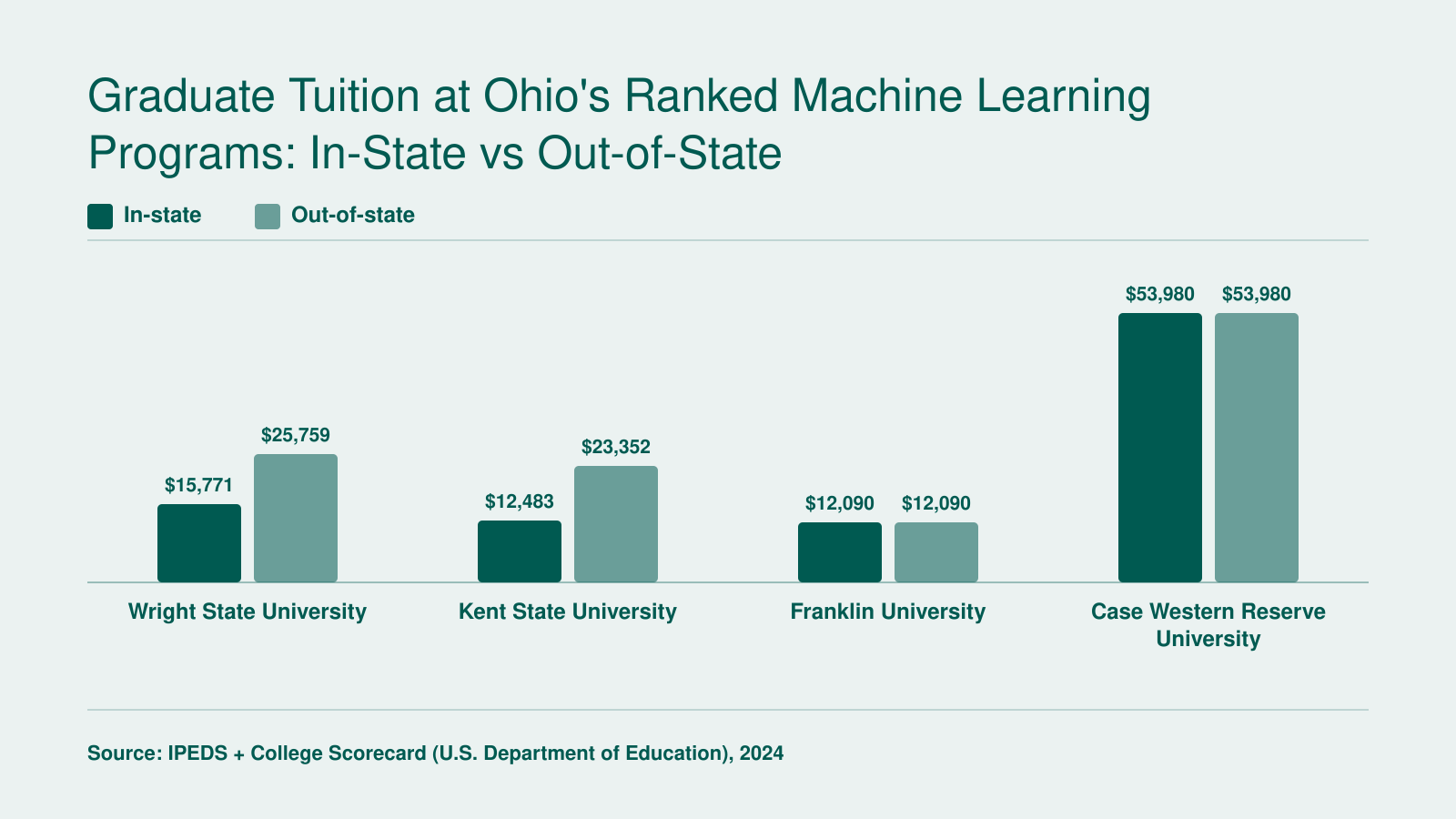
Graduate Tuition at Ohio's Ranked Machine Learning Programs: In-State vs Out-of-State
Franklin University has the lowest in-state graduate tuition and fees here at $12,090, and its price is the same for every student. Among the public schools, Kent State University is cheapest in-state at $12,483, but out-of-state students pay $10,869 more. Wright State University shows a similar gap of $9,988. Private schools like Franklin and Case Western Reserve University typically charge one rate regardless of residency.
Cost, Financial Aid, and Ohio Licensure for Master's in Machine Learning Students
Your total bill for a Master's in Machine Learning is the per-credit rate multiplied by the credit hours, plus fees. Kent State's M.S. in Artificial Intelligence requires 30 credits. At $572 per credit for Ohio residents, that is about $17,160. At $1,066 per credit for out-of-state students, it is about $31,980. Wright State's and Case Western's programs are also 30 credit hours. Confirm their per-credit rates, and Franklin's, on each bursar page. Required fees are extra at every school, so treat these totals as before-fees estimates when comparing the Most Affordable Master's in Machine Learning Programs.
Net price is an average, not a quote
Federal data show approximate annual net prices after aid, averaged across each whole institution: about $15,400 at Wright State, $20,800 at Kent State, $25,200 at Franklin, and $41,200 at Case Western. These are not graduate-specific quotes. Your own cost depends on your program and aid package.
Aid worth asking about
Wright State publishes the clearest options. These include an out-of-state surcharge scholarship for new domestic graduate students starting Fall 2026, Choose Ohio First awards of $3,000 to $9,000 a year, a graduate fellowship of up to $6,000 per semester, and WPAFB support of up to $6,000 a year. Eligibility for machine learning students varies, so verify it. Ask Kent State, Case Western, and Franklin directly about assistantships and department scholarships.
Licensure
Ohio requires no state license to work in machine learning. Employers look at institutional accreditation and, optionally, industry credentials such as cloud machine learning certifications from AWS, Google Cloud, or Microsoft.
In Ohio, the degree title matters less than what you pay and how you study. A lower-cost program in a format that fits your life often beats a bigger name.
What Ohio Machine Learning Master's Graduates Earn
Kent State University offers the clearest earnings picture among the schools here. Its master's graduates in computer and information sciences earned a median of $84,011 one year after finishing. Median debt for the same group was $37,544, an estimated payment of about $427 per month under a standard 10-year repayment plan. First-year earnings run more than double the typical debt, a strong return for a public program, especially at in-state tuition.
Case Western Reserve University, Wright State University and Franklin University do not yet have program-level earnings reported. For these schools, cost is the better comparison point. Wright State and Franklin charge far less tuition than Case Western, and a smaller loan balance does more to protect your return when salary outcomes are less certain.
Graduates of these programs typically pursue roles such as:
- Machine learning engineer: building, training and deploying models in production systems.
- Data scientist: turning large datasets into forecasts and business decisions.
- AI or ML researcher: advancing methods in academic, corporate or government labs.
In Ohio, employers include healthcare systems, insurance and financial services firms, manufacturers investing in automation, and defense and aerospace research in the Dayton area.
Frequently Asked Questions About Master's in Machine Learning Programs in Ohio
How long does it take to complete a machine learning master's in Ohio?
Which Ohio colleges offer a master's degree specifically in machine learning?
Can I switch into a machine learning master's in Ohio without a computer science undergrad degree?
Compare Machine Learning programs on the data that matters
Explore more Computers & IT specializations or browse every graduate field.
All Computers & IT programs