Best Master's in Machine Learning Programs in Pennsylvania
Compare 9 accredited Machine Learning programs in Pennsylvania at 6 schools, with graduate earnings, cost, debt, and completion data from IPEDS and the U.S. College Scorecard.

Pennsylvania has only a handful of dedicated machine learning master's programs, and they are selective: Carnegie Mellon admitted about 12 percent of applicants, while Penn State's online option admits most. Formats vary from campus-only study in Pittsburgh to Penn State's fully online degree.
The tension is cost against payoff. Published annual tuition runs from roughly $24,650 at Penn State to $62,200 at Carnegie Mellon, and reported earnings differ just as sharply. Admissions bars, GRE rules, and outcomes should be read side by side, not one at a time.
Key Points
- Carnegie Mellon's M.S. in Machine Learning graduates reported median earnings of $138,781 one year after completion.
- Penn State's online program has the lowest published per-credit rate, while Carnegie Mellon's annual rate is highest.
- Pennsylvania requires no state license for machine learning roles, so GRE policies and net price matter most for 2027 applicants.
Best Master's in Machine Learning Programs in Pennsylvania, Ranked
Pennsylvania's strongest machine learning master's options span an intensive Pittsburgh campus degree, flexible Philadelphia and Lehigh Valley tracks, and a fully online Penn State program. The list below mixes campus, online and hybrid formats, so compare tuition and net price alongside the curriculum. Graduation rates cited are institution-wide figures from federal data, not program-specific results.
Carnegie Mellon University
#1Pittsburgh, PA · ~$51,000/yr (est.)
Best for: Math-strong applicants wanting immersive campus study
Carnegie Mellon's Master of Science in Machine Learning is a 16-month, on-campus program inside its School of Computer Science. Core courses cover machine learning, probabilistic graphical models, optimization and deep learning, followed by a practicum in an internship or research setting. GRE scores are optional, and the program says it provides no financial support. Schools offering this program graduate 94% of students, and federal data show graduates in this field earned a median of $138,781 one year after finishing.
- 16-month program, completable in three semesters, with a fall start
- Nine total courses, including three electives
- Practicum can be an internship or research
- STEM-designated, with full-time and part-time options
- GRE optional; accepted students average a 3.9 GPA
- Prerequisite courses required; on-campus attendance required
- One-year program open to CMU undergraduates from any major
- Fall or spring start, full-time on the Pittsburgh campus
- Summer practicum in an internship or research
- No thesis or capstone; no GRE scores required
- Two letters of recommendation; three courses double-count
Lehigh University
#2Bethlehem, PA · ~$29,000/yr (est.)
Best for: Students blending optimization with machine learning
Lehigh offers machine learning as a concentration within its Master of Science in Optimization, pairing data analytics with computational decision-making. The department has a 5:1 student-to-faculty ratio and ties to Lehigh's I-DISC research institute, with graduates placed at employers such as Amazon, Boeing and Goldman Sachs. It can be taken on campus or online, and no GRE is required. Schools offering this program graduate 88% of students.
- Machine learning concentration inside an optimization degree
- 12-month path, with a four-term option
- On-campus and online formats
- No entrance exam required
- Two letters of recommendation minimum; $50 application fee
- Affiliated with I-DISC; research funded by NSF, DOE and DoD
Drexel University
#3Philadelphia, PA · ~$39,000/yr (est.)
Best for: Working professionals balancing part-time study
Drexel offers three distinct routes in Philadelphia: an engineering-focused machine learning degree, a campus AI and machine learning degree with applied and computational concentrations, and an online AI and machine learning degree. Part-time schedules suit working professionals, and the school runs a continuing partnership with Comcast that brings employee cohorts into its AI and machine learning master's. Schools offering these programs graduate 78% of students.
- 45 credits; about 18 months full-time or 3 to 4 years part-time
- Thesis or non-thesis track
- Hands-on work with Keras, TensorFlow and scikit-learn
- Graduate advisors guide course selection
- Applied and Computational concentrations
- 45 credits on 10-week quarter terms
- Hands-on capstone and graduate co-op available
- STEM-designated; fall or winter start
- Technical experience optional for the applied track
- Stackable certificates within the degree
- Three concentrations, including Data Science and Analytics
- 46 credits at $1,400 per credit, in as little as two years
- Test optional; 3.0 GPA minimum; one recommendation
- Four start dates per year; capstone required
- Military benefits accepted, with special rates for military and alumni
University of Pittsburgh-Pittsburgh
#4Pittsburgh, PA · ~$28,000/yr (est.)
Pitt's Intelligent Systems Program, housed in the School of Computing and Information, takes an interdisciplinary approach to applied AI, with machine learning and decision making as one of several concentrations. Funding comes from research and training grants, University fellowships and program funds. Its in-state tuition sits well below the private schools on this list. Schools offering this program graduate 85% of students.
- Machine learning and decision making concentration
- Six concentrations, including biomedical informatics and NLP
- MS and PhD degrees offered
- 3.0 GPA minimum; statement of purpose required
- Research and training grant funding; conference travel funds
- Assigned lab space in Sennott Square
Pennsylvania State University
#5University Park, PA · ~$25,000/yr (est.)
Penn State's Master of Artificial Intelligence, AI Engineering Option, is a 30-credit program delivered fully online through World Campus, built for learners who cannot relocate. Courses cover deep learning, natural language processing and predictive analytics, and it has the lowest published tuition on this list at $1,089 per credit. Schools offering this program graduate 34% of students, and federal data show graduates in this field earned a median of $116,067 one year after finishing.
- 30 credits with a 3-credit applied capstone paper
- Fully online; spring, summer and fall starts
- $1,089 per credit for 2026-27
- 3.0 GPA, calculus, linear algebra, statistics and two programming courses
- GRE and GMAT scores not accepted; two references required
- Can earn up to three graduate certificates; military benefits accepted
Cost & outcomes by school
Federal data for the highest-earning Machine Learning programs, independent of the ranking above. Earnings are this field's master's graduates four years after completing, where the Scorecard reports them.
| School | Earnings | Tuition / yr | Debt | Grads/yr | Format |
|---|---|---|---|---|---|
| Carnegie Mellon University PA | $193,154 | $50,975 | $61,305 | 825 | Campus |
| Pennsylvania State University PA | $166,387 | $24,650 | $41,000 | 13 | Online |
| Saint Joseph's University - Philadelphia PA | — | $20,048 | — | — | Campus |
| Lehigh University PA | — | $28,840 | — | — | Campus |
| University of Pittsburgh-Pittsburgh PA | — | $27,580 | — | 79 | Campus |
| Drexel University PA | — | $39,261 | — | 6 | Campus |
Sources: U.S. Department of Education. Tuition and graduates: IPEDS. Earnings and debt: College Scorecard, this field's master's graduates; a dash means no figure is reported.
Cost, debt & payoff
Median earnings of this field's master's graduates (4 yrs after completing) vs. their median federal loan debt · U.S. College Scorecard
Across these programs the median graduate earns about $193,154 and finishes with roughly $61,305 in debt — a ratio that clears a common rule of thumb (keep debt below first-year salary). Tuition and debt vary widely school to school, so check the per-school figures in the table above before you shortlist.
How We Ranked Pennsylvania's Machine Learning Master's Programs
This ranking compares Pennsylvania's Master's in Machine Learning programs on what graduates actually earn and what students actually pay, rather than on name recognition. We weigh five outcome measures: program-level earnings after completion, median federal debt, net price, graduate tuition, and the institution-wide completion rate. All of it comes from federal College Scorecard and IPEDS data, not reputation surveys or school marketing.
Know the limits. Earnings are medians for people who finished, so they say nothing about students who left. Small programs sometimes have unpublished figures, and we do not fill those gaps with guesses. Net price is an institution-wide average, not a personal quote, so your own aid offer will differ.
Treat the order as a starting shortlist. Once you have two or three candidates, check them against the No-GRE master's programs and cost sections below before you apply.
Online and Hybrid Master's in Machine Learning Options in Pennsylvania
Carnegie Mellon's campus-only model sits at one end of the spectrum, and fully online study at the other. Most of the schools here fall somewhere between.
Carnegie Mellon's M.S. in Machine Learning is Pittsburgh-based with no distance option. Part-time study is allowed only if you can attend daytime weekday classes, and the Advanced Study track is full-time only. Penn State's Great Valley Master of Artificial Intelligence is hybrid, often alternating in-person and online courses, and can be finished in as little as two years part-time. A fully online World Campus version lists $1,089 per credit. Drexel offers a fully online M.S. in AI & Machine Learning with an average length of two years, plus a campus-or-online M.S. in Machine Learning and AI that runs 2 to 4 years part-time, with a five-year completion limit.
Confirm with admissions whether online and on-campus students pay the same rate and receive the same diploma. Working professionals comparing Master's Programs in Pennsylvania should also ask about in-person residencies or proctored exams before enrolling.
A ranking is a shortlist, not a verdict: format tells you how a program is delivered, not how good it is, so check outcomes and net price before you apply.
Which Pennsylvania ML Master's Programs Waive or Make the GRE Optional
GRE policies changed widely after 2020, and they can change again between cycles, so confirm with each admissions office before you apply. The rows below reflect official admissions pages as retrieved in 2026. Lehigh and Pitt are not shown because we could not confirm a current published GRE policy for their programs, so check their admissions pages directly.
| School | Program | GRE Policy | Key Prerequisites | Application Deadline |
|---|---|---|---|---|
| Carnegie Mellon University | Master's in Machine Learning | Optional for Fall 2026 applicants starting August 2027; GRE Subject Test not required or expected | Strong programming; one year of college probability and statistics; matrix algebra; multivariate calculus; background in complexity theory and mathematics | Generally late November or early December; exact date on the SCS Master's Admissions page |
| Carnegie Mellon University | Master's in Machine Learning, Advanced Study | Optional for Fall 2026 applicants starting August 2027; GRE Subject Test not required or expected | Strong programming; one year of college probability and statistics; matrix algebra; multivariate calculus; background in complexity theory and mathematics | December only; exact date on the SCS Master's Admissions page |
| Carnegie Mellon University | Master of Science in AI Systems Management | Required unless you qualify for a GRE/GMAT waiver | For a waiver: college pre-calculus or higher, introductory statistics, and introductory Python (Java or C++ also accepted) | Round 1: December 1, 2026; Round 2: January 10, 2027 |
| Drexel University | Master's in Machine Learning and Artificial Intelligence | Not required; recommended if your GPA is below 3.0 on the 4.0 scale | Applied concentration: technical experience helpful, bridge courses available. Computational concentration: bachelor's in computer science or a STEM field | International: July 15, 2026; U.S. applicants, on campus and online: August 22, 2026 |
| Penn State World Campus | Master of Artificial Intelligence, Applied and Generative AI Option | Not required; GRE or GMAT scores will not be accepted | Bachelor's degree in computer science, engineering, or mathematics | Spring: November 15; May: March 15; no fall deadline stated on the page retrieved |
What a Master's in Machine Learning Costs in Pennsylvania (And Why No State License Is Needed)
Penn State's online program has the lowest published per-credit rate here, while Carnegie Mellon's full-time annual rate is the highest. Pennsylvania does not license machine learning engineers or data scientists, so no state exam stands between the degree and the job. Optional credentials such as the Google Cloud Professional Machine Learning Engineer or AWS machine learning certifications can supplement a master's. Funding routes include employer tuition assistance, Penn State's scholarships and military benefits, and Pitt's research and training grant funding.
| School and program | Format | 2026-27 published rate | Credits | Estimated tuition | Federal data program tuition (in-state / out-of-state) |
|---|---|---|---|---|---|
| Pennsylvania State University, Master of Artificial Intelligence | Online | $1,089 per credit, or $13,062 per semester at 12+ credits | 30 | About $32,670 at the per-credit rate; varies with enrollment pattern | $24,650 / $24,650 |
| University of Pittsburgh-Pittsburgh, Intelligent Systems Program | Campus | N/A | N/A | N/A | $27,580 / $46,786 |
| Carnegie Mellon University, M.S. in Machine Learning | Campus | $62,200 full-time annual rate ($864 per unit) | 111 units | $62,200, plus fees such as a $248 annual activities fee | $50,975 / $50,975 |
| Lehigh University, M.S. in Optimization | Campus (online format also listed) | N/A | N/A | N/A | $28,840 / $28,840 |
| Drexel University, M.S. in Machine Learning Engineering | Campus | N/A | 45 | N/A | $39,261 / $39,261 |
Related Articles
Machine Learning Master's Salary Outcomes in Pennsylvania
Graduates of Carnegie Mellon's Master of Science in Machine Learning reported median earnings of $138,781 one year after completion, rising to $193,154 at four years and sitting at $166,594 at the five-year mark. Median borrowing for that program was $61,305, which works out to roughly $697 a month on a standard 10-year repayment plan: a manageable share of a first-year salary at those levels.
Penn State's online Master of Artificial Intelligence with the AI Engineering option shows $116,067 one year out, $166,387 at four years and $140,490 at five. Median debt there was $41,000, or about $466 a month over 10 years, the lower borrowing figure of the two.
Program-level earnings are not published for every option on this list, so treat the figures above as the reported picture rather than the ceiling. Graduates typically move into machine learning engineer, data scientist and applied research scientist roles across tech, finance, healthcare and defense employers, a skill set that overlaps with the Master's in Data Analytics in Pennsylvania.
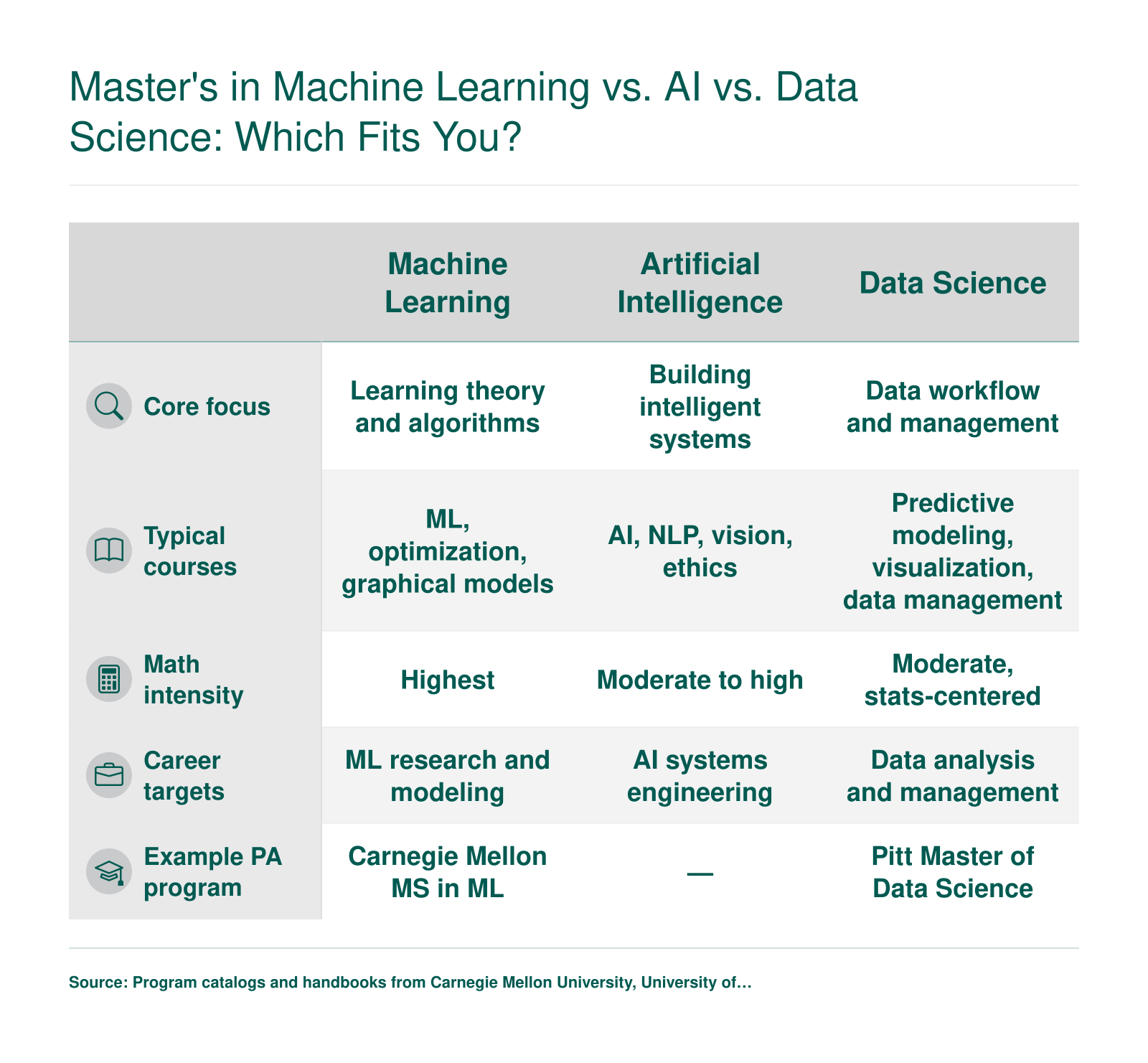
Master's in Machine Learning vs. AI vs. Data Science: Which Fits You?
Many Pennsylvania schools fold machine learning into AI or computer science degrees, so check the required courses, not just the degree title. Specializations in robotics, NLP and vision usually appear as electives or concentrations. Carnegie Mellon's machine learning master's, for example, supports NLP and vision through electives but requires no named specialization.
FAQs About Master's in Machine Learning Programs in Pennsylvania
Can I earn a machine learning master's degree online in Pennsylvania?
Are Pennsylvania ML and AI master's programs STEM-designated for international students' OPT extension?
How much does the online MSE-AI cost, and what courses does it include?
What is the acceptance rate for the online MSE-AI?
Compare Machine Learning programs on the data that matters
Explore more Computers & IT specializations or browse every graduate field.
All Computers & IT programs