Best Master's in Counseling Psychology Programs in Wisconsin
Compare 15 accredited Counseling Psychology programs in Wisconsin at 11 schools, with graduate earnings, cost, debt, and completion data from IPEDS and the U.S. College Scorecard.

Wisconsin's LPC requires a master's of at least 60 semester credits, so the real question is which program gets you there at a price you can carry. Per-credit rates already vary widely: $518 at UW-River Falls against $655 at Concordia University-Wisconsin.
This ranking combines campus and online programs and relies on federal IPEDS and College Scorecard outcomes, not marketing claims.
Several programs hold no CACREP accreditation, and a degree's title matters less than whether it satisfies the state licensing board.
Key Points
- Wisconsin LPC licensure requires a 60-credit master's, so verify fit before comparing tuition.
- CACREP accredits Marquette, Mount Mary, UW-Madison, UW-River Falls, and Viterbo, among others in Wisconsin.
- Marquette and Concordia University-Wisconsin offer online formats, while Carroll, Viterbo, and UW-Parkside run hybrid.
Top 10 Counseling Psychology Master's Programs in Wisconsin
Wisconsin's master's programs in this field mix counseling psychology, clinical mental health counseling, and school counseling, and they are accredited by different bodies. Each card below names the accreditor, and programs with no verified CACREP or MPCAC status are flagged because that can complicate the path to LPC licensure. Graduation rates are institution-wide figures for the whole school, not program completion rates.
University of Wisconsin-Madison
#1Madison, WI · ~$12,000/yr (est.)
Best for: Full-time students seeking a selective cohort
UW-Madison's M.S. in Counseling is a campus-based, two-year full-time program housed in the Department of Counseling Psychology, with part-time study also possible. Graduate tuition is $10,728 in-state and $24,054 out-of-state before fees, and the university graduates about 89.5% of its students. The program holds MPCAC accreditation through December 2031 (not CACREP), and admits only 10 to 12 students a year, which makes for a small, mentored cohort.
- MPCAC accredited through December 2031; not a CACREP program
- 60 credits, designed as a two-year full-time plan
- Part-time enrollment also possible; fall start
- Oral clinical case conceptualization (PIE) as capstone
- Practica at the training clinic, campus centers, and community agencies
- Only 10 to 12 students enrolled each year
- 3.0 GPA minimum, work experience and prerequisites required
- No entrance exam required
Marquette University
#2Milwaukee, WI · ~$25,000/yr (est.)
Best for: Working adults needing fully online study
Marquette's online M.S. in Clinical Mental Health Counseling is described as the only CACREP-accredited online CMHC program in Wisconsin. Graduate tuition is $24,480 for both residents and non-residents, and the university graduates about 83.2% of its students. A child and adolescent counseling specialization is available, and faculty help arrange clinical placements near you.
- CACREP accredited online program
- 60 credits across 15 courses
- 700 clinical hours: 100 practicum and 600 internship
- Child and adolescent counseling specialization available
- Mostly asynchronous, with synchronous counseling practice sessions
- Three start dates per year
- Faculty help secure clinical placements
University of Wisconsin-River Falls
#3River Falls, WI · $10,000 – $15,000/yr (est.)
Best for: Aspiring K-12 school counselors
UW-River Falls offers a campus-based master's in school counseling built on the ASCA National Model, with evening classes for working adults. Graduate tuition is $8,654 in-state and $18,609 out-of-state before fees, and the university graduates about 57.0% of its students. The CACREP accreditation covers school counseling, not clinical mental health, so this is the right fit for K-12 careers rather than the LPC route.
- CACREP accredited in School Counseling, not CMHC
- Grounded in the ASCA National Model
- Mid-program practicum and end-of-program internship
- Evening classes; one to three courses per term
- Fall and spring starts with rolling admissions
- No entrance exam required
- Licensure-eligible in Wisconsin and Minnesota
University of Wisconsin-Milwaukee
#4Milwaukee, WI · $13,000 – $26,000/yr (est.)
UW-Milwaukee's clinical mental health counseling concentration sits inside its Educational Psychology master's and trains students toward LPC licensure. Graduate tuition is $11,102 in-state and $24,533 out-of-state before fees, and the university graduates about 49.3% of its students. It carries MPCAC accreditation (not CACREP), has an urban, multicultural focus, and is test optional for admission.
- MPCAC accredited; CACREP status not established
- 60 credits; most courses held in person
- Test optional admissions; 3.0 GPA minimum
- Capstone required; prepares for the CPCE
- School reports about 85% earning LPC licensure
- Urban and multicultural emphasis with Milwaukee internships
- Fall start
Concordia University-Wisconsin
#5Mequon, WI · ~$13,000/yr (est.)
Concordia University-Wisconsin offers two routes: a fully asynchronous online Master's in Counseling with a professional counseling concentration, and a hybrid M.S. in Counseling with a clinical mental health track. Graduate tuition is $13,050 for all students, programs list $715 per credit, and the university graduates about 68.3% of its students. Neither CACREP nor MPCAC accreditation is established for Concordia, which can affect the LPC path, so confirm status before applying.
- No CACREP or MPCAC accreditation established; verify before applying
- 60 credits over about 3 to 3.5 years
- 8-week asynchronous online sessions; two courses meet in person
- 700 practicum and internship hours
- Prepares for the NCE and LPC-IT endorsement
- Rolling admissions; fall, spring, and summer starts
- No entrance exam required
- No CACREP or MPCAC accreditation established
- 60 credits with four concentration options
- 700 clinical hours with an assigned CUW site supervisor
- Prepares for LPC-IT; SAC-IT eligibility
- Dual licensure track available
Mount Mary University
#6Milwaukee, WI · ~$16,000/yr (est.)
Mount Mary University's M.S. in Professional Counseling is a campus-based program with Clinical Mental Health Counseling and School Counseling tracks. Graduate tuition is $14,940 for all students, and the university graduates about 43.0% of its students. The clinical mental health track is CACREP accredited through 2031, and small classes and a Chi Sigma Iota chapter add to the draw.
- CACREP accredited clinical mental health track, through 2031
- Clinical mental health and school counseling tracks
- Optional clinical rehabilitation counseling emphasis
- 60 credits, two-year plan; full-time and part-time
- 700 on-site clinical hours for CMHC students
- 3.0 GPA minimum; GRE or MAT accepted as alternative evidence
- Advanced trauma counseling coursework
- Fall, spring, and summer starts
Carroll University
#7Waukesha, WI · $10,000 – $15,000/yr (est.)
Carroll University's M.S. in Behavioral Health Psychology is a 60-credit hybrid program with online coursework and twice-monthly sessions on the Waukesha campus. Graduate tuition is $12,900 for all students, and the university graduates about 70.7% of its students. It is not listed as CACREP or MPCAC accredited, so verify how it fits the Wisconsin LPC path before applying.
- No CACREP or MPCAC accreditation established; verify before applying
- 60 credits; finish in as few as two years full-time
- Concentrations: Clinical Assessment, Adult and Geriatric, Youth Behavioral Health
- 700 clinical hours; over 95 approved clinical sites
- Thesis or capstone option
- Free community counseling clinic
- Hybrid with twice-monthly on-campus sessions
Viterbo University
#8La Crosse, WI · ~$10,000/yr (est.)
Viterbo University's M.S. in Mental Health Counseling is a hybrid program that mixes weekday classes with weekend intensives. Reported graduate tuition is $9,888 for all students, and the university graduates about 68.4% of its students. It is listed as CACREP accredited, and clinical courses are capped at six students for close supervision.
- Listed as CACREP accredited; confirm in the CACREP directory
- Hybrid with weekend intensive class option
- 600 clinical hours, 240 in direct client contact
- Four concentration options, including play therapy and addiction counseling
- Class sizes of 10 to 20; clinical courses capped at six
- Two dedicated play therapy labs
- Prepares for the CPCE; Chi Sigma Iota chapter
University of Wisconsin-Oshkosh
#9Oshkosh, WI · $10,000 – $15,000/yr (est.)
UW-Oshkosh offers a campus-based Clinical Mental Health Counseling emphasis within its Professional Counseling program. Graduate tuition is $8,580 in-state and $18,464 out-of-state before fees, and the university graduates about 46.1% of its students. The program is CACREP accredited through March 2031, making it one of the more affordable accredited routes to the Wisconsin LPC.
- CACREP accredited CMHC program, through March 2031
- 60 credits
- Eight core courses and six skills courses
- Two-semester field internship
- Coursework in trauma, addiction, and neuroscience
- Social justice and multicultural focus
- Chi Sigma Iota honor society
- Graduates can apply for a Wisconsin DSPS training license
University of Wisconsin-Parkside
#10Kenosha, WI · ~$10,000/yr (est.)
UW-Parkside's M.S. in Clinical Mental Health Counseling offers a hybrid format with a flexible online option through UW Online Collaboratives. Graduate tuition is $8,892 in-state and $19,519 out-of-state before fees, and the university graduates about 40.4% of its students. No CACREP or MPCAC accreditation is established, so confirm how it fits your licensure plans.
- No CACREP or MPCAC accreditation established; verify before applying
- 60 credits; meets Wisconsin licensure education requirements
- Online option via UW Online Collaboratives
- In-person practicum and internship required
- Rolling admissions; fall start
- Open to non-psychology bachelor's degrees
- 3.0 GPA minimum; prerequisite courses required
- Full-time and part-time study
Cost & outcomes by school
Federal data for the highest-earning Counseling Psychology programs, independent of the ranking above. Earnings are this field's master's graduates four years after completing, where the Scorecard reports them.
| School | Earnings | Tuition / yr | Debt | Grads/yr | Format |
|---|---|---|---|---|---|
| Mount Mary University WI | $72,860 | $15,540 | $51,247 | 28 | Campus |
| University of Wisconsin-Madison WI | $71,120 | $12,325 | $25,900 | 105 | Campus |
| University of Wisconsin-Milwaukee WI | $66,931 | $12,728 | $41,000 | 52 | Campus |
| Concordia University-Wisconsin WI | $65,922 | $13,260 | $45,945 | 33 | Online |
| University of Wisconsin-River Falls WI | — | $10,357 | $33,493 | 26 | Campus |
| Viterbo University WI | — | $9,888 | — | — | Hybrid |
| University of Wisconsin-Superior WI | — | $9,658 | — | — | Online |
| University of Wisconsin-Parkside WI | — | $10,184 | — | — | Hybrid |
| University of Wisconsin-Oshkosh WI | — | $10,051 | — | — | Campus |
| Carroll University WI | — | $14,424 | — | — | Hybrid |
| Marquette University WI | — | $24,680 | — | — | Online |
Sources: U.S. Department of Education. Tuition and graduates: IPEDS. Earnings and debt: College Scorecard, this field's master's graduates; a dash means no figure is reported.
Cost, debt & payoff
Median earnings of this field's master's graduates (4 yrs after completing) vs. their median federal loan debt · U.S. College Scorecard
Across these programs the median graduate earns about $69,026 and finishes with roughly $45,945 in debt — a ratio that clears a common rule of thumb (keep debt below first-year salary). Tuition and debt vary widely school to school, so check the per-school figures in the table above before you shortlist.
Cheapest Counseling Psychology Master's Programs in Wisconsin
Annual graduate tuition is the main comparison here, but it understates what you will pay, because most counseling master's programs run 48 to 60 credits and take two or more years. The schools below each list 60 credits where a credit count is available, so multiply the per-credit rate by the credit total for a realistic cost. Net price is an institution-wide average from federal data, not a quote for any counseling program, so treat it as context only.
| School | Program | Format | Annual graduate tuition (in-state) | Net price (institution-wide average) | Per-credit tuition | Credits | Estimated total tuition |
|---|---|---|---|---|---|---|---|
| University of Wisconsin-Parkside | MS in Clinical Mental Health Counseling | Hybrid | $10,184 | $11,772 | N/A | 60 | N/A |
| University of Wisconsin-Superior | MSE in Education, Counseling (Clinical Mental Health track) | Online | $9,658 | $12,220 | $578 | 60 | $34,680 |
| University of Wisconsin-River Falls | MS in Counseling (School Counseling track) | Campus | $10,357 | $14,054 | $518 | N/A | N/A |
| University of Wisconsin-Oshkosh | MS in Professional Counseling (Clinical Mental Health) | Campus | $10,051 | $14,305 | N/A | 60 | N/A |
| University of Wisconsin-Milwaukee | MS in Educational Psychology, Clinical Mental Health Counseling | Campus | $12,728 | $15,014 | N/A | 60 | N/A |
Online and Hybrid Master's in Counseling Psychology Options in Wisconsin
Fully online and hybrid formats solve different problems for counseling psychology master's programs. Online suits students who can't relocate, while hybrid trades some flexibility for campus contact. Marquette and Concordia University-Wisconsin are listed as online. Carroll, Viterbo, and UW-Parkside are hybrid. UW-Madison and several others are campus-based.
Even the best online master's in counseling psychology programs rarely mean remote from start to finish. Every program still requires a supervised practicum and internship. UW-Parkside says its in-person placements may be near the student's home. Concordia lists in-person instruction for two courses, and Carroll lists twice-monthly on-campus sessions.
Students outside Wisconsin considering master's programs in Wisconsin should check their own state's rules before enrolling. UW-Parkside's disclosure lists many states but limits Illinois to hybrid only. UW-Superior's online program qualifies graduates in Wisconsin and Minnesota and requires an attestation from students enrolling elsewhere. Look for a state authorization or licensure disclosure page on each school's site.
Wisconsin's Counseling Compact status for 2026 could not be confirmed here. Verify it with the state licensing board before counting on it.
Which Wisconsin Master's Programs Waive or Make the GRE Optional
No-GRE master's programs save time and money, but admission deadlines and GPA floors still decide who gets in. Only two ranked schools publish enough detail to summarize.
UW-Madison's MS in Counseling is one of the counseling psychology programs with no GRE required.1 It asks for a 3.00 minimum graduate GPA and an undergraduate degree, plus 3 credits of introductory psychology and 3 credits of statistics or measurement. Applicants may be admitted with deficiencies and finish those courses alongside the program. Admission is fall only, with a January 5 deadline.1 One applicant page ties January 5, 2027 to Fall 2027 entry, so confirm which year your date belongs to.
Marquette makes the GRE optional for both clinical mental health counseling master's programs with no GRE required and school counseling (General Test only). Both list a 3.00 GPA, a February 1 priority date, rolling review after that, and final deadlines of August 1 (June 1 for international applicants). Clinical mental health lists no course prerequisites, though human-service experience is recommended.
For the other ranked schools, the admissions pages we reviewed did not establish a GRE policy, GPA minimum, deadline, or prerequisites, and we won't guess. Check each program page every cycle, because policies change often.
Related Articles
Master's Program Costs and Wisconsin LPC Licensure
A master's in counseling only pays off financially if the degree qualifies you for a Wisconsin LPC, so check licensure fit before comparing price among the Most Affordable Master's in Counseling Psychology Programs. Under Wisconsin Administrative Code MPSW, the degree needs at least 60 semester credits (90 quarter), with up to 18 semester credits allowed from outside the degree.1 CACREP accreditation helps only in listed specialties, including Clinical Mental Health Counseling.1
After graduating, you apply for the Professional Counselor Training License.1 Then you complete at least 3,000 supervised practice hours1, including 1,000 face-to-face client hours, plus 30 hours of clinical-supervision training.2 You also pass a national exam (NCE, NCMHCE, or CRCE), which NBCC or CRCC administers, not the state.1 Confirm with DSPS whether Wisconsin's statutes-and-rules exam applies to your application.3
Tuition Gap
Published annual tuition and fees vary widely. UW-Parkside lists $8,270 in-state and $17,429 out-of-state. UW-Madison lists $11,603 in-state and $42,103 out-of-state. Private schools charge one rate: Viterbo $34,250, Concordia University-Wisconsin $35,470, Marquette $51,170.
The MPSW Examining Board and DSPS publish current rules and forms, so verify requirements there before enrolling.3
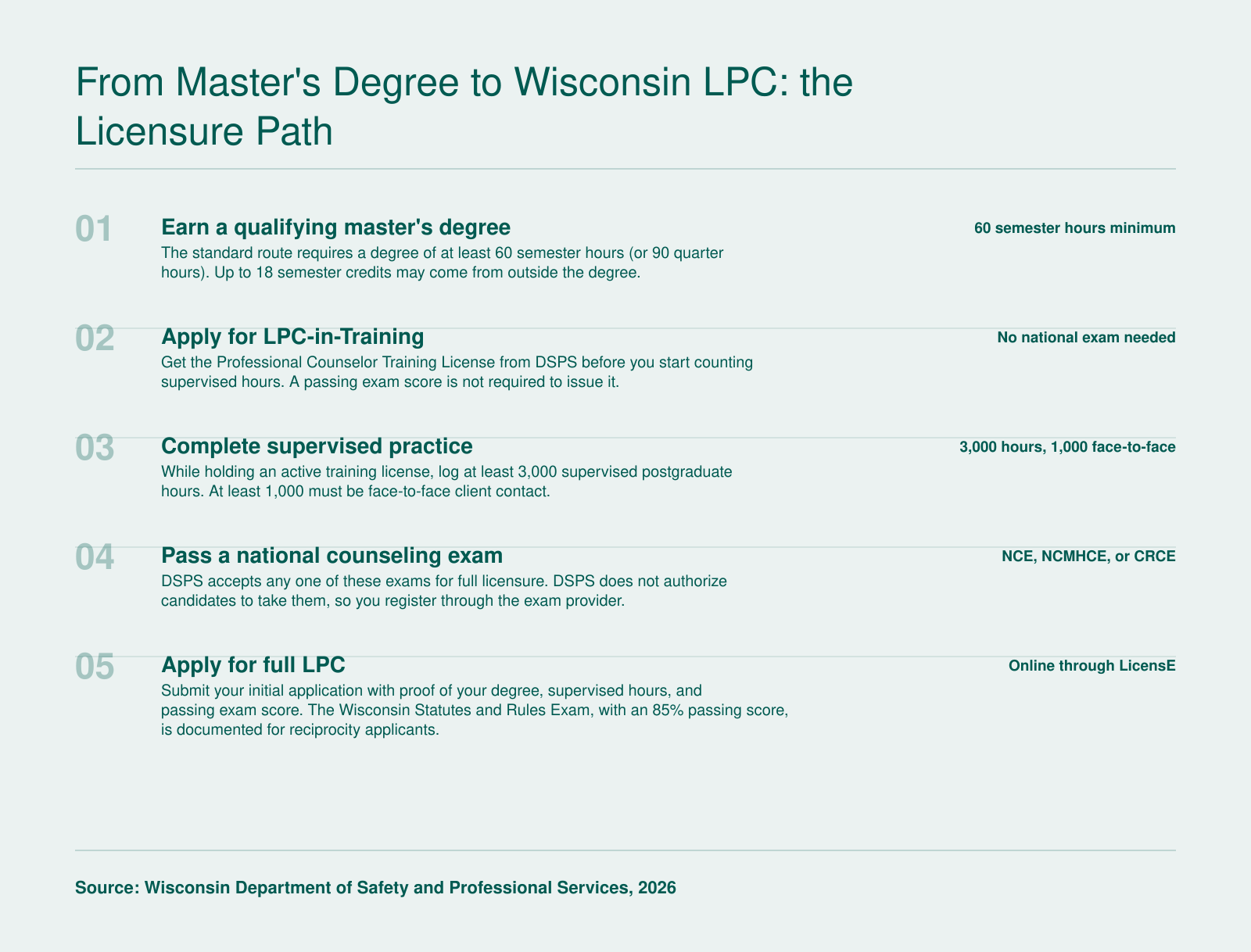
From Master's Degree to Wisconsin LPC: the Licensure Path
Wisconsin licenses professional counselors through the Department of Safety and Professional Services (DSPS). The order matters, because supervised hours only count once a training license is active.
Clinical Hours, Practicums, and Internship Placement in Wisconsin Master's Programs
How many supervised hours does a Wisconsin counseling master's actually require, and who finds your site? The CACREP baseline1, which Wisconsin's licensing board mirrors2, is a 100-hour practicum with 40 direct client hours, then a 600-hour internship with 240 direct hours. Mount Mary lists 700 total on-site clinical hours.4 Marquette's students should also check other states, since its materials say requirements elsewhere may exceed Wisconsin's.3
Placement support varies. Mount Mary faculty help secure sites, mainly in southeastern Wisconsin.4 UW-Madison and UW-Milwaukee expect students to select or seek their own sites, and Marquette requires department approval plus a signed affiliation agreement.3 UW-River Falls assigns nothing: students find sites within two hours of campus.5 Online students should expect to arrange local sites themselves.
Timing drives your timeline. UW-Madison's internship spans three semesters at roughly 20 hours a week, and UW-Milwaukee requires two practicum semesters.6 Starting site searches early helps keep a full-time degree at two to three years.
Wisconsin Counseling Psychology Master's Programs With the Highest Graduate Earnings
Earnings below are program-level medians measured five years after graduates finished the degree, not institution-wide figures. Debt and monthly payment (based on a 10-year repayment plan) show how much of that pay goes to the loan. Pass rates appear only where a program publishes one, and the exam type is often not specified.
| School | Program | Median earnings, 5 years after finishing | Median program debt | Estimated monthly payment | Published licensure exam pass rate |
|---|---|---|---|---|---|
| Concordia University-Wisconsin | Master's of Counseling (Professional Counseling) | $70,875 | $45,945 | $523 | N/A |
| Mount Mary University | M.S. in Professional Counseling (Clinical Mental Health Counseling) | $64,960 | $51,247 | $583 | 95% (2025) |
| University of Wisconsin-River Falls | Master's in Counseling (School Counseling) | $63,825 | $33,493 | $381 | N/A |
| University of Wisconsin-Madison | M.S. in Counseling | $63,458 | $25,900 | $295 | N/A |
| University of Wisconsin-Milwaukee | M.S. in Clinical Mental Health Counseling | $52,268 | $41,000 | $466 | 85% (within two years) |
Counseling Psychology vs. Clinical Mental Health Counseling: What's the Difference?
The labels on these degrees describe emphasis, not licensure. Wisconsin's DSPS grants the Licensed Professional Counselor credential based on a professional-counseling master's of at least 60 credits (no more than 18 earned outside the degree), so what you study matters far more than what the diploma says.
- Counseling psychology: UW-Madison's M.S. in Counseling carries MPCAC accreditation through 2031 and leans toward developmental, research-informed practice.
- Clinical mental health counseling: UW-Whitewater's CMHC emphasis is CACREP-accredited through March 2032, runs 60 credits, and is built for LPC-IT status and the NCE. UW-Milwaukee's 60-credit MPCAC-accredited program, one of Wisconsin's clinical mental health counseling master's programs, follows a similar route.
- Behavioral health psychology: Carroll University's 60-credit degree includes at least 700 clinical hours and is an approved Wisconsin LPC training program, though it is not CACREP- or MPCAC-accredited.
If a psychology-titled program is not an approved counseling track, confirm the coursework with DSPS before enrolling.
Compare Counseling Psychology programs on the data that matters
Explore more Psychology specializations or browse every graduate field.
All Psychology programs