Best Master's in Elementary Education Programs in Wisconsin
Compare 7 accredited Elementary Education programs in Wisconsin, with graduate earnings, cost, debt, and completion data from IPEDS and the U.S. College Scorecard.

A Wisconsin elementary education master's splits into two very different products: one that carries a career changer to a first DPI license, and one that deepens the credentials of a teacher already in a classroom. Confuse them and you enroll in the wrong degree.
The programs ranked here span hybrid and fully online delivery, with graduate in-state tuition from roughly $9,000 to $35,000 a year, a spread worth checking against the Most Affordable Master's in Elementary Education Programs list. Admissions rarely hinge on test scores, as the Master's in Elementary Education Programs With No GRE Required list confirms, but student teaching, the Foundations of Reading Test, and district salary schedules shape what the degree is worth once you hold it.
Key Points
- University of Wisconsin-River Falls is the lowest-tuition option here, with online classes.
- Concordia University-Wisconsin states that graduate entrance exams are not required for admission.
- Student teaching happens in a real classroom, even when coursework is online.
Top Elementary Education Graduate Programs in Wisconsin, Ranked
The best Wisconsin options keep the cost of a degree manageable, graduate a solid share of their students, and lead to a license you can actually use in a classroom. Three programs fit that picture, covering hybrid and fully online study. Accreditation (CAEP for the program, HLC for the university) and Wisconsin DPI approval are approved per program, so confirm each one in the DPI lookup before you apply.
University of Wisconsin-River Falls
#1River Falls, WI · $10,000 – $15,000/yr (est.)
Best for: Career changers seeking initial licensure
University of Wisconsin-River Falls is a public university in River Falls that graduates 57% of its students, and its listed graduate tuition of about $8,654 a year is the lowest of the three schools here. Its hybrid program is built for career changers and prepares candidates for Wisconsin elementary and middle school (K-9) licensure, with online coursework and an in-person student teaching semester. Minnesota residents may be able to use tuition reciprocity, which can lower the price further. We could not confirm CAEP status for the program or HLC status for the university from our sources, so check both, along with DPI approval, before enrolling.
- Hybrid: online coursework with an in-person student teaching semester
- 32-credit licensure portion; add the master's with one more course
- Cohort starts each fall; priority admission by July 1
- 2.8 GPA minimum; contingent admission possible for GPAs of 2.50 to 2.74
- Licensure requires Praxis and Wisconsin Foundations of Reading exams
- Field experiences arranged near your home
- Capstone required
- Minnesota residents may apply for tuition reciprocity
Concordia University-Wisconsin
#2Mequon, WI · ~$13,000/yr (est.)
Best for: Busy professionals wanting frequent start dates
Concordia University Wisconsin is a private university in Mequon that graduates 68% of its students. Its hybrid program leads to Wisconsin 4K-9 licensure through online courses in 8-week sessions, with a virtual Saturday session per course and in-person school experiences. Listed graduate tuition is about $13,050 a year, and the program is priced at $655 per credit across 40 credits. The GRE is not required, and up to half of graduate credits may transfer in. CAEP and HLC status were not confirmed in our sources, so verify them directly.
- 40 credit hours at $655 per credit
- Online courses in 8-week sessions with start dates in fall, spring and summer
- One virtual Saturday session via Zoom per course
- GRE not required; 3.0 minimum undergraduate GPA
- Leads to Wisconsin 4K-9 licensure; Foundations of Reading Test required
- At least two pre-student teaching experiences, then final semester student teaching
- Transfer up to 50% of graduate credits
- Licensure in 2 years; adding the master's takes about 6 more months
Ottawa University-Milwaukee
#3Brookfield, WI · $10,000 – $15,000/yr (est.)
Best for: Online-only learners wanting accelerated study
Ottawa University-Milwaukee, based in Brookfield, offers a fully online, accelerated route into elementary teaching with listed graduate tuition of about $11,682 a year. Its graduation rate is not reported in our data, so we cannot compare completion with the other two schools. Program materials describe CAEP accreditation, but the accreditation record we reviewed did not verify it. The program leads to Pre-K-6 licensure and its catalog link points to a Kansas version, so confirm with Wisconsin DPI that it meets Wisconsin requirements before you commit.
- 36 credit hours in an accelerated online format
- Leads to Pre-K-6 licensure; confirm Wisconsin DPI recognition
- Includes field experience and student teaching in inclusive classrooms
- Focus on ELL instruction and the science of reading
- Capstone required
- Program materials cite CAEP accreditation; verification not confirmed
Cost & outcomes by school
Federal data for the highest-earning Elementary Education programs, independent of the ranking above. Earnings are this field's master's graduates four years after completing, where the Scorecard reports them.
| School | Earnings | Tuition / yr | Debt | Grads/yr | Format |
|---|---|---|---|---|---|
| University of Wisconsin-Whitewater WI | $54,548 | $10,543 | $19,466 | 26 | Online |
| University of Wisconsin-River Falls WI | $54,263 | $10,357 | $31,343 | 27 | Hybrid |
| Ottawa University-Milwaukee WI | — | $13,002 | — | — | Online |
| Concordia University-Wisconsin WI | — | $13,260 | $27,383 | — | Hybrid |
| University of Wisconsin-Oshkosh WI | — | $10,051 | — | — | Campus |
| Edgewood University WI | — | $19,656 | — | — | Campus |
| Marquette University WI | — | $24,680 | — | 2 | Campus |
Sources: U.S. Department of Education. Tuition and graduates: IPEDS. Earnings and debt: College Scorecard, this field's master's graduates; a dash means no figure is reported.
Online and Hybrid Master's in Elementary Education Options in Wisconsin
Online coursework and online licensure are not the same thing, because student teaching always happens in a real classroom.
What "online" means here
University of Wisconsin-River Falls offers its online master's in elementary education classes. Its published information does not say whether sessions are live or self-paced, so ask the program before you count on a work-friendly schedule. Concordia University-Wisconsin and Ottawa University-Milwaukee should get the same questions: are class meetings synchronous, and are campus visits required? Delivery models vary, and master's programs in Wisconsin may be fully online, hybrid, or campus-based.
Student teaching and timing
River Falls requires a full semester of in-person student teaching. Its materials do not explain how placements are chosen or whether you can student teach near home, so confirm that and whether placements must be in Wisconsin. Licensure candidates complete Wisconsin certification requirements within about two years, and adding one course turns that work into the master's. Programs of this type commonly run 30 to 36 credits over roughly 12 to 24 months, with part-time pacing for paraprofessionals and career changers. Verify credit totals with each school.
The trap to avoid
Some online education master's degrees are built for teachers who already hold a license and do not lead to initial licensure. If you are changing careers, confirm that the program you choose includes initial licensure before you apply.
Related Articles
Which Wisconsin Elementary Education Master's Programs Waive the GRE?
Among the programs with admissions details confirmed here, GRE-free admission is the norm. Concordia University-Wisconsin states outright that graduate entrance exams are not required, and the University of Wisconsin-River Falls publishes no general GRE requirement. Because test scores rarely decide admission, GPA thresholds, the letter of intent, and licensure steps such as background checks and the timing of the Foundations of Reading test deserve more of your planning time, so confirm those dates with each program. Admissions details for Ottawa University-Milwaukee were not confirmed for this table, so check its admissions page directly.
| School | GRE Policy | Minimum GPA | Deadlines / Start Terms |
|---|---|---|---|
| University of Wisconsin-River Falls (Elementary Education M.Ed.) | No published policy for general admission. The GRE appears only as one possible basic-skills assessment for contingent admission when the GPA is 2.50 to 2.74. | Above 2.75 on a 4-point scale; contingent admission possible between 2.50 and 2.74 | July 1 priority deadline for the fall cohort; later applications may be considered if space is available |
| Concordia University-Wisconsin (Master of Science in Teaching and Learning, Elementary) | Not required | 3.00 on a 4.0 scale; applicants below 3.00 may still be reviewed | N/A |
Master's in Elementary Education Cost in Wisconsin: Tuition by School
The schools below are ordered from lowest to highest graduate in-state tuition. On that annual measure, the University of Wisconsin-River Falls is the most affordable option here, and Concordia University-Wisconsin charges the same rate to every student. Annual tuition is not the cost of the whole degree: Concordia's tuition-only total is a per-credit rate multiplied by required credits, and it leaves out fees. Net price is an institution-wide average after aid, not a quote for this program. Concordia does let students transfer up to 50% of graduate credits, which can lower the credits you pay for.
| School | In-state tuition (annual) | Out-of-state tuition (annual) | Per-credit tuition | Credits required | Estimated tuition-only degree total | Institution-wide net price after aid |
|---|---|---|---|---|---|---|
| University of Wisconsin-River Falls | $10,357 | $20,312 | N/A | N/A | N/A | $14,054 |
| Concordia University-Wisconsin | $13,260 | $13,260 | $655 (2026-27) | 40 | $26,200 (2026-27) | $36,201 |
Earnings and Debt After an Elementary Education Master's in Wisconsin
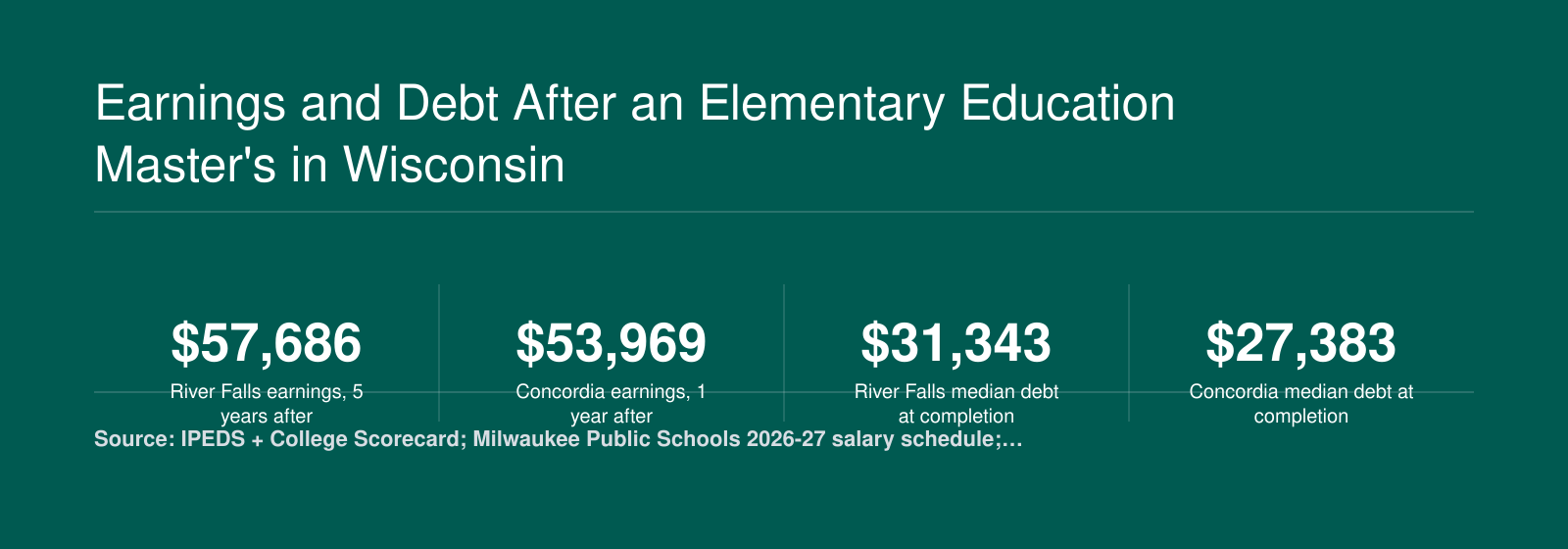
Program-level figures come from federal data and cover River Falls and Concordia. Wisconsin teachers are paid by district salary schedule, so the master's premium matters as much as first earnings. Milwaukee's 2026-27 schedule adds $3,804 at the start and $13,695 at the top, so debt of about $27,000-$31,000 takes roughly seven to eight years of starting-level premium to offset. That is faster in districts like Hudson, which adds $5,799 at the start, and faster still as pay moves up the lanes. For career changers, the degree also provides the initial license.
Moving Your Wisconsin Teaching License Across State Lines
Earning Wisconsin Elementary Education Licensure Through a Master's
Initial-licensure and advanced master's in elementary education programs can look alike in a course catalog, but they serve different people. Initial-licensure tracks, including the best MAT programs in Wisconsin and some M.Ed. or M.S. programs with licensure, are for career changers who hold a bachelor's degree and no teaching license. An advanced master's is for teachers who already hold one. Concordia University-Wisconsin's M.S. in Teaching and Learning, Elementary Education Initial Licensure, is the clear initial-licensure example here, advertising 4K-9 licensure. For University of Wisconsin-River Falls and Ottawa University-Milwaukee, check each program page to see which track you are looking at, because titles alone can mislead.
What DPI Requires
- Approved program: The master's must be a DPI-approved educator preparation program that covers the license area and the Wisconsin Educator Standards.
- Foundations of Reading Test: Required for an initial Tier II license. Exam 890 passes at 233, and earlier 090 and 190 scores are still accepted even though those versions ended after August 2025.
- Content knowledge: DPI identifies Praxis II Elementary/Multi Subject Content Knowledge 5001 for K-9 regular education. Score rules and alternatives depend on your program's approval, so ask before you register.
- Student teaching: Clinical experience is part of the pathway. Length and timing vary by program.
After Graduation
An approved pathway leads to a full Tier II Provisional license, which requires a bachelor's degree or higher. Tier III Lifetime requires a valid Tier II plus six semesters of successful experience. Your program recommends you, and you then apply through DPI's Educator Licensing Online (ELO).
Your next step: before you apply, confirm on DPI's educator preparation program listings that the program is approved for the license you want.
Compare Elementary Education programs on the data that matters
Explore more Education & Teaching specializations or browse every graduate field.
All Education & Teaching programs