Best Online Master's in Elementary Education Programs
Compare 230+ accredited online Elementary Education programs, with graduate earnings, cost, debt, and completion data from IPEDS and the U.S. College Scorecard.

Two paths lead to a fully online elementary education master's, and they rarely overlap. Career changers without a teaching license need an initial-licensure track, usually an M.A.T. that includes supervised student teaching. Licensed teachers already in classrooms pursue an M.Ed. for a salary-schedule bump or a specialization like reading or ESOL. Picking the wrong one wastes a year.
Every program here runs 100% online. Hybrid and campus-based formats are excluded, so required on-site residencies disqualify a program no matter how strong its reputation.
The real tension is state-specific: an online degree only raises your pay if your state will license you from it, and licensure rules, student teaching placement, and cost vary sharply by program.
Key Points
- Fully online elementary education master's totals range from $9,227 to $32,042.
- CUNY Brooklyn College graduates earned a median $81,371 five years later.
- Choose an M.A.T. for initial licensure; an M.Ed. fits licensed teachers.
Top 10 Fully Online Master's in Elementary Education Programs
These are fully online master's programs in elementary education; hybrid and campus-based formats are excluded from this list. The order reflects a blended quality composite that weighs career and institutional outcomes rather than cost or salary alone. Each profile pairs degree type and concentration options with tuition and institution-wide net price to make comparisons easier.
University of Florida
#1Gainesville, FL · ~$13,000/yr (est.)
Best for: Working educators seeking research-based advanced practice
Florida's College of Education emphasizes reflective practice and research-based methods across reading, math, science, social studies, and educational technology. The M.Ed. supports both current educators and career changers through an alternative certification track with clinical internship. Students develop inclusive teaching skills and can move into curriculum specialist or instructional coach roles.
- Emphasizes research-based teaching, inclusive practices, and assessment
- Coursework spans reading, math, science, social studies, and educational technology
- Prepares graduates for classroom, curriculum specialist, and instructional coach roles
- State-designated Educator Preparation Institute for career changers
- Yearlong clinical internship with mentor coach
- Leads to Florida certification
- Taught by UF education professors
University of Georgia
#2Athens, GA · ~$11,000/yr (est.)
Best for: Career changers pursuing initial Georgia certification
Georgia's M.A.T. is built for candidates seeking initial Georgia certification in grades PK through 5. The four-semester sequence combines coursework in language arts, social studies, mathematics, science, reading strategies, integrated curriculum, and assessment with a student teaching placement. Small cohorts provide one-on-one mentorship.
- Leads to initial Georgia PK-5 certification
- 33 credits across four semesters
- Student teaching placement in elementary classrooms
- ESOL endorsement may be included
University of Central Florida
#3Orlando, FL · ~$9,000/yr (est.)
Best for: Current K-6 teachers adding endorsements
UCF's 30-credit M.Ed. is designed for current K-6 teachers who want to stay in the classroom while adding expertise in student engagement, differentiation, and assessment. The program offers seven specializations, including Reading Education, ESOL, Gifted Education, and Early Childhood, with thesis and non-thesis capstone options. The degree is approved by the Florida Department of Education and housed in a top-ranked education school.
- 30-credit, two-year program for current K-6 teachers
- Seven specializations including Reading Education, ESOL, Gifted Education, and Early Childhood
- Thesis and non-thesis options with capstone or thesis defense
- Approved by the Florida Department of Education
- Reading Endorsement concentration for Florida schools
- Prepares for Florida Teacher Certification Examinations
- Three start dates per year
- Designed for experienced educators
- $327 per credit for this track
- 15-credit ESOL Endorsement coursework
- Helps experienced educators earn a professional teaching certificate
CUNY Brooklyn College
#4Brooklyn, NY · $10,000 – $15,000/yr (est.)
Brooklyn College's M.S.Ed. prepares teachers for New York State certification in grades 1 through 6, with an emphasis on urban, diverse classrooms. The curriculum integrates liberal arts, bilingual education, science, math, and social justice. Students complete internships in New York City schools and choose from three tracks based on their certification level.
- Three certification-level tracks based on experience
- Internships in NYC public and private schools
- Emphasizes bilingual education, literacy, and social justice
- Prepares for New York State certification
- Rolling admissions for fall and spring start terms
Siena University
#5Loudonville, NY · ~$17,000/yr (est.)
Siena College's MSEd leads to New York State Initial Teacher Certification for Birth through Grade 6. The program combines child development and inclusive pedagogy with fieldwork across rural, suburban, and urban school settings. Small classes and mentorship provide support for early childhood and elementary teaching careers.
- Leads to New York State Initial Teacher Certification, Birth through Grade 6
- Fieldwork in rural, suburban, and urban school partnerships
- Small classes with faculty and professional mentorship
- Rooted in Franciscan values and inclusive pedagogy
University of North Texas
#6Denton, TX · $9,000 – $16,000/yr (est.)
UNT's M.Ed. in Teaching helps educators support English learners and bilingual students in elementary classrooms. The 36-credit program covers classroom organization, curriculum development, and instructional strategies for diverse learners, including special education populations. Students complete student teaching or internship experiences and prepare for Texas EC-6 certification.
- 36 credit hours and 12 courses
- Focus on ESL methods and cultural responsiveness
- Prepares for EC-6 teaching certification
- Student teaching or internship component
- Bilingual Generalist concentration for emerging bilingual students
- 36 credit hours and 12 courses
- Prepares for EC-6, 4-8, or secondary certification
- Student teaching or internship component
Auburn University
#7Auburn, AL · $13,000 – $34,000/yr (est.)
Auburn's M.Ed. is an advanced credential for certified teachers, building on existing expertise rather than serving as an initial licensure path. It deepens content and methods in language arts, mathematics, science, and social studies for grades K-6. The program emphasizes research-based instruction, differentiation, assessment, and culturally responsive teaching.
- Designed for certified teachers seeking advanced study
- Leads to Alabama Class A certification
- Curriculum covers K-6 language arts, math, science, and social studies
- Emphasizes research-based instruction and culturally responsive teaching
- Accredited by CAEP
American Public University System
#8Charles Town, WV · $5,000 – $10,000/yr (est.)
American Public University's M.Ed. in Teaching is a nonlicensure option for licensed K-12 educators who want to deepen elementary teaching practice. The 36-credit program combines core work in classroom management, assessment, research methods, and education law with concentration coursework in integrated math, science, language arts, social studies, and arts. A capstone action research project lets students examine a real classroom problem.
- 36-credit, 12-course nonlicensure program
- Focus on classroom management, assessment, research methods, and education law
- Concentration work in integrated math, science, language arts, social studies, and arts
- Capstone action research project
University of Missouri
#9Columbia, MO · ~$14,000/yr (est.)
Missouri's M.Ed. in Elementary Education is an advanced, non-certification program for educators and others seeking deeper expertise in curriculum design, instructional strategies, and assessment. The 30-credit program emphasizes evidence-based teaching and critical inquiry. It supports leadership, curriculum development, or doctoral study.
- 30-credit advanced program
- Core courses in elementary education and research methods
- Does not lead to teacher certification
- Statement of purpose and two letters of recommendation required
University of Mississippi
#10University, MS · $5,000 – $10,000/yr (est.)
The University of Mississippi offers two graduate paths: a 30-credit M.Ed. in Elementary Education and a Master of Education in Curriculum and Instruction with an Elementary Education concentration. The programs emphasize advanced learning theories, curricular issues in elementary mathematics, teacher leadership, and culturally responsive instruction for K-6 classrooms. They are designed for licensed teachers and include clinical hours and capstone work.
- 30-credit, two-year program for K-6 educators
- Coursework covers advanced learning theories, elementary math, and teacher leadership
- Asynchronous classes for working professionals
- Teaching license or qualifying Praxis or GRE scores required
- Concentration in Elementary Education for current teachers
- 45 clinical hours and capstone required
- Does not lead to initial licensure
- 3.0 GPA in last 60 undergraduate hours and education-related degree required
Cost & outcomes by school
Federal data for the highest-earning Elementary Education programs, independent of the ranking above. Earnings are this field's master's graduates four years after completing, where the Scorecard reports them.
| School | Earnings | Tuition / yr | Debt | Grads/yr | Format |
|---|---|---|---|---|---|
| University of Washington-Seattle Campus WA | $80,738 | $18,792 | $30,990 | 103 | Hybrid |
| CUNY Brooklyn College NY | $80,655 | $11,524 | $27,668 | 124 | Online |
| Molloy University NY | $79,134 | $27,520 | $41,000 | 24 | Hybrid |
| Pacific Lutheran University WA | $77,198 | $30,535 | $34,896 | 37 | Hybrid |
| CUNY Hunter College NY | $77,067 | $11,398 | $25,523 | 127 | Hybrid |
| Alliant International University-San Diego CA | $75,075 | $19,690 | $35,450 | 215 | Online |
| Endicott College MA | $73,257 | $15,534 | — | 19 | Hybrid |
| Mercy University NY | $72,974 | $19,620 | $41,000 | 132 | Online |
| Heritage University WA | $72,707 | $10,620 | $34,477 | 15 | Hybrid |
| City University of Seattle WA | $71,341 | $12,533 | $37,807 | 15 | Online |
| American International College MA | $67,175 | $13,314 | $20,500 | 57 | Hybrid |
| Georgia Southwestern State University GA | $65,670 | $4,626 | $23,532 | 225 | Online |
Sources: U.S. Department of Education. Tuition and graduates: IPEDS. Earnings and debt: College Scorecard, this field's master's graduates; a dash means no figure is reported.
Cost, debt & payoff
Median earnings of this field's master's graduates (4 yrs after completing) vs. their median federal loan debt · U.S. College Scorecard
Across these programs the median graduate earns about $58,916 and finishes with roughly $28,371 in debt — a ratio that clears a common rule of thumb (keep debt below first-year salary). Tuition and debt vary widely school to school, so check the per-school figures in the table above before you shortlist.
How We Rank Online Master's in Elementary Education Schools
Online teacher preparation is now routine, so a polished program page tells you very little about whether a degree is worth its price.
The Filter
Only fully online programs qualify. Required campus residencies and hybrid formats are out. Local student teaching placements, which many licensure tracks require, are a different matter and are covered in the licensure section below.
What Goes Into the Quality Composite
- Cost: Graduate tuition and net price.
- Persistence: Institution-wide graduation and retention rates.
- Outcomes: College Scorecard program-level earnings and debt, where published.
Where the Data Falls Short
Net price and graduation rate describe the whole institution, not the elementary education master's alone, so treat them as signals rather than guarantees. Earnings figures exist only for programs with enough completers, which means some strong programs simply have no number to show.
Which Numbers Matter for You
Career changers should weigh total cost and licensure fit first. An affordable master's in elementary education that doesn't lead to a license in your state is no bargain. Already-licensed teachers should set the cost against the salary schedule bump their district pays for a master's degree. If the raise takes many years to repay the tuition, a lower-priced option deserves a hard look.
Accreditation and State Licensure: Will an Online Program Work in Your State?
An online degree only helps you if your own state will license you from it, so verify three things, including elementary education master's licensure requirements, before you apply.
The Three Checks
- Regional accreditation: The university itself should be regionally accredited. This protects your credits, your financial aid, and your standing with employers.
- CAEP or AAQEP accreditation: These accreditors review the education school's teacher preparation. States often look for them, though a few judge programs on their own approval lists.
- State approval for licensure: The program must be approved to lead to a license in the state where you plan to teach. State authorization to enroll students there is a separate matter and does not confer a license.
Find the Licensure Disclosure Page
Federal rule 34 CFR 668.43 requires schools to say, state by state, whether a licensure program meets, does not meet, or has not been determined to meet that state's educational requirements. Look for this page before you apply. It speaks to educational alignment, not a promise that you will be licensed.
Reciprocity Is Not Automatic
The NASDTEC Interstate Agreement eases moving a license between states, but each receiving state sets its own conditions. Massachusetts notes that the agreement does not waive degree, testing, or prerequisite requirements. Pennsylvania still requires its own tests, student teaching or an internship, and a 3.0 GPA.2 Georgia's out-of-state pathway asks for a state-approved program with pedagogy and clinical practice, plus three years of successful experience.1
Career changers should expect add-ons such as:
- Praxis or state-specific content exams (South Carolina requires math, social studies, science, reading, and pedagogy assessments for initial elementary certification in 2026)3
- Science of reading tests (South Carolina adds Praxis 5205 or Pearson 890 for elementary candidates beginning September 1, 2026)3
- Fingerprinting and background checks
Rules change often, so confirm current details with your state agency.
One Action to Take
Email the program's licensure office with your state's name before applying. Ask whether the program meets that state's requirements, including field placement, and get the answer in writing.
M.A.T. vs. M.Ed.: Initial Licensure or Advanced Study?
An M.A.T. is built for career changers who need an initial teaching license, while an M.Ed. is designed for educators who already hold a license and want advanced study. In practice, no license means choose a licensure-track program, while an existing license usually makes the advanced M.Ed. the faster and cheaper option. Check each program's listing in the ranking above to see which path it follows.
| Dimension | M.A.T., initial licensure track | M.Ed., advanced track |
|---|---|---|
| Who it is for | Career changers who did not study education as undergraduates and need to qualify for a first teaching license. | Licensed, practicing educators seeking advanced instructional design, curriculum theory, pedagogy, or specialization. |
| Requires a current teaching license? | No; it is intended to issue the initial license. | Yes; it builds on an existing license rather than granting a first one. |
| Student teaching requirement | Typically includes a student teaching placement as part of pedagogical preparation and subject-area content. | Not built around a student teaching requirement; coursework focuses on advanced study for licensed educators. |
| Typical outcome | Initial teaching certification; for example, graduates of the Columbus State University MAT in Special Education-General Curriculum receive a clear renewable teaching certificate for Georgia. | Certificate upgrade and subsequent pay raise for practicing teachers; it is an advanced credential, not a route to a first license. |
| Best fit | Professionals changing careers into elementary or special education who need a direct path to licensure. | Current teachers who need graduate-level study for a salary lane change, specialization, or curriculum leadership. |
| Enrollment scale example, SUNY Empire State University Special Education | Grew from 9 students at program launch in fall 2017 to 124 students. | Grew from 5 students at program launch in fall 2017 to 25 students. |
What You Need to Apply Without a Teaching License
Career changers entering an online initial-licensure elementary education master's should prepare for a few standard requirements, and a few that often surprise applicants.
- Bachelor's degreeA completed bachelor's degree from an accredited school is the baseline; it need not be in education.
- Minimum GPAGPA minimums vary, commonly between 2.5 and 3.0; some programs list 2.75 or 3.0, and a few accept lower GPAs with a basic-skills test.
- Basic skills or content testsPraxis Core, Praxis 5001, CKT 7001, and Pearson/Praxis Math or Foundations of Reading appear across programs; state requirements vary.
- Background check and fingerprintingExpect a criminal background check, often with fingerprinting, before field placements; several programs require it before admission or student teaching.
- Prerequisite courseworkSome programs expect 24 semester hours of elementary-content coursework or specific history/education courses; others review transcripts and allow gaps.
- Statement of purpose or interviewMany programs ask for a short written statement and sometimes an interview.
- GRE policyThe GRE is often not required or test-optional; confirm each school's current policy.
Related Articles
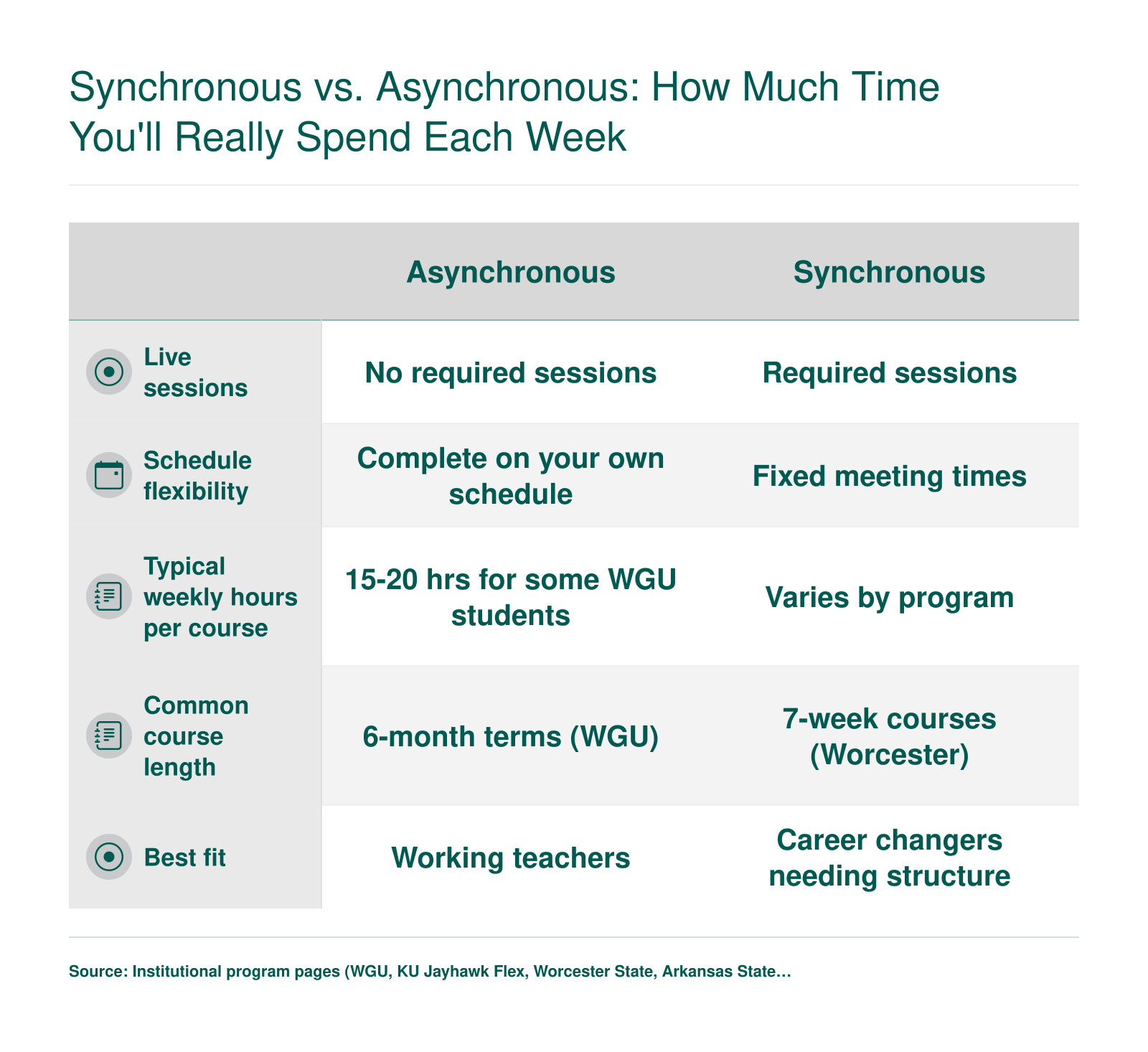
Synchronous vs. Asynchronous: How Much Time You'll Really Spend Each Week
Your weekly workload depends less on the degree name and more on whether your program is asynchronous or synchronous. Asynchronous programs let you move through material on your own schedule, while synchronous programs require scheduled live sessions. Use the comparison below to see which format fits your life.
How Much Does an Online Master's in Elementary Education Cost?
Published totals for fully online elementary education master's programs range from about $9,227 to $32,042, with per-credit rates from $235 to $963 depending on the program and residency. Across the ranking data, in-state graduate tuition ranges from $6,813 to $13,023 and out-of-state tuition ranges from $6,813 to $31,216; net price is an institution-wide average after aid, not a program quote. Students can offset costs through TEACH Grant funding of up to $3,772 for first disbursements through September 30, 2026, district tuition reimbursement, and transfer credit.
| Program | Per-credit tuition | Credits | Estimated tuition total | Residency and cost notes |
|---|---|---|---|---|
| American College of Education, M.Ed. in Elementary Education | $235 | 34 | $9,976 | Residency treatment not established |
| American College of Education, M.A. in Elementary Teaching | $235 | 34 | $10,976 | Total includes fees; residency treatment not established |
| UNC Pembroke, M.A.T. in Elementary Education | $237.78 to $963.28 | 30 | $9,227 to $30,992 | In-state and out-of-state rates plus per-credit and per-term distance fees |
| Liberty University, M.Ed. in Curriculum and Instruction, Elementary Education | $450 to $515 | 36 | N/A | Full-time and part-time graduate education rates differ |
| Auburn University at Montgomery, M.Ed. in Elementary Education | $483 to $531 | 30 | $14,490 to $15,930 | Alabama resident and nonresident rates, fees excluded |
| Grand Canyon University, M.Ed. in Elementary Education | $625 | 47 | N/A | Residency treatment not established |
| Brenau University, M.Ed. in Elementary Education | $866 | 37 | $32,042 | Residency treatment not established |
Graduate Earnings Snapshot
CUNY Brooklyn College graduates of the online childhood education master's had the highest median earnings in the data: $81,371 five years after finishing.
Elementary Education programs by state
Frequently Asked Questions About Online Elementary Education Master's Programs
What states accept an online elementary education master's from another state?
Can I complete student teaching online for an elementary education master's?
Can I keep working full-time while earning an online elementary education master's?
How much more do teachers with a master's degree earn on district salary schedules?
Compare Elementary Education programs on the data that matters
Explore more Education & Teaching specializations or browse every graduate field.
All Education & Teaching programs