Best Master's in Elementary Education Programs in Massachusetts
Compare 30 accredited Elementary Education programs in Massachusetts at 26 schools, with graduate earnings, cost, debt, and completion data from IPEDS and the U.S. College Scorecard.
Massachusetts splits its elementary teaching credential into two stages, and that structure decides which master's you need. A career changer with no teaching license needs an initial-licensure M.Ed. that includes a practicum and MTEL preparation. A teacher already in the classroom needs a professional-license route built on existing experience.
The best master's in elementary education programs in Massachusetts span campus, online, and hybrid formats, often on the same catalog page. Net price, median graduate earnings, and completion rates vary sharply across them, so the stronger name is not always the better value.
Key Points
- Merrimack College says no entrance exam is required for its program.
- Initial-license tracks fold supervised practicum into credits, so total bills differ from professional-license degrees.
- Only 59.5% of first-time takers passed the General Curriculum math MTEL in early 2026.
Top 10 Master's in Elementary Education Programs in Massachusetts
Each school earned its spot on what graduates get for their money: affordability, completion, and post-degree outcomes, weighed together. The list mixes campus, hybrid, and online options, and it includes both initial-license programs for career changers and professional-license programs for working teachers. Graduation rates cited below describe the whole institution, not the education program alone.
Boston College
#1Chestnut Hill, MA · ~$38,000/yr (est.)
Best for: Urban-minded career changers seeking licensure
Boston College, in Chestnut Hill, graduates about 91% of its students, and its M.Ed. in Elementary Education is a campus program built around a semester-long practicum in urban and suburban Greater Boston schools. It offers licensure and non-licensure pathways, with SEI endorsement courses included and the Donovan Urban Scholars Program for those committed to urban teaching. It is the priciest option on this list, so weigh it against the lower-cost public programs.
- 37 credit hours across 13 courses, with a full practicum
- Prepares for teaching grades 1-6
- Licensure and non-licensure pathways
- Full-time and part-time options, starts fall, spring, or summer
- SEI endorsement courses included
- Master's comprehensive exam required
- Donovan Urban Scholars Program available
University of Massachusetts-Amherst
#2Amherst, MA · $15,000 – $20,000/yr (est.)
Best for: Current UMass undergraduates fast-tracking to teaching
UMass Amherst is a public flagship that graduates about 83% of its students. Its elementary master's is a 4+1 accelerated pathway for current UMass undergraduates, who can earn up to 9 graduate credits early and finish the degree and license in one more year. It is a strong value for those already enrolled, but it is not an option for outside applicants.
- Campus program for current UMass undergraduates
- Earn up to 9 graduate credits as an undergrad
- Approved for Massachusetts licensure by DESE
- 3.0 GPA minimum and prerequisite courses required
- Social justice-oriented curriculum
Boston University
#3Boston, MA · $65,000 – $70,000/yr (est.)
Best for: Future teachers adding special education licensure
Boston University graduates about 89% of its students, and its Wheelock College of Education pairs rigorous coursework with mentored field experience and a full-time student teaching practicum. The EdM can be extended to dual licensure in special education or ESL, and a separate two-year Special Education concentration earns two initial licenses. Merit scholarships are available, which helps offset a high sticker price.
- 36 credit hours, full-time or part-time
- Campus program starting fall or spring
- Prepares for elementary teaching licensure
- Optional special education or ESL license add-on
- Mentored field experiences and student teaching practicum
- Apply by December 15, 2026
- Two-year program, full-time or part-time
- Earns two initial teaching licenses
- 54 course units plus 16 field experience units
- 120 clinical hours in urban and suburban placements
Worcester State University
#4Worcester, MA · ~$7,000/yr (est.)
Worcester State is a public university in Worcester that graduates about 61% of its students. Its M.Ed. is aimed at teachers who already hold an initial license and want the professional license; it does not grant an initial license. It is offered on campus and as a 100% online program at $13,906 in total program tuition, one of the lowest sticker prices in the state.
- 37 credit hours, requires an initial teaching license
- Does not grant an initial license
- Prepares for the DESE professional license
- Action research project and graduate portfolio required
- Two recommendation letters and work experience required
- Focus on diversity, equity, and inclusive practice
- 34 credits, finish in as few as 14 months
- $13,906 total tuition at $409 per credit
- No entrance exam required, 2.8 GPA minimum
- 100% online, starts summer or fall
- Supports the Massachusetts professional licensure self-petition
- Capstone and graduate portfolio required
Emmanuel College
#5Boston, MA · ~$14,000/yr (est.)
Emmanuel College, in Boston, graduates about 68% of its students and delivers its Elementary Education M.Ed. online in synchronous seven-week courses. The 36-credit program is built for working professionals and can be completed in as little as 12 months. Its urban education focus, student teaching practicum, and MTEL preparation suit career changers who want initial licensure for grades 1-6.
- Online, synchronous seven-week courses
- 36 credits, finish in as little as 12 months
- Initial licensure for grades 1-6
- Student teaching practicum and seminar
- Prepares for the MTEL exams
- Optional endorsements in moderate disabilities or ELL
- Six concentration options across the M.Ed.
Merrimack College
#6North Andover, MA · ~$37,000/yr (est.)
Merrimack College, in North Andover, graduates about 70% of its students. Its 36-credit M.Ed. in Elementary Education (1-6) leads to Massachusetts initial licensure and lets students choose online or on-campus delivery for each course. Total program tuition is $22,320, no GRE or GMAT is required, and a 450-hour practicum anchors the program.
- 36 credits, 13 months full-time or 2-3 years part-time
- $22,320 total tuition at $620 per credit
- No entrance exam required, test optional
- 450-hour full-time student teaching practicum
- MTEL prep built in, meets DESE licensure requirements
- Six start dates per year, eight-week terms
- Tuition-free fellowships and a $1,000 priority scholarship
Endicott College
#7Beverly, MA · $15,000 – $20,000/yr (est.)
Endicott College, in Beverly, graduates about 76% of its students. Its M.Ed. in Elementary Education is delivered fully online and leads to an initial Massachusetts license for grades 1-6. A 300-hour practicum, personal advising, and job placement support give career changers hands-on classroom time without a campus commute.
- 36 credit hours, delivered fully online
- Leads to a Massachusetts initial license for grades 1-6
- 300 clinical hours in diverse settings
- Built on Massachusetts Curriculum Frameworks
- Coursework in STEM methods, literacy, and special education
- Personal advising and job placement support
Gordon College
#8Wenham, MA · ~$9,000/yr (est.)
Gordon College, in Wenham, graduates about 69% of its students. Its Master of Education in Elementary Education prepares teachers for kindergarten through sixth grade, with an emphasis on the science of reading. The program is delivered online and offers both initial and professional licensure tracks, and it suits teachers headed for public, private, or Christian schools.
- Prepares for K-6 teaching, online format
- Initial or professional licensure options
- Emphasis on the science of reading
- Two concentration options within the M.Ed.
- Careers in public, private, and Christian schools and missions
Bridgewater State University
#9Bridgewater, MA · ~$9,000/yr (est.)
Bridgewater State University is a public school that graduates about 53% of its students. Its hybrid M.Ed. is for teachers who already hold an initial elementary license (grades 1-6) and want the professional license. The 31-credit program is a lower-cost route for working teachers, with 15 credits of advisor-approved electives.
- 31 credit hours, hybrid format
- For teachers who already hold an initial elementary license
- Leads to professional licensure in Massachusetts
- 15 credits of advisor-approved arts and sciences electives
- Entrance exam, 2.8 GPA minimum, and 3 recommendations required
- Comprehensive examination required to graduate
- Program materials list CAEP and NAEYC alignment
Westfield State University
#10Westfield, MA · $5,000 – $10,000/yr (est.)
Westfield State University, a public school in western Massachusetts, graduates about 54% of its students. Its 40-credit Elementary 1-6 M.Ed. leads to initial licensure and is approved by DESE and accredited by AAQEP. Evening classes and three pre-practicum field experiences before a full-time practicum make it practical for working career changers.
- 40 credit hours, leads to initial licensure for grades 1-6
- Accredited by AAQEP and approved by DESE
- Classes meet late afternoons and evenings
- Three pre-practicum field experiences, then full-time practicum
- Admission requires the MTEL Communication and Literacy test
- Thesis or capstone option, three recommendations
- Teacher Incentive Discount for MTEL completers
Cost & outcomes by school
Federal data for the highest-earning Elementary Education programs, independent of the ranking above. Earnings are this field's master's graduates four years after completing, where the Scorecard reports them.
| School | Earnings | Tuition / yr | Debt | Grads/yr | Format |
|---|---|---|---|---|---|
| Endicott College MA | $73,257 | $15,534 | — | 19 | Hybrid |
| Boston College MA | $68,576 | $37,520 | — | 23 | Campus |
| American International College MA | $67,175 | $13,314 | $20,500 | 57 | Hybrid |
| Cambridge College MA | $66,861 | $11,763 | — | 25 | Hybrid |
| Worcester State University MA | $66,285 | $6,813 | — | 49 | Campus |
| Northeastern University MA | $65,134 | $29,174 | — | — | Campus |
| Boston University MA | $62,027 | $67,626 | $25,500 | 10 | Campus |
| Fitchburg State University MA | $61,409 | $6,246 | — | 9 | Online |
| Merrimack College MA | $61,055 | $36,800 | $25,588 | 109 | Online |
| Salem State University MA | $60,928 | $9,360 | $15,041 | 82 | Campus |
| Lesley University MA | $58,844 | $19,890 | $34,401 | 54 | Hybrid |
| Lasell University MA | $58,830 | $12,150 | — | 3 | Hybrid |
Sources: U.S. Department of Education. Tuition and graduates: IPEDS. Earnings and debt: College Scorecard, this field's master's graduates; a dash means no figure is reported.
Cost, debt & payoff
Median earnings of this field's master's graduates (4 yrs after completing) vs. their median federal loan debt · U.S. College Scorecard
Across these programs the median graduate earns about $62,027 and finishes with roughly $23,000 in debt — a ratio that clears a common rule of thumb (keep debt below first-year salary). Tuition and debt vary widely school to school, so check the per-school figures in the table above before you shortlist.
Lowest-Cost Elementary Education Master's Options in Massachusetts
These schools post the lowest average net prices among the programs ranked here, based on IPEDS and College Scorecard data. Net price is an institution-wide average after grant aid, not a quote for any single student, so your own cost will depend on your aid package. Public universities dominate the low-cost end, with Bay Path University the only private school in the group.
| School | Graduate tuition (in-state) | Graduate tuition (out-of-state) | Average net price |
|---|---|---|---|
| Worcester State University | $6,813 | $6,813 | $13,381 |
| Fitchburg State University | $6,246 | $6,246 | $14,262 |
| Bay Path University | $15,162 | $15,162 | $14,271 |
| Salem State University | $9,360 | $11,069 | $15,996 |
| Framingham State University | $10,965 | $13,470 | $16,114 |
Online and Hybrid Master's in Elementary Education Options in Massachusetts
Format matters as much as curriculum when you are balancing a graduate degree with a classroom job. Emmanuel College and Merrimack College offer online master's in elementary education options, Endicott College and Bridgewater State University run hybrid formats, and several other schools offer M.Ed. programs in Massachusetts on campus. Salem State University's initial-licensure M.Ed. is fully online, though every student completes a yearlong public-school practicum.1 UMass Boston structures its elementary M.Ed. around 75 hours of pre-practicum fieldwork and a 14-week, five-day-per-week practicum that satisfies the state's 300-hour clinical requirement. Bridgewater State's initial pathway includes a full-time grades 1-6 student teaching semester or quarter under a cooperating teacher and university supervisor. For working teachers, Westfield State schedules classes in late afternoons and evenings, and Lesley University's Urban Initiative offers a yearlong residency in greater Boston.2 Even when coursework is online, licensure requires Massachusetts classroom time, so confirm placement options before enrolling: some programs may allow a paraprofessional role, emergency hire, or existing teaching job, while others arrange the school for you.
Related Articles
Which Massachusetts Programs Waive or Make the GRE Optional
Do you need the GRE for elementary education master's programs in Massachusetts? Not necessarily: many applicants look for No-GRE master's programs, but the answer depends on the school.
Merrimack College is the clearest case: its program page says no entrance exam is required and calls admission test optional. Bridgewater State University is conditional. Applicants with an undergraduate GPA below 3.0 must submit GRE scores or complete a low-GPA remedy, and those at 2.80 to 2.99 need a combined GRE score of 291. Applicants who already hold a master's face no GRE step, and the GRE is not required once you have passed the MTELs for the initial license. Westfield State lists an entrance exam without specifying which.
Salem State, Lesley, Boston University, UMass Amherst and Framingham State publish no GRE policy that we could verify, so confirm directly with admissions.
What schools ask for instead
- GPA: UMass Amherst lists a 3.0 minimum.
- References: Worcester State asks for two letters, Westfield State and Bridgewater State three.
- MTEL: Bridgewater State requires Foundations of Reading and General Curriculum Subtests 1 and 2 before professional-semester courses.
Deadlines
Bridgewater State and Merrimack admit on a rolling basis (Bridgewater suggests applying six to eight weeks ahead). Fixed dates: UMass Amherst January 19, 2026, Merrimack April 27, 2026, and Boston University December 15, 2026.
Cost and Massachusetts Licensure for Elementary Education Master's Students
Initial licensure and professional licensure tracks can produce very different bills. A program that includes a practicum, such as Salem State's Master of Education in Elementary Education, Initial Licensure, builds supervised field experience into the credit load, while a professional licensure MEd for current teachers, such as Bridgewater State's 31-credit offering, may be shorter.
Exact totals require a published per-credit rate and credit count. Salem State's 2026 summer rate, published on its Summer Tuition and Fees page, is $529.70 per credit, or $1,589.10 per 3-credit course, but its MEd total credits are not listed in the available materials. Bridgewater State's ranking data shows graduate tuition near $9,300, though its 2026 per-credit price is not clearly posted. Bridgewater also advertises free tuition for families earning $125,000 or less, though it is not clear whether that extends to this specific master's program. Public options like Fitchburg State, Worcester State, and Westfield State list graduate tuition between about $6,200 and $8,700, while Boston University's EdM lists $67,626.
On top of tuition, budget for licensure: Massachusetts DESE charges $100 for a first license application and $25 for each additional application. The Communication and Literacy Skills MTEL is $125. Practicum or SEI endorsement costs vary by program.
For most students, public state universities cost less per credit than private schools.
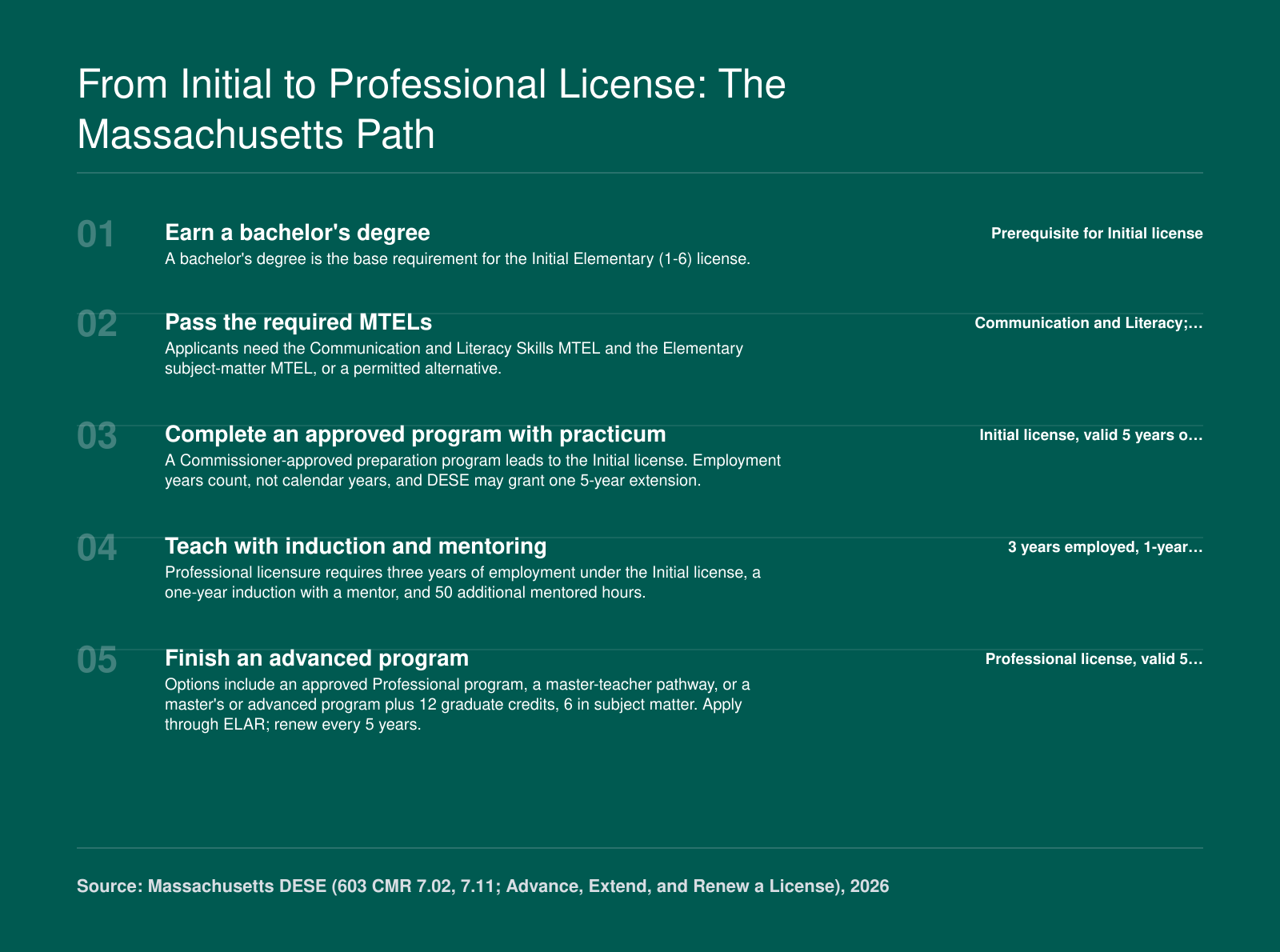
From Initial to Professional License: The Massachusetts Path
Massachusetts licenses elementary teachers (grades 1-6) in two stages. The Initial license gets you into the classroom, and the Professional license follows after experience, induction, and advanced study. Confirm current test names in the DESE Licensure Requirements Tool.
Programs Where Elementary Education Graduates Earn the Most
These figures are median earnings for graduates of each school's elementary education master's program, drawn from IPEDS and College Scorecard (2024). The measurement window differs by school, so compare rows with that in mind. American International College is the one program here with a published median debt figure: $20,500 against median earnings of $69,151 five years after finishing.
| School | Program | Median Graduate Earnings | Measured | Median Program Debt |
|---|---|---|---|---|
| Endicott College | M.Ed. in Elementary Education | $73,257 | Four years after finishing | |
| Worcester State University | Master of Education, Elementary Education | $72,190 | Five years after finishing | |
| American International College | Elementary Education Program | $69,151 | Five years after finishing | $20,500 |
| Boston College | M.Ed. in Elementary Education | $68,576 | Four years after finishing | |
| Northeastern University | Master of Arts in Teaching, Elementary Education (Grades 1-6) | $65,134 | Four years after finishing |
According to Massachusetts DESE data, just 59.5% of first-time test takers passed the General Curriculum mathematics, science, and technology/engineering MTEL from November 2025 through January 2026. Some programs here build in workshops or tutoring to help candidates clear that hurdle.
Quick Answers on Elementary Teaching Credentials in Massachusetts
Massachusetts licensure rules shape which master's route makes sense for you. These answers draw on guidance from the state Department of Elementary and Secondary Education (DESE). Confirm current requirements with DESE before you enroll.
Do you need a master's degree to teach elementary school in Massachusetts?
Can I earn initial licensure through a master's if my bachelor's isn't in education?
What is the difference between initial and professional licensure in Massachusetts?
Compare Elementary Education programs on the data that matters
Explore more Education & Teaching specializations or browse every graduate field.
All Education & Teaching programs