Best Master's in Elementary Education Programs in North Dakota
Compare 3 accredited Elementary Education programs in North Dakota, with graduate earnings, cost, debt, and completion data from IPEDS and the U.S. College Scorecard.

A lane change on a district salary schedule and a first teaching license are two different purchases, and North Dakota's elementary education master's degrees are not interchangeable between them.
The options are few: public universities running 30 to 33 credit online programs for educators already working in K-6 classrooms. That scarcity cuts both ways. Comparison is quick, but a degree designed for licensed teachers will not carry a career changer to initial licensure, which the state's Education Standards and Practices Board grants only through approved programs that include supervised student teaching.
Key Points
- University of North Dakota's M.Ed. lists a 2.75 cumulative GPA threshold.
- Dickinson State's $365.32 per-credit tuition is the lowest published here.
- North Dakota's ESPB requires Praxis Teaching Reading: Elementary for initial licensure.
Ranked: North Dakota's Top Master's in Elementary Education Programs
North Dakota's online and hybrid elementary education master's options are concentrated among public universities that tailor coursework to working teachers. These three ranked programs differ in credit requirements, tuition pricing, and classroom focus, but each is built around the needs of already-licensed elementary educators.
University of North Dakota
#1Grand Forks, ND · ~$14,000/yr (est.)
Best for: Licensed teachers pursuing curriculum leadership
This public university's master's in elementary education is designed for licensed teachers seeking to advance their classroom practice. The 30-credit curriculum emphasizes curriculum development, differentiated instruction, and educational technology, with coursework in STEM education, mathematics, and reading. Students complete a thesis, independent study, or scholarly project, and asynchronous classes offer flexibility for working educators.
- CAEP accredited
- 30 total credit hours
- Thesis or capstone option
- 100% online coursework
- No required campus visits
- Top 10 online program nationally
- Same degree as on-campus
- Free online tutoring and 24/7 technical support
Valley City State University
#2Valley City, ND · ~$8,000/yr (est.)
Best for: K-6 educators needing flexible online format
This public university's master of education with an elementary education concentration is built for K-6 teachers seeking advanced knowledge and skills. The 33-credit sequence blends core courses in school, community, and family issues with specialized elementary teaching, literacy, and 21st-century tools. Students complete an action research project, portfolio defense, and capstone, preparing for roles as elementary educators, curriculum specialists, instructional coaches, or supervisors.
- 33 total credit hours
- Capstone required
- Designed for K-6 educators
- Action research project required
- Oral defense of portfolio
- Electives in STEM education
- Focus on instructional technology
- Supervisor, leader, or coach outcomes
Dickinson State University
#3Dickinson, ND · ~$7,000/yr (est.)
Best for: Current elementary educators prioritizing low cost
This public university's master of education in elementary education is tailored for current elementary educators deepening their expertise. The curriculum covers cross-curricular literacy, language arts, math instruction, and purposeful technology integration for younger learners. Admission requires a 3.0 undergraduate GPA and a personal statement, with a $35 application fee, and the university is accredited by the Higher Learning Commission.
- 3.0 GPA minimum
- $35 application fee
- Designed for elementary education teachers
- Focus on cross-curricular literacy
- Integrates technology for young learners
- Primarily online coursework
- Personal statement of goals required
- Higher Learning Commission accredited
Cost & outcomes by school
Federal data for the highest-earning Elementary Education programs, independent of the ranking above. Earnings are this field's master's graduates four years after completing, where the Scorecard reports them.
| School | Earnings | Tuition / yr | Debt | Grads/yr | Format |
|---|---|---|---|---|---|
| University of North Dakota ND | $62,264 | $13,677 | — | 13 | Online |
| Dickinson State University ND | — | $6,576 | — | 10 | Online |
| Valley City State University ND | — | $8,075 | — | 7 | Online |
Sources: U.S. Department of Education. Tuition and graduates: IPEDS. Earnings and debt: College Scorecard, this field's master's graduates; a dash means no figure is reported.
What Shaped This List of North Dakota Elementary Education Master's Programs
A good master's in elementary education in North Dakota fits a working teacher's budget, schedule, and long-term goals. This list leans on affordability, flexibility for people already in classrooms, and each institution's track record. Cost figures combine graduate tuition and fees with an institution-wide average net price, so treat them as approximations, not a quote for your situation. Graduation rates are also institution-wide, not specific to the elementary education program, so read them as a signal of overall stability rather than a measure of this one degree.
Online and Hybrid Master's in Elementary Education Options in North Dakota
Every online master's in elementary education program ranked here is built for teachers who are already in a classroom, and none requires you to relocate.
The University of North Dakota's M.Ed. in Elementary Education is delivered fully online with no required campus visits, and its coursework is asynchronous, meaning you work through material on your own schedule rather than logging in for scheduled live sessions. It includes an online teaching practicum; the practicum course runs 1 to 4 credits, centers on school observations and applying research, and requires instructor and advisor consent. Valley City State University's M.Ed. with an elementary education concentration is also listed as 100% online, spread across six semesters and 33 credit hours, finishing with an action research report and an oral defense of a portfolio rather than a separate field placement. Dickinson State describes its M.Ed. as primarily online and aimed at practicing elementary educators.
UND states that its teacher education programs are CAEP accredited and approved by the ND ESPB, and that online students earn the identical degree and transcript as on-campus students. Confirm accreditation and field requirements directly with Valley City State and Dickinson State before enrolling in an M.Ed. in North Dakota, particularly if you plan to seek licensure outside North Dakota.
Related Articles
Which North Dakota Elementary Education Master's Programs Waive or Make the GRE Optional
Among the programs below, University of North Dakota publishes the clearest admission thresholds: at least a 2.75 cumulative undergraduate GPA, or at least a 3.00 in the last two years, and a transfer limit of one-fourth of required degree credits. The table lists published GRE status, deadlines, GPA, and transfer credit; where an official page is silent, the cell says not stated.
| School | GRE Policy | Application Deadline | Minimum GPA / Key Requirements | Transfer Credit Limit |
|---|---|---|---|---|
| University of North Dakota | Not stated on the official program requirements page | August 1 (2026) | At least 2.75 cumulative undergraduate GPA, or at least 3.00 GPA in the last two undergraduate years, on a 4.00 scale | One-fourth of the required degree credits may be transferred |
| Valley City State University | Not stated on the official catalog page | Not stated on the official catalog page | Not stated on the official catalog page | Not stated on the official catalog page |
| Dickinson State University | Not stated for an elementary education master's pathway. The official page documents the undergraduate BSE | Not stated on the official elementary education page | Not stated on the official elementary education page | Not stated on the official elementary education page |
Cost and North Dakota Licensure for Elementary Education Master's Students
Among Best Master's in Education Programs in North Dakota, Dickinson State University is the cheapest option with a published price, and none of these degrees should be treated as a shortcut to a first license.
Dickinson State charges $365.32 per credit for 30 credits, about $10,959.60 in 2025-2026, plus a $35 application fee. Valley City State charges $410.33 per credit for 33 credits, roughly $13,541 in tuition for 2026-2027. It also adds $1,536 in mandatory annual fees, and part-time students pay that full amount each year. Both schools charge one rate regardless of residency. Valley City applies it to online and on-campus students alike. The University of North Dakota applies its online graduate rate regardless of residency too, but I could not confirm its per-credit dollar amount or fees, so check its bursar page before comparing.
None of the sources I reviewed establishes a current teaching license as a formal admission requirement. UND's 30-credit M.Ed. is built for licensed teachers and other education professionals. Valley City's program targets K-6 educators. Dickinson State says its M.Ed. does not directly issue an initial license, an important elementary education master's licensure vs non-licensure distinction. Initial elementary licensure there, the state's north dakota teacher certification pathway, takes a student-teaching semester, a 2.75 GPA, the Praxis PLT and a content-area Praxis. A Dickinson flyer mentions K-8 licensure, so confirm with the school which program it describes.
UND lists 2+ years to finish and Valley City lists six semesters. Dickinson State publishes no pacing.
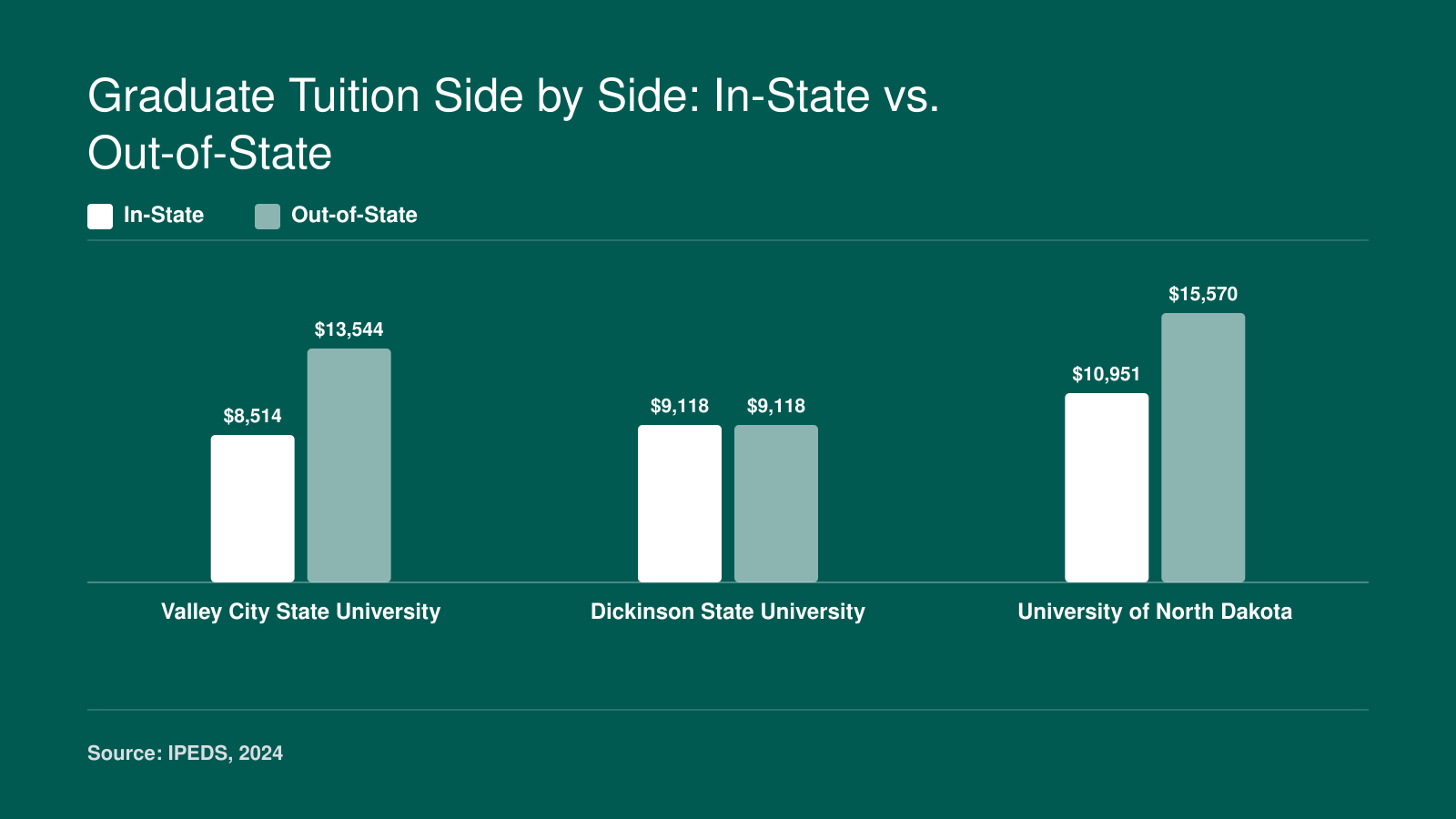
Graduate Tuition Side by Side: In-State vs. Out-of-State
Published annual graduate tuition and required fees show a clear residency split at most North Dakota programs. Valley City State University lists the lowest in-state rate at $8,514, while University of North Dakota's out-of-state rate reaches $15,570. Dickinson State University charges $9,118 regardless of residency. These are yearly published rates, not total program cost.
North Dakota Teacher Licensing Through ESPB
Does a Master's in Elementary Education Raise Teacher Pay in North Dakota?
North Dakota districts pay teachers on lanes, and moving from a bachelor's to a master's lane raises the salary immediately, an important factor when comparing Education & Teaching Master's Programs. Bismarck Public Schools' 2025-26 schedule lists a Step 0 bachelor's salary of $53,066 and a master's salary of $57,291, a $4,225 difference; by Step 25 the gap reaches $5,214 ($83,582 vs. $88,796).1
Program-level earnings data is thin here. For University of North Dakota's master's in elementary education, median earnings were $54,848 one year after finishing and $62,264 four years after finishing. Program-level debt and earnings are not published for the other schools on this page, so treat any salary claim that does not name the program carefully.
ROI math: at UND's $13,677 annual tuition, finishing in two years brings program cost near $27,354. Divided by the $4,225 entry-level lane increase, that is roughly six and a half years to break even, before grant aid, taxes, or loan interest. A cheaper annual tuition like Dickinson State's $6,576, one of the Most Affordable Master's in Elementary Education options, shortens that timeline.
Picking the Right Elementary Education Master's for Your Situation
The gap between a master's built for licensed teachers and one built for career changers is wider than most program pages make clear, and picking the wrong side of it costs a year.
If you do not already hold a North Dakota license, settle that question first: confirm with the program whether its coursework leads to initial elementary education licensure or assumes you are already certified. Everything else is secondary to that answer.
Working teachers face a different calculation. Look for fully asynchronous delivery, a part-time sequence you can carry alongside a full teaching load, and a total cost you can weigh honestly against the salary-lane increase your district actually pays.
Two checks before you enroll: ask how many graduate credits the program will transfer in if you have earned any, and get written confirmation from your district's HR office that the degree qualifies for lane movement on its schedule.
Compare Elementary Education programs on the data that matters
Explore more Education & Teaching specializations or browse every graduate field.
All Education & Teaching programs