Best Master's in Math Education Programs in North Dakota
Compare accredited Mathematics master's programs by earnings, cost, and outcomes.
Sample layout — live rankings and program data appear here once the data source is connected.
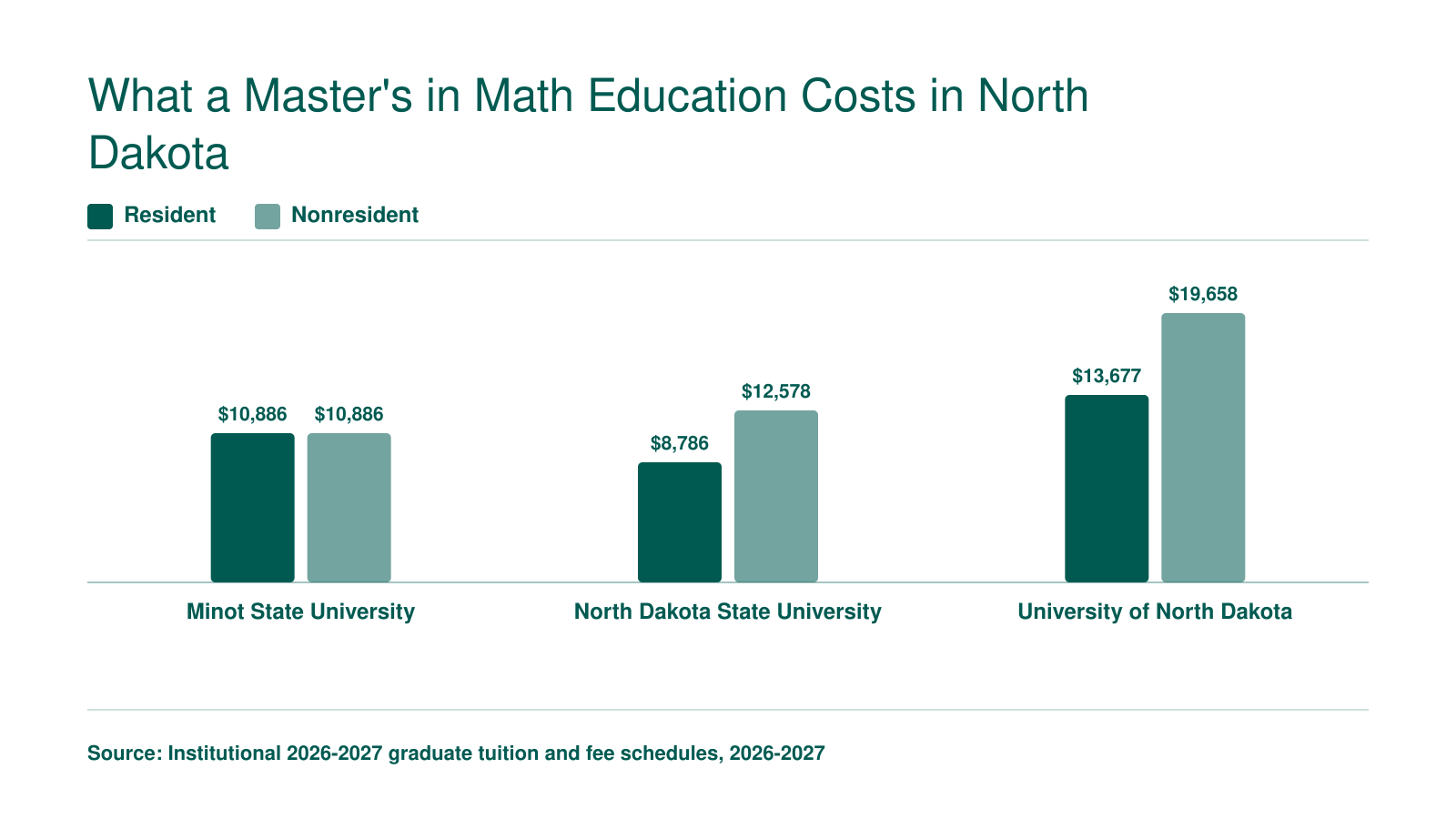
Resident graduate tuition for North Dakota's Education & Teaching Master's Programs in math education ranges from $8,786 at North Dakota State University to $13,677 at the University of North Dakota, both campus programs. Minot State University offers its Master of Education in Secondary Mathematics online at a flat $10,886 regardless of residency.
The decision turns on format, price, and licensure fit. A secondary math license requires the Praxis Mathematics (5165) exam, and only NDSU advertises a teacher licensure option, which matters more to career changers than to licensed teachers.
Key Points
- North Dakota State charges the lowest published resident tuition at $8,786.
- Minot State hosts the only clearly documented online math education master's.
- Secondary math licensure requires passing Praxis Mathematics 5165 through ND Teach.
Ranked: North Dakota's Best Master's in Math Education Programs
North Dakota's graduate math education landscape is compact, with three schools offering a relevant master's in mathematics education. That makes fit, format, and cost comparisons especially important. The ranked list below uses federal outcome data and program details to help you weigh those tradeoffs.
North Dakota State University
#1Fargo, ND · ~$9,000/yr (est.)
Best for: Licensure-focused educators seeking R1 research
North Dakota State University's Master of Education in Mathematics Education combines advanced math content with evidence-based teaching practice and offers a teacher licensure option for candidates with a teachable major. The institution reports a 64% graduation rate, and estimated graduate tuition and fees are about $11,110 in-state and $15,764 out-of-state. Its teacher preparation programs are CAEP-accredited and ESPB-approved, with mathematics included among the approved initial-licensure areas. R1 research access, dedicated advising, and graduate assistantships round out the offering.
- Mathematics Education concentration within the M.Ed.
- Teacher licensure option for teachable major holders
- Dedicated academic advisor for personalized plans
- Graduate assistantships available to offset costs
- Curriculum focuses on content and pedagogy
- R1 research environment with faculty collaboration
University of North Dakota
#2Grand Forks, ND · ~$14,000/yr (est.)
Best for: Aspiring math educators seeking hands-on teaching labs
University of North Dakota's Master's in Mathematics Education blends advanced mathematics with effective teaching methods and includes practice teaching in the Math Active Learning Lab and an independent study project. The institution reports a 60% graduation rate, with estimated graduate tuition and fees of about $10,951 in-state and $15,570 out-of-state. Teacher education at UND is CAEP-accredited and ESPB-approved, though the graduate mathematics education track is not listed as a separate advanced CAEP-ESPB program. Small graduate courses and R1 research resources support the degree.
- 32 total credit hours
- 2-year program with fall start
- Practice teaching in Math Active Learning Lab
- Volunteer at annual Math Track Meet
- Independent study capstone required
- Small graduate courses, as few as five students
- Carnegie R1 institution ranked #144 by NSF
- Teaches algebra, calculus, statistics, Java, R
Minot State University
#3Minot, ND · ~$11,000/yr (est.)
Best for: Working educators needing online eight-week courses
Minot State University's Master of Education with a concentration in Secondary Mathematics is built for current educators, pairing core teaching and learning courses with math content such as geometry, calculus, and statistics for teachers. The institution reports a 45% graduation rate, and estimated graduate tuition and fees are $8,702 for both in-state and out-of-state students. Minot State's teacher education unit is CAEP-accredited, and its M.S. in Special Education is ESPB-approved; the graduate mathematics education MAT is currently listed as inactive. The degree requires a capstone or thesis and allows fall, spring, or summer starts.
- 30 total credit hours
- Concentration in Secondary Mathematics
- Thesis or capstone option required
- Starts in fall, spring, or summer
- 2.8 GPA minimum for admission
- Requires two years of work experience
- Small class sizes with faculty advisor
- Includes math courses for teachers, such as geometry and calculus
Online and Hybrid Master's in Math Education Options in North Dakota
An online master's in math education lets a working teacher take graduate math and pedagogy courses without relocating or leaving the classroom. In North Dakota, the clearest documented example is at Minot State University, which offers a Master of Education with a Secondary Mathematics Concentration delivered online.1 It includes 18 credits of graduate mathematics coursework.2
In-Person Requirements
Minot State's published program information lists its summer math courses as online.3 For 2026, MATH 565 Calculus for Teachers runs online June 8 to July 31, with a May 1 application deadline.2 MATH 521 Probability and Statistics for Teachers is offered in odd-numbered summers.2 The sources reviewed do not say whether classes meet at set times or can be completed on your own schedule, and they do not describe a required residency or on-campus summer session. Confirm both with the department before you apply.
UND and NDSU
The sources we reviewed do not establish a delivery format for a math education master's at the University of North Dakota or North Dakota State University. Ask each graduate office directly about format, scheduling, and any campus requirements.
Tuition for Online Students
No published comparison of online and resident tuition rates turned up for these programs. Check Minot State's current graduate tuition schedule.
A full-time teacher is best served by Minot State's online format; a career changer should confirm student-teaching and licensure steps first.
Which Master's in Math Education Programs Waive the GRE?
Published admissions pages do not confirm a GRE waiver for a mathematics education master's track at the schools below.
- University of North Dakota GRE policyPublished math graduate pages do not state a GRE requirement or waiver for a math education track; the listed requirements are for the M.S. in Mathematics.
- University of North Dakota prerequisitesApplicants need a bachelor's in mathematics, a 2.75 overall or 3.0 junior/senior GPA, and MATH 431 Introduction to Real Analysis.
- University of North Dakota licensure noteNo current teaching license is stated as an admission requirement.
- University of North Dakota deadlinesPublished deadlines are March 1 for fall and August 1 for spring.
- North Dakota State University GRE policyThe Education Master's (MS/MEd, on campus and online) does not specify a GRE requirement or waiver, and it does not list a mathematics education concentration.
- North Dakota State University mathematics GRE noteThe separate mathematics graduate program says the GRE is not required, but that policy is not stated for the Education Master's.
- North Dakota State University prerequisitesFor the mathematics M.S., applicants need a baccalaureate degree with a 3.0 cumulative and 3.0 advanced math GPA.
- North Dakota State University licensure noteNo current teaching license is stated in the published education master's requirements.
- North Dakota State University deadlinesEducation master's deadlines are March 15 for summer/fall and October 15 for spring.
- Minot State University GRE policyThe M.Ed. admissions standards do not state a GRE requirement or waiver.
- Minot State University prerequisitesApplicants need a bachelor's in education or a related area, a 2.75 overall or 3.0 last-60-hours GPA, and a current education position or two years of experience.
- Minot State University deadlinesPublished deadlines are May 15 for summer, July 30 for fall, and November 30 for spring for domestic applicants.
Related Articles
What a Master's in Math Education Costs in North Dakota
Published graduate tuition and fees vary by residency. North Dakota State University lists $8,786 for residents and $12,578 for nonresidents; the University of North Dakota lists $13,677 and $19,658. Minot State lists one graduate rate of $10,886 for resident, contiguous, MSEP, WUE, and nonresident students, with part-time costs around $501 per credit and a 30-credit program. Funding may include graduate assistantships, federal TEACH Grants, and North Dakota teacher loan forgiveness of up to $6,500 per year in rural critical-need positions. These figures are advertised tuition and fees, not net price after aid.
North Dakota Math Teacher Licensure With a Master's Degree
Already-licensed teacher or career changer: the answer changes which program fits. A teacher with a classroom license usually wants graduate coursework that deepens mathematics content and moves them up a district salary schedule. Someone entering teaching from another field needs a program tied to a state-approved educator-preparation sequence, such as a Master of Arts in Teaching (MAT) in North Dakota that ends in a recommendation for an initial license.
Which path each program serves
North Dakota State University runs initial-licensure teacher preparation approved by the Education Standards and Practices Board and accredited by CAEP, so it is the likelier route for career changers. Minot State's math education master's does not lead to initial licensure; it is built for teachers who already hold one. The University of North Dakota's Master of Education in Mathematics Education is described as preparing middle and high school teachers, but UND does not clearly state whether the degree itself carries the initial-licensure sequence. Ask admissions directly before enrolling.
Exams and state requirements
ESPB expects beginning teachers to pass the Praxis Core Academic Skills exams, including Core Mathematics (5733), where the current qualifying score is 150 with a 143 minimum. Secondary math candidates take Praxis Mathematics (5165) and the Principles of Learning and Teaching exam for their grade level; ESPB publishes the current cut scores. Secondary licensure also calls for at least 26 semester hours of professional education, roughly 10 weeks of supervised student teaching, a 2.5 GPA, and mandated-reporter training. The initial in-state license runs two years.
M.S. versus M.Ed.
An M.S. leans toward advanced mathematics content; an M.Ed. leans toward pedagogy, assessment, and curriculum. Neither label alone tells you whether licensure is included.
North Dakota Licensing Snapshot
How We Rank These Programs
Our ordering rests on federal data, not reputation. We pull graduate tuition, net price, institution-wide graduation rates, and, where they are published, program-level earnings and debt figures from the College Scorecard and IPEDS, then weigh cost against what graduates actually carry out the door, the same tradeoff that anchors the Most Affordable Master's in Math Education ranking.
Delivery format and whether a math education track is currently offered come from each university's own published program data. Admissions requirements, including testing policy, and licensure pathways were checked directly against school pages and the North Dakota Education Standards and Practices Board.
One limit is worth stating plainly: graduation rates and net price describe the whole institution, not a single master's track. Use them as context about the university, not a verdict on the program.
Master's in Math Education in North Dakota: FAQs
Do I need a teaching license to enroll in a math education master's in North Dakota?
What is the difference between an M.S. and M.Ed. in math education?
Can I get a math teaching license with a master's degree in North Dakota?
Will a master's degree raise my pay as a North Dakota teacher?
Compare Mathematics programs on the data that matters
Explore more Education & Teaching specializations or browse every graduate field.
All Education & Teaching programs