Best Master's in Speech-Language Pathology Programs in Wisconsin
Compare 13 accredited Speech Pathology programs in Wisconsin at 9 schools, with graduate earnings, cost, debt, and completion data from IPEDS and the U.S. College Scorecard.

Wisconsin offers no shortcut to a speech-language pathology license: every route runs through a CAA-accredited master's, so the program you choose is your clinical training ground and your credential on-ramp. Campus, online, and hybrid formats share one ranked list, with no-GRE-required programs, cost, and licensure covered alongside.
Because ASHA's clinical-hour standard is the same across formats, the real tradeoff lands on placement support and net cost, not delivery method. A cheaper tuition means little if a program cannot secure the school and medical practicums Wisconsin licensure requires.
Key Points
- Online and campus students meet the same ASHA clinical hour standard.
- Many programs dropped the GRE; confirm each school's 2027 policy.
- Public universities cost Wisconsin residents far less than private options.
Top Master's in Speech-Language Pathology Programs in Wisconsin, Ranked
Seven Wisconsin schools offer speech-language pathology master's programs in our data, and several run more than one track or delivery format. Public universities generally cost Wisconsin residents far less than the private options, while the private schools tend to graduate a larger share of their students. Each card below shows what the school offers and how many students it graduates.
University of Wisconsin-Madison
#1Madison, WI · ~$12,000/yr (est.)
Best for: Research-minded students eyeing doctoral study
The University of Wisconsin-Madison graduates about 90% of its students, the strongest rate among Wisconsin schools on this list. Its campus-based two-year M.S. in speech-language pathology meets ASHA certification and Wisconsin licensure requirements and offers a teacher certification option. Students who want research training can pursue a combined M.S./Ph.D. path. Minnesota residents may qualify for Wisconsin resident tuition under the state reciprocity agreement.
- Campus-based clinical M.S. with a combined M.S./Ph.D. option
- Prepares for ASHA certification and Wisconsin state licensure
- Teacher certification option available
- Application deadline of January 1, submitted online
- Research involvement opportunities alongside clinical training
- Two-year professional program accredited by CAA
- Supervised clinical experiences in on- and off-campus settings
- Qualifies for Wisconsin licensure and teacher certification
- Application deadline of January 15
- SLP info sessions and student open house events
- Listed as a concentration in Normal Aspects of Speech, Language and Hearing
- Two-year clinical program accredited by CAA of ASHA
- Diagnostic experiences plus therapy with children and adults
- Meets Wisconsin DPI requirements for school practice
Marquette University
#2Milwaukee, WI · ~$25,000/yr (est.)
Best for: Aspiring bilingual English-Spanish clinicians
Marquette University graduates about 83% of its students. Its residential M.S. requires 52 credits and 400 clinical clock hours, with placements in campus, school and medical settings. Students choose a non-thesis or thesis plan and can add a Bilingual English-Spanish specialization. Graduates can qualify for Wisconsin DPI and Illinois ISBE school licensure.
- 52 total credits, including 16 credits of clinical coursework
- 400 clinical hours: 375 direct contact and 25 observation
- Two years across four terms plus one summer session
- Thesis (Plan A) or non-thesis (Plan B) option, with Praxis and capstone
- Bilingual English-Spanish specialization requires ACTFL oral proficiency testing
- Seven undergraduate prerequisite courses required
- Meets Wisconsin and Illinois school licensure requirements
University of Wisconsin-River Falls
#3River Falls, WI · $10,000 – $15,000/yr (est.)
Best for: Budget-minded Wisconsin residents
The University of Wisconsin-River Falls graduates about 57% of its students. Its full-time, two-year M.S. in Communication Sciences and Disorders requires 54 credits, 20 of them in clinical experience through school and rehabilitation-facility internships. The ASHA-accredited program makes graduates eligible for clinical certification after the Praxis exam and a clinical fellowship. It is a campus-only option with a fall start.
- 54 credits: 34 specialization and 20 clinical experience
- Full-time two-year program with a fall start
- Internships in schools and rehabilitation facilities
- Applications through CSDCAS by January 15
- Three letters of recommendation and a personal statement
- Coursework includes aphasia, dysphagia and audiology
University of Wisconsin-Eau Claire
#4Eau Claire, WI · ~$11,000/yr (est.)
The University of Wisconsin-Eau Claire graduates about 64% of its students and is the only school in our data offering a fully online route alongside a residential one. It was ranked fourth among Wisconsin SLP institutions in the 2026 U.S. News graduate survey. Students train at the UWEC Speech & Language Clinic and more than 90 affiliated clinical sites.
- Two-year on-campus format
- Clinical training at the UWEC Speech & Language Clinic
- Over 90 off-campus clinical sites
- No minor required
- Accredited by CAA of ASHA
- Three-year part-time online format
- Short summer residency required
- Same clinical placement network as the residential track
- Meets CCC-SLP certification requirements
- Blends online and on-campus coursework
- Approved by Wisconsin DPI
- Post-baccalaureate courses offered for non-CSD majors
- Roughly 40 or more graduates per year
- Thesis or capstone option
Viterbo University
#5La Crosse, WI · ~$10,000/yr (est.)
Viterbo University in La Crosse graduates about 68% of its students. Its 58-credit M.S. runs two years across five year-round, full-time semesters, with face-to-face coursework and clinical experiences in healthcare facilities and schools. Admission requires a bachelor's in communication disorders or a post-baccalaureate certificate. It lists coverage of Deaf culture and diverse communities.
- 58 credit hours over five semesters
- Year-round full-time study
- Blended format with face-to-face coursework
- Clinical placements in healthcare and schools
- Covers swallowing and cognitive-communication disorders
- Post-baccalaureate certificate route for non-CSD majors
- Meets Wisconsin licensure requirements
Concordia University-Wisconsin
#6Mequon, WI · ~$13,000/yr (est.)
Concordia University-Wisconsin in Mequon graduates about 68% of its students. Its two-year, full-time master's uses block tuition that holds the rate steady for both years and covers electives at no extra cost. Students train in an on-campus Speech, Language, and Hearing Clinic and complete externships in educational and medical settings. Applicants without a CSD bachelor's can start with a one-year, 30-credit leveling program.
- Two-year full-time program with locked tuition rate
- On-campus Speech, Language, and Hearing Clinic
- Externships in educational and medical settings
- One-year, 30-credit leveling program for non-CSD majors
- Electives and special topics included at no added cost
- Interprofessional education certificate on graduation
- Eligible for Wisconsin DPI licensure
University of Wisconsin-Milwaukee
#7Milwaukee, WI · $13,000 – $26,000/yr (est.)
The University of Wisconsin-Milwaukee graduates about 49% of its students, the lowest rate on this list, though its program is a lower-cost public option in a major metro area. The campus-based M.S. in Communication Sciences and Disorders starts each fall and prepares students for ASHA certification. Its CAA accreditation was recently extended through 2034. Applicants need 15 graded CSD credits by the deadline and 27 by program start.
- Campus-based program with a fall term start
- Applications through CSDCAS by January 15
- 15 graded CSD credits at application, 27 at program start
- Admission possible with up to two course deficiencies
- Prerequisites include phonetics, anatomy and physiology, and statistics
- Typically structured across six semesters
- TOEFL proficiency required for international applicants
Cost & outcomes by school
Federal data for the highest-earning Speech Pathology programs, independent of the ranking above. Earnings are this field's master's graduates four years after completing, where the Scorecard reports them.
| School | Earnings | Tuition / yr | Debt | Grads/yr | Format |
|---|---|---|---|---|---|
| Marquette University WI | $69,306 | $24,680 | $41,428 | 44 | Campus |
| University of Wisconsin-Milwaukee WI | $64,875 | $12,728 | $37,397 | 25 | Campus |
| University of Wisconsin-Madison WI | $64,515 | $12,325 | $39,736 | 34 | Campus |
| University of Wisconsin-River Falls WI | $62,481 | $10,357 | $41,000 | 20 | Campus |
| University of Wisconsin-Whitewater WI | $61,200 | $10,543 | $41,000 | 16 | Campus |
| University of Wisconsin-Eau Claire WI | $59,887 | $10,665 | $41,000 | 44 | Hybrid |
| University of Wisconsin-Stevens Point WI | $57,093 | $10,374 | $38,238 | 30 | Campus |
| Viterbo University WI | — | $9,888 | — | — | Hybrid |
| Concordia University-Wisconsin WI | — | $13,260 | — | 24 | Campus |
Sources: U.S. Department of Education. Tuition and graduates: IPEDS. Earnings and debt: College Scorecard, this field's master's graduates; a dash means no figure is reported.
Cost, debt & payoff
Median earnings of this field's master's graduates (4 yrs after completing) vs. their median federal loan debt · U.S. College Scorecard
Across these programs the median graduate earns about $62,481 and finishes with roughly $41,000 in debt — a ratio that clears a common rule of thumb (keep debt below first-year salary). Tuition and debt vary widely school to school, so check the per-school figures in the table above before you shortlist.
What Earned a Spot on This List of Wisconsin SLP Master's Programs
Which checks actually separate one Wisconsin SLP master's from another? A careful applicant evaluating speech pathology master's programs starts with accreditation, then weighs cost, completion, and early outcomes. Four takeaways:
- Accreditation comes first: Only programs holding accreditation or candidacy from ASHA's Council on Academic Accreditation (CAA) qualify.1 Current CAA listings identify no accredited speech pathology master's programs in Wisconsin as being in candidacy or on probation.2
- One flag to know: UW-Milwaukee is listed as "Accredited - With Monitoring" because it was found noncompliant on Standard 6.4, program equipment and materials.2 The source distinguishes this from probation, but ask the program about it.
- Graduation rates are institution-wide: They describe the whole university, not the SLP cohort.
- Net price is an institution-level average after aid: Your own cost in a specific program may differ.
Online and Hybrid SLP Master's Options in Wisconsin
UW-Eau Claire's online M.S. runs 36 months part-time in a cohort, compared with about two years for its residential track. It is the clearest distance option among the master's programs in Wisconsin here, and it appears in our list of the Best Online Master's in Speech-Language Pathology Programs. Viterbo's listing mentions a blended format, but its coursework is face-to-face and full-time, so treat it as a campus program. The other schools ranked here are campus-based.
Residencies and pacing
Expect some in-person time. Eau Claire describes a summer residency for online students, and its online clinical-methods course requires one week of face-to-face clinical lab. Descriptions differ on whether those are the same week, so ask the program how many on-campus periods you will face. Live-session requirements are not spelled out in the material available, so confirm how much class time is scheduled and how much is self-paced.
Clinical placements
Eau Claire states that online students complete practica and externships in their own geographic area. The externships are nine-week blocks in schools and rehabilitation settings, under certified SLPs, and a background check is required. Ask whether staff arrange your sites or you must find them for approval.
Out-of-state applicants
No state-authorization details were available for enrolling students outside Wisconsin, so check eligibility before applying.
Online delivery suits working professionals and students in rural Wisconsin who cannot relocate for two full-time years.
Wisconsin SLP Master's Programs That Waive or Make the GRE Optional
Most Wisconsin speech-language pathology programs take applications through CSDCAS, and many have dropped the GRE in recent cycles. The table reflects what each school's admissions information said in 2026. Where no GRE policy appeared, we say so rather than guess, so confirm with the program before you apply.
| School | GRE Policy | Notes From Admissions Page |
|---|---|---|
| University of Wisconsin-Madison | Not required. The admissions committee permanently removed the GRE from the application. | Applicants must meet Graduate School and department-specific admission requirements. |
| Marquette University | Not required. | Applicants apply directly through CSDCAS. The listed application deadline is January 15. |
| University of Wisconsin-Milwaukee | No GRE policy published in the FAQ reviewed. | Applicants need an undergraduate Communication Sciences and Disorders major or equivalent leveling and prerequisite coursework. |
| University of Wisconsin-Eau Claire | No GRE policy published in the graduate studies information reviewed. | The university lists the Master of Science in Speech-Language Pathology among its graduate programs. |
| University of Wisconsin-River Falls | No GRE policy published in the information reviewed. | No admissions details were available to confirm. Check with the program directly. |
Related Articles
Prerequisites and Admission Requirements for Wisconsin SLP Master's Programs
Requirements vary by school, so check each program's current admissions page before you plan coursework.
- Bachelor's degreeA CSD major isn't always required. Concordia accepts a CSD bachelor's, or another bachelor's plus a CSD leveling program. Career changers can use leveling or post-bacc coursework.
- ASHA science prerequisitesTranscripts need biological science, a physical science (chemistry or physics), social or behavioral science, and statistics. UW–Milwaukee says non-CSD gaps don't affect eligibility but must be finished before the degree, and it accepts CLEP.
- CSD foundation coursesUW–Milwaukee requires 15 completed CSD credits to apply, including English phonetics, anatomy and physiology, and language development. UW–Eau Claire requires 30 SLHS credits to apply, out of 38 total, and lets you finish the rest in graduate school.
- GPA and deadlinesUW–Eau Claire sets a 3.25 CSD/SLHS minimum and Concordia a 3.0 cumulative minimum. CSDCAS deadlines typically fall in January or February. UW–Milwaukee's is January 15, and UW–Eau Claire's is January 15, 2027, for the 2027 cohort.
- Cohort sizeCohorts are generally small and admission is competitive. Published sizes vary, so confirm them directly with each program.
What Wisconsin SLP Master's Graduates Earn Early On
Median earnings below are program-level figures, measured one year after finishing the master's degree. They reflect graduates who were working, and they come from the federal College Scorecard. For employment context, UW-Madison, UW-River Falls and UW-Eau Claire report 93% to 100% of graduates employed (Madison's figure includes those continuing to a Ph.D.) within a year of graduating.
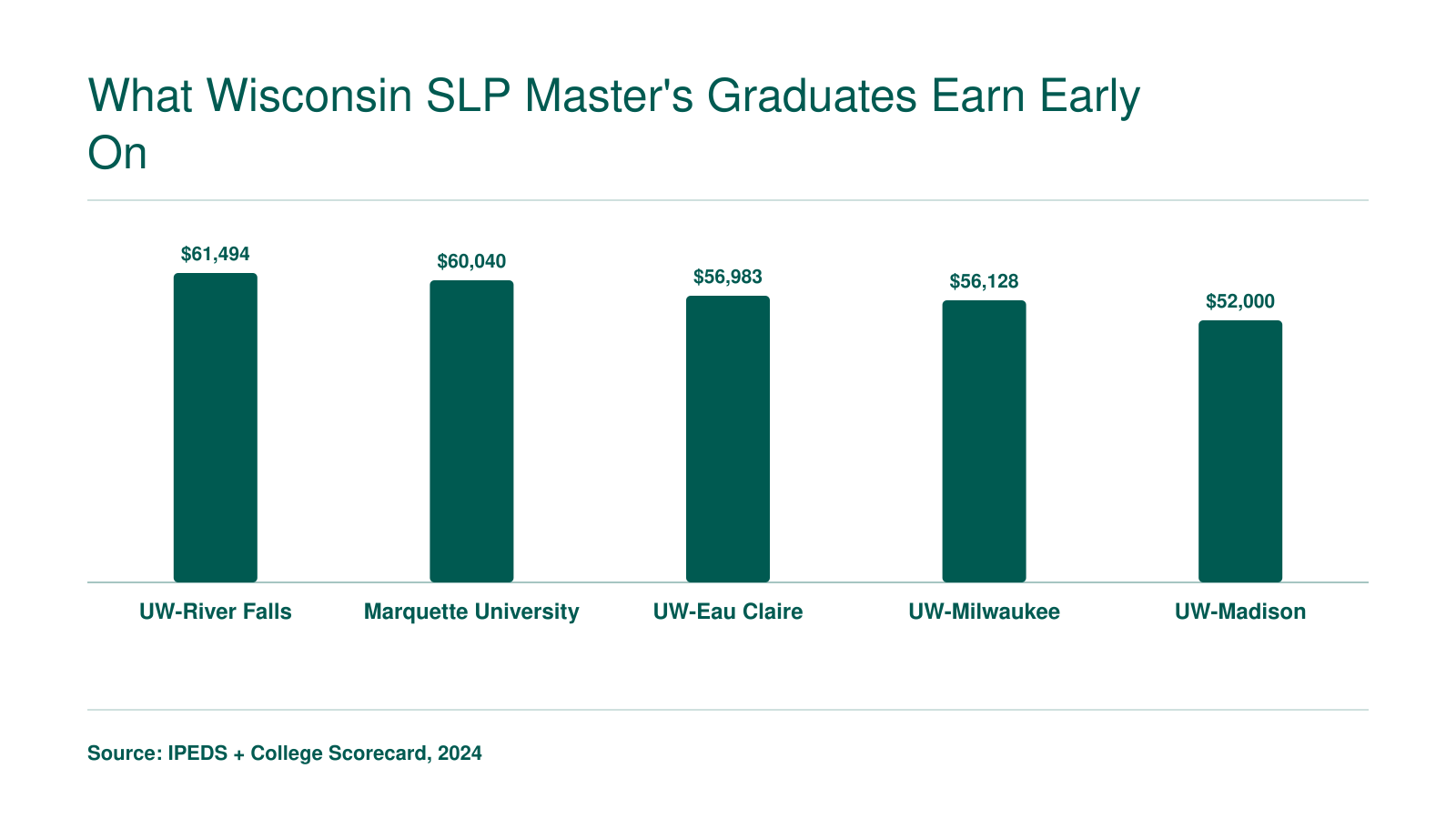
The program that places you well matters more than the name on the diploma: clinical placement support and what you pay against what you earn decide the value of a Wisconsin SLP master's.
What a Speech Pathology Master's Costs in Wisconsin and How Licensure Works
A speech pathology master's in Wisconsin comes with two separate hurdles: the tuition you pay to earn the degree and the credentials you need before you can practice.
Tuition Across Wisconsin Programs
Listed graduate tuition runs from $9,888 at Viterbo University to $24,680 at Marquette University, a range worth comparing with the most affordable master's in speech-language pathology programs. Both are private and charge the same rate regardless of residency. Among public options, UW-River Falls is the lowest for Wisconsin residents at $10,357. The residency gap matters most at the UW campuses. UW-Milwaukee lists $12,728 for residents and $26,159 for nonresidents, and UW-Madison charges $12,325 versus $25,651. Program length also changes the total: River Falls requires 54 credits, Marquette 52 and Viterbo 58. Net price figures are campus-wide averages rather than SLP-specific numbers, so ask each program about aid for its own students.
Wisconsin's Two Credentials
To work in healthcare settings, you need a speech-language pathologist license from the Department of Safety and Professional Services (DSPS). Public schools require a separate license from the Department of Public Instruction (DPI). If you hold a master's in communication disorders and a DSPS license and a Wisconsin public school hires you, you can start on a one-year license. Completing an approved school SLP program qualifies you for the Tier II provisional license.
The ASHA CCC-SLP Path
- Degree: Finish a CAA-accredited master's.
- Clinical hours: Log 400 supervised hours. That includes 25 hours of guided observation and 375 of direct client contact, with at least 325 at the graduate level.
- Exam: Pass Praxis 5331 with a score of 162 or higher.
- Clinical Fellowship: Complete at least 36 weeks and 1,260 hours under a CCC-SLP mentor.
Compare Speech Pathology programs on the data that matters
Explore more Communications & Media specializations or browse every graduate field.
All Communications & Media programs