Best Nurse-Midwifery (CNM) MSN Programs
Compare 30+ accredited Nurse Midwifery programs at 20+ schools, with graduate earnings, cost, debt, and completion data from IPEDS and the U.S. College Scorecard.
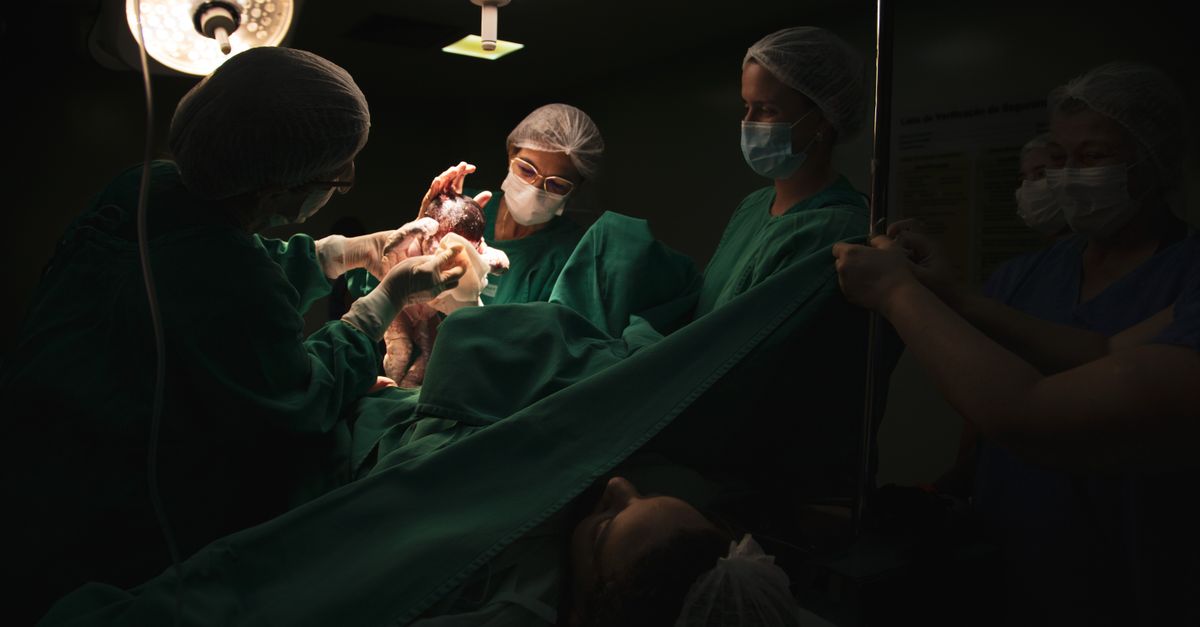
Certified nurse-midwives attend a growing share of U.S. births and, in many states, serve as primary care and gynecologic providers well beyond the delivery room. Entry requires an accredited graduate program, supervised clinical hours, and a passing score on the American Midwifery Certification Board exam, where 74.5% of candidates passed on the first attempt in 2025.
That shared endpoint hides wide variation. Tuition, residency pricing, format, and how much help a school gives you finding preceptors differ sharply from one program to the next, and clinical placement support is often the deciding factor in whether a student finishes on schedule.
Midwifery education remains a small, competitive field. Seats are limited, clinical sites are contested, and the program you choose shapes where you can realistically practice.
Key Points
- AMCB reported a 74.5% first-time pass rate in 2025, so ask schools for theirs.
- Program-level earnings data is not yet available for these nurse-midwifery MSN programs.
- No program trains you online alone: every format requires supervised, in-person clinical hours.
Best Nurse-Midwifery MSN Schools Ranked for 2027
Accredited nurse-midwifery MSN programs vary widely in price, format, and clinical intensity. We compared tuition, graduation rates, certification preparation, and post-graduation earnings to surface the strongest options. The cards below separate the expensive name from the stronger value so you can match a program to your budget and career goals.
Yale University
#1New Haven, CT · ~$50,000/yr (est.)
Best for: Aspiring CNMs seeking Ivy League training
Yale offers two nurse-midwifery routes at its School of Nursing: a standalone specialty and a dual nurse-midwifery/women's health nurse practitioner option. The program is highly selective, with an institutional graduation rate near 96 percent and median earnings above $113,000 one year after completion for related master's graduates. Placements are arranged across Connecticut and nearby states, with a full-time final semester and full-time or part-time study options.
- Campus-based at the YSN campus in Orange, CT
- Accepts RNs or Graduate Entry Pre-specialty students
- Curriculum meets ACNM Core Competencies
- Prepares graduates for AMCB certification
- Full-time and part-time study options
- Clinical placements in CT and nearby states
- Final semester is a full-time clinical placement
- Dual specialty option available
- Two-year campus program with dual CNM/WHNP focus
- Holistic primary health care orientation
- Clinical experiences across the lifespan
- Includes advanced health assessment, pathophysiology, and pharmacology
- Midwifery model of care emphasis
- Collaborative interdisciplinary management
- Elective and independent study options
- Clinical site flexibility
University of Pennsylvania
#2Philadelphia, PA · ~$48,000/yr (est.)
Best for: Working RNs wanting accelerated campus training
Penn's nurse-midwifery MSN is a selective campus program with a 15-month full-time track or a 24-month part-time option, plus some hybrid course flexibility. The university reports a 96.5 percent institutional graduation rate and median earnings over $115,000 one year after graduation for master's completers in the field. Admission requires a BSN, a 3.0 GPA, an active RN license, and statistics coursework.
- Full-time track can be completed in 15 months
- Part-time track takes 24 months
- Campus-based with some hybrid course options
- Requires BSN with 3.0 GPA, RN license, and statistics
- Clinical placements arranged by Penn Nursing
- Includes advanced pharmacology and evidence-based practice
- Prepares graduates for national certification
- Summer or fall start options
University of Michigan
#3Ann Arbor, MI · $29,000 – $58,000/yr (est.)
Best for: Public-university value seekers in the Midwest
Michigan's nurse-midwifery program is the first graduate midwifery program in the state and sits within a top-ranked school of nursing. Students train in hospitals and birth centers while studying lifespan women's health care and normal newborn care. The public university reports a 93.2 percent graduation rate and an in-state net price around $13,100, making it one of the lower-cost options in the top ten.
- 2-year and 3-year plan options
- Clinical placements in birth centers and hospitals
- Focuses on women's health across the lifespan and newborn care
- Prepares students for certification exams
- CCNE accredited
Georgetown University
#4Washington, DC · $60,000 – $65,000/yr (est.)
Georgetown's online, part-time dual nurse-midwifery and women's health nurse practitioner MSN takes about 27 months and includes two in-person intensives. The program requires 49 credits and more than 1,000 clinical hours, with a curriculum centered on health equity and trauma-informed care. Graduates are eligible for both AMCB and NCC certification exams.
- Online program with weekly live classes
- Part-time 27-month duration
- 49 total credits required
- Over 1,000 clinical hours
- Dual CNM and WHNP certification eligibility
- Two in-person intensives required
- Requires BSN, RN license, and 3.0 GPA
- ACME and CCNE accredited
Johns Hopkins University
#5Baltimore, MD · ~$65,000/yr (est.)
Johns Hopkins offers nurse-midwifery as a 51-credit concentration within its MSN, with clinical training in prenatal, labor, delivery, and postpartum care. The campus program emphasizes mentorship from certified nurse-midwives and leadership preparation for hospital, clinic, and birth center roles. The university reports a 93.8 percent graduation rate, reflecting strong completion outcomes at a private research institution.
- 51-credit campus-based MSN concentration
- Prepares for nurse-midwife certification
- Covers prenatal, labor, delivery, and postpartum care
- Includes leadership training for labor and delivery roles
- Faculty mentorship from certified nurse-midwives
- Combined with Shenandoah University certificate option
- Fall start date option
Ohio State University
#6Columbus, OH · ~$14,000/yr (est.)
Ohio State offers a standalone nurse-midwifery MSN and a dual nurse-midwifery/women's health NP track on its Columbus campus. The curriculum includes at least 975 clinical hours and is accredited by ACME and CCNE. In-state graduate tuition is around $13,200 per year, and completers report median earnings near $101,000 one year after finishing.
- Campus-based program
- Prepares for CNM certification
- ACME accredited
- Minimum 975 clinical hours
- Includes advanced health assessment, pathophysiology, and pharmacology
- Multiple clinical practicum courses
- Evidence-based practice and quality improvement focus
- Dual CNM and WHNP certification eligibility
- Full-time and part-time study options
- Graduate entry pathway available
- Includes reproductive dynamics and labor and birth immersion
- Advanced health assessment and pharmacology coursework
- Health policy and advocacy coursework
Texas Tech University Health Sciences Center
#7Lubbock, TX · ~$7,000/yr (est.)
Texas Tech Health Sciences Center runs a hybrid MSN that combines online or web-enhanced coursework with occasional campus visits. The program is ACME and CCNE accredited and prepares graduates for the AMCB certification exam, with completers reporting median earnings around $110,600 one year after finishing. Published materials list 51 semester hours in one place and 47 in another, so applicants should verify the current credit requirement before enrolling.
- Hybrid online and campus format
- Occasional travel to Lubbock campus
- Requires BSN, valid RN license, and 3.0 GPA
- Three professional references required
- ACME and CCNE accredited
- Qualifies graduates for AMCB certification exam
- Fall and spring start dates
- Post-master's certificate option available
New York University
#8New York, NY · ~$43,000/yr (est.)
NYU's nurse-midwifery MSN is a 48-credit campus program built around the Midwifery Model of Care and advanced clinical training. The school reports an 87.6 percent graduation rate and median earnings above $141,000 one year after graduation for master's completers in the field. Admission requires a bachelor's degree in nursing or a related field, a 3.0 GPA, and an active RN license.
- 48-credit campus-based program
- Requires bachelor's in nursing or related field
- Minimum 3.0 GPA and active RN license
- Statistics and research prerequisites
- ACME accredited
- Emphasizes Midwifery Model of Care
- Advanced pathophysiology and pharmacotherapeutics included
- Multiple practicum courses and electives
Rutgers University
#9New Brunswick, NJ · ~$23,000/yr (est.)
Rutgers' 50-credit, three-year MSN includes synchronous remote coursework and on-campus skills labs at its simulation center, with clinical placements across New Jersey. The curriculum emphasizes full-scope midwifery practice and health equity, and recent certification rates have exceeded 80 percent. In-state students see a net price around $24,400, with completers reporting median earnings near $103,000 one year after finishing.
- 50-credit, 3-year plan of study
- Synchronous remote courses with on-campus skills labs
- State-of-the-art simulation center
- Clinical sites across New Jersey
- Prepares for AMCB certification
- Emphasis on health equity
George Washington University
#10Washington, DC · ~$36,000/yr (est.)
George Washington's nurse-midwifery MSN combines online coursework with clinical immersion, requiring 50 credits and 840 clinical hours. The program is fully accredited by ACME and qualifies graduates for the AMCB certification exam. Admission requires a BSN, an active RN license, and a 3.0 GPA, along with recommendation letters and a statement of purpose.
- Online coursework with clinical immersion
- 50 credits required
- 840 clinical hours
- ACME accredited
- Eligible for AMCB certification
- Requires BSN, active RN license, and 3.0 GPA
- Two recommendation letters and a statement of purpose
- Focus on women's health and primary care
Cost & outcomes by school
Federal data for the highest-earning Nurse Midwifery programs, independent of the ranking above. Earnings are this field's master's graduates four years after completing, where the Scorecard reports them.
| School | Earnings | Tuition / yr | Debt | Grads/yr | Format |
|---|---|---|---|---|---|
| AdventHealth University FL | $214,531 | $30,280 | $134,000 | 46 | Online |
| California State University-Fullerton CA | $182,816 | $8,994 | $41,000 | 20 | Hybrid |
| University of California-San Francisco CA | $159,229 | $14,738 | $77,233 | 136 | Campus |
| New York University NY | $151,024 | $42,726 | $67,284 | 163 | Campus |
| Stony Brook University NY | $134,363 | $14,222 | $29,728 | 161 | Hybrid |
| Yale University CT | $131,639 | $49,500 | $118,849 | 108 | Campus |
| Georgetown University DC | $127,831 | $61,670 | $127,131 | 259 | Online |
| Old Dominion University VA | $127,286 | $15,390 | $41,000 | 80 | Hybrid |
| Texas Tech University Health Sciences Center TX | $126,759 | $7,153 | $50,275 | 162 | Hybrid |
| Case Western Reserve University OH | $126,688 | $53,980 | $124,668 | 70 | Campus |
| University of Pennsylvania PA | $124,042 | $47,844 | $49,400 | 219 | Campus |
| Rutgers University NJ | $122,331 | $23,241 | $30,750 | 15 | Hybrid |
Sources: U.S. Department of Education. Tuition and graduates: IPEDS. Earnings and debt: College Scorecard, this field's master's graduates; a dash means no figure is reported.
Cost, debt & payoff
Median earnings of this field's master's graduates (4 yrs after completing) vs. their median federal loan debt · U.S. College Scorecard
Across these programs the median graduate earns about $119,929 and finishes with roughly $49,838 in debt — a ratio that clears a common rule of thumb (keep debt below first-year salary). Tuition and debt vary widely school to school, so check the per-school figures in the table above before you shortlist.
What Went Into These CNM MSN Rankings
How do rankings separate genuine value in nurse-midwifery education from a school's reputation? The programs below were compared on IPEDS and College Scorecard outcomes that follow graduates into the workforce, not on name recognition or undergraduate prestige.
Costs that reflect graduate tuition
We used degree-aware graduate tuition, meaning the price charged specifically to master's-level nursing students rather than the university's broader undergraduate sticker price. Net price after aid was also considered. Because net price averages across all aid packages, it signals general affordability but is not what any individual student will pay. A low advertised tuition did not automatically outweigh a high net price after typical financial aid.
Completion and program structure
Program type, such as online, hybrid, or on-campus, was treated as a delivery consideration rather than a quality score. The institution-wide graduation rate gives a sense of how well students persist across the university, though it is not specific to midwifery cohorts. A hybrid format was not scored as better or worse than a campus-based cohort; rather, the format helped us compare programs on similar delivery terms.
Earnings and debt where published
Where federal data reported earnings for nurse-midwifery graduates specifically, those program-level figures carried more weight than school-wide averages. Debt outcomes were handled the same way: program-level debt loads were considered when available, with gaps noted in plain terms when data had not yet been published. Published earnings and debt reflect graduates who borrowed federal aid and may not include every completer.
None of these measures are a per-student promise. They are directional evidence of what recent cohorts have experienced.
Nurse-Midwifery MSN Costs Beyond the Sticker Price
The sticker price on a nurse-midwifery MSN program page rarely includes the fees, travel, and clinical costs that can add several thousand dollars before graduation. The most affordable programs below show just how much residency status and program format change the final bill.
What Published Tuition Leaves Out
- Program and clinical fees: East Carolina adds a $500 liability-insurance fee in the first clinical course, and some schools charge per-course technology fees.
- Books and supplies: UAB budgets about $600 per term for books and supplies, while other programs vary by whether readings are hard copy or electronic.
- Travel and equipment: Clinical sites at East Carolina are usually 30 to 60 minutes from home, and students may need a lab coat, stethoscope, and laptop.
- Screening and insurance: UAB lists a $92 background check and health insurance at roughly $270 per month, with immunization and compliance costs separate.
Rutgers estimates $1,181 per credit for in-state students in 2026-2027 and requires 964 clinical hours. Texas Tech Health Sciences Center reports about $300 to $400 per semester hour, though it is unclear whether mandatory fees are included.
Public vs. Private All-In Costs
Published graduate tuition for the lowest-cost public programs below ranges from about $7,400 to $17,700 in state, with out-of-state rates pushing past $36,000 at several schools. Old Dominion reports total program cost around $23,328 in state and $31,152 out of state, while Cincinnati lists about $50,901 in state and $51,756 out of state. Frontier Nursing University's published cost of attendance totals $46,644, but that figure is not fully itemized by degree or enrollment period.
Private options can be much higher: Johns Hopkins lists graduate tuition at $65,230 regardless of residency. Keep in mind that the institution-wide net price shown for each school is averaged over all students, not a guarantee for nurse-midwifery students specifically. Your actual out-of-pocket cost will depend on program fees, clinical placement, travel, and financial aid.
Online, Hybrid, and Campus-Based CNM MSN Formats: What to Expect
"Fully online" and "hybrid" sound like opposite ends of a spectrum, but for nurse-midwifery they converge on the same reality: no program trains you to catch babies entirely through a screen. Where they differ is how much in-person time is built in, and whether you can complete it close to home.
What Each Format Looks Like
Several programs in these rankings are delivered predominantly online, including Vanderbilt, George Washington, Georgia College & State University, Shenandoah, Frontier, University of Cincinnati, and Old Dominion. Rutgers runs as a hybrid that blends remote coursework with in-person skills labs, simulations, and seminars. Campus-based options like Yale, Penn, Michigan, Johns Hopkins, Ohio State, and NYU expect you on-site for the academic portion.
Note that "online" rarely means zero travel. Frontier is delivered fully online yet still requires two brief campus immersions in Versailles, Kentucky. Bethel's hybrid builds in two three-day on-campus intensives.1 Shenandoah schedules an immersion each fall and spring of the clinical year at its Winchester campus, and Cincinnati folds in skills-intensive visits.2 Georgia College holds short lab days roughly once per semester. Budget for these trips when you compare programs.
Clinical Placement Is Local, With Caveats
Every CNM program requires hundreds of in-person clinical hours (from roughly 720 at Shenandoah to nearly 1,000 at Rutgers), and those hours happen at real birth settings, not online. The question is where.
- Home-community placement: Frontier and Georgia College aim to place students near home with approved preceptors, though the school assists rather than guarantees.
- State-bound programs: Public universities can tie clinical hours to their own state. Georgia College's placements stay within Georgia, and Rutgers secures sites across New Jersey, so out-of-state students may not complete locally.
- Restricted enrollment: Cincinnati does not currently enroll students in Arizona, Louisiana, Massachusetts, New York, Oregon, Rhode Island, or Tennessee.2
Before enrolling, confirm in writing whether the program will place you in your community or expect you to relocate or secure your own preceptor.
Nurse-Midwifery MSN Admission Pathways for ADN, BSN, and Non-Nursing Students
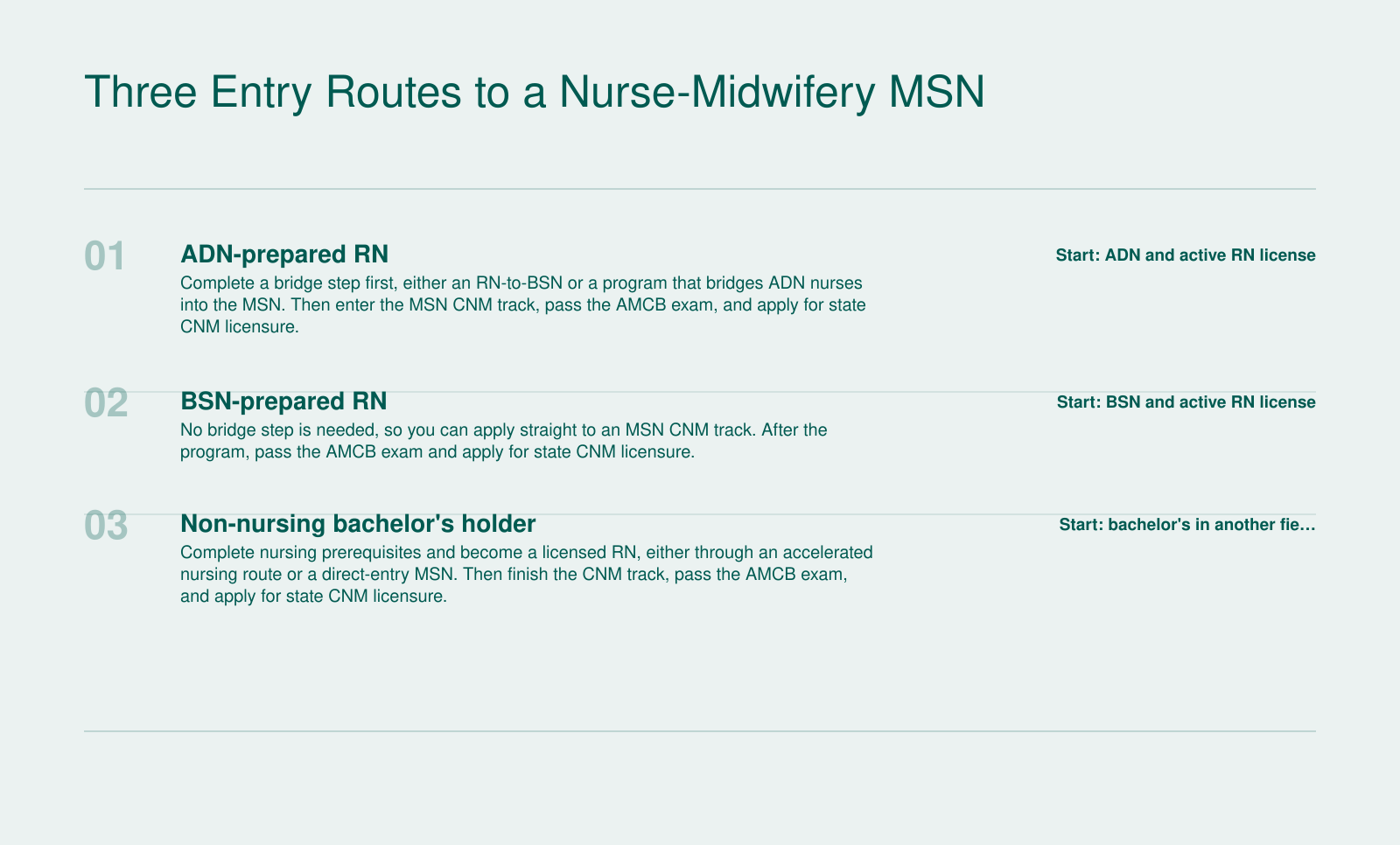
Requirements differ by school, so treat the examples below as a range, not a universal standard. A BSN is the standard route into a nurse-midwifery MSN. ADN-prepared RNs usually need a bridge first, and non-nursing bachelor's holders are considered case by case at best. Always confirm current details with each program.
- Pathway 1: RN with a BSNThe most common route. East Carolina University, George Washington University, the University of Cincinnati, and Texas Tech University Health Sciences Center all list a BSN as the prerequisite degree. Texas Tech specifies a nursing program accredited by CCNE or ACEN.
- Pathway 2: RN with an ADNAn associate degree alone is generally not enough for direct MSN admission. East Carolina's clearest option is RN-to-BSN first, which can run alongside the required hospital experience. Completing a BSN does not guarantee admission to the midwifery track.
- Pathway 3: Non-nursing bachelor'sAvailability is case by case. The programs profiled here describe BSN-prepared applicants, so no direct-entry route is established for them. Where a program accepts another discipline's degree, expect a current RN license, a GPA around 3.0, and about one year of RN experience.
- RN licensureAn active, unrestricted or unencumbered license is the norm. East Carolina requires a North Carolina license and residency at admission, so check whether a program ties you to one state.
- Minimum GPA3.0 is common. Cincinnati and Texas Tech list 3.0, George Washington lists 3.0 as preferred, and East Carolina splits its requirement into 2.7 overall and 3.0 in the nursing major. Cincinnati also asks for a 3.0 science GPA.
- Prerequisite coursesStatistics is the usual requirement, sometimes with research methods or science coursework. Cincinnati requires a grade of at least 2.0 in statistics, and Texas Tech requires at least a C in research and statistics.
- Nursing experienceEast Carolina and Cincinnati each ask for one year of RN experience. Cincinnati expects antepartum, intrapartum, and/or postpartum experience. East Carolina prefers labor and delivery experience but does not require it.
- Application materialsExpect official transcripts, recommendation letters, a resume, and a statement of purpose. George Washington lists two letters of recommendation. Interview and testing requirements are not universal, so verify them school by school.
Three Entry Routes to a Nurse-Midwifery MSN
Every route ends in the same place: an MSN with a nurse-midwifery track, the AMCB certification exam, and state CNM licensure. What changes is the step you complete first. Check each program's admissions page for exact prerequisites and timelines.
Clinical Hours and AMCB Exam Readiness in CNM MSN Programs
The clinical phase is where a nurse-midwifery MSN stops being coursework and becomes the training that determines whether you can sit for certification. The tension most students underestimate is logistical, not academic: securing supervised hours in the right settings, with qualified preceptors, in a region where births actually happen under experienced oversight.
How Many Hours and What They Cover
As of 2026, nurse-midwifery programs typically require somewhere in the range of 600 to 900 supervised clinical hours, though the exact figure varies by program. The University of Delaware, for example, lists 816 practicum hours. These hours are not interchangeable: they must span the full scope of midwifery practice, including prenatal (antepartum), intrapartum, postpartum, newborn, and gynecologic care. A program that loads you up on prenatal visits but leaves you short on intrapartum experience has not prepared you for the realities of the work.
Published birth-count minimums are harder to pin down. Neither Delaware nor Rutgers publishes a fixed number of births you must attend, so treat any "required deliveries" figure you hear as program-specific and worth confirming directly with admissions.
Preceptors and Placement Support
Who finds your clinical site matters enormously, and schools differ. Some schools that offer nurse practitioner programs arrange preceptors or provide regional coordinators; others expect you to secure your own placement. Rutgers, for instance, spells out preceptor eligibility in detail: preceptors may be midwives, APRNs (including family nurse practitioners), physician assistants, or physicians, must hold national board certification where applicable, and need at least one year of relevant experience. Non-CNM/CM preceptors cannot supervise more than 50% of your total clinical hours, and a preceptor must be present for every birth you attend. Before you enroll, ask plainly whether the program places you or leaves the search to you.
Connecting Training to the AMCB Exam
All of this feeds one goal: eligibility for the American Midwifery Certification Board (AMCB) exam. To qualify, you need an active RN license and completion of a graduate degree from a nurse-midwifery program accredited by ACME. Your program director verifies that completion and attests to your readiness. For preparation, AMCB offers a Candidate Handbook and a Self-Assessment Examination; no commercial course or question bank is required, though individual schools may fold their own review support into the final term.
Related Articles
In 2025, 74.5% of AMCB certification candidates passed on their first attempt, according to the American Midwifery Certification Board's 2025 Annual Report. This consistently high first-time pass rate signals that graduates are arriving well prepared for the national certification exam.
Nurse Midwifery programs by state
Compare Nurse Midwifery programs on the data that matters
Explore more Nursing specializations or browse every graduate field.
All Nursing programs