Most Affordable Nurse-Midwifery (CNM) MSN Programs
Compare 30+ accredited most affordable Nurse Midwifery programs at 20+ schools, with graduate earnings, cost, debt, and completion data from IPEDS and the U.S. College Scorecard.
In-state versus out-of-state residency can nearly triple the price of the same nurse-midwifery MSN. Among the programs ranked here, annual graduate tuition starts at $7,658 for in-state students at East Carolina University and climbs to $57,776 for nonresidents at the University of Michigan.
Sticker tuition rarely matches the final bill. Grants and assistantships pull it down, while clinical travel, campus immersions and multi-year enrollment push it up.
One constraint doesn't bend: only graduates of ACME-accredited programs can sit for the AMCB exam, so a cheap seat without that status buys nothing.
Key Points
- ACME accreditation is required before you can take the AMCB exam.
- Clinical placements typically require 800 to 1,200 supervised hours.
- Median debt varies from $26,425 to $134,000 across programs.
10 Affordable Nurse-Midwifery MSN Programs for 2027
These ten nurse-midwifery MSN programs stand out for graduate tuition that aligns with after-aid net price and for flexible hybrid or online study. The list below surfaces each school's delivery format, graduate rates, and key program details so you can compare value beyond the sticker price. Use the ACME directory to confirm the accreditation status of any program before you apply.
California State University-Fullerton
#1Fullerton, CA · $9,000 – $19,000/yr (est.)
Best for: California nurses prioritizing low net price
Cal State Fullerton offers a hybrid MSN with a Nurse-Midwifery/Women's Health NP emphasis for California nurses seeking primary women's health care training. The program arranges clinical placements and prepares graduates for advanced practice roles across the lifespan. Listed as ACME-accredited in the ACME directory; confirm current status before applying.
- Hybrid program format
- Women's Health Care concentration
- Nurse-Midwifery/Women's Health NP emphasis
- Clinical placements arranged
- Primary health care for women
- Pregnancy and gynecologic care
Marshall University
#2Huntington, WV · $5,000 – $10,000/yr (est.)
Best for: West Virginia nurses wanting hybrid flexibility
Marshall University's hybrid MSN Nurse-Midwifery combines online coursework with campus visits and a Shenandoah University partnership, appealing to working nurses who need some flexibility. The program includes clinical preceptorships and carries a BSN, 3.0 GPA, and RN license requirement. Check the ACME directory for current accreditation status.
- Hybrid program type
- Cooperative program with Shenandoah University
- Includes clinical preceptorships
- 3.0 GPA requirement
- Current RN license needed
East Carolina University
#3Greenville, NC · ~$8,000/yr (est.)
Best for: North Carolina RNs pursuing AMCB certification
East Carolina University's hybrid MSN Nurse-Midwifery prepares nurses for AMCB certification through online coursework and clinical experiences in North Carolina. The program offers an MSN degree or a post-master's certificate and emphasizes safe, competent midwifery practice. Check the ACME directory for current accreditation status.
- Hybrid program format
- Prepares for AMCB certification
- MSN degree or Post-Masters Certificate
- Virtual informational sessions available
Stony Brook University
#4Stony Brook, NY · ~$14,000/yr (est.)
Stony Brook University's 45-credit MSN Nurse Midwifery uses a hybrid distance education model with on-site clinical requirements, serving nurses who want to continue working while training. The curriculum emphasizes women's health across the lifespan, advanced assessment, and evidence-based practice. Check the ACME directory for current accreditation status.
- 45 total credits required
- Hybrid distance education format
- On-site clinical requirements included
- Focuses on women's lifespan care
- Prepares for certified nurse midwife role
Ohio State University
#5Columbus, OH · ~$14,000/yr (est.)
Ohio State University's campus-based nurse-midwifery MSN includes a standard track and a dual Nurse-Midwifery/Women's Health NP option, both requiring significant clinical hours. The program prepares graduates for national CNM certification and offers full-time and part-time plans. Check the ACME directory for current accreditation status.
- Campus-based program format
- Prepares for CNM certification
- Includes pregnancy and childbirth
- Covers newborn care up to 28 days
- Minimum 975 clinical hours
- Dual certification eligibility
- Focus on women's health
- Includes nurse-midwifery
- Prepares for primary care
- Full-time and part-time options
University of Alabama at Birmingham
#6Birmingham, AL · ~$9,000/yr (est.)
The University of Alabama at Birmingham's hybrid MSN Nurse-Midwifery Pathway holds initial ACME accreditation through 2030 and prepares graduates for the AMCB national exam. The 54-credit program includes 780 clinical hours and serves working healthcare professionals with online coursework and on-campus intensives. Initial ACME accreditation through 2030; graduates are eligible for AMCB certification.
- Hybrid distance-accessible format
- 54 credit total program
- 780 clinical training hours
- Comprehensive women's healthcare focus
- Certification exam preparation
Old Dominion University
#7Norfolk, VA · $15,000 – $36,000/yr (est.)
Old Dominion University's hybrid MSN with a nurse-midwifery concentration runs as a two-year full-time joint program with Shenandoah University, blending online coursework with clinical training. Admission requires a current RN license, a bachelor's degree with a 3.0 GPA, and prerequisite courses. Check the ACME directory for current accreditation status.
- Hybrid online/campus format
- Two-year full-time program
- Joint program with Shenandoah University
- 48 total credit hours
- Eligible for national certification
University of Michigan
#8Ann Arbor, MI · $29,000 – $58,000/yr (est.)
The University of Michigan's MSN Nurse-Midwifery is a campus-based program with clinical placements in birth centers and hospitals, offering two-year and three-year plans. The school is known for strong outcomes and flexible scheduling, though out-of-state tuition is higher than many public peers. Check the ACME directory for current accreditation status.
- Ranked #3 nationally
- First graduate program in Michigan
- Campus-based learning
- Offers MSN and DNP options
- 2-year and 3-year plans available
James Madison University
#9Harrisonburg, VA · ~$13,000/yr (est.)
James Madison University's hybrid MSN Nurse-Midwifery pairs first-year JMU coursework with second-year clinical training at Shenandoah University, including over 720 clinical hours. The competency-based curriculum emphasizes women's health and primary care, with a January application deadline. Check the ACME directory for current accreditation status.
- Hybrid program format
- Partnership with Shenandoah University
- First year at JMU, second at Shenandoah
- Over 720 clinical hours
- Competency-based curriculum
Rutgers University
#10New Brunswick, NJ · ~$23,000/yr (est.)
Rutgers University's hybrid MSN Nurse-Midwifery offers synchronous remote courses, on-campus labs, and clinical placements across New Jersey, with a three-year plan of study. The advertised in-state per-credit tuition does not include a $600 midwifery clinic fee or a $35 midwifery examination fee, so factor those into total cost. Check the ACME directory for current accreditation status.
- 50 credits total
- 3-year plan of study
- Hybrid program format
- Primarily synchronous remote courses
- On-campus skills labs
- Clinical sites across New Jersey
- Estimated $1,125 per credit
Cost & outcomes by school
Federal data for the highest-earning Nurse Midwifery programs, independent of the ranking above. Earnings are this field's master's graduates four years after completing, where the Scorecard reports them.
| School | Earnings | Tuition / yr | Debt | Grads/yr | Format |
|---|---|---|---|---|---|
| AdventHealth University FL | $214,531 | $30,280 | $134,000 | 46 | Online |
| California State University-Fullerton CA | $182,816 | $8,994 | $41,000 | 20 | Hybrid |
| University of California-San Francisco CA | $159,229 | $14,738 | $77,233 | 136 | Campus |
| New York University NY | $151,024 | $42,726 | $67,284 | 163 | Campus |
| Stony Brook University NY | $134,363 | $14,222 | $29,728 | 161 | Hybrid |
| Yale University CT | $131,639 | $49,500 | $118,849 | 108 | Campus |
| Georgetown University DC | $127,831 | $61,670 | $127,131 | 259 | Online |
| Old Dominion University VA | $127,286 | $15,390 | $41,000 | 80 | Hybrid |
| Texas Tech University Health Sciences Center TX | $126,759 | $7,153 | $50,275 | 162 | Hybrid |
| Case Western Reserve University OH | $126,688 | $53,980 | $124,668 | 70 | Campus |
| University of Pennsylvania PA | $124,042 | $47,844 | $49,400 | 219 | Campus |
| Rutgers University NJ | $122,331 | $23,241 | $30,750 | 15 | Hybrid |
Sources: U.S. Department of Education. Tuition and graduates: IPEDS. Earnings and debt: College Scorecard, this field's master's graduates; a dash means no figure is reported.
Cost, debt & payoff
Median earnings of this field's master's graduates (4 yrs after completing) vs. their median federal loan debt · U.S. College Scorecard
Across these programs the median graduate earns about $119,929 and finishes with roughly $49,838 in debt — a ratio that clears a common rule of thumb (keep debt below first-year salary). Tuition and debt vary widely school to school, so check the per-school figures in the table above before you shortlist.
Nurse-Midwifery Program Total Cost: Fees, Travel, and Clinical Extras
The advertised per-credit rate is the least useful number on a program page; any nurse practitioner program cost comparison shows the bill you actually pay is credits times rate plus everything the rate leaves out. Annual tuition only covers a slice of the total cost of a master's degree. Multiply the required credits by the per-credit price, then add fees.
Frontier Nursing University shows the math: 55 credits at about $726 each is $39,930 in tuition. Its $40,655 estimate adds a $50 application fee, $200 acceptance fee, and $475 matriculation fee, and a $100 per-course transfer review can apply on top.1 Loyola New Orleans lists $885 per credit hour, so its 50 credits come to $44,250 before university fees.
Residency can change the bill sharply. At Texas Tech Health Sciences Center, 2026-2027 rates run $288.29 per credit in state and $716.29 out of state. Nonresidents outside Texas studying online pay a flat $589 per credit, roughly $30,000 in tuition across 51 credits. Per-credit technology ($25.11) and learning resources ($19.40) fees, malpractice insurance, and term-based student services fees still apply.
Budget separately for items rarely in the headline price:
- Required extras: books, background checks, and clinical or technology fees.
- Travel: flights and lodging for on-campus intensives.
- Credentialing: the certification exam fee after graduation.
Who Finds Your Preceptor? Clinical Placement and Its Hidden Costs
National MSN nurse-midwifery programs typically require 800 to 1,200 clinical hours, with 975 or more precepted. Birth minimums vary by program, so confirm the count before you apply. Shenandoah University, for example, requires about 720 hours and treats its 1:4 clinical-hour ratio as a way to account for long births, not as a birth total.
Placement models differ. Georgia College & State University has students secure preceptors with coordinator help, offers no guarantee, and keeps all rotations in Georgia. Shenandoah describes a collaborative student-faculty process, with no guarantee stated. The University of Arizona's proposed midwifery program plans a $2,000 per-semester fee to build clinical sites and preceptors. Self-placement can lower the sticker price of affordable MSN programs, but you pay in search time and risk delayed graduation.
Budget for the extras: background checks, drug screenings, certification modules, uniforms, and travel. Add lost work income if rotations cut your hours. Texas Tech notes occasional campus trips and non-refundable placement fees.
Ask admissions: - Will the school guarantee a site and preceptor for every student, in writing? - What happens if I live out of state, and who pays for added travel or fees?
Related Articles
Online Nurse-Midwifery MSN Programs vs. Hybrid and Campus Study
Fully online nurse-midwifery MSN programs still require in-person clinical training; online refers to didactic coursework only. Hybrid programs add required campus labs or immersions, and campus-based tracks concentrate more coursework in person. State authorization can limit where students live and complete clinicals.
| Program and format | Online coursework | Required on-campus time | Clinical placement | State authorization |
|---|---|---|---|---|
| University of Cincinnati (online with on-campus immersion) | Online with in-person precepted practice | One skills intensive campus visit | In-person precepted practice; local placement not specified | Not available in Arizona, Louisiana, Massachusetts, New York, Oregon, Rhode Island, or Tennessee |
| Frontier Nursing University (fully online didactic) | 100% online | Two brief on-campus immersions in Versailles, Kentucky | Clinical practicum in the student's home community | No state restriction stated in this source |
| Georgia College & State University (online with recurring campus labs) | Online program | Campus labs and simulations about once per semester, 1 to 3 days each, plus a summer immersion | Mostly home community; all rotations must be completed in Georgia | Rotations must be completed in Georgia |
| Vanderbilt University (in-person/hybrid specialty) | First two semesters in person | Onsite several days per week in Spring, then one day per week in Summer | Assigned US sites; local placement not guaranteed | State authorization not detailed |
Can Non-Nurses Become CNMs? BSN, RN Bridge, and Direct-Entry Routes
The push to widen midwifery access has made entry paths more flexible, but one rule holds firm: in the United States, becoming a certified nurse-midwife (CNM) requires becoming a nurse first.
The Standard BSN-to-MSN Route
Most applicants arrive with a bachelor's degree in nursing (BSN) and an active RN license. Programs commonly expect relevant clinical experience, and many midwifery tracks favor time in labor and delivery or women's health before midwifery coursework begins.
RN-to-MSN Bridge Options
Nurses holding a diploma or associate degree can often bridge directly to affordable RN-to-MSN programs. Typical requirements include a current RN license, a GPA around 3.0 (with the GRE or MAT if grades are not well above that), roughly a year of relevant experience, and prerequisite courses such as community health, research and evidence, and patient safety.
Direct-Entry Routes for Non-Nurses
Bachelor's holders in other fields can pursue direct entry MSN programs, such as Marquette University's Direct Entry Masters Program in Nurse-Midwifery and the Graduate-Entry MSN at the University of Illinois Chicago, which add nursing prerequisites and RN licensure before midwifery study. Note that CNM differs from the CPM and CM credentials, which follow non-nursing training paths.
What Nurse-Midwifery Graduates Earn After Finishing
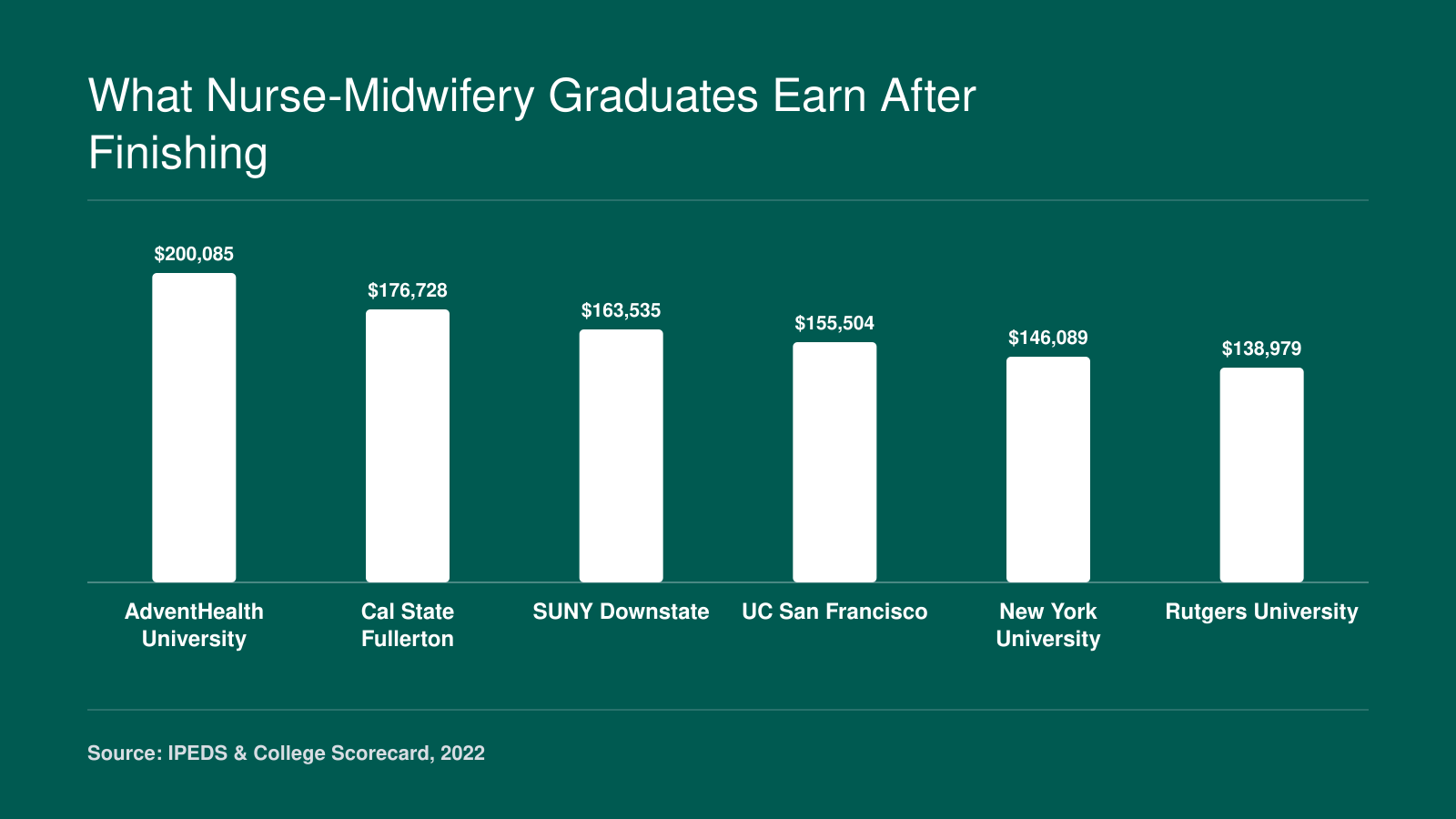
The chart below shows median annual earnings for nurse-midwifery graduates five years after finishing. These figures come from IPEDS and College Scorecard data. Median program debt at these schools runs from $26,425-$134,000, so the earnings-to-debt tradeoff varies across programs.
Nurse Midwifery programs by state
Quick Answers: Price, Timeline, and AMCB Exam Results
What is the most affordable nurse-midwifery MSN program?
How long does it take to become a certified nurse-midwife?
How often do nurse-midwifery graduates pass the AMCB certification exam on the first try?
Compare Nurse Midwifery programs on the data that matters
Explore more Nursing specializations or browse every graduate field.
All Nursing programs