Master's in Addiction Psychology Programs With No GRE Required
Compare 20+ accredited no-gre Addiction Psychology programs, with graduate earnings, cost, debt, and completion data from IPEDS and the U.S. College Scorecard.

Dropping the GRE has become routine for addiction-focused master's programs, but a waived test says little about whether a degree leads to a counseling license. Policies also vary by program and change from one admissions cycle to the next.
No ranked list or tally of qualifying schools is offered. A program's own admissions page is the only reliable source for its testing policy.
The larger risk is a degree that skips the test but falls short of your state board's coursework and supervised-hour rules.
Key Points
- No GRE required can mean waived, optional, or never considered.
- Verify each program's no-GRE policy on its admissions page before applying.
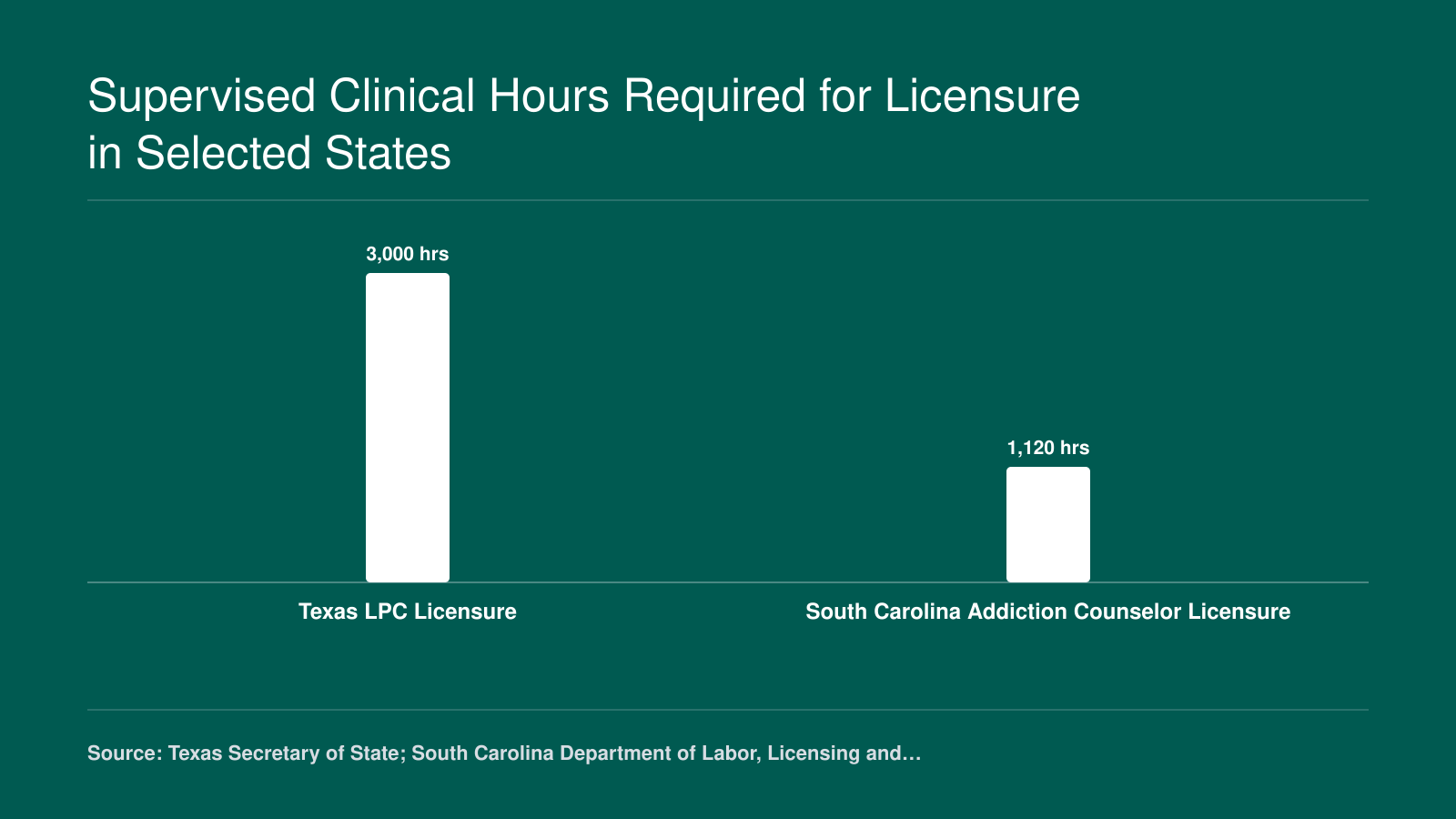
- Licensure hours vary widely: Texas requires 3,000, South Carolina 1,120.
Master's in Addiction Psychology Programs With No GRE Required
-
#1
Texas Tech University Health Sciences Center
Master of Science in Addiction Counseling (MSAC)
$7,153grad tuition / yr 46grads / yrNo GRE required60 credits2 yearsVisit program site →54score -
#2
Regent University
M.S. in Psychology
$58,142median earnings $17,869grad tuition / yr $34,166median federal debt 158grads / yrNo GRE required39 creditsVisit program site →52score -
#3
Arizona State University
Master of Science in addiction psychology
$10,843grad tuition / yr 13grads / yrNo GRE required45 credits2 yearsVisit program site →51score -
#4
Carlow University
Master of Science in Professional Counseling: Addictions Counseling Track
$57,187median earnings $24,816grad tuition / yr $55,109median federal debt 30grads / yrNo GRE required60 creditsVisit program site →37score
How we rank. Each program is scored on graduate figures only: the field's master's earnings and debt, graduate tuition and the number of master's graduates, normalized across all programs in this field. Data comes from the U.S. Department of Education's IPEDS and College Scorecard; no school pays for placement.
Compare the top programs
| Rank | School | Earnings | Tuition / yr | Debt | Grads/yr | Format |
|---|---|---|---|---|---|---|
| 1 | Texas Tech University Health Sciences Center TX | — | $7,153 | — | 46 | Online |
| 2 | Regent University VA | $58,142 | $17,869 | $34,166 | 158 | Online |
| 3 | Arizona State University AZ | — | $10,843 | — | 13 | Hybrid |
| 4 | Carlow University PA | $57,187 | $24,816 | $55,109 | 30 | Campus |
Sources: U.S. Department of Education. Tuition and graduates: IPEDS. Earnings and debt: College Scorecard, this field's master's graduates; a dash means no figure is reported.
Cost, debt & payoff
Median earnings of this field's master's graduates (4 yrs after completing) vs. their median federal loan debt · U.S. College Scorecard
Across these programs the median graduate earns about $63,352 and finishes with roughly $55,109 in debt — a ratio that clears a common rule of thumb (keep debt below first-year salary). Tuition and debt vary widely school to school, so sort the ranking by "Most affordable" or "Lowest debt" to weigh cost against outcomes.
What 'No GRE Required' Actually Means for Addiction Psychology Master's Programs
The GRE has lost much of its gatekeeping role in graduate admissions, and Master's in Addiction Psychology programs are no exception: most no longer require it. But master's programs with no GRE required is a loose label that covers three distinct policies, and the difference matters when you plan your application.
- Permanently no GRE: The program has dropped the test entirely and will not consider scores.
- Test-optional: Scores are not mandatory, but if you submit them, they factor into the decision.
- Conditional waiver: The GRE is waived only if you meet a threshold, such as a minimum undergraduate GPA (often around 3.0), a prior graduate degree, or documented professional experience in the field.
Treat those waiver triggers as patterns to verify, not guarantees. Two further cautions: many test-optional policies began as temporary pandemic-era measures, so confirm the waiver applies to your specific entry term. And a university can waive the GRE institution-wide while a particular department or track still asks for scores. Read the policy at the program level, including any addiction counseling master's programs you may be comparing, not just the admissions homepage.
How to Verify a No-GRE Policy Directly on an Admissions Page
Before you apply, treat the program-specific admissions page as the controlling document and look for these details.
- Start on the program pageOpen the addiction psychology or counseling master's page itself, not the graduate school's general page, because test policies can differ.
- Check the policy dateLook for an effective date or entry term tied to the no-GRE or test-optional wording; it may apply only to a specific cohort.
- Read waiver conditionsConfirm GPA thresholds or experience tied to any waiver, such as a 3.0 cumulative GPA in the last 60 college credits.
- Confirm deadlines and startsNote rolling review or fixed fall/spring/summer starts. If no deadline is listed, email for the next entry term.
- Check prerequisitesAsk whether intro psychology or statistics is required and whether an unrelated bachelor's is accepted, with any added coursework.
- Get silence in writingIf the page doesn't state a GRE policy, ask admissions in writing and save the reply.
Addiction Psychology vs. Addiction Counseling: Choosing the Right No-GRE Degree
A nonclinical master's in addiction psychology and a licensure-track master's in addiction counseling can share a name, a price range, and a no-GRE policy, yet lead to very different careers. An MS or MA in addiction psychology or addiction studies often centers on research, prevention, or program administration. A master's in addiction counseling or clinical mental health counseling is built to meet state licensure requirements.
Dropping the GRE does not change licensure eligibility. Curriculum, supervised practicum hours, and accreditation decide that, so check those before you weigh a test waiver.
If you want to treat clients, choose a licensure-track program even when a nonclinical option costs less or finishes sooner. Some nonclinical graduates later have to complete extra coursework, and sometimes additional supervised experience, before a state board will consider them. That detour can erase the savings you were chasing at enrollment.
Confirm what each program leads to by reading its course list and its stated licensure outcomes.
Median Pay for Substance Abuse and Behavioral Disorder Counselors
Related Articles
Licensing and Clinical Training Requirements to Check Before You Apply
A degree that satisfies one state's board can fall short in another, so the program is only half the decision. The typical path runs through a master's degree, a supervised practicum and internship, postgraduate supervised hours, and a licensing exam such as the NCE, NCMHCE, or an IC&RC or NAADAC exam.
Maryland's LCADC shows how specific this gets. The Board of Professional Counselors and Therapists requires a master's or higher totaling 60 semester credits (or 90 quarter credits), including 39 credits of addiction coursework.1 After that comes 2 years and 2,000 hours of supervised experience, plus the MAC and the Maryland Law Assessment.1 The board's materials also mention EMAC, so confirm the current exam with the board directly. We could not verify comparable details for other large states, so check your own addiction counselor licensure requirements by state.
Portability and placements
The Counseling Compact covers LPCs or a state's equivalent, not automatically addiction credentials.2 It requires an unencumbered home-state license and a 60-hour degree.2 As of October 19, 2026, the Compact reported 11 operational states,4 though 40 states and jurisdictions have enacted it.3 Enactment is not the same as operational.
Ask every online master's in addiction psychology program whether it arranges practicum placements or expects you to find your own, and whether it can place students in your state.
Supervised Clinical Hours Required for Licensure in Selected States
Postgraduate supervised experience is where licensure paths diverge sharply. Texas LPC candidates face a 3,000-hour supervised requirement, while South Carolina's addiction counselor license requires 1,120 hours. Verify current board rules because proposals and specialty tracks change.
Evaluating Cost, Accreditation, and Online Format for No-GRE Programs
Evaluating a no-GRE addiction psychology master's, a specific Master's in Psychology With No GRE Required path, means checking three things before you apply: what you will actually pay, which accreditors back the program, and how much of the degree can be completed from a distance.
Build the full cost picture
Start with the per-credit rate times total credits to identify an affordable master's in addiction psychology. Purdue Global lists $420 per credit for its online MS in Psychology with an Addictions concentration;1 the 70-credit capstone track and 75-credit thesis track put base tuition at roughly $29,400 to $31,500 before fees.2 Then add technology, practicum, background-check, and graduation fees. Arizona State University's online MS in Addiction Psychology does not publish a flat per-credit rate on the page reviewed; it directs students to a tuition calculator, so use the school's current tuition and fees page.
Separate institutional and programmatic accreditation
Regional or institutional accreditation, such as Purdue Global's Higher Learning Commission status,3 is what opens eligibility for federal aid and credit transfer. For counseling licensure, many states also expect programmatic accreditation like CACREP or MPCAC. Purdue Global holds NASAC accreditation,2 and ASU lists NAADAC Approved Education Provider status, but the pages reviewed do not list CACREP or MPCAC approval. Verify addiction counseling master's licensure requirements by state.
Check the online format
ASU's 45-credit program includes a 6-credit practicum and a 6-credit applied project, and Purdue Global requires an onsite practicum for the addictions concentration; Indiana licensure seekers may need 700 hours.2 Confirm whether any practicum can be completed near you.
The 2024 CACREP Standards require every entry-level counseling degree, including addiction counseling specialties, to include at least 60 semester credit hours (or 90 quarter hours) of graduate study. That threshold applies to all students, so a shorter program will not meet this accreditor's benchmark.
Addiction Psychology programs by state
Questions to Ask Admissions Offices Before Enrolling in a No-GRE Program
Before you commit, ask the admissions office for written answers to the questions below. A good response should be specific about prerequisites, delivery format, transfer limits, and clinical placement support before any deposit.
Can I enter a no-GRE addiction psychology master’s program with a bachelor’s degree in an unrelated field?
Are there fully online no-GRE addiction psychology master’s programs without campus residencies?
Will my transfer credits or prior graduate coursework count toward the degree?
Does the program help place online students in practicum sites in my state?
Compare Addiction Psychology programs on the data that matters
Explore more Psychology specializations or browse every graduate field.
All Psychology programs