Most Affordable Master's in Addiction Psychology Programs
Compare 20+ accredited most affordable Addiction Psychology programs, with graduate earnings, cost, debt, and completion data from IPEDS and the U.S. College Scorecard.

Published in-state tuition for an addiction psychology master's runs from roughly $6,800 at Youngstown State to about $16,000 at Montclair State, and that spread widens once fees, aid, and out-of-state rates enter the picture. The cheapest option is not always the one that clears your state's addiction psychology master's licensure requirements.
Degree titles compound the problem: a psychology-focused program and an addiction counseling program can carry similar prices but very different paths to an LPC, LADC, or CADC.
In these rankings, net price and financial aid carry the most weight, with early earnings and debt factored in.
Key Points
- Youngstown State lists in-state tuition near $6,800 for 2027.
- A psychology-focused degree does not automatically qualify for LPC licensure.
- Federal debt and early earnings vary widely, not just tuition.
10 Affordable Addiction Psychology Master's Schools Worth a Look
Price came first, but a cheap degree that leaves you in debt or underpaid is not a bargain, so debt and early earnings weighed in too. These 10 schools show that affordable addiction psychology master's programs come in many shapes: fully online, hybrid, and campus based. The goal is to help you compare where tuition is manageable without giving up clinical hours or state licensure alignment.
Purdue University Global
#1West Lafayette, IN · $10,000 – $15,000/yr (est.)
Best for: Working adults needing flexible online format
Purdue Global's online Master of Science in Psychology with a concentration in Addictions is built around chemical and psychological dependency, psychopharmacology, group counseling, and co-occurring disorders. The curriculum includes two practicum courses and a thesis or capstone choice, and the program is NASAC accredited. It is designed for addiction counseling rather than clinical psychology licensure, making it a fit for students who want MAC certification preparation or state licensure coursework, especially in Indiana with its 700 practicum-hour requirement.
- 70 total credit hours
- NASAC accredited
- 700 clinical hours required for Indiana licensure
- Two practicum courses included
- Choose thesis or capstone track
- Prepares for Master Addictions Counselor (MAC) certification
University of Arkansas at Pine Bluff
#2Pine Bluff, AR · ~$9,000/yr (est.)
Best for: Arkansas residents seeking low in-state tuition
The University of Arkansas at Pine Bluff offers a Master of Science in Addiction Studies through its School of Arts and Sciences, one of two graduate programs alongside computer science. Published details are thin, so interested students should contact Graduate Studies directly for current curriculum, cost, and admission requirements. This is likely a fit for Arkansas residents who want a low-cost public option and are willing to confirm specifics before applying.
- Offered through School of Arts and Sciences
- Graduate Studies office: 870-575-8315
- Inquiry email: [email protected]
- Campus tours can be scheduled
Youngstown State University
#3Youngstown, OH · ~$7,000/yr (est.)
Best for: Ohio students wanting in-person clinical sites
Youngstown State's addiction counseling concentration sits within a CACREP-accredited counseling MSEd, a 63-credit campus program with a 600-hour internship in Northeast Ohio or Western Pennsylvania. It covers drug, alcohol, gambling, and process addictions, and students can work at the university's Community Counseling Clinic, which offers free or reduced services. The program meets Ohio licensure course requirements and suits Ohio or nearby students who want a structured, in-person clinical path with a long alumni network.
- 63 total credit hours
- CACREP accredited
- 600-hour internship in Northeast Ohio or Western Pennsylvania
- Satisfies Ohio licensure educational requirements
- Covers drug, alcohol, gambling, and process addictions
- Community Counseling Clinic offers free or reduced services
- Three start dates per year
- 2.7 GPA minimum
Touro University Worldwide
#4Los Alamitos, CA · ~$9,000/yr (est.)
Touro University Worldwide offers an online Master of Arts in Counseling with a specialization in addiction counseling, a 60-credit path that can be finished in about two years. The curriculum covers case management, pharmacology, ethics, and counseling best practices, aligned with CACREP standards and California Board of Behavioral Sciences requirements. Clinical internships are built in, making this a fit for working professionals in California or elsewhere who want a flexible online route toward substance abuse counseling or LPC or LPCC licensure.
- 60 total credit hours
- 100% online delivery
- Clinical internships included
- Aligned with CACREP standards
- Covers California BBS requirements
- Prepares for LPC or LPCC licensure
- Two years to complete
Texas Tech University Health Sciences Center
#5Lubbock, TX · ~$7,000/yr (est.)
Texas Tech University Health Sciences Center offers a 60-credit online Master of Science in Addiction Counseling that can be completed in about two years. Coursework spans psychopathology, neurobiology of addiction, advanced addiction counseling, and couples and family counseling, with addiction-specific clinical experiences and an internship. Graduates also earn a telehealth certificate, and the program holds CACREP accreditation with no GRE requirement, making it a fit for Texas and out-of-state students who want a flexible route to the National Counselor Examination and professional counselor licensure.
- 60 total credit hours
- CACREP accredited
- Fully online option available
- No GRE required
- 2.7 GPA minimum
- Two letters of recommendation minimum
- Telehealth certificate for all graduates
- Addiction-specific clinical experiences included
Metropolitan State University of Denver
#6Denver, CO · ~$11,000/yr (est.)
Metropolitan State University of Denver's Master of Science in Clinical Behavioral Health with an emphasis in Addictions Counseling is a 61 to 67 credit campus program that includes two practicums and a six-credit internship counting toward the Licensed Addictions Counselor credential. It can also qualify graduates for a provisional Licensed Professional Counselor license in Colorado. Admission requires a 3.0 GPA, an interview, and an essay, and a free bridge class covers addiction basics for students without behavioral health experience, making it a fit for Colorado residents who want a structured, apprenticeship-like campus path.
- 61 to 67 credit hours
- Two three-credit practicum experiences
- Six-credit internship counts toward LAC
- Prepares for LAC and provisional LPC licensure
- 3.0 GPA minimum
- Face-to-face interview required
- Bridge class for students without behavioral health experience
- Part-time and full-time enrollment available
Arizona State University
#7Scottsdale, AZ · ~$11,000/yr (est.)
Arizona State University offers the Master of Science in addiction psychology through ASU Online, a 45-credit program of 15 courses delivered mostly asynchronously across five 7.5-week sessions each year. A weekly live Zoom class supports the practicum and applied project, and practicum students complete 600 supervised clinical hours. The program is a NAADAC Approved Education Provider and meets Arizona licensure preparation requirements, making it a fit for U.S. residents who want a mostly online, license-aligned addiction psychology degree.
- 45 total credit hours
- 15 total courses
- NAADAC Approved Education Provider
- No GRE required
- 3.0 GPA minimum
- 600 supervised clinical hours
- Five 7.5-week sessions annually
- Mostly asynchronous with weekly live Zoom class
Indiana Wesleyan University-National & Global
#8Marion, IN · ~$11,000/yr (est.)
Indiana Wesleyan University National & Global delivers an online Master of Arts in Addictions Counseling, a 48-credit program that integrates evidence-based CBT, DBT, and Motivational Interviewing within a Christian worldview. Students complete 100 practicum and 600 internship hours, and the program is NAADAC Approved and NASAC accredited. Tuition is $610 per credit with a locked rate, making this a practical choice for working adults who want a faith-informed online path into advanced addiction counseling.
- 48 total credit hours
- 100 practicum and 600 internship hours
- NAADAC and NASAC accredited
- $610 per credit with locked tuition
- Christian worldview integrated
- Training in CBT, DBT, and Motivational Interviewing
- 3 letters of recommendation minimum
- 3.0 GPA minimum
Montclair State University
#9Montclair, NJ · ~$16,000/yr (est.)
Montclair State University offers a Master of Arts in Counseling with a concentration in Addictions Counseling, a CACREP-accredited 60-credit program on campus. It includes fieldwork in treatment centers, transition homes, and outpatient facilities, plus coursework that supports both the LCADC and LPC credentials. Evening and summer classes and full-time or part-time enrollment make it a fit for New Jersey or commuting students who want a social-justice-oriented, in-person graduate experience.
- 60 total credit hours
- CACREP accredited
- Prepares for LCADC and LPC licensure
- Evening and summer classes
- Full-time and part-time options
- Complete in 2.5 to 3 years
- Fieldwork in treatment centers and outpatient facilities
- 2.9 GPA minimum
Indiana Wesleyan University
#10Marion, IN · ~$11,000/yr (est.)
Indiana Wesleyan University offers the same 48-credit online Master of Arts in Addictions Counseling as its National & Global arm but with two required on-campus intensives and a GRE requirement. The curriculum blends CBT, DBT, and Motivational Interviewing with a Christian worldview, and includes 100 practicum and 600 internship hours. This version may appeal to Indiana-based or faith-oriented students who can attend brief campus residencies while completing most work online.
- 48 total credit hours
- $610 per credit with locked tuition
- 100 practicum and 600 internship hours
- Two on-campus intensives required
- GRE required
- NAADAC and NASAC accredited
- Christian worldview integrated
- Training in CBT, DBT, and Motivational Interviewing
Cost & outcomes by school
Federal data for the highest-earning Addiction Psychology programs, independent of the ranking above. Earnings are this field's master's graduates four years after completing, where the Scorecard reports them.
| School | Earnings | Tuition / yr | Debt | Grads/yr | Format |
|---|---|---|---|---|---|
| University of Southern California CA | $72,615 | $71,515 | $130,999 | 71 | Campus |
| Lewis & Clark College OR | $67,080 | $19,800 | $119,806 | 91 | Campus |
| Johnson & Wales University RI | $66,809 | $15,156 | $47,933 | 25 | Hybrid |
| Touro University Worldwide CA | $65,314 | $9,000 | $40,813 | 369 | Online |
| Touro University NY | $63,393 | $14,979 | $59,552 | 30 | Online |
| Marquette University WI | $63,310 | $24,680 | $57,690 | 65 | Campus |
| Antioch University OH | $59,927 | $27,846 | $94,422 | — | Hybrid |
| Regent University VA | $58,142 | $17,869 | $34,166 | 158 | Online |
| Carlow University PA | $57,187 | $24,816 | $55,109 | 30 | Campus |
| Montreat College NC | $55,401 | $11,820 | — | 16 | Online |
| United States University CA | — | $6,543 | — | — | Online |
| Youngstown State University OH | — | $6,848 | — | 39 | Campus |
Sources: U.S. Department of Education. Tuition and graduates: IPEDS. Earnings and debt: College Scorecard, this field's master's graduates; a dash means no figure is reported.
Cost, debt & payoff
Median earnings of this field's master's graduates (4 yrs after completing) vs. their median federal loan debt · U.S. College Scorecard
Across these programs the median graduate earns about $63,352 and finishes with roughly $55,109 in debt — a ratio that clears a common rule of thumb (keep debt below first-year salary). Tuition and debt vary widely school to school, so check the per-school figures in the table above before you shortlist.
Addiction Psychology, Addiction Counseling or Substance Abuse Counseling: Read the Degree Title Closely
Will a master's in addiction psychology qualify you for LPC licensure the same way an addiction counseling master's would? Not automatically. A psychology-focused MA or MS often emphasizes research, theory, and assessment, while licensure-oriented programs in clinical mental health counseling or addictions counseling build the supervised clinical hours and counseling curriculum state boards expect. Recovery studies and other non-clinical degrees usually prepare students for prevention, peer support, or research roles, not for direct clinical licensure.
Start with regional or institutional accreditation as the baseline. For counseling licensure tracks, look for CACREP, which accredits counseling programs, not psychology programs. MPCAC covers counseling and counseling psychology master's programs, and NASAC specializes in addiction studies and addiction counseling. A non-CACREP psychology degree can still work in some states that allow equivalent programs, but it may trigger transcript review or extra coursework. Florida, Kentucky, North Carolina, and Ohio require CACREP for the professional counselor pathway. Before applying, read the program's licensure disclosure page and compare it with your intended state's board rules.
How Much a Master's in Addiction Psychology Really Costs After Fees and Aid
A low published tuition is only part of the story. Listed tuition for most affordable master's in psychology programs varies widely: public in-state pricing runs from roughly $6,800 at Youngstown State to about $16,000 at Montclair State, while out-of-state costs climb to about $30,800 at Colorado State. Private options range from about $9,000 at Touro University Worldwide to roughly $24,800 at Carlow University. Beyond net price, expect per-credit technology or distance fees, practicum placement and liability insurance, background checks, books, and licensure exam fees, often billed separately.1
For 2026, graduate students are not eligible for Direct Subsidized loans, and most aid is built around up to $20,500 a year in Direct Unsubsidized loans.1 New borrowers generally cannot use Grad PLUS unless they meet a limited exception;2 assistantships and employer tuition benefits can close part of the gap. A realistic budget should calculate the total cost of a master's degree by multiplying your program's per-credit rate by total credits and adding fees. As one example, a 48-credit program here at $610 per credit is about $29,300 before fees, so plan for a total-program range in the low $20,000s to above $70,000 before aid.
Related Articles
Studying Online: Live Classes, Self-Paced Courses and State Restrictions
Live online classes in an online master's in addiction psychology give you structure and faculty contact, while self-paced courses let you fit coursework around a job. Programs vary by delivery format: fully online, campus-based, or hybrid, so confirm the format before applying.
ASU is mostly asynchronous. Only the practicum and applied project courses require a weekly live 3-hour Zoom session, which is manageable for most working adults but fixed on your calendar. ASU requires no routine on-campus residency, but the 600-hour practicum still needs a local addiction-treatment site, a requirement shared by many addiction counseling master's programs.
Other online programs are less flexible. Indiana Wesleyan lists two required on-campus intensives, which add travel and lodging costs.
State rules matter too. ASU says online tuition and fees are the same regardless of Arizona residency, though a $275-per-credit program fee applies. Enrollment is open only to U.S. residents, and in most cases only from approved states.1 Confirm yours with the program before applying.
Admission Requirements and Transfer Credit Checklist
- Bachelor's degreeAn accredited bachelor's is the baseline, but a psychology major is not always required. ASU's M.S. Addiction Psychology considers health, behavioral health, psychology, counseling, or related fields, while Liberty requires an accredited bachelor's without prescribing one major.
- Minimum GPAPublished minimums at several schools here cluster around 2.75–3.0: UND requires 2.75 cumulative or 3.0 in upper-division work, GCU requires 2.8, and ASU and Liberty require 3.0.
- GREThe GRE is commonly waived or dropped. ASU does not require it; GCU asks for GMAT 500 or GRE 300 only through its lower 2.5 GPA alternative.
- PrerequisitesRequirements vary by program. UND asks for about 20 semester credits of behavioral science, including personality, abnormal psychology, developmental psychology, and statistics.
- Transfer creditGraduate transfer caps vary: ASU and GCU allow up to 12 credits, UMN up to 10, and Liberty up to 24 into its 48-hour M.A. Credits generally must be graduate-level, recent, and meet grade and course-overlap standards.
- Prior CADC courseworkPrior addiction-certification coursework does not automatically transfer. It may count only if the receiving program deems it equivalent, accredited, graduate-level, recent, and not used toward a previous degree.
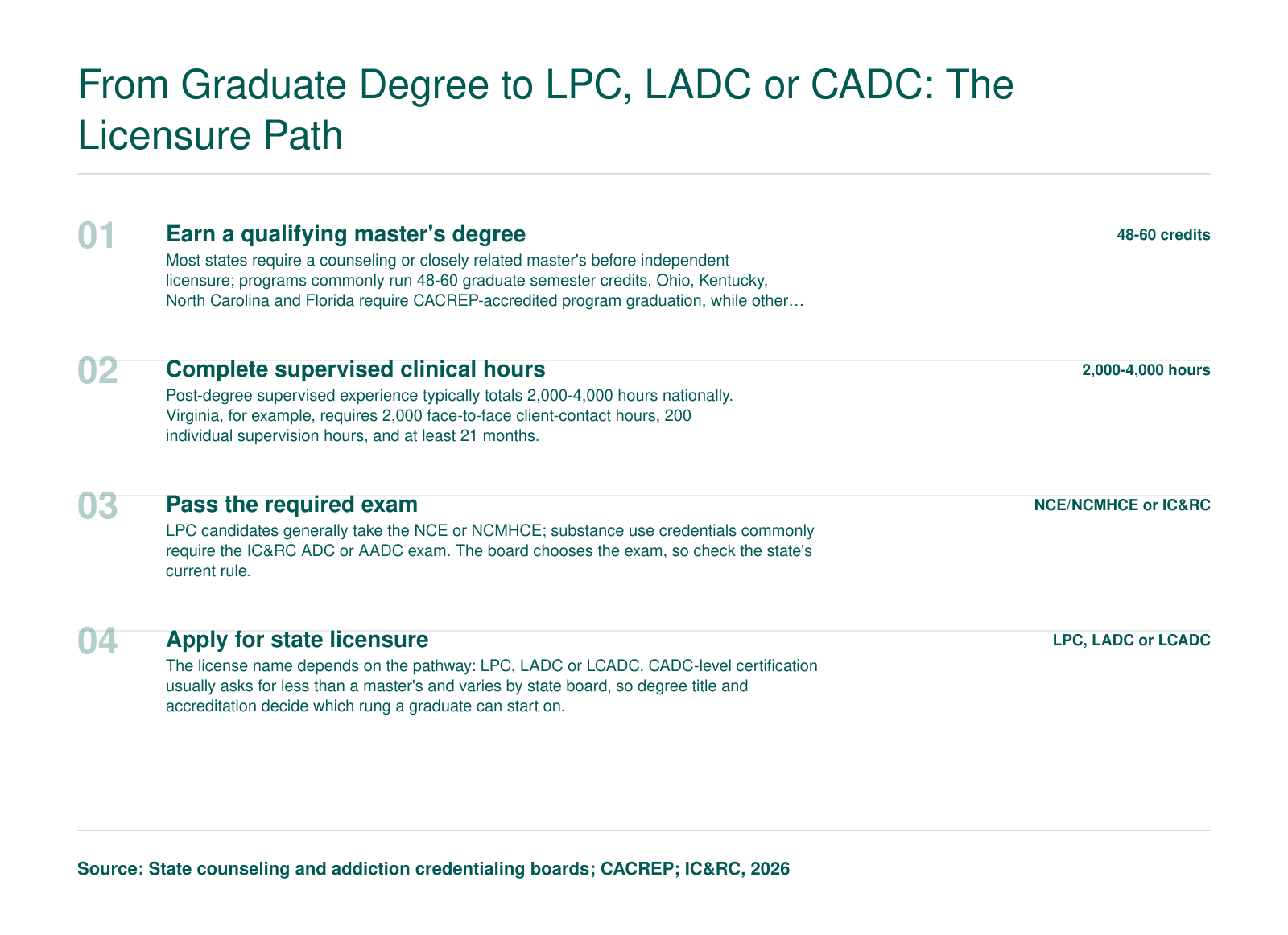
From Graduate Degree to LPC, LADC or CADC: The Licensure Path
Each state sets its own ladder, but the shape is consistent: finish a qualifying master's, complete supervised post-degree clinical hours, pass the required exam, then apply for a state license. The degree title and accreditation matter before the hours do, because they decide whether a graduate starts on the LPC/LADC/LCADC rung or the lower CADC rung. CADC-level certification often requires less than a master's, and exact totals vary by state board.
Practicum Hours and Who Finds Your Clinical Site
CACREP's counselor-education standard for addiction counseling master's programs is 100 practicum hours plus 600 internship hours. Some programs go higher: South Carolina's addiction counseling program lists 150 practicum hours for 2026-2027. Non-licensure psychology tracks often require fewer, but no single national minimum applies, so ask each school.
The hours are usually unpaid. Seattle University's online program, for example, expects 20 to 25 internship hours a week, which is close to a part-time job. Working students should plan for reduced income or a schedule change.
Placement help varies. Some programs keep a coordinator and an approved-site list, while others expect you to network early (St. Bonaventure suggests about six months ahead). Many do both. This is most acute for online addiction counseling master's programs, whose school may have no local contacts. Ask whether self-found sites need approval and whether your state requires more hours.
What Graduates Earn and Owe After Finishing
The table below shows program-level median earnings at the reported point after completion, along with median federal debt and the standard 10-year monthly payment where published. These earnings reflect typical early-career roles for graduates in addiction psychology such as substance use counselor, case manager, prevention specialist and treatment program coordinator. Monthly payments are based on the program's reported evaluation debt and may not correspond directly to the median federal debt shown.
| School | Program | Median earnings | Earnings window | Median federal debt | 10-year monthly payment |
|---|---|---|---|---|---|
| Lewis & Clark College | Master of Arts in Professional Mental Health Counseling, Specialization in Addictions | $71,725 | 5 years after completion | $19,500 | $1,363 |
| Touro University Worldwide | Master of Arts in Counseling | $65,314 | 4 years after completion | $25,000 | $464 |
| Touro University | Counseling: Addiction Specialization (MAC) | $63,393 | 4 years after completion | $15,547 | $677 |
| Regent University | M.S. in Psychology (Addictions) | $58,142 | 4 years after completion | $24,534 | $389 |
| Montreat College | Master of Science in Counseling Psychology with Substance Abuse and Addiction Counseling | $57,892 | 5 years after completion | $25,813 | N/A |
Addiction Psychology programs by state
Compare Addiction Psychology programs on the data that matters
Explore more Psychology specializations or browse every graduate field.
All Psychology programs