Addiction Counseling Master's Programs With No GRE Required
Compare 80+ accredited no-gre Addiction Counseling programs at 70+ schools, with graduate earnings, cost, debt, and completion data from IPEDS and the U.S. College Scorecard.
Substance abuse, behavioral disorder, and mental health counselors earned a median wage of $59,350 in May 2025, and most state credentials now sit behind a master's degree and thousands of supervised hours. Massachusetts, for example, requires a master's or doctoral degree plus 6,000 supervised hours for its independent LADC I.
Many counseling programs have dropped the GRE, weighing recovery-field work history, essays, and interviews instead. That shift helps working applicants, but a waiver is sometimes conditional on GPA, and program pages contradict university-wide ones. The costlier mistake is enrolling somewhere whose coursework your licensing board won't accept.
Key Points
- CACREP accreditation often matters more than a GRE waiver.
- Verify test-optional status on each program's admissions page for 2026.
- Addiction counselors earned a median $59,350 in May 2025.
Addiction Counseling Master's Programs With No GRE Required
-
#1
Ohio State University
Master of Arts in Educational Studies, Counselor Education, Clinical Mental Health Counseling-Addictions Concentration
$91,866median earnings $13,901grad tuition / yr 10grads / yrNo GRE required61 credits2 yearsVisit program site →67score -
#2
Capella University
Master of Science in Clinical Mental Health Counseling
$59,050median earnings $15,092grad tuition / yr $45,797median federal debt 1,261grads / yrNo GRE required90 credits39 monthsVisit program site →62score -
#3
Liberty University
Master of Arts in Addiction Counseling
$53,721median earnings $8,730grad tuition / yr $32,676median federal debt 738grads / yrNo GRE required48 creditsVisit program site →57score -
#4
University of Minnesota-Twin Cities
Master of Professional Studies in Addictions Counseling
$75,444median earnings $22,017grad tuition / yr $42,831median federal debt 41grads / yrNo GRE required30 creditsVisit program site →56score -
#5
Washburn University
Master of Arts in Family & Human Services/Addiction Counseling
$10,787grad tuition / yr $41,000median federal debt 11grads / yrNo GRE required2 yearsVisit program site →56score -
#6
Metropolitan State University of Denver
Master of Science in Clinical Behavioral Health
$11,017grad tuition / yr 19grads / yrNo GRE required61 creditsVisit program site →48score -
#7
Regent University
M.S. in Psychology - Addictions
$58,142median earnings $17,869grad tuition / yr $34,166median federal debt 158grads / yrNo GRE requiredVisit program site →48score -
#8
The University of Alabama
Counselor Education: Clinical Mental Health Counseling, MA
$11,980grad tuition / yr 6grads / yrNo GRE required60 creditsVisit program site →47score
How we rank. Each program is scored on graduate figures only: the field's master's earnings and debt, graduate tuition and the number of master's graduates, normalized across all programs in this field. Data comes from the U.S. Department of Education's IPEDS and College Scorecard; no school pays for placement.
Compare the top programs
| Rank | School | Earnings | Tuition / yr | Debt | Grads/yr | Format |
|---|---|---|---|---|---|---|
| 1 | Ohio State University OH | $91,866 | $13,901 | — | 10 | Campus |
| 2 | Capella University MN | $59,050 | $15,092 | $45,797 | 1,261 | Hybrid |
| 3 | Liberty University VA | $53,721 | $8,730 | $32,676 | 738 | Online |
| 4 | University of Minnesota-Twin Cities MN | $75,444 | $22,017 | $42,831 | 41 | Campus |
| 5 | Washburn University KS | — | $10,787 | $41,000 | 11 | Online |
| 6 | Metropolitan State University of Denver CO | — | $11,017 | — | 19 | Campus |
| 7 | Regent University VA | $58,142 | $17,869 | $34,166 | 158 | Online |
| 8 | The University of Alabama AL | — | $11,980 | — | 6 | Hybrid |
Sources: U.S. Department of Education. Tuition and graduates: IPEDS. Earnings and debt: College Scorecard, this field's master's graduates; a dash means no figure is reported.
Cost, debt & payoff
Median earnings of this field's master's graduates (4 yrs after completing) vs. their median federal loan debt · U.S. College Scorecard
Across these programs the median graduate earns about $59,937 and finishes with roughly $51,521 in debt — a ratio that clears a common rule of thumb (keep debt below first-year salary). Tuition and debt vary widely school to school, so sort the ranking by "Most affordable" or "Lowest debt" to weigh cost against outcomes.
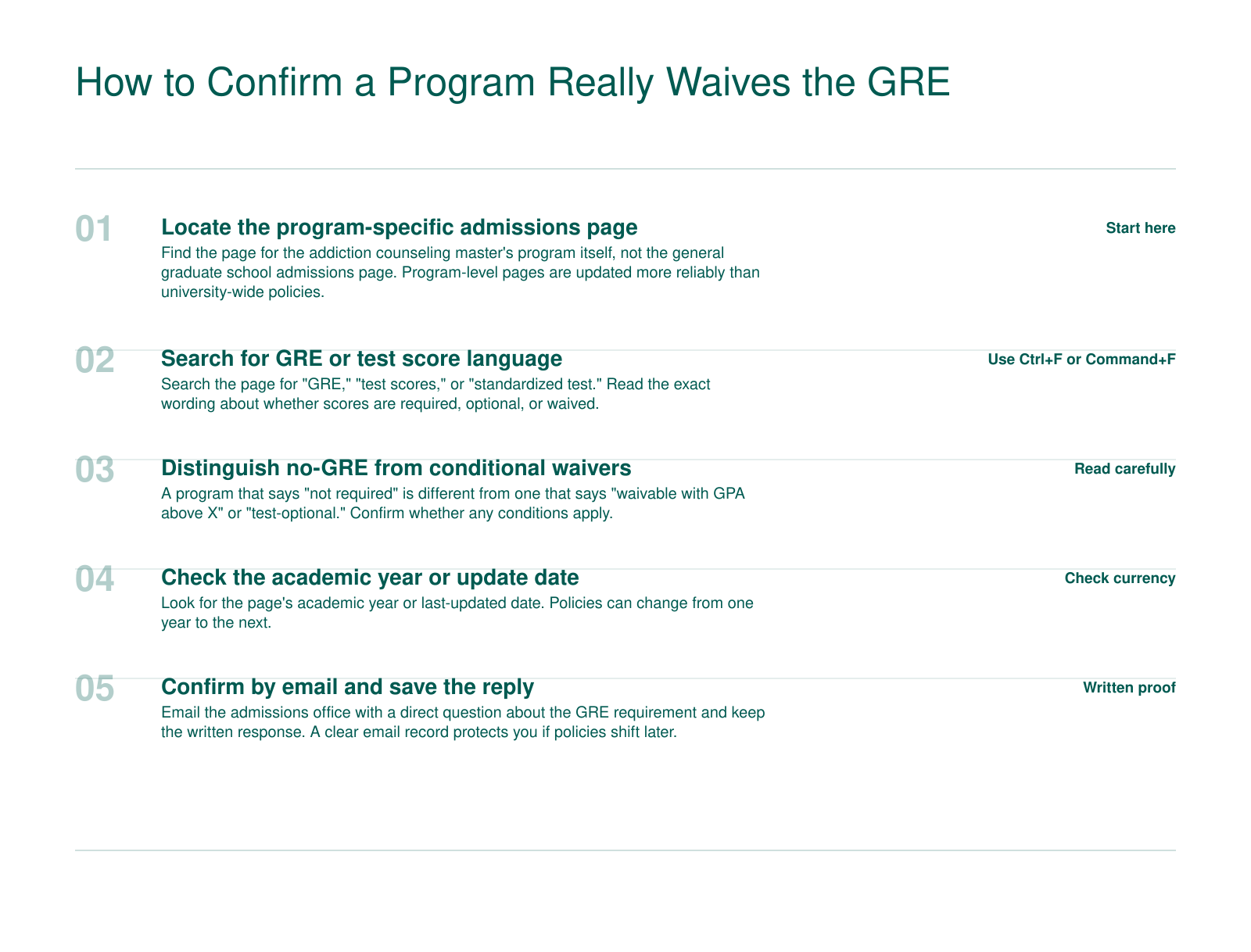
How to Confirm a Program Really Waives the GRE
Start with the program's own admissions page, not the university-wide graduate page. Third-party directories and general graduate school pages often lag behind program-level policy changes. A conditional waiver, such as a GPA threshold, is not the same as a program that never requires the GRE.
What Else to Check Beyond the GRE: GPA, Prerequisites, MAT, and Deadlines
A no-GRE policy is only one part of the admissions picture. Verify these items before you apply.
- Minimum undergraduate GPALook for a 2.75–3.0 threshold, though some programs consider lower GPAs case-by-case or through the last 60 credits.
- Prerequisite courseworkSeveral programs require only a bachelor's degree and no psychology-specific courses, but confirm transcript and statistics expectations.
- Alternative examsA GRE waiver does not always remove all testing, ask whether the MAT or another exam is requested for applicants below the GPA line.
- Personal statement and recommendationsExpect to submit a goal statement plus two to three recommendations; Eastern Oregon lists essays and three references.
- InterviewSome programs add an admissions or group interview, so check whether it is required or by invitation only.
- Background checkClinical placements usually require a background check, so confirm the timing before you apply.
- Application deadlinesRolling review is common at NYU and Northwestern; fixed dates include Lamar's Dec. 29, 2026 and Palo Alto's Nov. 1 and Dec. 1, 2026.
CACREP Accreditation and Why It Matters More Than the GRE
Programmatic accreditation, not test scores, is becoming the filter that decides whether a counseling degree leads to a license. Institutional (regional) accreditation makes a school eligible for federal financial aid. CACREP accreditation reviews the counseling program itself, and many state boards treat it as the most direct route to licensure.
Degree structure matters too. A standalone addiction counseling master's may point you toward a state addiction credential. A CACREP Addiction Counseling specialty, or a clinical mental health counseling (CMHC) degree with an addiction concentration, usually aligns with the professional counselor license and its broader scope of practice.
Verify in two steps:
- Search the directory: Look up the school in CACREP's directory and note which specialty is listed.
- Match your track: Confirm the exact degree and concentration you would enroll in is the accredited one, not a sibling program.
Master's programs with no GRE required can still be CACREP-accredited. Capella and Walden each state that their CMHC degrees, which house addiction specializations, are CACREP-accredited and require no GRE.12 Carlow reports CACREP accreditation through 2029 for its Addictions Counseling track, with no GRE or GMAT.3 Check any school's claim against the directory before you apply.
Related Articles
Licensure Portability: Will Your Degree Work in Your State?
Addiction counselors generally license through one of two tracks. State addiction credentials (CADC, LADC, LCADC and similar titles) vary widely by state. Massachusetts requires a master's or doctoral degree plus 6,000 supervised hours for its independent LADC I.1 The general counselor license (LPC or LMHC) typically expects a 60-credit counseling master's2, so a clinical mental health counseling master's with no GRE required that includes an addiction focus can also meet that requirement.
Online addiction counseling master's programs add a wrinkle. A school may not be authorized to enroll residents of every state, and its curriculum may not match every board's coursework rules. Find the program's state licensure disclosure page, which should say whether the degree meets, does not meet, or has not been reviewed against your state's requirements.
Portability tools help, within limits. The Counseling Compact has been enacted in 40 states and jurisdictions2 but was operational in only 11 as of October 19, 20263, and it covers fully licensed LPCs, not standalone addiction credentials. IC&RC reciprocity lets credential holders transfer between member boards, but each receiving board still applies its own rules.
Before applying, compare your state board's education requirements line by line against the program's curriculum.
Supervised Clinical Hours Required for Licensure in Five Large States
CACREP-accredited counseling programs typically include a 100-hour practicum and 600-hour internship during the degree, while post-degree supervised hours vary widely by state. The table below lists the verified post-degree requirements for two states where current details were available. Confirm current figures with the state board, because requirements change over time.
| State | Credential | Post-Degree Supervised Hours | Required Exam | Licensing Board |
|---|---|---|---|---|
| California | Licensed Professional Clinical Counselor (LPCC) | 3,000 total supervised hours over 104 weeks minimum | California Law and Ethics Exam and National Clinical Mental Health Counselor Examination (NCMHCE) | California Board of Behavioral Sciences (BBS) |
| Texas | Licensed Professional Counselor (LPC), following LPC Associate registration | 3,000 hours over a minimum of 18 months, including at least 1,500 hours of direct counseling experience | National Counselor Examination (NCE) or National Clinical Mental Health Counseling Examination (NCMHCE), plus the Texas LPC jurisprudence examination | Texas State Board of Examiners of Professional Counselors |
Cost, Format, and Residency Requirements to Compare
Tuition is the clearest cost signal, but the addiction counseling master's program total cost includes fees, practicum expenses, and format tradeoffs. Grand Canyon University lists its MS in Addiction Counseling at $610 per credit over 36 credits, or $21,960 before fees.1 Liberty University's MA in Addiction Counseling is 48 credits;3 at the full-time online rate of $600 per credit for 2026-2027, total tuition is $28,800.2 Confirm each program's current GRE policy, since test-optional admission may be tied to GPA or alternative requirements.
Hidden and direct costs
Beyond tuition, budget for technology fees, travel and lodging for any required on-campus residency, and background checks plus liability insurance for practicum placement. Liberty also lists separate full-time, part-time, and military per-credit rates,2 so confirm your enrollment category before budgeting.
Format and pacing
Both Grand Canyon and Liberty schedule 8-week online courses, but synchronous meeting requirements can vary, so confirm whether live attendance is required. Many addiction counseling master's degrees run 48 to 60 credits; Liberty's 48-credit plan is common, while Grand Canyon's 36-credit program is shorter, and students who want a quicker route may compare accelerated addiction counseling master's programs. Federal aid requires regional accreditation, and behavioral health employers sometimes offer tuition benefits that offset these costs.
What Addiction Counselors Earn
The median annual wage was $59,350 in May 2025.
Addiction Counseling programs by state
Common Questions About No-GRE Addiction Counseling Master's Programs
Applicants often ask the same questions when a program drops the GRE. The short answer: the test is rarely the deciding factor, but accreditation, coursework, and state licensure rules are.
Can I complete an addiction counseling master's degree online without the GRE?
Are there CACREP accredited addiction counseling programs with no GRE requirement?
Does skipping the GRE make a degree look less credible to licensing boards or employers?
Can I start working toward a state addiction credential while I'm in my master's program?
Compare Addiction Counseling programs on the data that matters
Explore more Counseling specializations or browse every graduate field.
All Counseling programs