Best Addiction Counseling Master's Programs in Pennsylvania
Compare 3 accredited Addiction Counseling programs in Pennsylvania, with graduate earnings, cost, debt, and completion data from IPEDS and the U.S. College Scorecard.

A master's in addiction counseling is a clinical graduate degree that trains you to assess and treat substance use disorders. In Pennsylvania, the curriculum decides which credentials you can pursue afterward. Treatment providers need master's-level clinicians, but a program with gaps in coursework or clinical hours can mean extra classes before you qualify for both the CAADC and the LPC.
The schools here mix campus and online delivery. Average net price after aid runs from about $18,200 at Waynesburg to roughly $38,500 at Drexel. The cheapest option is not automatically the best fit for your licensure goals.
Key Points
- Carlow requires no GRE; Drexel and Waynesburg publish no clear policy.
- Carlow's 60-credit program costs $1,083 per credit, near $65,000 total.
- Waynesburg and Drexel offer distance delivery, while Carlow stays on campus.
Ranked: Pennsylvania Addiction Counseling Master's Schools
Prestige doesn't pay off student loans, so this list weighs what you'll pay after aid, whether the program keeps licensure doors open, and who each program really suits. Two Pennsylvania schools have CACREP-accredited master's programs in addiction counseling, and they lead the list. Kutztown University's addiction counseling concentration is not yet accredited and is listed as a CACREP new application in process, so it is not ranked here. Net price figures below are institution-wide averages after aid, not program-specific costs.
Waynesburg University
#1Waynesburg, PA · ~$17,000/yr (est.)
Best for: Working adults needing fully online study
Waynesburg University offers a fully online Master of Arts in Counseling with an Addictions Counseling concentration. The program is CACREP-accredited in addiction counseling and is described as the first accredited addictions program in Pennsylvania. It runs about 20 months at $42,900 total program tuition, with fall and spring starts and a virtual admission interview. The institution-wide average net price after aid is about $27,000, and the school's overall graduation rate is 66%. Pennsylvania residents get priority for a state workforce grant of up to $32,000, which carries a three-year commitment to work at an eligible Pennsylvania treatment facility.
- CACREP-accredited in the Addiction Counseling specialty
- 100% online, about 20 months
- $42,900 total program tuition
- Fall and spring start dates
- Admission interview required
- Prepares for LPC licensure and CAADC certification
- SUD Workforce Development Grant up to $32,000, with service commitment
- HRSA loan repayment options up to $75,000
Carlow University
#2Pittsburgh, PA · $20,000 – $25,000/yr (est.)
Best for: Campus learners wanting extended clinical training
Carlow University's MS in Professional Counseling: Addictions Counseling Track is taught on campus in Pittsburgh. Its program page lists CACREP accreditation through 2029. The 60-credit curriculum includes 51 core credits, 9 addictions credits, and 700+ clinical hours, and it costs $1,046 per credit. No entrance exam is required, admissions are rolling, and work experience is expected. The institution-wide average net price after aid is about $25,500, and the school's overall graduation rate is 60%. Carlow also takes part in a state addiction workforce project that offers tuition support and paid field placements to Pennsylvania residents who commit to three years of service.
- CACREP accredited, listed through 2029
- 60 credits: 51 core and 9 addictions electives
- 700+ clinical hours in addictions settings
- $1,046 per credit; scholarships up to $27,600
- No entrance exam; rolling admissions, fall and spring starts
- 3.0 minimum GPA and two recommendation letters
- Prepares for LPC, NCC, and CAADC credentials
- Transfer up to 9 credits from CACREP programs
Drexel University
#3Philadelphia, PA · ~$39,000/yr (est.)
Best for: Philadelphia students aiming for national credentials
Drexel University offers a campus-based Master of Science in Addiction Counseling in Philadelphia. It is designed to prepare graduates for the AADC or MAC certification exams. We could not confirm CACREP accreditation for this program from the sources reviewed, so check the CACREP directory and Drexel's published state-by-state licensure document before applying. The institution-wide average net price after aid is about $25,300, and the school's overall graduation rate is 78%, the highest of the three. It suits Philadelphia-area students who want a national certification focus and will verify state licensure rules themselves.
- Campus-based program in Philadelphia
- Prepares for AADC and MAC certification exams
- Curriculum meets licensure requirements in most states
- State boards may add their own requirements
- State-by-state licensure information document published
Cost & outcomes by school
Federal data for the highest-earning Addiction Counseling programs, independent of the ranking above. Earnings are this field's master's graduates four years after completing, where the Scorecard reports them.
| School | Earnings | Tuition / yr | Debt | Grads/yr | Format |
|---|---|---|---|---|---|
| Carlow University PA | $57,187 | $24,816 | $55,109 | 30 | Campus |
| Drexel University PA | $57,006 | $39,261 | $56,375 | 29 | Campus |
| Waynesburg University PA | — | $16,920 | — | 23 | Online |
Sources: U.S. Department of Education. Tuition and graduates: IPEDS. Earnings and debt: College Scorecard, this field's master's graduates; a dash means no figure is reported.
Which PA Master's Programs Waive or Skip the GRE?
Carlow is the only school here with a clearly stated GRE answer: it does not require the test. For Drexel and Waynesburg, no GRE policy could be confirmed from an official admissions page, so the table says so instead of guessing. Admissions rules change annually, so confirm every requirement and deadline with each school before you apply.
| School | GRE Policy | Application Deadline | GPA / Prerequisites |
|---|---|---|---|
| Carlow University | Not required (GRE and GMAT scores) | April 1 for Fall, November 1 for Spring. Late applications are still accepted, but priority goes to those who meet the deadlines. | 3.0 cumulative GPA. Below 3.0 may be reviewed case by case with relevant helping-field work history or strong upper-level grades in psychology, human services, social work, or a related major. Also expects an accredited bachelor's degree, helping-field work or volunteer experience, and graduate-level writing ability. |
| Waynesburg University | No published policy. | Not confirmed from an official page | Master of Arts in Counseling is CACREP-accredited. A 3.0 GPA appears on the advanced specialty addictions certificate page, but a separate master's GPA is not confirmed. That certificate requires an accredited bachelor's degree. |
| Drexel University | No published policy. | Not confirmed from an official page | Not confirmed. Check the program's admissions page for GPA and prerequisite courses. |
Related Articles
Online and Hybrid Master's in Addiction Counseling Options in Pennsylvania
Waynesburg University and Drexel University both deliver their addiction counseling master's at a distance, while Carlow University keeps its program on campus.
- Waynesburg University: Its CACREP-accredited Master of Arts in Counseling with an Addictions Counseling concentration is listed as a 100% online, 20-month program with fall and spring starts. An admission interview is required.
- Drexel University: The online, part-time M.S. in Addictions Counseling runs 57.5 quarter credits, or 63.5 with practicum supervision. That practicum is optional, but some states require one for licensure or certification, so check your target state's rules before skipping it.
- Carlow University: The 60-credit M.S. in Professional Counseling is delivered on campus and includes 700 clinical hours.
Neither Waynesburg's nor Drexel's program information describes an in-person residency or immersion. Still, confirm this with admissions before you enroll. Neither school spells out whether it arranges practicum and internship sites or expects students to find their own, or whether sites outside Pennsylvania qualify. Ask both questions early.
If you work full time, start lining up a placement site before your clinical term begins. Approach your current employer or local treatment providers, then confirm that the site and supervisor meet your program's requirements.
Pennsylvania's Licensed Professional Counselor Path After Graduation
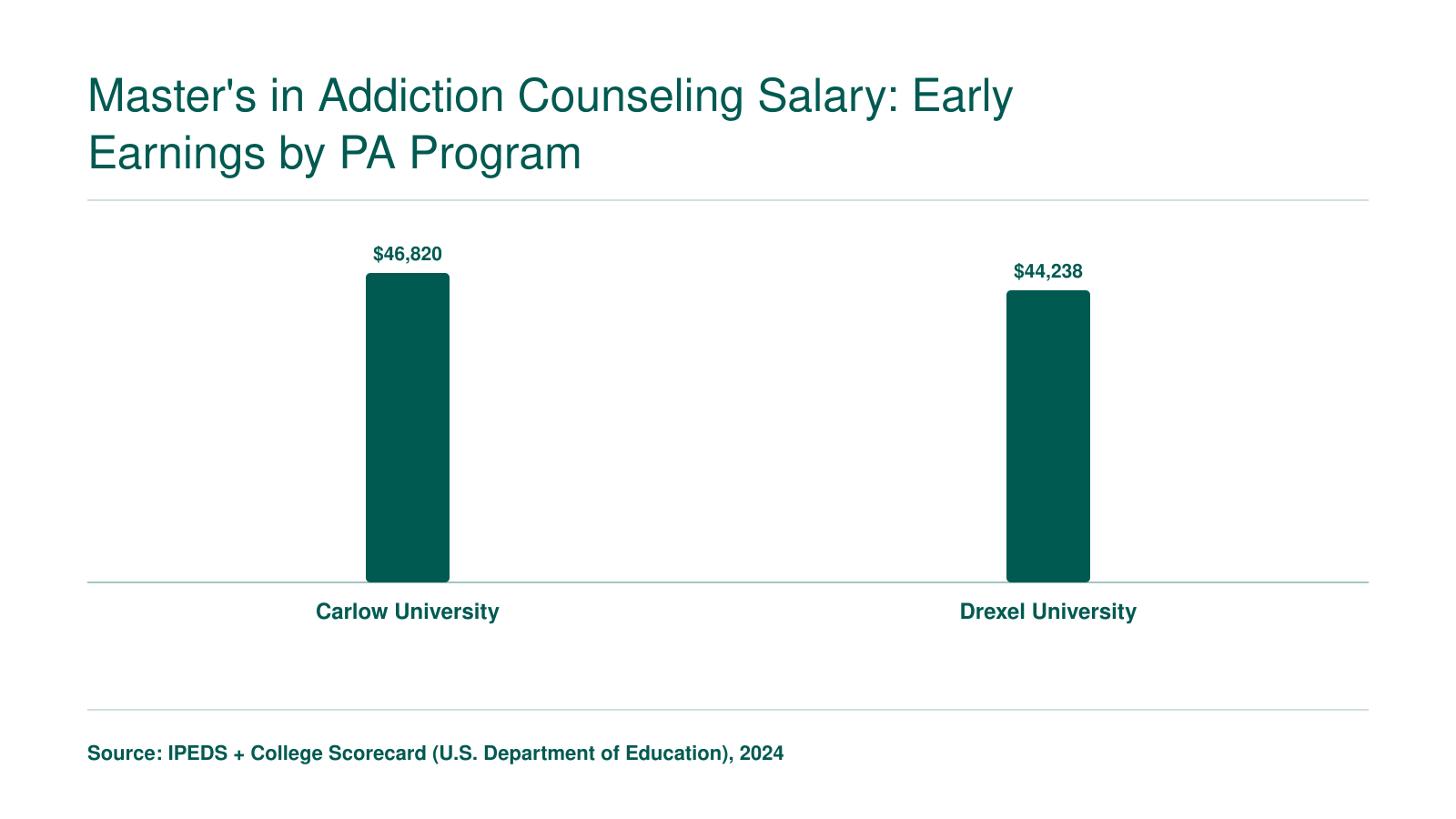
Master's in Addiction Counseling Salary: Early Earnings by PA Program
Median earnings one year after finishing the degree are the closest read on first-job pay. Both ranked programs below with a published program-level figure are shown; Waynesburg University is left out because no program-level earnings figure is reported for it. Treat these as small-cohort medians, not guarantees.
What a PA Addiction Counseling Master's Costs and How It Prepares You for CAADC Certification
Carlow University lists its 60-credit M.S. in Professional Counseling: Addictions Counseling at $1,083 per credit, which puts published tuition for the full degree near $65,000 before fees. That figure contrasts sharply with the institution-wide average net price after aid, roughly $51,000. Treat that net number as an approximation: it blends all programs and aid levels across the university, not addiction counseling students specifically, and your actual cost depends on the scholarships and grants you qualify for.
Estimating Your True Program Cost
Per-credit tuition is only one input. To estimate the real total, add any required fees to the tuition figure and multiply by the credits you still need to complete. Carlow's degree splits into 51 core credits and 9 addictions electives. Its public materials list a per-credit rate but do not name a fixed mandatory program fee, so ask admissions to itemize fees before you model your budget.
Meeting the CAADC Education Standard
Pennsylvania's CAADC credential requires a master's degree, 180 education hours across four content domains (including 6 ethics hours), 2,000 hours of supervised work experience, and 100 supervision hours. Carlow states that its curriculum delivers the 180 addiction-specific education hours CAADC requires and includes 700-plus clinical hours, so no supplemental coursework is needed.
Before you apply, ask admissions for a CAADC course-mapping sheet and a personalized financial aid estimate. Those two documents turn advertised rates into decisions you can trust.
Quick Answers on Pennsylvania Addiction Counseling Master's Programs
These short answers cover the questions prospective students ask most often about addiction counseling master's programs in Pennsylvania. Details change by school, so confirm timelines, transfer limits, and tuition with each admissions office. The sections below go deeper on format, cost, and licensure.
Which Pennsylvania addiction counseling master's programs meet CAADC requirements without additional coursework?
Are there fully online addiction counseling master's programs in Pennsylvania with no in-person residencies?
How long does it take to complete an addiction counseling master's degree part-time in Pennsylvania?
How much does a master's in addiction counseling cost in Pennsylvania after financial aid?
What is the difference between a master's in addiction counseling and a certificate in substance use disorder counseling?
Can you transfer graduate credits into a Pennsylvania addiction counseling master's program?
Does CACREP accreditation matter for addiction counselors seeking Pennsylvania licensure?
Compare Addiction Counseling programs on the data that matters
Explore more Counseling specializations or browse every graduate field.
All Counseling programs