Best Online Addiction Counseling Master's Programs
Compare 50+ accredited online Addiction Counseling programs, with graduate earnings, cost, debt, and completion data from IPEDS and the U.S. College Scorecard.

The cheapest online master's in addiction counseling is not always the one that qualifies you for licensure in your state. Among the schools ranked here, average annual net price runs from $10,338 at Fort Valley State University to $29,627 at Touro University.
Credit loads diverge too. University of South Dakota's NASAC-accredited degree can require between 33 and 45 credits, while Texas Tech University Health Sciences Center's CACREP-accredited program takes 60.
Coursework moves online. Supervised clinical hours stay local, completed at an approved site near home.
Key Points
- Fort Valley State lists the lowest in-state tuition here at $5,790.
- Bay Path University reports the highest median earnings among ranked programs.
- Texas requires 3,000 supervised hours for full LPC licensure.
The 10 Best Fully Online Addiction Counseling Master's Programs
Every program below can be completed fully online, with no required on-campus or hybrid component for the core pathway. The profiles focus on program fit, cost, and graduate outcomes rather than reputation.
Texas Tech University Health Sciences Center
#1Lubbock, TX · ~$7,000/yr (est.)
Best for: Working counselors seeking telehealth training
Texas Tech University Health Sciences Center is one of the first programs to build telehealth training into the core curriculum, so graduates are prepared to deliver remote addiction care. The 60-credit online MS in Addiction Counseling is CACREP-accredited and accepts two start dates each year, with rolling review and fixed term deadlines. Students complete addiction-specific clinical experiences and prepare for the NCE and LPC pathway.
- 60-credit CACREP-accredited curriculum
- Telehealth certificate built into degree
- Rolling review with fall and spring starts
- Prepares for NCE and LPC licensure
- Addiction-specific clinical experiences
Arizona State University
#2Scottsdale, AZ · ~$11,000/yr (est.)
Best for: Psychology-minded learners preferring short sessions
Arizona State University's online MS in Addiction Psychology is a 45-credit program with 7.5-week courses, a six-credit practicum, and an applied project. The school accepts up to 12 graduate transfer credits earned within three years with B or higher grades, and offers five session starts each year. The program is a NAADAC Approved Education Provider and is taught by research-active faculty.
- 45 total credit hours
- 15 courses in 7.5-week sessions
- Up to 12 transfer credits accepted
- Transfer credits need B or higher within 3 years
- Six-credit practicum and applied project
- Five session starts per year
- NAADAC Approved Education Provider
Touro University
#3New York, NY · ~$15,000/yr (est.)
Best for: Budget-conscious students seeking supervised fieldwork
Touro University's online MA in Counseling, Addiction Specialization, is a 60-credit program with two practicum and four internship courses for hands-on training. Graduate tuition is about $22,450 in and out of state, and the approximate institution-wide average net price is $29,627. The school graduates 72% of students, and recent program graduates had median earnings of $48,131 one year after finishing.
- 60 total credit hours
- Two practicum and four internship courses
- 2.5 GPA minimum
- Scholarships available
- State licensing regulations vary
University of South Dakota
#4Vermillion, SD · ~$7,000/yr (est.)
The University of South Dakota's online MA in Addiction Counseling and Prevention uses 33 to 45 credits depending on your background, which can shorten the path if you already hold relevant credentials. In-state graduate tuition is $9,432, out-of-state is $12,942, and the approximate institution-wide average net price is $19,858. The school graduates 60% of students, and recent program graduates had median earnings of $47,863 one year after finishing. The program reports a 95% employment placement rate and internships across the U.S. and abroad.
- 33 to 45 credit hours based on background
- 95% job placement rate reported
- NASAC-accredited
- Internships nationally and internationally
- Prepares for highest SD credential
Indiana Wesleyan University
#5Marion, IN · ~$11,000/yr (est.)
Indiana Wesleyan University's online MA in Addictions Counseling is a 48-credit program with a faith-based lens and evidence-based training in CBT, DBT, and motivational interviewing. Students complete 100 practicum and 600 internship hours under doctoral-level supervisors, plus two required intensives. Graduate tuition is $32,352 for both in-state and out-of-state students, and the approximate institution-wide average net price is $22,866. The school graduates 67% of students, and recent program graduates had median earnings of $44,983 one year after finishing.
- 48 total credit hours
- 100 practicum and 600 internship hours
- Two required intensives
- NASAC and NAADAC approved
- Locked tuition rate while enrolled
- CBT, DBT, and motivational interviewing training
Liberty University
#6Lynchburg, VA · ~$9,000/yr (est.)
Liberty University's online MA in Addiction Counseling is a 48-credit, 100% online program with 8-week courses and no standardized testing for admission. Graduate tuition is $22,465 for in-state and out-of-state students, and the approximate institution-wide average net price is $29,357. The school graduates 65% of students, and recent program graduates had median earnings of $45,136 one year after finishing. Students may transfer up to 50% of the degree total, and multiple start dates are available each year.
- 48 total credit hours
- Transfer up to 50% of degree total
- 8-week asynchronous online courses
- No entrance exam required
- Military tuition discount available
- Prepares for CSAC and LSATP in Virginia
Fort Valley State University
#7Fort Valley, GA · ~$6,000/yr (est.)
Fort Valley State University's online MSW with an Alcohol and Drug Addiction Counseling concentration is a CSWE-accredited program with full-time, part-time, and advanced standing tracks. The 54-credit standard path prepares students for LMSW licensure and later LCSW, with synchronous online classes and a social justice focus. In-state graduate tuition is $5,526, out-of-state is $16,932, and the approximate institution-wide average net price is $10,338. The school graduates 41% of students, and recent program graduates had median earnings of $38,662 one year after finishing.
- 54 total credit hours; 30 for advanced standing
- Full-time, part-time, advanced standing tracks
- CSWE-accredited MSW
- Synchronous online classes
- Prepares for LMSW and LCSW
- HBCU with social justice emphasis
Washburn University
#8Topeka, KS · ~$11,000/yr (est.)
Washburn University's online MA in Family & Human Services with an Addiction Counseling concentration prepares students for Kansas LMAC licensure and can be completed full-time or part-time. In-state graduate tuition is $9,945, out-of-state is $20,949, and the approximate institution-wide average net price is $15,280. The school graduates 53% of students, and recent program graduates had median earnings of $52,595 one year after finishing. You can add a Trauma & Recovery Graduate Certificate with just two extra courses.
- Full-time or part-time options
- Prepares for Kansas LMAC licensure
- No entrance exam required
- Trauma and Recovery certificate add-on
- Fieldwork completed in your community
- Minority fellowships available
Eastern Washington University
#9Cheney, WA · ~$14,000/yr (est.)
Eastern Washington University's online MA in Advanced Addiction Counseling and Treatment is a 48-credit program aligned with Washington's Licensed Agency Affiliated Counselor requirements. Courses cover group counseling, co-occurring disorders, CBT, trauma-informed care, and harm reduction. In-state graduate tuition is $8,586, out-of-state is $25,959, and the approximate institution-wide average net price is $13,886. The school graduates 43% of students. Full-time and part-time enrollment options are available.
- 48 total credit hours
- Aligns with Washington LAAC requirements
- Covers co-occurring disorders and CBT
- Trauma-informed care and harm reduction focus
- Full-time and part-time options
- Out-of-state licensure varies by board
Ottawa University-Online
#10Overland Park, KS · ~$13,000/yr (est.)
Ottawa University-Online's MS in Addiction Counseling is a flexible online program with six start terms per year across spring, summer, and fall. Graduate tuition is $13,296 for both in-state and out-of-state students. The school graduates 43% of students, and the program focuses on counseling techniques and ethical practice for addiction treatment settings.
- Six start dates per year
- Spring, summer, and fall starts
- Fully online format
- Focus on counseling techniques and ethics
Cost & outcomes by school
Federal data for the highest-earning Addiction Counseling programs, independent of the ranking above. Earnings are this field's master's graduates four years after completing, where the Scorecard reports them.
| School | Earnings | Tuition / yr | Debt | Grads/yr | Format |
|---|---|---|---|---|---|
| Bay Path University MA | $79,114 | $15,162 | $56,228 | 25 | Online |
| Johnson & Wales University RI | $66,809 | $15,156 | $47,933 | 25 | Hybrid |
| Touro University Worldwide CA | $65,314 | $9,000 | $40,813 | 369 | Online |
| Walden University MN | $60,034 | $10,885 | $80,386 | 888 | Hybrid |
| Capella University MN | $59,050 | $15,092 | $45,797 | 1,261 | Hybrid |
| Regent University VA | $58,142 | $17,869 | $34,166 | 158 | Online |
| Grand Canyon University AZ | $58,045 | $10,015 | $41,000 | 1,169 | Online |
| University of South Dakota SD | $57,591 | $7,118 | $29,750 | 79 | Online |
| Liberty University VA | $53,721 | $8,730 | $32,676 | 738 | Online |
| Lincoln University MO | — | $7,782 | — | — | Online |
| Cornerstone University MI | — | $9,522 | — | — | Hybrid |
| Campbellsville University KY | — | $9,920 | — | — | Online |
Sources: U.S. Department of Education. Tuition and graduates: IPEDS. Earnings and debt: College Scorecard, this field's master's graduates; a dash means no figure is reported.
Cost, debt & payoff
Median earnings of this field's master's graduates (4 yrs after completing) vs. their median federal loan debt · U.S. College Scorecard
Across these programs the median graduate earns about $59,937 and finishes with roughly $51,521 in debt — a ratio that clears a common rule of thumb (keep debt below first-year salary). Tuition and debt vary widely school to school, so check the per-school figures in the table above before you shortlist.
CACREP vs. NASAC: How Program Accreditation Shapes Your Licensure Options
Accreditation is not a minor detail for students in addiction counseling master's programs. It determines which licenses and credentials a graduate can realistically pursue.
CACREP vs. NASAC
CACREP accredits counseling master's programs, including addiction counseling and clinical mental health counseling specialties, and is the standard most licensed professional counselor boards recognize. NASAC, the accreditation arm of NAADAC, focuses on addiction studies programs rather than the broader counseling core.
Why the difference matters
A CACREP-accredited clinical mental health counseling program with an addiction emphasis keeps both the licensed professional counselor and addiction-specific credential doors open. A NASAC-only or unaccredited program may still prepare you for state addiction credentials, but it can limit your ability to pursue the LPC, especially where CACREP is mandatory. Florida, Kentucky, North Carolina, and Ohio now require CACREP graduation for professional counselor licensure, with the requirement effective July 1, 2025.1
Where the programs here stand
Several programs below hold CACREP accreditation in addiction counseling pathways, and NASAC accreditation also appears among the options. Before applying, verify a program's current status directly in the CACREP and NASAC directories, since CACREP lists more than 969 master's and doctoral programs at 483 institutions.
Master's-Level Addiction Counseling Credentials in Eight Key States
Texas requires at least 3,000 supervised hours before you can hold a full LPC, and state guidance says that requirement cannot be waived.1 Texas and New York show how far apart the addiction and counseling tracks can sit:
- Texas LCDC: No master's required (an associate degree or higher qualifies). The standard is 4,000 supervised hours, which may be waived for a counseling-related master's plus 48 graduate semester hours.2
- Texas LPC: Graduate degree in counseling or a related field required3, with at least 3,000 supervised hours.1
- New York CASAC and CASAC Advanced: No master's required.45 The base CASAC calls for at least 6,000 supervised hours.4 A separate CASAC Master's credential is the degree-based tier.4
- New York MHC: Master's required, with 3,000 supervised hours.6 Non-CACREP degrees qualify if the program is state-registered or judged substantially equivalent.7
In both states, the top-tier counseling license requires a master's. The base addiction-specific credentials in both states do not. California, Florida, North Carolina and other states set their own rules for addiction counseling master's programs, so confirm with each board before enrolling.
The Counseling Compact is designed to let LPCs practice across member states. It does not cover credentials like the LCDC or CASAC, which usually require a new application when you move.
Related Articles
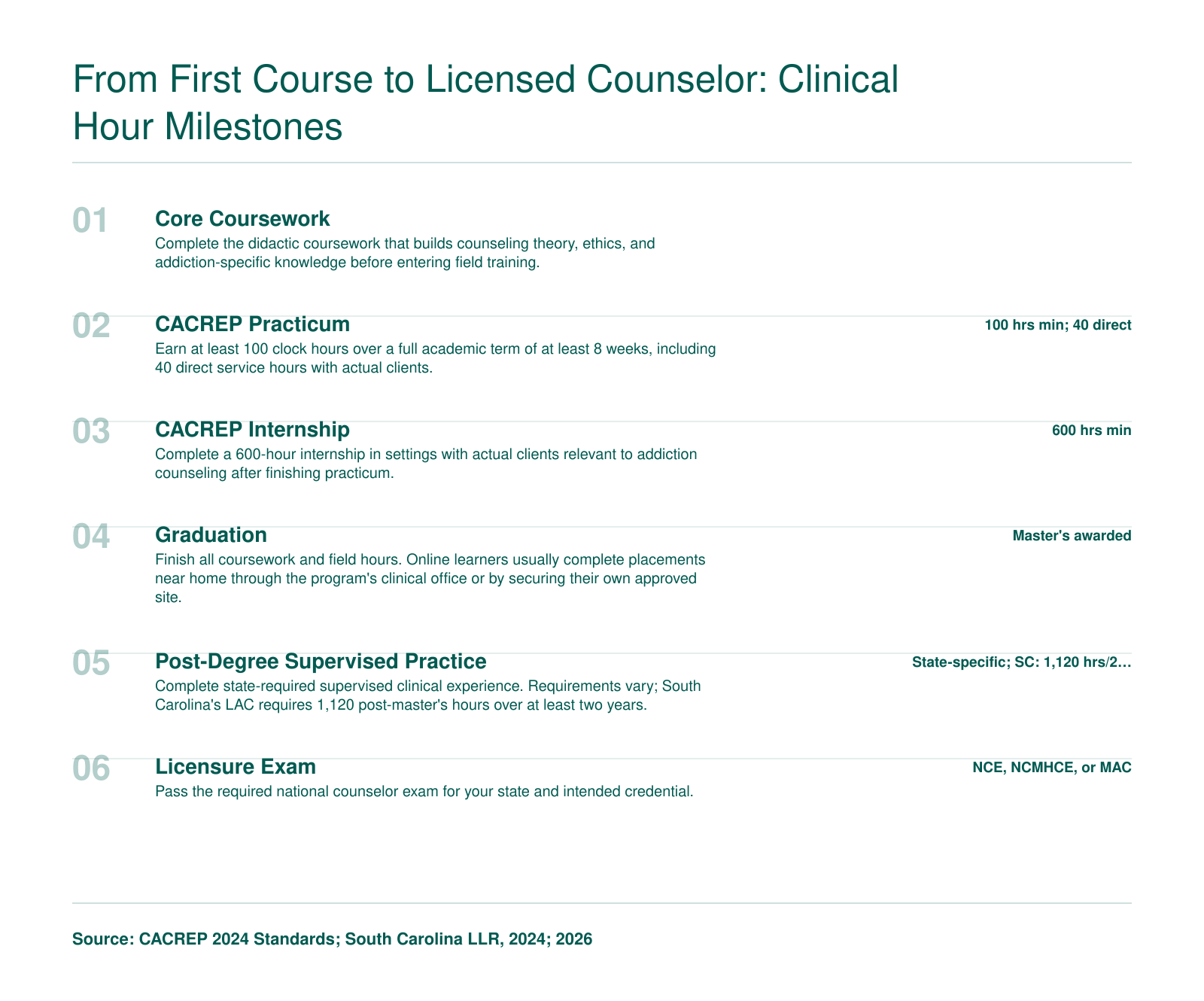
From First Course to Licensed Counselor: Clinical Hour Milestones
Online students typically complete practicum and internship hours at approved sites near home, arranged through the program's clinical placement office. Some programs require students to identify and secure their own approved site. The path below moves from first course through graduation, post-degree supervision, and the licensure exam.
What an Online Addiction Counseling Master's Really Costs Beyond Tuition
Among the affordable addiction counseling master's programs, Fort Valley State University lists the lowest in-state tuition at $5,790, while out-of-state students pay $18,268. Purdue Global keeps its published tuition close for all students at $10,211 in state and $11,241 out of state, and Bay Path University, a private institution, charges the same $15,162 regardless of residency. Public options here show wider gaps between in-state and out-of-state rates. These net price figures are institution-wide averages, not quotes for a specific program: $7,770 at Purdue Global, $10,338 at Fort Valley State, and $14,271 at Bay Path.
Debt and hidden fees
Program-level median federal debt, where published, varies widely. Fort Valley State reports $73,173 with a 10-year monthly payment near $832; Bay Path reports $56,228 and roughly $640 monthly.
Beyond tuition, budget for per-credit technology or distance-learning fees, which affect an addiction counseling master's program cost and depend on the school and term. Background checks generally run $25 to $75.1 Practicum liability insurance, supervision fees, and residency travel are not standardized and may be charged separately or included in tuition depending on the placement.
Credential exam costs
For credentials, the MAC base exam costs $150.2 The NCC AP application fee is $235 per level, so a first credential is often about $385 before state administrative fees.3 NBCC lists a $34.95 NCE preparation product, but the 2026 exam registration fee is not published.
Earnings Snapshot for Recent Graduates
Bay Path University reports the highest program-level median earnings among the schools ranked here.
Addiction Counseling programs by state
Addiction Counseling Master's Questions Readers Ask Most
Prospective students often ask how online addiction counseling master's programs fit with a full-time job and what licensing will require. Here are concise answers to the questions that come up most.
Can I finish an online addiction counseling master's while working full-time?
Which states require a master's degree to become a fully licensed addiction counselor?
Do any fully online addiction counseling programs still require a campus visit?
Compare Addiction Counseling programs on the data that matters
Explore more Counseling specializations or browse every graduate field.
All Counseling programs