Best Master's in Addiction Psychology Programs
Compare 20+ accredited Addiction Psychology programs, with graduate earnings, cost, debt, and completion data from IPEDS and the U.S. College Scorecard.
HRSA's latest behavioral health workforce projections show a shortage of roughly 87,630 full-time addiction counselors by 2036. The shortfall is colliding with a treatment system that needs clinicians trained in the psychology of substance use, and a master's degree remains the most common entry point. The schools ranked here include online, campus, and hybrid formats, but tuition and practicum requirements vary sharply by delivery model. Licensure is the real gatekeeper: most states require supervised clinical hours and a credentialing exam after graduation, so cost, timeline, and early-career earnings matter only if they align with the state license you intend to hold.
Key Points
- Addiction psychology licensure usually requires a doctorate; counseling master's degrees are the faster route.
- Tuition ranges from a few thousand dollars to over $60,000 per year.
- HRSA projects roughly 87,630 fewer full-time addiction counselors than needed by 2036.
The 10 Best Master's in Addiction Psychology Schools for 2027
The programs below span online and campus formats, with graduate tuition ranging from about $8,800 to $64,400 and net price from roughly $15,000 to $36,000.
Arizona State University
#1Tempe, AZ · ~$14,000/yr (est.)
Best for: Aspiring licensed counselors needing flexible pacing
This public research university combines addiction science faculty with licensed treatment practitioners, grounding the curriculum in both research and clinical practice. Students complete a 45-credit master's sequence with a six-credit practicum and capstone. Admission is rolling across two fall, two spring, and one summer start each year, and dedicated advising supports students in the addiction psychology track. The school graduates about 68% of students overall.
- 45 total credit hours and 15 courses
- Six-credit practicum plus capstone
- NAADAC-approved education provider
- 7.5-week course terms for flexible pacing
- Prepares for addiction counseling licensure
- Dedicated advising for addiction psychology students
- Rolling admission across five entry points annually
- Faculty include Nobel laureates and Fulbright scholars
Montclair State University
#2Montclair, NJ · ~$16,000/yr (est.)
Best for: Working counselors needing evening and summer classes
This public university offers a CACREP-accredited 60-credit counseling program with a dedicated addictions counseling concentration. Students complete fieldwork in treatment centers, transition homes, and outpatient facilities while building toward LPC and LCADC eligibility. Evening and summer classes support full- and part-time enrollment, and most full-time students finish in two and a half to three years. The school graduates about 65% of students overall.
- CACREP-accredited, 60 credit hours
- Four concentration options available
- Fieldwork in treatment centers and outpatient facilities
- Prepares for LCADC and LPC licensure
- Full-time and part-time enrollment options
- Most full-time students finish in 2.5 to 3 years
- Evening and summer classes
- 2.9 GPA minimum and two recommendation letters
Touro University
#3New York, NY · ~$15,000/yr (est.)
Best for: Budget-conscious learners wanting low per-credit cost
This private university keeps per-credit tuition at $500, making the 60-credit addiction specialization one of the more affordable paths in the ranking. The curriculum integrates clinical practicum and internship experiences with core counseling theory and addiction-specific interventions. Graduates often pursue addiction counselor or clinical supervisor roles and may continue toward state licensure. The school graduates about 72% of students overall.
- 60 credit hours across 20 courses
- $500 per-credit tuition
- Clinical practicum and internship included
- 2.5 GPA minimum for admission
- Scholarships available
- Coursework in ethics and cultural competence
- Prepares for addiction counseling and licensure
Lewis & Clark College
#4Portland, OR · $15,000 – $20,000/yr (est.)
This private liberal arts college offers an addictions specialization within its professional mental health counseling master's, with a focus on co-occurring disorders. Students train at an on-campus community counseling center and can choose from more than 100 approved internship sites. The program's CACREP accreditation supports Oregon LPC licensure and CADC I educational hours. The school graduates about 75% of students overall.
- 62 total credit hours
- CACREP, OBLPCT, and MHACBO accredited
- Focus on co-occurring mental health and substance use
- Practicum at on-campus Community Counseling Center
- Over 100 approved placement sites
- Eligible for NCE and NCC examinations
- Fulfills CADC I educational hours
- Optional EcoSomaArts Therapy Certificate
Colorado State University-Fort Collins
#5Fort Collins, CO · ~$14,000/yr (est.)
This public land-grant university offers a streamlined two-year addiction counseling track and a longer joint degree combining addiction counseling with social work. The core program emphasizes clinical internship hours that count toward addiction counselor licensure, with 360 to 480 supervised hours per semester in the second year. Small cohorts and a dedicated scholarship fund support graduate study. The school graduates about 67% of students overall.
- 43 total credit hours
- Two-year program with rolling admission
- NASAC accreditation through 2028
- Clinical internship of 360 to 480 hours per semester
- Eligible for Licensed Addiction Counselor exam
- Option to pursue LPC equivalency
- No thesis or capstone required
- Scholarships available, including Morgan Sneed Memorial
- 83 total credit hours
- Joint degree combining MACP and MSW
- Prepares for LAC and LCSW licensure
- Focus on co-occurring disorders
- Advanced standing available for BSW graduates
- Includes internship and field placement
- Three-year program of study
Indiana Wesleyan University
#6Marion, IN · ~$11,000/yr (est.)
This private university integrates evidence-based treatments such as CBT, DBT, and motivational interviewing with a Christian worldview in its addictions counseling master's. The 48-credit curriculum requires 700 clinical hours, including 100 practicum and 600 internship hours. Locked per-credit tuition and flexible scheduling are designed for working adults. The school graduates about 67% of students overall.
- 48 total credit hours
- NAADAC and NASAC accredited
- $610 per-credit locked tuition rate
- 3.0 GPA minimum and three recommendation letters
- 700 clinical hours required
- Evidence-based training in CBT, DBT, and motivational interviewing
- Christian worldview integrated throughout
- GRE required for admission
Waynesburg University
#7Waynesburg, PA · ~$17,000/yr (est.)
This private university offers Pennsylvania's first CACREP-accredited addictions counseling program. The curriculum blends core counseling competencies with specialized addictions coursework and can be completed in as few as 20 months full time. Grant-backed funding through the UWDP may provide up to $32,000 in stipends and tuition support. The school graduates about 66% of students overall.
- CACREP accredited
- $42,900 total program tuition
- 20-month full-time completion
- First CACREP-accredited addictions counseling program in Pennsylvania
- Meets LPC licensure requirements
- Prepares for CAADC certification
- Up to $32,000 in UWDP grant stipends and tuition
- Admission interview required
Indiana Wesleyan University-National & Global
#8Marion, IN · ~$11,000/yr (est.)
This national and global campus of a private Christian university mirrors the addictions counseling master's offered through the main campus, with the same clinical hour requirements and NAADAC/NASAC approvals. The 48-credit program includes 100 practicum and 600 internship hours and covers psychopathology, ethics, and co-occurring disorders. Locked per-credit tuition and financial aid are available. The school graduates about 35% of students overall.
- 48 total credit hours
- NAADAC and NASAC accredited
- $610 per-credit locked tuition rate
- 3.0 GPA minimum and three recommendation letters
- 700 clinical hours required
- Courses cover psychopathology, ethics, and co-occurring disorders
- Christian worldview integrated
- GRE required for admission
Carlow University
#9Pittsburgh, PA · $20,000 – $25,000/yr (est.)
This private Catholic university offers an addictions counseling track within a 60-credit professional counseling master's. Students complete more than 700 clinical hours in addiction settings, and the curriculum meets Pennsylvania LPC licensure expectations while providing 180 hours toward CAADC certification. Rolling admission and a no-GRE policy lower barriers to entry, with AC-WIP scholarships up to $27,600 available. The school graduates about 60% of students overall.
- 60 total credit hours
- CACREP accredited
- $1,046 per-credit tuition
- No GRE required
- Rolling admission with fall and spring starts
- More than 700 clinical hours
- Meets LPC, NCC, and CAADC requirements
- AC-WIP scholarship up to $27,600
Regent University
#10Virginia Beach, VA · ~$18,000/yr (est.)
This private Christian university offers a 39-credit psychology master's with an addictions concentration designed as a non-licensure track and a gateway to doctoral study. The curriculum covers addictive behaviors, process addictions, and faith-based intervention strategies from a Christian perspective. Six start dates per year and no GRE requirement emphasize flexibility for working students. The school graduates about 57% of students overall.
- 39 total credit hours
- No GRE required
- Six start dates per year
- $695 per-credit tuition
- Six concentration options
- Non-licensure addictions counseling track
- Christian worldview integrated throughout
- Ranked #5 online psychology program by Fortune
Cost & outcomes by school
Federal data for the highest-earning Addiction Psychology programs, independent of the ranking above. Earnings are this field's master's graduates four years after completing, where the Scorecard reports them.
| School | Earnings | Tuition / yr | Debt | Grads/yr | Format |
|---|---|---|---|---|---|
| University of Southern California CA | $72,615 | $71,515 | $130,999 | 71 | Campus |
| Lewis & Clark College OR | $67,080 | $19,800 | $119,806 | 91 | Campus |
| Johnson & Wales University RI | $66,809 | $15,156 | $47,933 | 25 | Hybrid |
| Touro University Worldwide CA | $65,314 | $9,000 | $40,813 | 369 | Online |
| Touro University NY | $63,393 | $14,979 | $59,552 | 30 | Online |
| Marquette University WI | $63,310 | $24,680 | $57,690 | 65 | Campus |
| Antioch University OH | $59,927 | $27,846 | $94,422 | — | Hybrid |
| Regent University VA | $58,142 | $17,869 | $34,166 | 158 | Online |
| Carlow University PA | $57,187 | $24,816 | $55,109 | 30 | Campus |
| Montreat College NC | $55,401 | $11,820 | — | 16 | Online |
| Indiana Wesleyan University IN | — | $10,926 | $44,477 | 70 | Online |
| Indiana Wesleyan University IN | — | $10,620 | $44,477 | 61 | Online |
Sources: U.S. Department of Education. Tuition and graduates: IPEDS. Earnings and debt: College Scorecard, this field's master's graduates; a dash means no figure is reported.
Cost, debt & payoff
Median earnings of this field's master's graduates (4 yrs after completing) vs. their median federal loan debt · U.S. College Scorecard
Across these programs the median graduate earns about $63,352 and finishes with roughly $55,109 in debt — a ratio that clears a common rule of thumb (keep debt below first-year salary). Tuition and debt vary widely school to school, so check the per-school figures in the table above before you shortlist.
How We Rank These Programs
Addiction-focused master's degrees now span online and campus formats with very different price tags, so a fair comparison of addiction counseling master's programs has to look past the brochure. Every school on this list had to earn its spot on cost, completion, and career payoff.
What Goes Into the Comparison
For each school, we looked at graduate tuition and fees for both in-state and out-of-state students, average net price after aid, the institution-wide graduation rate, and whether the program is delivered online or on campus. Where federal data publishes program-level earnings and debt for graduates, those figures count too.
The inputs come from College Scorecard and from tuition data derived from IPEDS, the federal postsecondary data system. We do not assign invented point values to any single factor, and we do not estimate numbers a source has not published.
Limits Worth Knowing
- Institution-wide measures: The graduation-rate and net-price figures are institution-wide, not specific to this program. A school with a strong overall rate may have a different completion picture inside its clinical mental health counseling programs.
- Missing earnings: Some programs have no published earnings yet, often because they are small or recently launched. We say so plainly instead of filling the gap.
- Sticker price versus total cost: Per-credit rates and required credit hours vary widely, so a lower tuition figure does not always mean a cheaper degree.
Treat the list as a first screen. Before you apply, confirm current tuition, accreditation, and practicum requirements directly with each program.
Addiction Psychology, Addiction Counseling, or Addiction Studies: Picking Your Track
Addiction psychology is a doctoral-level route to licensed psychology practice, while addiction counseling is a shorter, master's-level route to treating people directly. That is the core answer to the difference between the two. An "addiction psychologist" generally needs a doctorate plus a state psychology license. A master's typically leads to counselor credentials such as LADC, CADC, or LPC. Addiction studies sits apart as an interdisciplinary degree that does not create a uniform license on its own.
How the Three Tracks Compare
- Addiction psychology: Focuses on assessment, diagnosis of co-occurring disorders, and psychological testing. Job titles include Clinical Psychology and Counseling Psychology roles with an addiction specialty. Expect extensive supervised practicum, then doctoral training. The full path typically runs 8 to 12 years after high school. Best fit if you want diagnostic authority and independent practice.
- Addiction counseling: Focuses on direct treatment, group and individual counseling, and relapse prevention. Titles include substance abuse counselor and licensed addiction counselor. Supervised clinical hours are central to licensure. The path often takes 2 to 3 years. Best fit if you want to start treating clients sooner.
- Addiction studies: Often non-clinical, with a research, policy, education, or outreach emphasis. Roles may include case management or program coordination. Practicum expectations vary widely by program. Best fit if you are drawn to systems-level work, though value depends on the program, your state, and any later credential.
What the Pay Data Says
Salary figures track occupations, not degrees. Substance abuse, behavioral disorder, and mental health counselors had a national median wage of $28.53 per hour in 2025, with 17% projected growth from 2024 to 2034 for the broader category. Addiction studies postings average roughly $46,000 to $56,000 in 2026, though job-title averages are not standardized. Before you apply, check your state's licensing rules, because requirements differ.
Related Articles
Accreditation and Licensure: What Credential Your Degree Unlocks
Accreditation matters because licensing boards and credentialing bodies check that your degree and coursework meet recognized standards. Look for regional accreditation of the institution, then for program-level recognition such as CACREP (including its addiction counseling specialty), NASAC for addiction studies, or MPCAC. Do you need a license to be an addiction psychologist? The title "psychologist" requires a doctorate, so master's-level practice runs through counselor licensure or certification. Supervised hours vary widely by state (Minnesota requires 2,000, Texas 4,000, and CADC pathways commonly range from 2,000 to 6,000), so check your curriculum against your own state board before you enroll. LPC and LMHC licenses and the NAADAC and NBCC Master Addiction Counselor credentials have their own rules, so confirm those directly with the issuing body.
| Credential | Who Issues It | Education Required | Supervised Experience | Exam |
|---|---|---|---|---|
| IC&RC ADC (Alcohol and Drug Counselor) | IC&RC member boards | Master's degree or higher in a related field (master's-level pathway) | 2,000 hours of supervised work experience specific to the ADC domains, plus 100 hours of supervision with at least 10 in each domain | IC&RC ADC Examination |
| IC&RC AADC (Advanced Alcohol and Drug Counselor) | IC&RC member boards | Master's degree in a relevant field | 2,000 hours of supervised work experience specific to the AADC domains, plus 100 hours with at least 10 in each domain | AADC Examination |
| Minnesota LADC (Licensed Alcohol and Drug Counselor) | Minnesota Board of Behavioral Health and Therapy | Bachelor's degree; 18 semester credits (270 clock hours) of alcohol and drug counseling coursework; 880 hours of practicum | 2,000 hours of supervised professional practice acceptable to the board | Written exam; 2,000 hours of post-degree supervised practice may substitute for the oral exam |
| Texas LCDC (Licensed Chemical Dependency Counselor) | Texas Certification Board | N/A | 4,000 hours of supervised work as a registered counselor intern | Alcohol and Drug Counselor (ADC) exam |
| CADC (Certified Alcohol and Drug Counselor) | State credentialing authority; title, steps, and portability vary by state | High school diploma or GED and 225 clock hours of training, including 100 addiction-specific hours and 6 in ethics | Commonly 2,000 to 6,000 hours, plus 100 to 300 hours of clinical supervision; varies by state | N/A |
Online vs. Campus Programs: Practicum Hours and Flexibility Compared
Online programs move lectures and discussion boards onto your schedule, while campus programs anchor you to a fixed class calendar and a local cluster of training sites. Neither format lets you skip supervised clinical work. Of the ranked schools, Arizona State, Touro, Indiana Wesleyan, Waynesburg, and Regent deliver online, while Montclair State, Lewis & Clark, Colorado State, and Carlow are campus-based.
Clinical Hours Don't Go Online
CACREP's 2024 standards set the benchmark most CACREP-accredited online clinical mental health counseling programs follow: a 100-hour practicum (at least 40 hours of direct client service over at least eight weeks) plus a 600-hour internship (240 direct service), for 700 total.1 Trinity Washington and Indiana Wesleyan follow that structure.23 Hazelden Betty Ford also requires 700 clinical hours, then adds two four-day on-campus residencies.4 Requirements still vary. Grand Canyon's addiction counseling students log 300 hours, while Minnesota's addictions counseling program requires an 880-hour supervised internship.56 Your state board may add hours beyond what your program requires, so check its rules before enrolling.
Who Finds Your Placement?
Online students complete hours at a site near home, but the program must approve both the site and the on-site supervisor, as Grand Canyon and Minnesota do.56 No uniform national policy governs placement help or whether you can train at your current employer. Before applying, ask directly: does the program hold site agreements in your state, or will you be cold-calling clinics yourself? A program that leaves placement entirely to you can stall your progress toward graduation. Campus programs often have deeper local networks; Lewis & Clark lists over 100 approved placement sites.
Fitting It Around a Job
Asynchronous courses let you watch lectures and post work on your own time, which suits shift workers. Synchronous sessions require live attendance but build the role-play and feedback skills that counseling psychology master's programs demand. Ask which a program uses, and budget time off for in-person requirements such as Indiana Wesleyan's two on-campus intensives.3 Shorter terms, like Arizona State's 7.5-week courses, let you focus on fewer classes at once.
Non-Clinical Options
If you want program management, prevention, or research rather than licensure, an online addiction studies degree may fit better. Regent's M.S. in Psychology with an Addictions concentration is explicitly a non-licensure track, with six start dates a year.
How Long Does a Master's in Addiction Psychology Take?
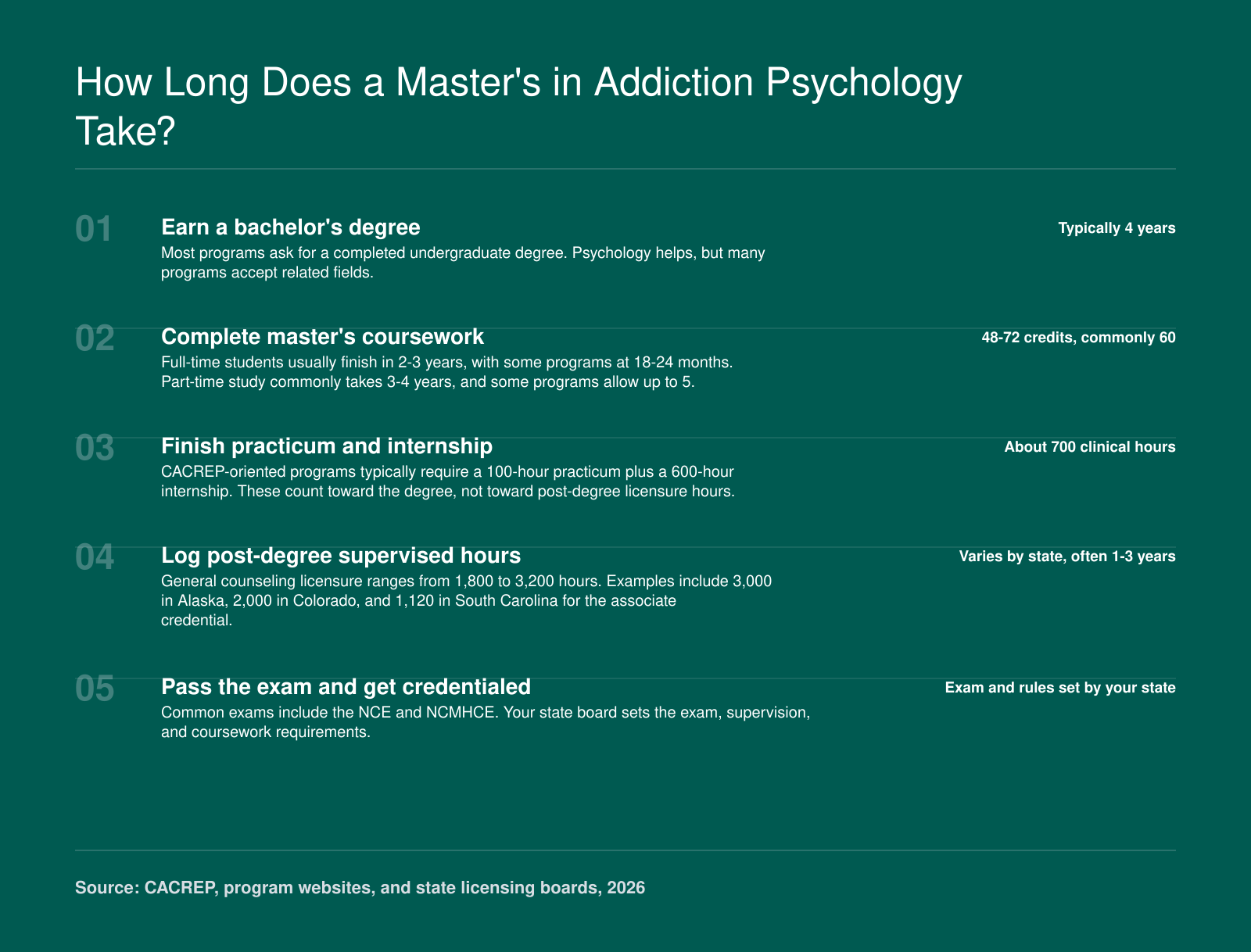
Most full-time students finish the coursework in about 2 years, though a 60-credit program can run up to 3. Part-time study typically stretches to 3-4 years. Licensure adds a supervised-practice phase after graduation.
What a Master's in Addiction Psychology Costs, and How to Pay Less
A master's in addiction psychology often costs much less than the headline tuition once flat-rate online pricing, assistantships, and loan repayment are factored in. The main spread is residency and format, not program quality.
Tuition and Net Price: Where the Savings Are
Listed graduate tuition and fees for the addiction psychology programs below run from about $6,800 to more than $36,000 per year before aid. The most affordable listed options include Youngstown State University (roughly $6,848 in state and $7,028 out of state), Touro University Worldwide ($9,000 flat online), Purdue University Global ($10,211 in state, $11,241 out of state), and Indiana Wesleyan University ($10,620 flat). Public universities often charge non-residents much more: Arizona State lists about $27,521 out of state and Colorado State about $30,813 out of state. Net price figures are institution-wide averages, not quotes for this specific program, and they range from roughly $7,800 to $29,600 after grant aid and living costs are blended in.
Loan Repayment After You Are Working
The NHSC Substance Use Disorder Workforce Loan Repayment Program pays up to $75,000 for three years of full-time service (about 40 hours per week, 45 weeks per year)1 or $37,500 for three years of half-time service at an NHSC-approved SUD facility in a high-need area. The STAR Loan Repayment Program can provide up to $250,000 over six years of full-time behavioral health service with patients recovering from substance use.2 Both are repayment programs tied to an eligible job, not tuition scholarships while enrolled. Approval also means signing a service commitment, so plan for the three- or six-year obligation.
Funding Before Graduation
The SAMHSA-funded NBCC Minority Fellowship Program (part of the NBCC Foundation Programs) includes an addictions counseling track for graduate students. The 2026 master's cycle had already closed, with the next application window expected in February 2027, so verify current award terms then. In the meantime, graduate assistantships can reduce tuition in exchange for teaching or research work, and some treatment centers offer employer tuition benefits to current employees. Online programs with one flat rate can also shield you from non-resident surcharges.
Admission Requirements and Application Tips
Requirements vary by school, so confirm details on each program's admissions page. These are the patterns across the programs on this list.
- Bachelor's degreeAn accredited bachelor's is the baseline. Arizona State asks for health, behavioral health, psychology, counseling, or a related field. Wichita State accepts any undergraduate major. Texas Tech prefers related degrees but considers other majors.
- Minimum GPACutoffs run from 2.5 at Touro University Worldwide to 3.0 at Arizona State, Minnesota, Liberty, Indiana Wesleyan, and Wichita State. Many programs bend. Texas Tech lets applicants below 2.7 make a case with work experience, and Minnesota accepts below 3.0 with an extenuating-circumstances statement.
- GRE policyTexas Tech, Minnesota, and Wichita State do not require an exam. Indiana Wesleyan asks for the GRE only if your GPA is below 3.0. Grand Canyon sets a 2.8 GPA threshold, but a GMAT or GRE score can offset a lower GPA. Check the policy for Arizona State, Liberty, and Touro directly.
- Letters and personal statementTexas Tech and Arizona State ask for two letters, while Indiana Wesleyan and Wichita State ask for three. Arizona State also wants a personal statement and CV. Choose recommenders who can speak to your clinical or academic readiness.
- PrerequisitesStatistics or abnormal psychology are common prerequisites, but several schools do not state a course list. Confirm before you apply so you can finish any gaps first.
- Background checks and experienceIndiana Wesleyan explicitly requires a criminal background check. Other schools may require one at the placement site, so ask early. Volunteer or paid work in recovery settings strengthens an application, and Texas Tech normally expects prior human-service work.
HRSA's National Center for Health Workforce Analysis projects a national shortage of roughly 87,630 full-time addiction counselors by 2036, easing slightly to about 77,050 by 2038. Those projections, drawn from HRSA's behavioral health workforce data, signal strong, sustained demand for graduates entering this field.
Addiction Psychology programs by state
Compare Addiction Psychology programs on the data that matters
Explore more Psychology specializations or browse every graduate field.
All Psychology programs