Best Addiction Counseling Master's Programs in Virginia
Compare 5 accredited Addiction Counseling programs in Virginia at 4 schools, with graduate earnings, cost, debt, and completion data from IPEDS and the U.S. College Scorecard.

What does it take for a Virginia master's to actually qualify you for the state's substance abuse credentials? The Board of Counseling grants the LSATP only after a 60-semester-hour degree covering 15 content areas, 2,000 supervised clinical hours, and the MAC exam. A degree alone does not clear that bar.
The programs ranked below include both campus and fully online options, and they diverge sharply on credential alignment: William & Mary's 60-hour M.Ed. meets LSATP content, while Regent's addictions track is a non-licensure degree. Tuition, GRE policy, and graduate earnings vary just as widely.
Key Points
- Liberty University offers its 48-credit addiction counseling master's fully online, with eight start dates a year.
- Virginia's LSATP license requires a 60-semester-hour graduate degree, 2,000 clinical hours, and a passing exam score.
- Net price after aid varies widely, so compare it with sticker tuition before choosing.
Ranked Addiction Counseling Master's Programs in Virginia
Each program below was checked against what Virginia's licensing board asks of applicants, and CACREP status is stated plainly for each. No source we reviewed confirms a CACREP listing for a Virginia degree carrying the Addiction Counseling specialty label itself. Treat any program without a verified listing as unconfirmed until you see it on the CACREP directory.
Virginia Commonwealth University
#1Richmond, VA · ~$17,000/yr (est.)
Best for: Research-minded students drawn to addiction science
Virginia Commonwealth University offers its M.S. in addiction studies through the School of Medicine in Richmond, with intermediate and advanced addiction studies certificates as stepping stones. The program is part of an international collaboration with King's College London and the University of Adelaide. CACREP accreditation is not confirmed for this degree; VCU's separate M.S. in Clinical Mental Health Counseling is CACREP-accredited through March 2032, but that is a different program. The school's overall graduation rate is 63%, and published graduate tuition is $13,766 in-state and $28,294 out-of-state.
- M.S. in addiction studies administered by the School of Medicine
- Part of an international program with King's College London and Adelaide
- Intermediate and advanced addiction studies certificates also offered
- Certificate completers may petition for M.S. admission
- Related bachelor's degree, two recommendations, statement of intent, and résumé
- 3.0 undergraduate GPA strongly preferred for U.S. applicants
- Program materials describe online study; confirm format with VCU
Liberty University
#2Lynchburg, VA · ~$9,000/yr (est.)
Best for: Working adults needing flexible online study
Liberty University's M.A. in Addiction Counseling is built around Virginia credentials, designed to meet educational requirements for CSAC certification and, with additional courses, LSATP licensure. It is a 48-credit program taught online in 8-week courses with several start dates a year, and it requires no entrance exam. We could not independently confirm CACREP accreditation for this degree. The school's overall graduation rate is 65%.
- 48 credit hours, 100% online in 8-week courses
- $580 per credit; military tuition discount at $290 per credit
- No entrance exam required; 3.0 minimum GPA
- Prepares for CSAC; additional courses needed for LSATP
- Internship included
- Transfer up to 50% of degree credits
- Eight start dates per year, asynchronous classes
Regent University
#3Virginia Beach, VA · ~$18,000/yr (est.)
Best for: Faith-centered students pursuing addiction recovery work
Regent University offers two online addiction-focused master's degrees with a Christian worldview: an M.S. in Psychology with an Addictions concentration and an M.A. in Human Services with an Addictions Counseling focus. Both are described as non-licensure degrees, so neither leads directly to Virginia licensure, and CACREP accreditation is not confirmed for either. They suit students pursuing recovery work, nonprofit roles, or doctoral preparation. The school's overall graduation rate is 57%.
- Online, 39+ credit hours at $695 per credit
- Non-licensure track
- Courses include Addictive Behaviors and Addiction Intervention
- Faith-based intervention training
- No entrance exam required
- Foundation for doctoral study
- Online, 30 credit hours at $615 per credit
- Non-licensure counseling degree
- Synchronous and asynchronous options
- Test optional; no entrance exam required
- Faith-based interventions with addiction recovery focus
- Next listed start: June 22, 2026
William & Mary
#4Williamsburg, VA · $15,000 – $20,000/yr (est.)
William & Mary's M.Ed. in Counseling with an Addictions Counseling concentration is the most licensure-aligned program on this list, designed to satisfy Virginia's LPC and LSATP coursework and clinical requirements. Program materials describe it as CACREP-accredited, but we could not verify that on the CACREP directory. The program is also described as currently on hiatus, so confirm admissions availability before applying. The school's overall graduation rate is 89%, and published graduate tuition is $10,905 in-state and $29,352 out-of-state.
- 60 credit hours, typically two full-time years
- 750 clinical hours including practicum and two internships
- Training at the university's New Leaf Clinic
- Prepares for LPC licensure and meets LSATP requirements in Virginia
- Fall entry; part-time options available
- No prior counseling experience required
- Listed as on hiatus; verify current admissions
Cost & outcomes by school
Federal data for the highest-earning Addiction Counseling programs, independent of the ranking above. Earnings are this field's master's graduates four years after completing, where the Scorecard reports them.
| School | Earnings | Tuition / yr | Debt | Grads/yr | Format |
|---|---|---|---|---|---|
| Virginia Commonwealth University VA | $82,962 | $17,252 | $41,000 | 21 | Campus |
| Regent University VA | $58,142 | $17,869 | $34,166 | 158 | Online |
| Liberty University VA | $53,721 | $8,730 | $32,676 | 738 | Online |
| William & Mary VA | — | $17,666 | — | — | Campus |
Sources: U.S. Department of Education. Tuition and graduates: IPEDS. Earnings and debt: College Scorecard, this field's master's graduates; a dash means no figure is reported.
Cost, debt & payoff
Median earnings of this field's master's graduates (4 yrs after completing) vs. their median federal loan debt · U.S. College Scorecard
Across these programs the median graduate earns about $58,142 and finishes with roughly $34,166 in debt — a ratio that clears a common rule of thumb (keep debt below first-year salary). Tuition and debt vary widely school to school, so check the per-school figures in the table above before you shortlist.
Online and Hybrid Master's in Addiction Counseling: What Ranked Virginia Schools Offer
Liberty University delivers its 48-credit Master of Arts in Addiction Counseling as an online addiction counseling master's program, using 8-week courses with eight starts a year and no set login times. No required on-campus residency is established, but the internship is an exception: it must be addiction-related work with individuals, couples, or families, completed in person. Liberty accepts up to 24 transfer credits (half the degree), provided each course earned at least a B-, carries 3 or more semester hours, overlaps roughly 80% with the Liberty equivalent, and is under ten years old, which can meaningfully shorten completion.
Regent University's M.S. in Psychology (Addictions) is also available online, making it one of the online master's programs in Virginia, though it is a non-licensure track.
Virginia Commonwealth University's addiction studies master's runs fully online, with clinical hours completed at an approved site. William & Mary's addictions concentration is campus-based, with face-to-face instruction and clinical training on site.
Whether these schools arrange placements or expect you to find an approved site is not published for every program. Before you enroll, confirm the program will approve a practicum site near you.
GRE Policies at Ranked Virginia Addiction Counseling Programs
Most of the schools here count as master's programs with no GRE required, but the published detail varies.
- Liberty University: Not required. The Master of Arts in Addiction Counseling asks for a 3.0 GPA and a regionally or nationally accredited bachelor's degree. Official transcripts must arrive sealed, and applicants who speak English as a second language need a TOEFL score (80 internet-based, 250 computer-based, or 600 paper-based).
- Regent University: The program page lists no entrance exam requirement. We could not confirm a minimum GPA.
- William & Mary: Test-optional. Its counseling program starts each fall, but we did not find a confirmed deadline or GPA floor.
- Virginia Commonwealth University: The addiction studies program page does not publish a GRE policy that we could verify. It notes that written exceptions are reviewed by the program director, so ask the program directly.
None of these pages stated whether interviews or recommendation letters are required, so check the current application checklist for each. Liberty offers multiple start dates but no firm application deadline in the materials we reviewed.
Related Articles
Addiction Counseling Master's Program Cost in Virginia, School by School
The table compares annual master's-level tuition and each institution's average net price after aid for the lowest-cost schools here. Net price is an institution-wide average across all students who receive aid, not a quote for this degree. To estimate a full program cost, multiply the per-credit rate by total credits. Liberty University's 48-credit M.A. in Addiction Counseling runs $28,800 at the $600 full-time rate, $31,920 at $665 part-time, and $14,880 at the $310 military rate (2026-2027, subject to annual change, fees not included). Virginia LSATP requires 60 credits, and the 12 extra credits add $7,200 full-time ($36,000 total), $7,980 part-time ($39,900), or $3,720 military ($18,600), assuming the same rates apply. Regent University lists $695 per credit for 39 or more credits (at least $27,105 before fees), but its track is non-licensure, so extra coursework would be needed for licensure. William & Mary's 60-credit program is built to meet LSATP requirements.
| School | Master's program | In-state annual tuition | Out-of-state annual tuition | Average net price after aid (institution-wide) |
|---|---|---|---|---|
| William & Mary | M.Ed. in Counseling, Clinical Mental Health & Addictions | $17,666 | $36,684 | $19,096 |
| Regent University | M.S. in Psychology, Addictions | $17,869 | $17,869 | $19,923 |
| Virginia Commonwealth University | M.S. in Addiction Studies | $17,252 | $32,470 | $23,433 |
Virginia Board of Counseling Snapshot
Does Your Master's Meet Virginia's Substance Abuse Counseling Rules?
The LSATP (Licensed Substance Abuse Treatment Practitioner) requires a 60-semester-hour graduate degree covering 15 content areas at roughly 3 hours each, plus 2,000 clinical hours and the MAC exam. The CSAC (Certified Substance Abuse Counselor) sits a tier below: no master's required, just 240 clock hours of didactic training, 2,000 supervised hours, and the NCAC-1 exam.
Certification Versus Licensure
CSAC is a certification you can earn without a graduate degree, which makes it a faster entry point. LSATP is a full license requiring the master's described above. Addiction counseling also differs from clinical mental health counseling in scope, which is why many graduates pursue the LPC alongside or instead of the LSATP, giving them broader clinical practice. Virginia LPCs are exempt from the MAC exam on several substance-abuse pathways.
Program Alignment and Timeline
Among the schools here, William & Mary states its program meets LSATP requirements and prepares graduates for Virginia LPC licensure, while Liberty says its degree prepares students for both CSAC and LSATP. Expect roughly two years for the master's, then a supervised residency of at least 21 months with 200 hours of face-to-face supervision.
Portability
Virginia credentials are not automatically reciprocal. Moving states means proving substantial equivalency to that board, so confirm requirements before you relocate.
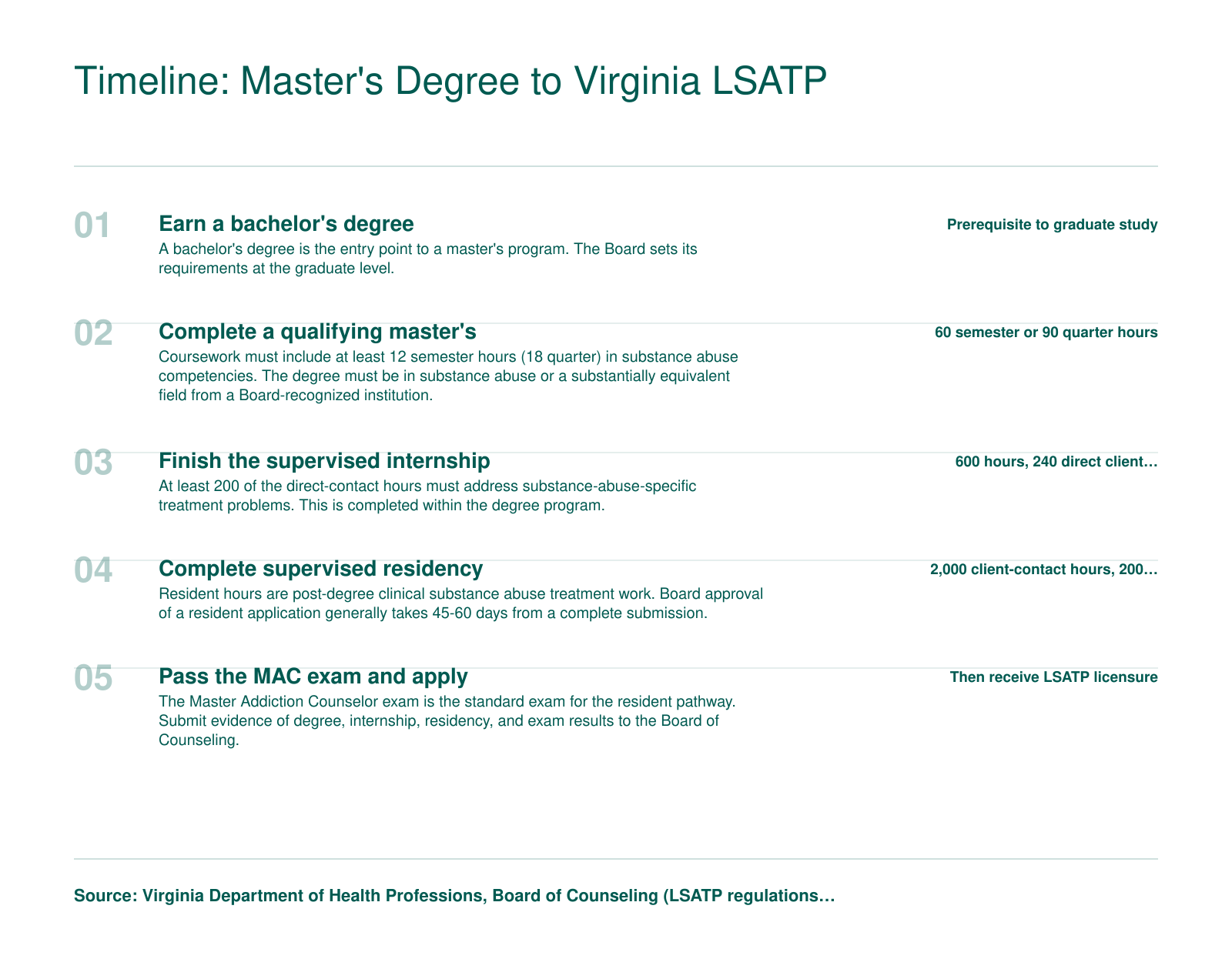
Timeline: Master's Degree to Virginia LSATP
Virginia's Licensed Substance Abuse Treatment Practitioner credential follows a fixed order, and each stage carries its own hour or credit requirement. Use this timeline to see where your master's fits and what comes after graduation.
Earnings and Debt After a Master's in Addiction Counseling
Earnings and debt figures measure what graduates actually earn once they leave a program and what they still owe on it, which together tell you whether the degree pays for itself. Where published, the numbers below reflect federal reporting windows measured years after graduation.
What the Numbers Show
- Virginia Commonwealth University: Median earnings of about $82,962 four years after finishing, paired with roughly $41,000 in median debt and a $466 monthly payment on a 10-year plan.
- Regent University: About $58,142 four years out, with median debt near $34,166 and a $389 monthly payment.
- Liberty University: About $53,721 four years out, with the lowest median debt here at $32,676 and a $372 monthly payment.
- William & Mary: Program-level earnings and debt are not yet published for this degree.
On earnings relative to what graduates borrow, VCU leads outright. Liberty offers the strongest balance for budget-minded students: solid earnings against the lowest debt load on this list.
Compare Addiction Counseling programs on the data that matters
Explore more Counseling specializations or browse every graduate field.
All Counseling programs