Accelerated Addiction Counseling Master's Programs
Compare 80+ accredited fastest Addiction Counseling programs at 70+ schools, with graduate earnings, cost, debt, and completion data from IPEDS and the U.S. College Scorecard.

Compressed addiction counseling degrees are now common, yet state boards still license on credit hours and supervised experience, not calendar time. Most master's-level credentials expect around 60 credits and thousands of post-degree clinical hours.
So "accelerated" usually means shorter terms and year-round study, not fewer credits or fewer practicum and internship hours. The speed gain is real but modest, and it can vanish if a program's curriculum falls short of your state's rules.
The practical question is whether a faster path still ends in a license and a salary that justifies the debt.
Key Points
- In-state tuition here ranges from $8,917 to $27,484.
- Carlow graduates earn $54,729 median five years after finishing with $55,109 debt.
- Clinical site placement, not course speed, often sets graduation dates.
Top Accelerated Addiction Counseling Master's Programs Ranked
Speed only matters if the degree pays off, so this list weighs time-to-degree alongside net price, debt, and earnings. The five schools below offer accelerated addiction counseling master's programs with compressed schedules, shorter credit loads, or pathways that let students begin graduate work early.
Carlow University
#1Pittsburgh, PA · $20,000 – $25,000/yr (est.)
Best for: Pennsylvania learners wanting funded clinical placements
Carlow's CACREP-accredited counseling master's pairs core counseling theories with an addictions concentration and requires more than 700 clinical hours in addiction settings. Pennsylvania's Addiction Counseling Workforce Impact Project provides tuition assistance and practicum stipends for students who commit to working in approved treatment facilities after graduation. The program offers rolling admission, no GRE requirement, and an accelerated pathway that lets undergraduates earn graduate credits early.
- 60 credit hours; complete in 2.5 to 3.5 years
- 700+ clinical hours in addictions settings
- No GRE required; rolling admissions
- Prepares for LPC, NCC, and CAADC credentials
- Accelerated option for eligible undergraduates
- State-funded tuition assistance for Pennsylvania placements
University of Central Oklahoma
#2Edmond, OK · $5,000 – $10,000/yr (est.)
Best for: Oklahoma undergraduates accelerating into graduate study
Central Oklahoma's addictions counseling master's requires 42 to 45 credit hours, with a practicum and a capstone or thesis option, and is built around Oklahoma's twelve core functions of substance abuse counseling. The program supports an accelerated BA to MA pathway that lets sociology undergraduates earn graduate credits before finishing the bachelor's degree. Graduates are prepared for Licensed Alcohol and Drug Counselor licensure.
- 42 to 45 credit hours required
- Practicum plus capstone or thesis option
- Accelerated BA to MA pathway for sociology majors
- Prepares for Oklahoma LADC licensure
- Curriculum covers trauma and co-occurring disorders
- 2.8 GPA minimum for admission
Western Connecticut State University
#3Danbury, CT · ~$15,000/yr (est.)
Best for: Connecticut professionals needing hybrid one-year training
Western Connecticut State's addiction studies master's can be completed full-time in one year, with a hybrid schedule that mixes on-campus and online work. The program includes a 200-hour clinical internship and emphasizes evidence-based, harm-reduction approaches across individual, family, and group counseling. It supports Connecticut LADC licensure and offers an LPC pathway through a partnership with UConn.
- Full-time completion in one year
- Hybrid format with online options
- 200-hour clinical internship required
- Prepares for Connecticut LADC licensure
- UCONN partnership for LPC pathway
- Advanced standing available for qualified applicants
Fisher College
#4Boston, MA · ~$27,000/yr (est.)
Fisher College's counseling psychology master's includes an addictions concentration delivered through a hybrid format that combines live virtual classes with on-campus sessions. The 60-credit program uses 12-week terms and is designed to be completed in about two years. It offers a specialized addictions track with coursework in recovery, evidence-based practices, and motivational interviewing.
- 60 credit hours completed in 12-week terms
- Addictions track with recovery and motivational interviewing
- Hybrid live virtual and on-campus classes
- Prepares for LMHC licensure
- Scholarship support available for addictions students
Ottawa University-Surprise
#5Surprise, AZ · ~$13,000/yr (est.)
Ottawa University-Surprise offers a 36-credit online addiction counseling master's built around assessment, psychopharmacology, co-occurring disorders, and family systems. The curriculum includes a 150-hour practicum and is designed for working adults seeking an accelerated format. It prepares graduates for Arizona's Licensed Associate Substance Abuse Counselor credential.
- 36 credit hours in accelerated online format
- 150-hour practicum required
- Prepares for Arizona LASAC licensure
- Curriculum covers co-occurring disorders and psychopharmacology
- Military benefits accepted
Cost & outcomes by school
Federal data for the highest-earning Addiction Counseling programs, independent of the ranking above. Earnings are this field's master's graduates four years after completing, where the Scorecard reports them.
| School | Earnings | Tuition / yr | Debt | Grads/yr | Format |
|---|---|---|---|---|---|
| Western Connecticut State University CT | — | $15,039 | — | — | Hybrid |
Sources: U.S. Department of Education. Tuition and graduates: IPEDS. Earnings and debt: College Scorecard, this field's master's graduates; a dash means no figure is reported.
Cost, debt & payoff
Median earnings of this field's master's graduates (4 yrs after completing) vs. their median federal loan debt · U.S. College Scorecard
Across these programs the median graduate earns about $59,937 and finishes with roughly $51,521 in debt — a ratio that clears a common rule of thumb (keep debt below first-year salary). Tuition and debt vary widely school to school, so check the per-school figures in the table above before you shortlist.
How Fast Is 'Fast'? Credit Loads, Summer Terms, and Transfer Limits
Compressed terms speed up each course in addiction counseling master's programs, but they rarely shorten the degree itself. Albertus Magnus runs its addiction track in eight-week modules, capped at 12 credits a semester.1 Capella uses 10-week courses with a short break between quarters. Both still require full credit totals.
Realistic Timelines
Licensure-track programs here generally require 60 semester credits5 (or 90 quarter credits at Western States2 and Capella). That puts "accelerated" closer to 24 months5 than 12. VCU lists a minimum of two years with summers built in.5 Western States says online students can finish in two years,3 though its catalog shows 12 quarters,2 so confirm the pace with admissions. UMGC's online format could finish in under three and a half years at 9 credits plus summer 6, or about two and a half years at 12 plus 6.4
Transfer Credit Caps
Transfer limits are modest: 12 credits at VCU,5 Albertus Magnus,1 and UMGC,4 9 at UTSA,6 and none at Oklahoma's online program.7 A 12-credit transfer can cut about one semester, but only if the courses were recent and earned a B or better. It won't turn two years into one.
Format and the Fastest Options
Online addiction counseling master's programs and hybrid formats suit working adults, but UTSA caps students at 9 counseling credits per semester,6 which slows full-time pacing. The truly fastest routes are usually non-licensure or bachelor's-to-master's tracks. Check whether they meet your state's licensure coursework and clinical hour rules before enrolling.
Licensure Rules for Addiction Counselors in Key States
Licensure for master's-level addiction counselors varies significantly by state, with different credential names, degree requirements, and supervised experience expectations. The table below shows key requirements for selected high-population states, including California, Texas, New York, Florida, Pennsylvania, and New Jersey. Because CACREP accreditation is not listed as an explicit requirement for these credentials, ask your state board how it treats accredited degrees, especially if you plan to seek licensure in another state. Always confirm current rules with your state board before enrolling, because requirements, exam names, and supervised hours change.
| State | Master's-Level Credential | Education Requirement | Supervised Hours | Exam | CACREP Required? |
|---|---|---|---|---|---|
| California | Licensed Advanced Alcohol and Drug Counselor (LAADC) | Master's degree in alcohol and drug counseling from an approved or accredited school; qualifying degree must contain at least 60 semester or 90 quarter units | At least 6 semester or 9 quarter units of supervised fieldwork; also requires either certification by a certifying organization or 2,000 hours of postgraduate supervised experience | IC&RC Advanced Alcohol and Drug Counselor (AADC) examination | N/A |
| Texas | Licensed Chemical Dependency Counselor (LCDC) | Master's degree is not required; an associate degree is the minimum for the LCDC credential | N/A | IC&RC Alcohol and Drug Counselor (ADC) examination | N/A |
| New York | Credentialed Alcoholism and Substance Abuse Counselor (CASAC) | No degree is required for the base CASAC credential | N/A | IC&RC Alcohol and Drug Counselor (ADC) examination | N/A |
| Florida | Certified Addiction Professional (CAP) | Bachelor's degree is required; a master's degree is not specified as required for the CAP credential | N/A | IC&RC Alcohol and Drug Counselor (ADC) examination | N/A |
| Pennsylvania | Certified Advanced Alcohol and Drug Counselor (CAADC) | Master's degree required | N/A | IC&RC Advanced Alcohol and Drug Counselor (AADC) examination | N/A |
| New Jersey | Advanced Alcohol and Drug Counselor (AADC) | N/A | N/A | AADC examination | N/A |
Related Articles
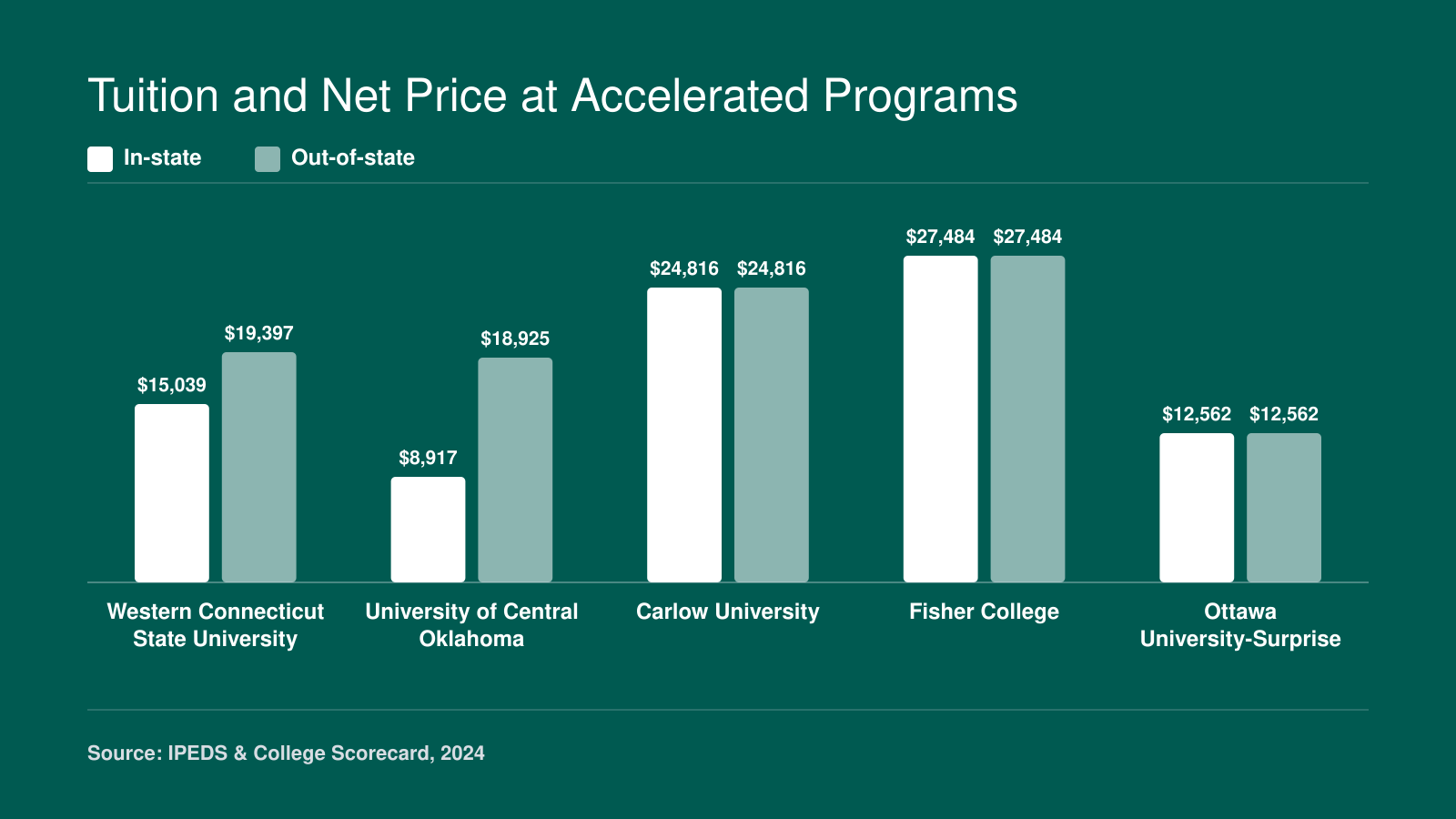
Tuition and Net Price at Accelerated Programs
Graduate tuition varies widely among the ranked addiction counseling programs. In-state tuition ranges from $8,917 at University of Central Oklahoma to $27,484 at Fisher College. The net price shown in institutional data is an average after aid across all students, not a quote for this specific program.
Before You Apply: Prerequisites and Deadlines
- Degree and GPAAn accredited bachelor's is typical. Published GPA minimums vary, with several programs at 2.7 or 3.0.
- Prerequisite courseworkRequirements differ by program: Johnson & Wales lists introductory psychology, abnormal psychology, and statistics or research methods; Carlow lists lifespan, personality theory, and introduction to counseling.
- GRE and supporting materialsGRE scores are not required at Minnesota, Texas Tech, Carlow, and Touro. Expect recommendation letters and a personal statement; some programs add an interview.
- Deadlines and start datesFixed deadlines include Carlow's fall April 1 and spring November 1, plus Colorado State's fall July 30 and spring November 1. Texas Tech and Liberty offer rolling or frequent starts; Touro has six starts a year.
What Graduates Earn and Owe After Finishing
Carlow University's addictions counseling track reports the strongest program-level numbers here. Graduates earned a median of $54,729 five years after finishing, up from $46,820 one year out. Median program debt was $55,109, which works out to about $627 a month on a 10-year repayment plan. Debt roughly matches a full year of five-year earnings, so the payment is manageable but not trivial.
The University of Central Oklahoma shows a median of $45,001 five years after finishing. No program-level debt or monthly payment is recorded for it, so a debt-to-earnings comparison isn't possible.
Western Connecticut State, Ottawa University-Surprise, and Fisher College have no program-level earnings or debt figures, so judge them on cost, licensure fit, and format rather than on a salary promise.
The practical takeaway: an affordable addiction counseling master's program that leaves you owing less can be the smarter choice even when graduates earn about the same. A lower monthly payment relative to the typical master's in addiction counseling salary protects your budget far longer than a slightly higher paycheck does.
Addiction Counseling programs by state
Quick Answers on Accelerated Addiction Counseling Degrees
These quick answers address pace, accreditation, clinical hours, online delivery, and cost for accelerated addiction counseling master's programs. Requirements vary by state and school, so verify details with your licensing board and the program directly.
What is the fastest master's in addiction counseling?
Are accelerated addiction counseling master's programs CACREP accredited?
How many clinical hours does addiction counseling licensure require?
Can an accelerated addiction counseling master's be finished fully online, including practicum?
How much does an accelerated addiction counseling master's cost in total?
Compare Addiction Counseling programs on the data that matters
Explore more Counseling specializations or browse every graduate field.
All Counseling programs