Best Addiction Counseling Master's Programs in Massachusetts
Compare 4 accredited Addiction Counseling programs in Massachusetts, with graduate earnings, cost, debt, and completion data from IPEDS and the U.S. College Scorecard.

A master's in addiction counseling in Massachusetts is usually a 60-credit clinical mental health or counseling psychology degree with a substance use concentration built in. That structure matters because two different credentials can sit at the end of it: the LADC I, issued by the Department of Public Health and tied to 270 hours of addiction-specific coursework, and the LMHC, which follows the broader clinical counseling route.
The programs below put campus, hybrid, and online formats on one list, and they do not prepare students equally for both credentials.
Choosing the wrong concentration rarely ends a career, but it can mean extra coursework after graduation to close a licensure gap.
Key Points
- Bay Path graduates earn a median $79,114 four years after finishing.
- Bay Path's online master's costs $15,162 in tuition and requires no GRE.
- Public Health issues LADC credentials, while a separate board licenses LMHCs.
Top Massachusetts Master's Programs for Addiction Counseling, Ranked
Each school earned its spot on what students actually get out of it: completion, affordability after aid, and how graduates fare. The three programs below all fold addiction training into a clinical mental health or counseling psychology master's, so read the credit counts and licensure notes closely. CACREP status could not be confirmed for these three, so check the CACREP directory before you apply.
Bay Path University
#1Longmeadow, MA · ~$15,000/yr (est.)
Best for: Working professionals needing online flexibility
Bay Path University in Longmeadow offers a 60-credit clinical mental health counseling master's with a concentration in Foundations of Alcohol and Drug Abuse Counseling. It is built for working adults: the program runs online, and the graduate counseling application does not require the GRE or GMAT. The school's institution-wide graduation rate is about 44 percent, and its institution-wide average net price after aid is roughly $14,271. CACREP status for this program was not confirmed in our research, so verify it directly.
- 60 total credit hours
- Prepares for the CADAC certification exam
- Eligible for Massachusetts LMHC licensure
- 100-hour practicum and 600-hour internship
- 300 internship hours in substance use treatment settings
- Coursework includes psychopharmacology and co-occurring disorders
- Complete within 5 years
- Post-master's supervised experience required for licensure
Fisher College
#2Boston, MA · ~$27,000/yr (est.)
Best for: Boston learners wanting live hybrid classes
Fisher College in Boston delivers its Master of Arts in Counseling Psychology in a hybrid format, pairing live virtual classes with on-campus sessions. Students choose between a Trauma track and an Addictions Counseling track, and the program is aimed at LMHC licensure. The school's institution-wide graduation rate is about 28 percent and its institution-wide average net price after aid is roughly $26,649, so compare the aid you would actually receive. CACREP status and the exact number of addiction-specific courses were not confirmed.
- 60 total credit hours across 20 courses
- Complete in six 12-week terms over 24 months
- Hybrid: synchronous online classes plus on-campus sessions
- Two tracks: Trauma or Addictions
- Addictions electives cover recovery and evidence-based practices
- Prepares for LMHC licensure and the National Clinical Mental Health Examination
- Theodore Everett Berlin Scholarship available to addictions track students
William James College
#3Newton, MA · ~$40,000/yr (est.)
Best for: Campus learners targeting substance use licensure
William James College in Newton offers the most clearly defined addiction pathway of the three: a Substance Use and Addictions concentration inside its clinical mental health counseling master's. The concentration lists three addiction-specific courses totaling 9 credits, and the program is approved by the Massachusetts Bureau of Substance Abuse Services. Its ADEPT Center connects coursework with partner treatment providers across the state. Graduation rate and net price are not published for the school here, and CACREP status was not confirmed.
- 60 total credit hours
- Two years full time or three years part time
- Concentration includes 9 addiction-specific credits: COU CN515, COU CN621, COU CN622
- 960 clinical hours, including a 600-hour internship in substance use settings
- Prepares for LADC and CADC credentials
- 270 content hours toward the LADC I credential
- Approved by the Massachusetts Bureau of Substance Abuse Services
- On-campus program in Newton
Cost & outcomes by school
Federal data for the highest-earning Addiction Counseling programs, independent of the ranking above. Earnings are this field's master's graduates four years after completing, where the Scorecard reports them.
| School | Earnings | Tuition / yr | Debt | Grads/yr | Format |
|---|---|---|---|---|---|
| Bay Path University MA | $79,114 | $15,162 | $56,228 | 25 | Online |
| Fisher College MA | — | $27,484 | — | — | Hybrid |
| Boston Graduate School of Psychoanalysis Inc MA | — | $23,638 | — | 17 | Campus |
| William James College MA | — | $40,250 | — | 66 | Campus |
Sources: U.S. Department of Education. Tuition and graduates: IPEDS. Earnings and debt: College Scorecard, this field's master's graduates; a dash means no figure is reported.
Online and Hybrid Master's Paths for Massachusetts Students
Counselor education moved online far faster than its clinical requirements did, and that gap is where students comparing master's programs in Massachusetts should concentrate their questions.
How each format works
- Bay Path University: Delivered online, 60 credits, with a 100-hour practicum and a 600-hour internship. Of those field hours, 300 must occur in substance use settings, so the coursework travels but the clinical work does not.
- Fisher College: Hybrid, combining live virtual classes held in real time with on-campus sessions in Boston, across 20 courses and 60 credits in 12-week terms. How often students are expected on campus is not published.
- William James College: The substance use and addictions concentration is campus-based in Newton and carries 960 clinical hours. The college's online mental health counseling program instead builds in two summer residencies, a two-week intensive and a shorter four-day session, with weekly synchronous classes in the later years.
Placement is the variable that matters
Neither Bay Path nor Fisher spells out whether the school secures your practicum site or you find it yourself. Ask before you deposit. LADC supervised hours must come from approved settings under qualified supervision, and a student-sourced search can add months. If you are weighing an online program based outside Massachusetts, confirm it satisfies state academic and field standards before enrolling.
Who Licenses Addiction Counselors in Massachusetts
Related Articles
Which Massachusetts Master's Programs Waive or Skip the GRE
Graduate counseling admissions have shifted steadily away from standardized tests, and the schools ranked here reflect that broader shift toward No-GRE master's programs. Of the programs on this list, Bay Path University states plainly that the GMAT or GRE is not required. For Fisher College and William James College, the official admissions materials do not publish a GRE policy either way, so treat that silence as missing information, not a confirmed waiver, and contact the program directly before you assume anything.
Common Prerequisites
- Bachelor's degree: Required across the board.
- Minimum GPA: William James College expects a 3.0, with no hard cutoff published.
- Coursework: William James requires no specific prerequisite courses; verify expectations with Fisher directly.
- Supporting materials: Plan on recommendation letters, a statement of purpose, and possibly an interview.
Deadlines and Start Terms
- William James College: October 7, 2026 for Fall 2026; campus cohorts start in August and January, online each fall.
- Bay Path University: Rolling starts in January, May, and September, generally with fast decisions.
Tip for the earliest cohort: apply ahead of the posted date rather than on it. Online seats often fill on a space-available basis after the general deadline, so an early, complete file protects your preferred start term.
What Graduates Earn and Owe After a Massachusetts Counseling Master's
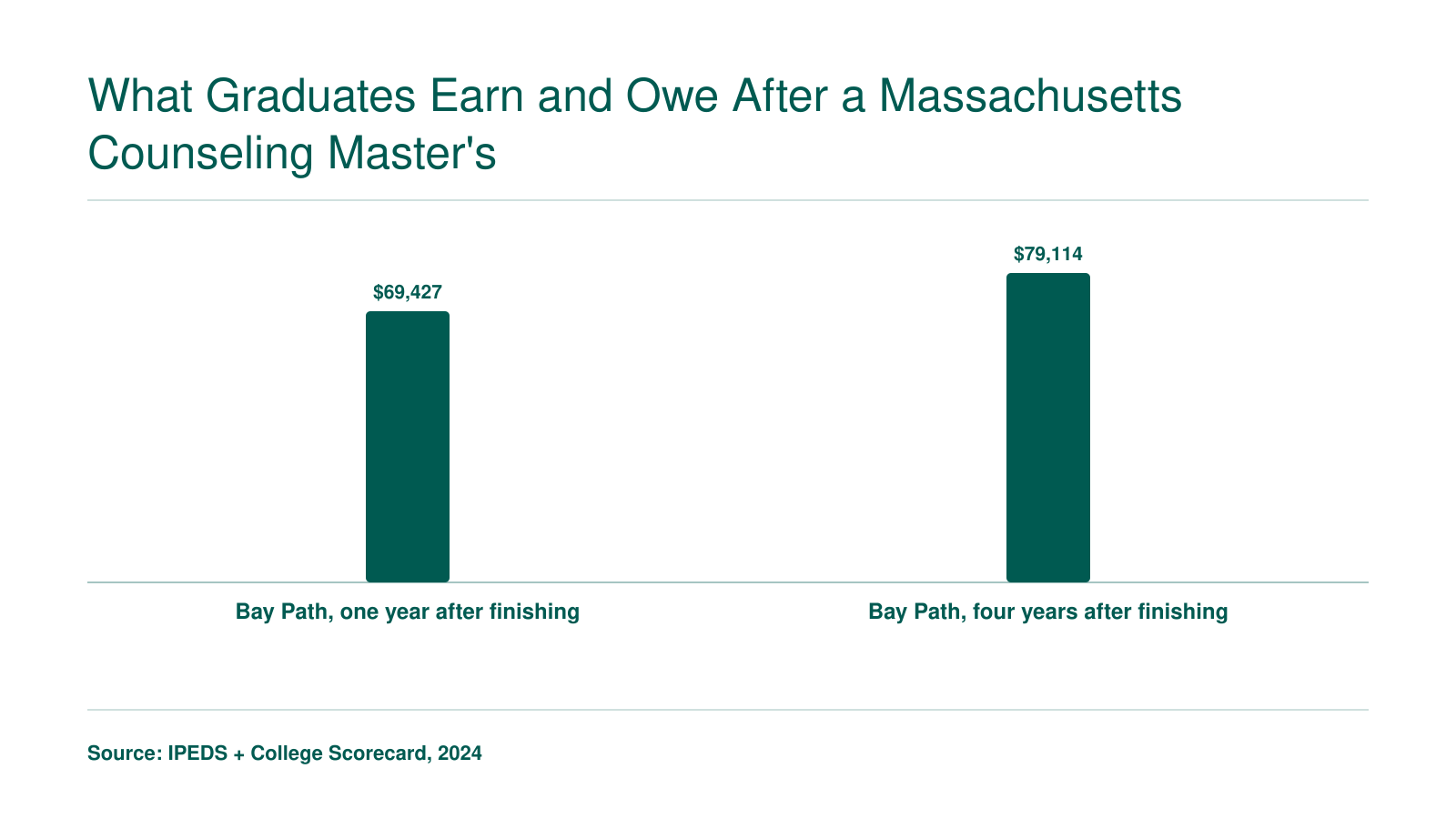
Bay Path University's online Master of Science in Clinical Mental Health Counseling, Foundations of Alcohol and Drug Abuse Counseling concentration, shows median earnings of $69,427 one year after finishing and $79,114 four years after finishing. Completers of the same program carry median debt of $56,228. These are College Scorecard medians for program completers.
Master's Tuition, Fees, and How Your Degree Maps to LADC or LMHC Licensure
What the Cost Figures Show
The published program tuition figure is $15,162 for Bay Path University's online Master of Science in Clinical Mental Health Counseling with its alcohol and drug counseling concentration. For Fisher College's hybrid Master of Arts in Counseling Psychology with an Addictions Counseling concentration, it is $27,484. Confirm with each bursar whether those numbers cover the full 60 credits or a single year. Neither figure includes mandatory fees, practicum or internship liability insurance, or background checks, so budget for those separately.
Institution-wide net price averages, which are approximations and not program-specific, run $14,271 at Bay Path and $26,649 at Fisher.
Bay Path is the lowest-cost option here and Fisher the highest, a gap of roughly $12,000 on tuition. The likely drivers are different tuition rates and fee structures, but only each school's current graduate schedule can confirm that.
Licensure Mapping
Both programs are 60 credits, the length Massachusetts now expects for LMHC applicants (60 semester credits under the 2026 rule).1
- Bay Path: Describes itself as eligible for LMHC licensure and prepares students for the CADAC exam. It includes a 100-hour practicum, a 600-hour internship, and a 300-hour substance use internship.
- Fisher: States it prepares students for LMHC licensure and offers addictions electives on recovery and evidence-based practice.
Neither program's materials say they satisfy LADC I education hours. A CADAC exam path is not the same thing as LADC I.
Next Step
Before paying a deposit, email admissions and ask for written confirmation of which credential your course plan satisfies: LMHC, LADC I, or both. Ask for the full fee schedule at the same time.
Quick Answers: LADC, LMHC, and Massachusetts Master's Degrees
What master's degree do you need to become an LADC in Massachusetts?
What is the difference between LADC and LMHC in Massachusetts?
Can one master's program prepare you for both the LADC I and the LMHC?
Does a CACREP-accredited master's matter for Massachusetts licensure or for moving to another state?
Compare Addiction Counseling programs on the data that matters
Explore more Counseling specializations or browse every graduate field.
All Counseling programs