Best Addiction Counseling Master's Programs in Minnesota
Compare 8 accredited Addiction Counseling programs in Minnesota, with graduate earnings, cost, debt, and completion data from IPEDS and the U.S. College Scorecard.

Minnesota's LADC requires an 880-hour practicum, yet the master's programs that prepare students for it run anywhere from 30 to 60 credits. The University of Minnesota-Twin Cities' 30-credit professional studies degree targets the LADC directly. Metropolitan State University lists both the LADC and the LPCC for its 60-credit program, putting it among the LPCC programs in Minnesota covered below.
Campus, online, and hybrid programs are ranked together, with GRE policy, cost, CACREP status, and timeline compared, including which are addiction counseling master's programs with no GRE required.
Coursework built for the LADC does not automatically satisfy the LPCC, so the cheaper degree is not always the cheaper license.
Key Points
- LADC applicants need 270 coursework hours and an 880-hour practicum.
- Moorhead's master's takes 24 months full time, up to five part time.
- Crown College and the University of Minnesota both hold CACREP accreditation.
Ranked: Top Master's in Addiction Counseling Programs in Minnesota
Minnesota's four options look very different once you set what students pay beside how many graduate and what they earn afterward. Institution-wide graduation rates below describe the whole school, not the addiction program, and earnings appear only where federal data reports them at the program level.
University of Minnesota-Twin Cities
#1Minneapolis, MN · ~$22,000/yr (est.)
Best for: Working adults wanting online flexibility
Schools offering this program graduate about 85% of students, the highest rate among Minnesota options, and the Master of Professional Studies in Addictions Counseling is priced at $884 per credit for residents and nonresidents alike. Federal data shows graduates earned a median of $61,488 one year after completion and $75,444 four years after. The 30-credit program includes 880 clinical hours, no entrance exam, rolling admissions, and online, hybrid, synchronous and asynchronous options. It fits working adults who want a flexible schedule with an in-person internship that meets Minnesota LADC education requirements.
- 30 total credit hours
- 880 clinical hours
- No entrance exam required
- 3.0 GPA minimum
- Rolling admissions
- Online and hybrid formats, synchronous and asynchronous
- Average completion in 1.75 to 3 years
- Prepares for Minnesota LADC licensure
Metropolitan State University
#2Saint Paul, MN · ~$11,000/yr (est.)
Best for: Career changers pursuing dual licensure
Metropolitan State in Saint Paul combines addiction and mental health training in one integrated degree, with schools offering this program graduating about 44% of students. Coursework covers psychopharmacology, trauma-informed care, and group and family counseling, with practicum placements in community settings. Graduates are eligible for both LADC and LPCC licensure after supervised practice. It suits career changers who want one degree to support both licenses and the option of part-time study.
- 60 total credit hours
- NASAC accredited listing
- Leads to LADC and LPCC eligibility in Minnesota
- Full-time and part-time options
- Summer, fall and spring starts
- 3.0 GPA minimum
- Capstone required
- Bachelor's-to-master's pathway from its Alcohol and Drug Counseling degree
Minnesota State University Moorhead
#3Moorhead, MN · ~$12,000/yr (est.)
Best for: Certificate holders moving up to a master's
Minnesota State Moorhead offers a CACREP-accredited MS in Counseling with an addiction counseling emphasis, and schools offering this program graduate about 57% of students. The 60-credit hybrid format blends face-to-face and online coursework, and students learn alongside peers in clinical mental health and school counseling. A certificate-to-master's bridge lets existing certificate holders continue without starting over. It fits people in the Fargo-Moorhead region who want an accredited, flexible route toward the LADC.
- CACREP accredited
- 60 total credit hours
- Hybrid delivery, face-to-face and online
- Three emphasis areas in the counseling program
- Bridge from Addiction Counseling Certificate to master's
- Prepares for Minnesota LADC credential
Crown College
#4Saint Bonifacius, MN · ~$12,000/yr (est.)
Crown College in Saint Bonifacius offers its Alcohol and Drug Counseling Emphasis as an online add-on to the M.A. in Counseling through the Graduate School of Counseling. Schools offering this program graduate about 45% of students, and Crown is the only private option here. Completing the emphasis lets graduates apply for dual licensure in professional counseling and alcohol and drug counseling. It fits distance learners who want the LPCC and LADC pathways together and are comfortable paying private-school rates.
- Fully online option available
- Add-on to the M.A. in Counseling
- Dual licensure pathway for professional and alcohol and drug counseling
- Offered through the Graduate School of Counseling
- Included in the 2026-2027 catalog
Cost & outcomes by school
Federal data for the highest-earning Addiction Counseling programs, independent of the ranking above. Earnings are this field's master's graduates four years after completing, where the Scorecard reports them.
| School | Earnings | Tuition / yr | Debt | Grads/yr | Format |
|---|---|---|---|---|---|
| University of Minnesota-Twin Cities MN | $75,444 | $22,017 | $42,831 | 41 | Campus |
| Hazelden Betty Ford Graduate School MN | $68,447 | $29,558 | $59,214 | 44 | Hybrid |
| Walden University MN | $60,034 | $10,885 | $80,386 | 888 | Hybrid |
| Capella University MN | $59,050 | $15,092 | $45,797 | 1,261 | Hybrid |
| Minnesota State University Moorhead MN | — | $11,902 | — | — | Hybrid |
| Metropolitan State University MN | — | $11,323 | — | 18 | Campus |
| Crown College MN | — | $11,740 | — | — | Online |
| Adler Graduate School MN | — | $14,700 | — | 46 | Online or campus |
Sources: U.S. Department of Education. Tuition and graduates: IPEDS. Earnings and debt: College Scorecard, this field's master's graduates; a dash means no figure is reported.
Cost, debt & payoff
Median earnings of this field's master's graduates (4 yrs after completing) vs. their median federal loan debt · U.S. College Scorecard
Across these programs the median graduate earns about $64,241 and finishes with roughly $52,506 in debt — a ratio that clears a common rule of thumb (keep debt below first-year salary). Tuition and debt vary widely school to school, so check the per-school figures in the table above before you shortlist.
Online and Hybrid Master's Options for Minnesota Addiction Counselors
Can you earn a master's in addiction counseling in Minnesota without regularly driving to campus? Some of the Best Online Addiction Counseling Master's Programs make it possible, but the formats differ.
- University of Minnesota-Twin Cities offers a Master of Professional Studies in Addictions Counseling: Online or hybrid starting Fall 2026. The online route combines asynchronous courses with remote live classes. No on-campus residency is listed, and the school describes evening and online courses without publishing fixed meeting times.
- Minnesota State University Moorhead: Hybrid, attended in person or by Zoom. Classes meet five to six times a semester, at 4:30 p.m. or later. Its addiction emphasis page says courses are face-to-face and some online work may be required, so confirm what you can complete remotely.
- Crown College: Offers its alcohol and drug counseling emphasis fully online; ask admissions about live sessions.
- Metropolitan State University: Listed as campus-based.
Practicum for distance students
University of Minnesota students complete at least 880 supervised internship hours at an area agency approved by faculty. Published sources don't say whether schools arrange sites for distance students or allow out-of-state placements, so ask each program directly.
Wherever classes are delivered, your practicum must satisfy Minnesota Board of Behavioral Health and Therapy rules if you want the LADC.
Related Articles
Which Minnesota Master's Programs Waive the GRE, and Which Don't Say
Where a Minnesota program publishes a GRE position, it is usually that the test is not required. Several schools say nothing at all, and the table marks those cases rather than guessing. Admissions rules change often, so confirm every detail with the program before you apply.
| School | GRE Policy | Minimum GPA | Other Key Requirements |
|---|---|---|---|
| University of Minnesota-Twin Cities (Master of Professional Studies in Addictions Counseling) | Not required; holistic application review | Not stated on the page reviewed | Holistic review of the full application; confirm specific materials with the program |
| Metropolitan State University | No published policy | Confirm with admissions | Prerequisites and application materials not verified here; confirm with admissions |
| Minnesota State University Moorhead (Addiction Counseling Graduate Certificate) | No published policy | 3.0 cumulative, or 3.25 for the last 30 semester credits | Open only to graduates of the university's MS in Counseling program; bachelor's degree from a regionally accredited institution; GradCAS application, résumé, transcripts, roughly 350-word career-goals essay, informational interview, and CastleBranch background check |
| Crown College | No published policy | Confirm with admissions | Prerequisites and application materials not verified here; confirm with admissions |
Paying for a Master's in Addiction Counseling and Qualifying for the LADC or LPCC
What does one of these degrees actually cost once you multiply the per-credit rate by the credits the license requires? That math, not the annual sticker price, decides your total bill.
Per-credit math versus published tuition
The University of Minnesota lists $884 per credit for 2026-27, and at 30 required credits that comes to roughly $26,520 before fees, with no single consolidated fee total published. Metropolitan State posts the lowest published graduate tuition here (about $11,323, identical for residents and nonresidents), with Crown College near $11,740 and Minnesota State University Moorhead near $11,902. Since those three run 60 credits, pace matters as much as rate. Metropolitan State is the most affordable route to a full 60-credit degree, ranking among the Most Affordable Addiction Counseling Master's Programs.
Treat net price figures (roughly $16,800 at Minnesota, $16,900 at Metropolitan State, $18,000 at Moorhead, $26,700 at Crown) as approximate institution-wide averages after aid, not quotes for a graduate seat. Ask each program about assistantships, and check current eligibility for Minnesota's state loan forgiveness programs covering behavioral health practitioners.
Which credential each degree supports
- University of Minnesota (Addictions Counseling, 30 credits): meets LADC educational and internship requirements, including 880 supervised hours; not LPCC.
- University of Minnesota (Integrated Behavioral Health, 60 credits): LADC and LPCC.
- Metropolitan State (60 credits): LADC and LPCC.
- Minnesota State Moorhead (60 credits): prepares for the LADC.
- Crown College: dual licensure pathway within its counseling master's.
A shorter LADC-only degree saves real money upfront, but it rules out independent mental health practice unless you return for additional credits later.
Minnesota LADC Licensing at a Glance
How Long Does It Take to Become an Addiction Counselor in Minnesota?
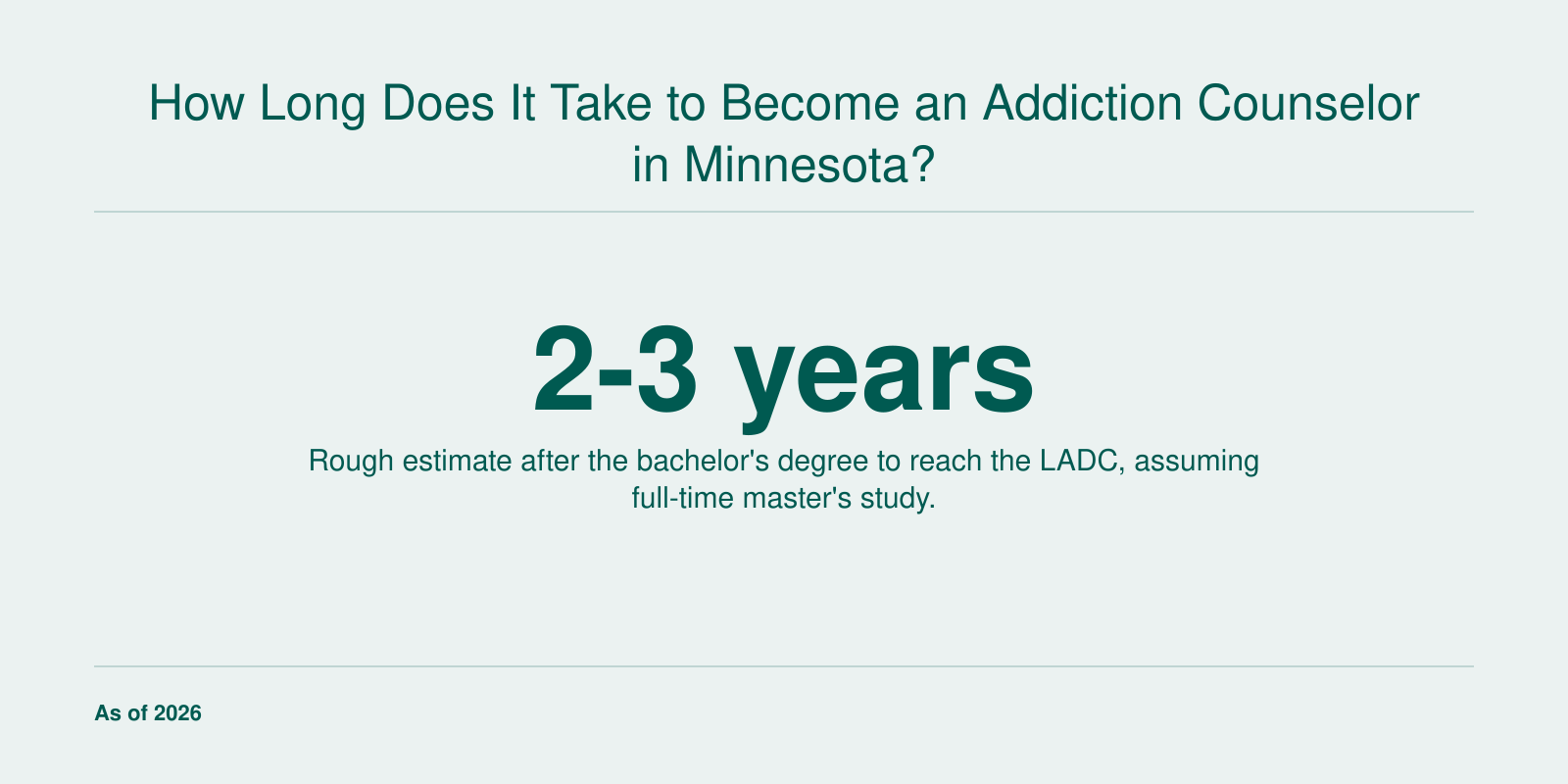
The path runs in order: bachelor's degree, master's, supervised practicum, licensing exam, then the LADC. Full-time master's study typically takes about two years (Minnesota State University Moorhead lists 24 months, with up to five years part time). Practicum happens during the degree. Exam and application steps add a few months, though Board processing times vary. The optional LPCC adds 4,000 post-degree supervised hours, roughly two to four years depending on weekly hours. Part-time online students and those adding the LPCC should expect a longer timeline.
Quick Answers Before You Apply
Deadlines and start terms change from year to year, and some schools publish little. Treat these answers as a starting point and confirm dates on each admissions page before you plan around them.
When do Minnesota addiction counseling master's programs take applications for 2026-2027, and which terms can you start in?
Should you aim for the LADC, the LPCC, or both?
Can you complete a Minnesota addiction counseling master's online?
Compare Addiction Counseling programs on the data that matters
Explore more Counseling specializations or browse every graduate field.
All Counseling programs