Master's in Sociology Programs With No GRE Required
Compare 320+ accredited no-gre Sociology programs at 180+ schools, with graduate earnings, cost, debt, and completion data from IPEDS and the U.S. College Scorecard.

Skipping the GRE saves roughly $220 in prep and testing fees plus months of study, but it does not make admission easier. Like MSW programs no GRE required, programs that dropped the exam lean harder on undergraduate GPA minimums, writing samples, and three letters of recommendation.
Waivers are now common in sociology master's programs, from Hunter's applied digital sociology MS to UAB's fully online MA. Policies still shift year to year, so confirm with the department before assuming.
Most of these degrees run 30 to 36 credits, and published in-state tuition spans a wide range, from about $7,400 to $35,800.
Key Points
- No GRE is required at several ranked sociology master's programs for 2027.
- One-year graduate earnings range from $44,892 to $52,284 here.
- Florida Atlantic assistantships offer tuition waivers plus $6,000 per term.
Best No-GRE Sociology Master's Programs for 2027
These sociology master's programs are listed as GRE-waived or test-optional, but policies shift and some schools attach conditions such as GPA minimums. The list is not a value ranking; it reflects a composite of retention, completion, and institutional quality with more moderate weight on cost and graduate earnings. Confirm the current application requirements directly with each program before you apply.
Stony Brook University
#1Stony Brook, NY · ~$14,000/yr (est.)
Best for: Research-oriented terminal MA candidates
Stony Brook University's sociology M.A. is a 30-credit terminal program with required core work in theory, statistics, methods, and global sociology, plus a faculty-reviewed research paper. The program uses a fall-only admissions cycle and currently lists no GRE requirement, though applicants should confirm the latest waiver. Its structured research component makes it a strong fit for students planning a focused master's project rather than a generalist degree.
- 30-credit terminal master's degree
- Six core courses in theory, statistics, methods, and global sociology
- Four electives plus a mandatory faculty-reviewed research paper
- Fall-only admission with January 1 deadline
- No GRE required; confirm current policy
- Optional writing sample and CV
- TOEFL 80 minimum for international applicants
University of Iowa
#2Iowa City, IA · $13,000 – $32,000/yr (est.)
Best for: Social psychology focused sociology students
The University of Iowa offers an M.A. in sociology, with or without thesis, inside a department known for a social psychology emphasis. Admission is fall-only and no GRE is required, but applicants should verify the current policy. The program expects a 3.25 undergraduate GPA and carries separate application fees for domestic and international students.
- MA with thesis or non-thesis option
- Social psychology concentration
- 3.25 undergraduate GPA expected
- No GRE required
- Fall-only admission with January 1 deadline
- $60 domestic / $100 international application fee
- Three recommendation letters required
CUNY Hunter College
#3New York, NY · ~$11,000/yr (est.)
Best for: Applied digital sociology career changers
CUNY Hunter College's M.S. in Applied Digital Sociology is a 30-credit, two-year campus program built around media research, marketing research, and international development tracks. The program combines qualitative and quantitative methods with an internship or research assistantship and a portfolio or thesis. Hunter lists no GRE requirement, and New York State residents pay a lower graduate tuition rate; confirm current residency rates and deadlines.
- Two-year, 30-credit M.S. program
- Media research and analysis concentration
- Core statistics, research methods, and theory
- Internship or research assistantship required
- Digital portfolio or thesis required
- Fall admission with March 15 and April 15 deadlines
- No GRE required
- Marketing research and consumer behavior concentration
- Core courses require a grade of B or better
- Full-time or part-time enrollment options
- NY resident tuition $11,090 per year
- Out-of-state tuition $25,650 per year
- Part-time tuition $470 per credit
- Research and training in international development concentration
- Combines qualitative and quantitative digital research
- Electives in policy analysis and data analysis
- Fall-only admission with early and regular deadlines
- Test-optional admissions
Texas Tech University
#4Lubbock, TX · $5,000 – $10,000/yr (est.)
Texas Tech University's sociology M.A. is a 36-credit, campus-based degree with thesis and non-thesis tracks, a required comprehensive exam, and competitive teaching assistantships. The program lists no GRE requirement and accepts fall and spring applications. Core work emphasizes sociological theory and research methods, with room for a minor outside the department.
- 36-credit M.A. with thesis or non-thesis track
- Core coursework in sociological theory and research methods
- Minimum 3.0 GPA for admission
- Letters of recommendation and writing sample required
- No GRE required
- Teaching assistantships available competitively
- Comprehensive examination and thesis defense required
Oklahoma State University
#5Stillwater, OK · ~$9,000/yr (est.)
Oklahoma State University's M.S. in Sociology offers three specialty concentrations: Crime and Deviance, Environmental Sociology, and Social Inequality. The program emphasizes theory, methods, and statistics and does not require GRE scores. Fall and spring admission deadlines vary by funding consideration, so applicants should confirm the relevant date.
- Crime and Deviance concentration
- No GRE scores required
- Fall admission with funding deadline February 1
- Spring admission deadline September 15
- Graduate seminars and close faculty-student relationships
- Sociological theory, methods, and statistics core
- Environmental Sociology concentration
- Small graduate seminars
- Fall admission deadlines February 1 and April 1
- Funding opportunities available
- No GRE required for admission
- Social Inequality concentration
- MS and PhD degrees offered
- Fall and spring admission options
- Five specialty areas for focused study
- Test-optional admissions
Howard University
#6Washington, DC · $35,000 – $40,000/yr (est.)
Howard University's M.A. in Sociology focuses on race, inequality, and the Black experience, with 33 credit hours, full-time campus study, and interdisciplinary opportunities in Washington, D.C. The program does not require GRE scores. However, Howard's Graduate School currently lists Sociology as not accepting applicants for Fall 2027, so prospective students should confirm future application cycles before planning.
- 33-credit, full-time campus program
- Race, Inequality and the Black Experience concentration
- No GRE required
- 3.0 GPA minimum and bachelor's degree
- Three professor recommendations, statement, and writing sample
- Rolling review with November 15 and January 15 deadlines
University of Alabama at Birmingham
#7Birmingham, AL · ~$9,000/yr (est.)
The University of Alabama at Birmingham offers a fully online, 30-credit master's in sociology designed for working professionals. The non-thesis program substitutes a capstone project and covers social theory and social data analytics, with no GRE or GMAT requirement. Its online format is a distinct fit for students seeking flexible scheduling.
- Fully online, 30-credit non-thesis program
- Capstone project in place of a traditional thesis
- No GRE or GMAT required
- Designed for working professionals
- Social data analytics and social theory coursework
- Flexible scheduling with nine courses total
Portland State University
#8Portland, OR · ~$18,000/yr (est.)
Portland State University's listed sociology master's path is a bachelor's-plus-master's route for current PSU sociology majors, allowing up to 20 graduate credits at undergraduate tuition rates. The non-thesis program can be completed in as little as five years and does not require GRE scores. PSU also offers a standalone non-thesis M.S. for applied-research careers and a Ph.D. pathway in which students earn the M.S. along the way.
- Bachelor's + Master's pathway for current PSU sociology majors
- Complete non-thesis master's in as little as five years
- 20 graduate credits at undergraduate tuition rates
- Minimum 3.5 sociology GPA and 3.3 overall GPA
- No GRE required
- 45 total graduate credits with five electives
- Rolling admissions and advising appointment required
Texas State University
#9San Marcos, TX · ~$9,000/yr (est.)
Texas State University's M.S. in Applied Sociology is a 36-credit program with practicum and non-practicum tracks; the listed non-practicum option offers more coursework flexibility. No GRE is required, but applicants need a 3.0 GPA, statement of purpose, and three recommendations. The training emphasizes quantitative and qualitative research and statistical analysis for research and policy roles.
- 36-credit Master of Science degree
- Non-practicum track with coursework flexibility
- No GRE requirement
- 3.0 GPA and bachelor's degree required
- Statement of purpose and three recommendations
- $55 domestic or $90 international application fee
- Quantitative and qualitative research training
University of Colorado Denver/Anschutz Medical Campus
#10Denver, CO · $5,000 – $10,000/yr (est.)
The University of Colorado Denver's M.A. in Sociology is a 33-credit program with a Health and Society concentration and hybrid, in-person, and online delivery options. GRE scores are optional rather than required, so applicants may submit them to strengthen the file but are not required to do so. The program allows full-time or part-time study and offers multiple culminating options, including a thesis, report, or internship.
- 33-credit M.A. with Health and Society concentration
- Hybrid, in-person, and online formats available
- GRE optional rather than required
- Priority deadline March 15; rolling to June 15
- Three recommendations, statement, and writing sample
- Thesis, report, internship, or extended coursework options
- WICHE-qualified students may receive in-state tuition
Cost & outcomes by school
Federal data for the highest-earning Sociology programs, independent of the ranking above. Earnings are this field's master's graduates four years after completing, where the Scorecard reports them.
| School | Earnings | Tuition / yr | Debt | Grads/yr | Format |
|---|---|---|---|---|---|
| American Public University System WV | — | $8,700 | — | 29 | Online |
| University of North Carolina at Charlotte NC | — | $8,037 | — | 6 | Campus |
| East Tennessee State University TN | — | $11,366 | — | 9 | Campus |
Sources: U.S. Department of Education. Tuition and graduates: IPEDS. Earnings and debt: College Scorecard, this field's master's graduates; a dash means no figure is reported.
Cost, debt & payoff
Median earnings of this field's master's graduates (4 yrs after completing) vs. their median federal loan debt · U.S. College Scorecard
Across these programs the median graduate earns about $69,199 and finishes with roughly $36,380 in debt — a ratio that clears a common rule of thumb (keep debt below first-year salary). Tuition and debt vary widely school to school, so check the per-school figures in the table above before you shortlist.
How We Rank No-GRE Sociology Master's Programs
Our composite gives a bonus when a program qualifies as one of the No-GRE master's programs, but it also weights retention and completion rates and broader institutional quality. Cost and graduate earnings carry moderate weight, keeping affordability and career payoff in view without letting any single number dominate. We draw from federal College Scorecard and IPEDS data, so the order rests on reported outcomes rather than marketing claims. One caveat: graduation rates and net price are institution-wide averages, not figures specific to a cohort within sociology master's programs. That means a strong or weak university-wide result may not perfectly match the sociology department, but it remains a consistent, verifiable benchmark across schools.
No-GRE Sociology Master's Costs: Tuition and Net Price Compared
The table below shows published in-state and out-of-state graduate tuition alongside net price for the no-GRE sociology programs in this comparison. Net price is an institution-wide average after grants and scholarships, not a personal quote, and online programs may charge a separate per-credit or flat e-tuition. Among the online options, NMSU Global Campus is the lowest-cost entry shown, with $6,605 in-state tuition and a published $444.40 per credit; Loyola Chicago and Northeastern publish higher per-credit rates of $1,270 and $1,489.
| School | Format | In-State Graduate Tuition | Out-of-State Graduate Tuition | Net Price |
|---|---|---|---|---|
| CUNY Hunter College | Campus | $11,398 | $20,828 | $2,984 |
| New Mexico State University | Online | $6,605 | $19,448 | $8,889 |
| Portland State University | Campus | $17,745 | $23,334 | $9,552 |
| University of Colorado Denver | Hybrid | $9,298 | $27,154 | $11,900 |
| Northern Illinois University | Campus | $9,176 | $9,176 | $13,391 |
| University of Houston-Clear Lake | Campus | $9,762 | $19,194 | $15,563 |
| Texas State University | Campus | $8,997 | $16,377 | $16,805 |
| Oklahoma State University | Campus | $9,092 | $24,595 | $17,447 |
| University of Northern Colorado | Campus | $15,376 | $26,446 | $17,760 |
| University of Alabama at Birmingham | Online | $8,640 | $21,168 | $18,749 |
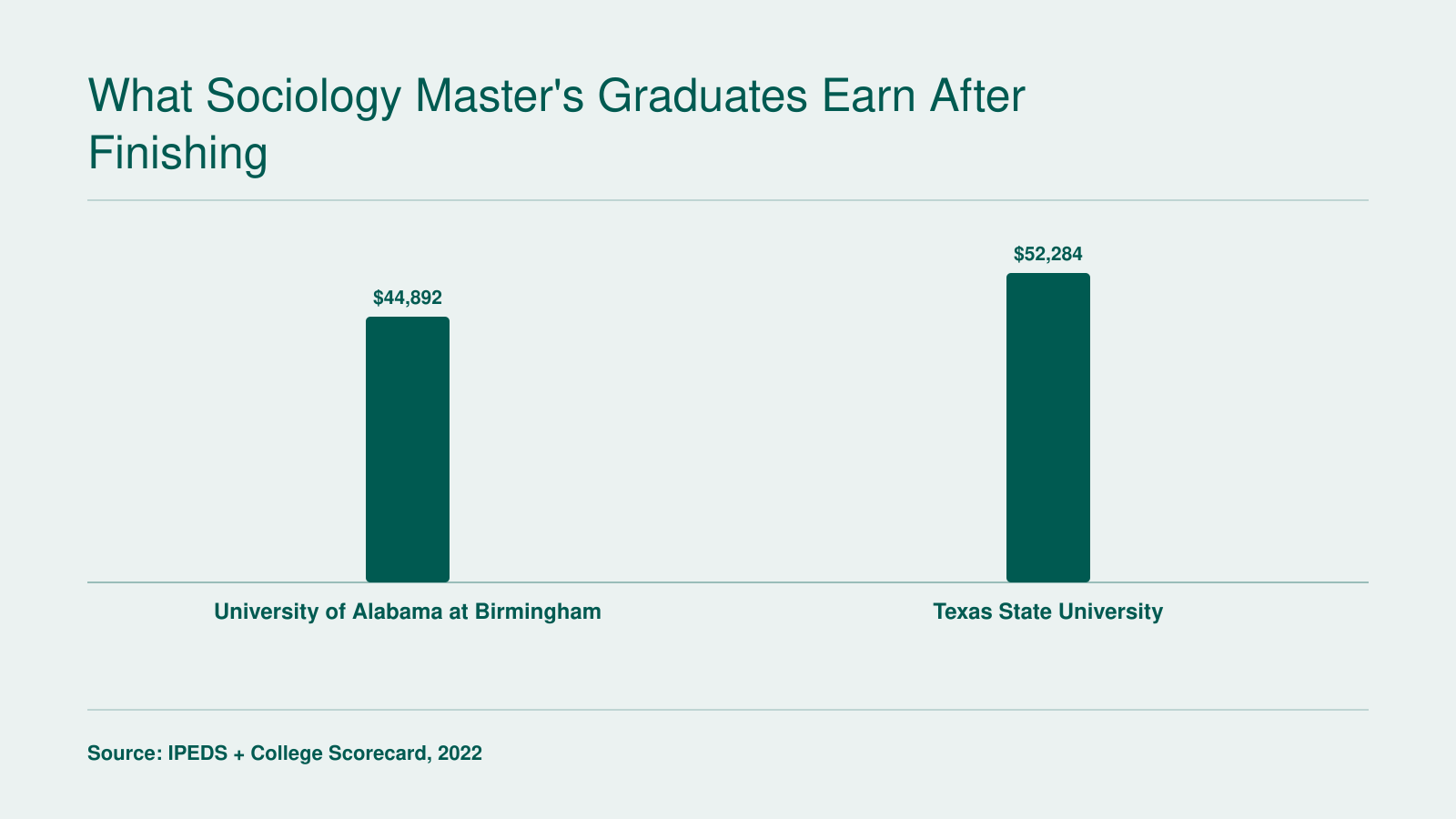
What Sociology Master's Graduates Earn After Finishing
For programs with published one-year earnings, the figures sit at $44,892 and $52,284. Median program debt runs $34,166-$36,380, so the early earnings picture is stronger than typical borrowing.
Related Articles
Online vs. Campus No-GRE Sociology Master's Programs
UAB's 30-credit MA is an online master's in sociology with a non-thesis format, which makes it uncommon in this ranking. Most are campus-based, including Stony Brook, Iowa, Hunter, and Howard, and Colorado Denver offers a hybrid format. Online options confirmed elsewhere include New Mexico State (100% online), Virginia Commonwealth (fully online, no campus visit)1, Arizona State, and East Texas A&M2.
Live Classes or Self-Paced?
Official pages rarely say whether online courses meet live or run asynchronously. UAB mentions flexible scheduling, but none of the online programs above spell out their delivery style. Ask admissions directly.
Thesis, Capstone, or Internship
The culminating requirement matters more than the delivery mode.
- PhD-bound: Choose a thesis track where offered, such as New Mexico State, Virginia Commonwealth1, or Iowa, since it produces original research for doctoral applications.
- Career-focused: A capstone or internship fits better. UAB requires a capstone project, Virginia Commonwealth allows a practicum or internship1, and Hunter requires an internship or research assistantship.
New Mexico State lists 36 credits on its program page but 30 for the non-thesis option in its catalog, so confirm the count before applying.
A Tip for Working Adults
Before committing, get written confirmation of any required live sessions and the culminating-project timeline. Those two details decide whether the program fits around your job.
How to Apply to a Sociology Master's Without GRE Scores
- Check bachelor's requirementsMost programs require an accredited bachelor's degree. Marshall requires 12 undergraduate sociology credits; Texas Woman's expects a sociology bachelor's or equivalent, while Arizona State accepts any-field degrees with qualifying grades.
- Verify GPA and GRE policyA 3.0 minimum is common, often based on the last 60 undergraduate hours or graduate work. None of the programs here require the GRE, though several accept optional scores.
- Gather application materialsPrepare a statement of purpose, writing sample, two to three recommendation letters, and resume. Stony Brook asks for three letters from former instructors.
- Track deadlines and fundingFall deadlines include UMass Amherst December 31, Stony Brook January 1, Temple March 1, and Marshall April 15; Marshall also has November 15 for spring. Funding deadlines may be earlier.
- Plan international stepsEnglish minimums vary: Indianapolis asks TOEFL 79 or IELTS 6.5; Temple lists IELTS 7.0 or TOEFL 100 for tests taken before January 2026. Submit credential evaluations early and confirm I-20 timing. Fully online programs generally do not qualify for F-1 visas.
Sociology programs by state
Frequently Asked Questions About No-GRE Sociology Master's Programs
How long does a master's in sociology take?
Can I get a master's in sociology without a sociology background?
What careers can I pursue with a master's in sociology?
Is a non-thesis sociology master's enough if I later want a PhD?
Compare Sociology programs on the data that matters
Explore more Social Work & Social Sciences specializations or browse every graduate field.
All Social Work & Social Sciences programs