Best Master's in Sociology Programs in Connecticut
Compare 4 accredited Sociology programs in Connecticut at 3 schools, with graduate earnings, cost, debt, and completion data from IPEDS and the U.S. College Scorecard.

Connecticut has only a few places to earn a sociology master's, so the decision turns on cost, format, and admissions rather than name recognition. Published annual in-state graduate tuition runs from $14,930 at Southern Connecticut State University to $49,500 at Yale, with UConn at $22,872.
The formats differ as much as the prices. UConn and SCSU offer standalone in-person master's degrees. Yale's M.A. is awarded only to Ph.D. students under specified circumstances, including those who withdraw after meeting M.A. requirements.
For applicants who want a terminal degree, the two public universities are the realistic options.
Key Points
- SCSU is cheapest for residents at $14,930 versus UConn's $22,872.
- Neither UConn nor SCSU publishes a GRE policy for 2027 applicants.
- Neither university offers a fully online sociology master's in 2027.
Best Sociology Master's Schools in Connecticut: Ranked List
Connecticut's sociology master's options split into two clear paths: dedicated terminal M.A. and M.S. programs at public universities, and an en route Yale master's tied to doctoral study. The programs below emphasize applied research, social justice, and flexible capstone options, with in-person formats at Storrs and New Haven. Yale's sociology master's is an en route doctoral off-ramp, not a standalone terminal program, and UConn, SCSU, and Yale each hold NECHE regional accreditation.
University of Connecticut
#1Storrs, CT · ~$23,000/yr (est.)
Best for: Connecticut residents wanting in-person research training
University of Connecticut's M.A. in Sociology is a 30-credit, in-person program at the Storrs campus, well suited to Connecticut residents who want a terminal research-focused degree. Students choose among five specializations: Gender and Sexuality, Racism and Social Inequality, Human Rights, Policy, and Research Methods, and finish with a capstone portfolio of three papers. The university graduates about 83% of students overall, and an accelerated track lets qualified UConn undergraduates count graduate credits toward both degrees.
- 30 total credit hours
- Five specializations: gender, inequality, human rights, policy, and methods
- 12 core credits include research logic, theorists, and methods
- 6 required sociology electives plus 12 additional electives
- Capstone portfolio of at least three papers
- In-person at Storrs campus
- Public policy and data science electives with advisor approval
- Complete BA and MA in five years
- Social justice focus covering gender and racism
- Requires GPA above 3.3 and faculty advisor approval
- Two-stage application: junior year then senior year
- Rolling admissions basis
Southern Connecticut State University
#2New Haven, CT · ~$15,000/yr (est.)
Best for: Applied learners seeking flexible admission pathways
Southern Connecticut State University offers a Master of Science in Sociology with a nine-credit social justice core and applied research emphasis in New Haven. The 30-credit program includes service learning, internships, and a choice of thesis or special project, and it prepares graduates for criminal justice, research, marketing, and consulting roles. SCSU graduates about 50% of students overall and maintains separate in-state and out-of-state tuition rates.
- 30 credits: 9-credit social justice core
- Thesis or special project capstone options
- Service learning, internships, and independent research
- Non-matriculated enrollment up to 9 credits possible
- Conditional admission for GPAs 2.5 to 2.99; alternate route for 2.0 to 2.49
- Accepts fall or spring enrollment
- Separate in-state and out-of-state tuition rates
Yale University
#3New Haven, CT · ~$50,000/yr (est.)
Best for: Doctoral-bound students needing an en route MA
Yale University's Master of Arts in Sociology is primarily an en route degree for doctoral students who withdraw after meeting specified requirements, rather than a conventional standalone master's. The curriculum includes eight term courses with statistics and theory requirements, plus High Pass or Honors in five courses, and builds strong quantitative and qualitative research skills. Yale graduates about 96% of students overall, reflecting strong institutional support.
- En route MA for students withdrawing from the sociology Ph.D.
- Eight term courses including statistics and theory
- High Pass or Honors in five courses
- 16 concentration options
- Research workshops and combined study opportunities
- Builds qualitative and quantitative research skills
Cost & outcomes by school
Federal data for the highest-earning Sociology programs, independent of the ranking above. Earnings are this field's master's graduates four years after completing, where the Scorecard reports them.
| School | Earnings | Tuition / yr | Debt | Grads/yr | Format |
|---|---|---|---|---|---|
| Southern Connecticut State University CT | — | $14,930 | — | 10 | Campus |
| University of Connecticut CT | — | $22,872 | — | 1 | Campus |
| Yale University CT | — | $49,500 | — | 9 | Campus |
Sources: U.S. Department of Education. Tuition and graduates: IPEDS. Earnings and debt: College Scorecard, this field's master's graduates; a dash means no figure is reported.
Which Connecticut Sociology Master's Programs Waive the GRE? Admissions Requirements Explained
GRE policies
Neither UConn's standalone sociology M.A. admissions page nor Southern Connecticut State University's sociology graduate admission page publishes a GRE policy, so applicants should not assume the test is required or waived. UConn does state that students in its accelerated sociology M.A. pathway are not required to take the GRE, a policy that aligns with a broader list of Master's in Sociology Programs With No GRE Required. If a score matters to your planning, email the graduate coordinator directly rather than inferring a policy from silence.
GPA, letters, and written materials
Both sociology master's programs look for a cumulative undergraduate GPA of 3.0 or higher, and neither lists specific prerequisite sociology courses.
- UConn: One academic or professional recommendation plus a personal statement connecting your goals to social analytics and data-driven decision-making. No separate writing sample is requested.
- SCSU: One to two letters, a 300 to 500 word statement of purpose addressing your interest in the M.S. and social justice studies, and a strong writing sample from a previous course. Applicants without a sample should contact the graduate coordinator.
Deadlines and below-threshold applicants
UConn sets June 30 for all fall materials, with no separate international date published. SCSU admits for fall or spring on a rolling basis; its portal opens September 1 for fall and April 1 for spring of the prior year. SCSU may conditionally accept applicants between 2.5 and 3.0, and those from 2.0 can take courses as non-matriculated students, applying after three courses graded B or higher.
Online and Hybrid Master's in Sociology Options in Connecticut
Neither UConn nor Southern Connecticut State University currently offers a fully online sociology master's degree. UConn's graduate catalog lists the M.A. in Sociology as in person at the Storrs campus. SCSU's M.S. in Sociology is not listed among its online or hybrid programs, which the university defines as 100 percent and 51 to 99 percent online coursework, respectively. Official pages for both programs also do not list an evening schedule or a formal part-time track, though SCSU notes full-time students must register for scheduled elective coursework each term.
No fully online in-state sociology master's option is published, so Connecticut residents considering fully online study generally need to look at out-of-state options in the Best Online Master's in Sociology Programs ranking, where in-state tuition typically does not apply. For students aiming at research careers, the campus formats at UConn Storrs and SCSU New Haven in Connecticut offer closer access to graduate assistantships and faculty research labs than a remote degree would.
Related Articles
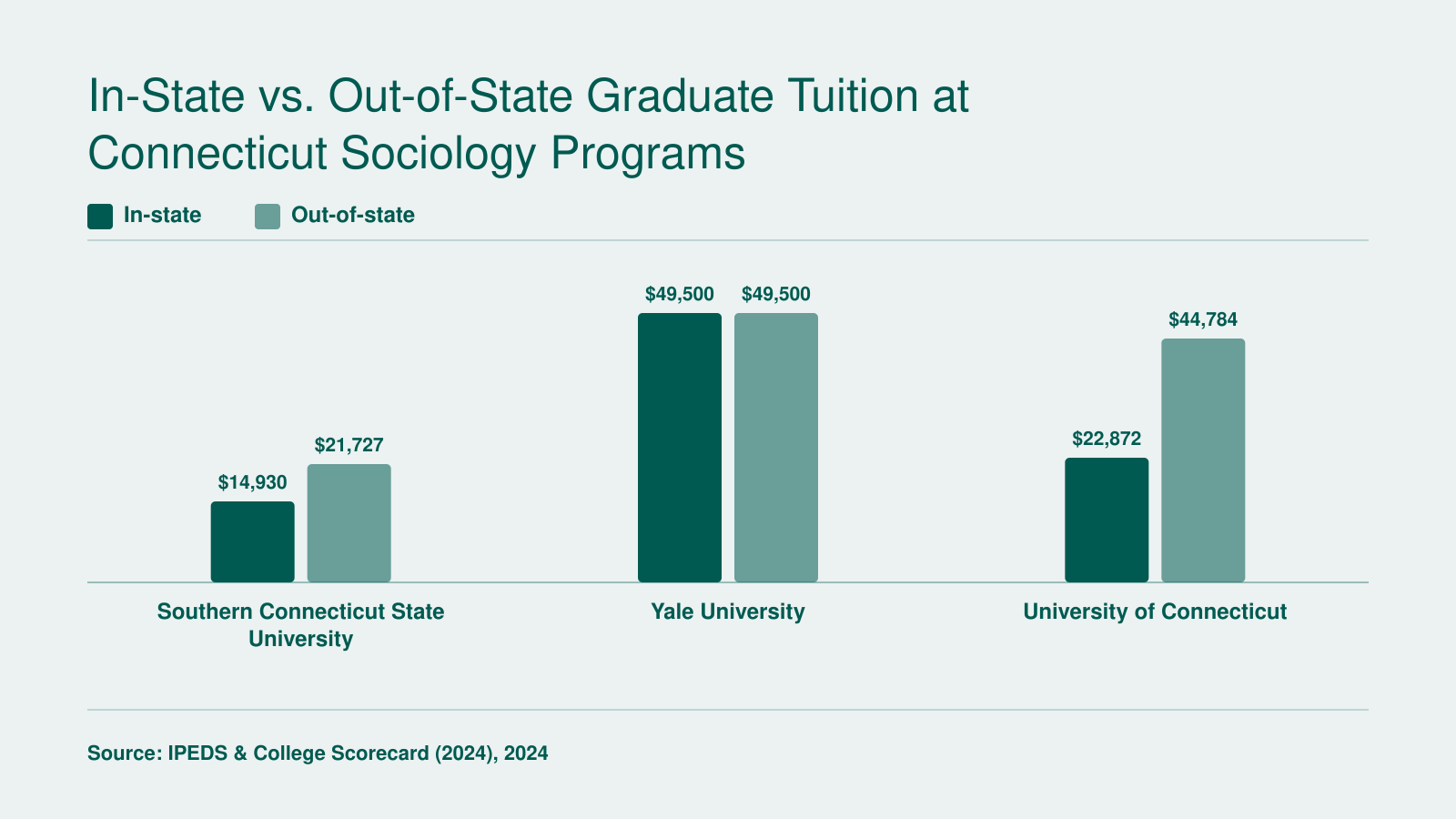
In-State vs. Out-of-State Graduate Tuition at Connecticut Sociology Programs
Graduate tuition differs sharply by residency in Connecticut. The chart below compares published in-state and out-of-state graduate tuition and required fees for the ranked sociology programs. Southern Connecticut State University is the cheapest option for Connecticut residents at $14,930, while UConn carries the largest out-of-state premium at roughly $21,900; Yale charges the same rate for all students. These are published figures, and funded assistantships can sharply lower the real cost.
Master's in Sociology Cost, Assistantships, and Connecticut Licensure or Certification
Federal data lists annual graduate tuition and fees of $22,872 in-state and $44,784 out-of-state at UConn, versus $14,930 and $21,727 at Southern Connecticut State University. These match the chart above. They are yearly figures, not confirmed 2026-27 per-credit rates, so check each bursar page before budgeting. UConn's MA is 30 credits, so your total depends on how many semesters you take. Institution-wide net price after aid runs about $25,097 at UConn and $20,857 at SCSU. Treat those as rough campus averages, not program quotes; compare them with the Most Affordable Master's in Sociology Programs ranking.
Assistantships and fellowships
UConn Sociology says most students receive full support through 20-hour-per-week appointments. Pre-MA students are usually teaching assistants, and some work as research assistants. The package includes a stipend, a tuition waiver, and subsidized health insurance. Department and Graduate School fellowships may also be available. Ask the department how to be considered for funding when you apply.
The fine print matters:
- Waiver terms: It covers tuition only, for Fall and Spring, and requires active payroll authorization and at least 6 enrolled credits.1
- Fees: You still pay mandatory fees the assistantship does not cover.
- Stipend amount: Current dollar figures are not listed, so request them.
SCSU's sociology master's assistantship and waiver terms are not published, so ask that department directly.
Licensure and optional credentials
Connecticut has no state license for sociologists. Licenses apply only if you move into regulated fields such as clinical social work or counseling. The optional route is certification from the Association for Applied and Clinical Sociology: Certified Applied Sociologist or Certified Clinical Sociologist.2 Applicants need an M.A. or M.S., about 3,000 hours of work experience over two years within the past five, and a $200 application fee.3
Careers and ROI for Sociology Master's Graduates in Connecticut
Federal data do not publish program-level earnings and debt for the sociology master's at these three schools, so no dollar figure is placed on any of them. That is a real limit on ROI math, and it matters more than the generic wage numbers you will see elsewhere.
Why "sociologist" wages mislead
Many competitor pages quote a national "sociologist" wage. Few master's graduates hold that title. Is a Master's in Sociology Worth It? notes the occupation is concentrated in research and development services, state and local government, and universities (as of May 2023), and it does not describe master's holders specifically. Southern Connecticut State University lists "sociologist" among possible titles, but the broader pattern is applied work under other names.
Common titles and Connecticut employers
- Research analyst or data analyst: health systems, research firms, survey and consulting companies.1
- Policy analyst or legislative researcher: state agencies and policy offices.
- Program evaluator: nonprofits and public agencies.
- Nonprofit program manager: community organizations and social service agencies.2
- Community college instructor: colleges, often alongside other work.
Sources do not show that any Connecticut agency routinely hires sociology master's graduates for each of these titles, so treat them as plausible paths, not guarantees.
What improves hiring odds
Strong research methods and statistics training is the skill set that most improves hiring prospects. Yale, UConn, and SCSU all build in methods or statistics coursework, so use electives and your thesis or capstone to get the kind of real data experience a master's in data analytics Connecticut program targets.
Frequently Asked Questions About Sociology Master's Programs in Connecticut
These answers cover common questions about sociology master's programs in Connecticut and are consistent with the admissions and cost details discussed above. Use them to compare UConn and Southern Connecticut State University before you apply.
How many sociology master's programs are in Connecticut?
Does Yale offer a sociology master's degree?
Which is better for a sociology master's degree: UConn or Southern Connecticut State University?
Can I get a sociology master's without an undergraduate sociology degree?
Compare Sociology programs on the data that matters
Explore more Social Work & Social Sciences specializations or browse every graduate field.
All Social Work & Social Sciences programs