Best Online Master's in Sociology Programs
Compare 30+ accredited online Sociology programs, with graduate earnings, cost, debt, and completion data from IPEDS and the U.S. College Scorecard.

Nearly every fully online sociology master's here runs 30 credit hours, and in-state graduate tuition at the public options ranges from roughly $6,000 to $17,000. Emporia State's applied sociology MA can be finished in 12 months through seven-week sessions; University of North Dakota lists two to four years. Timeline shapes total cost as much as the per-credit rate.
Only 100% online programs qualify for the ranking; hybrid and residency-required degrees are excluded. The comparisons ahead cover price and debt, thesis versus capstone tracks, GRE policies, and graduate earnings.
Sociology master's pay varies widely by job title, so the format you pick matters less than where the degree points you.
Key Points
- The 2027 ranking covers only fully online sociology master's programs.
- Federal IPEDS and College Scorecard outcomes drive rankings, not prestige.
- First-year earnings for debt-reporting programs range from about $44,900 to $53,300.
Best Fully Online Master's in Sociology Programs of 2027
These are the top 100% online sociology master's programs, with no hybrid or in-person components required. The list blends fully online delivery with baseline quality signals such as institution-wide graduation rate, net price, and program-level Scorecard outcomes where published. Use it to compare what each school asks of you and what it can offer after graduation.
Arizona State University
#1Tempe, AZ · ~$14,000/yr (est.)
Best for: Busy professionals needing flexible online pacing
Arizona State University's T. Denny Sanford School of Social and Family Dynamics offers a fully online 30-credit MA in Sociology with customizable electives and a capstone. The program emphasizes sociological theory, research methods, and statistics while allowing students to move through accelerated enrollment sessions. Admission expects a bachelor's degree with a 3.0 GPA, plus recommendations and a personal statement.
- 30 credit hours, fully online delivery
- No second language requirement
- Minimum 3.0 undergraduate GPA expected
- Capstone culminating experience
- Customizable elective coursework
- Sociological theory, research methods, and statistics core
- Accelerated degree options available
- Multiple enrollment sessions each year
American Public University System
#2Charles Town, WV · $5,000 – $10,000/yr (est.)
Best for: Military learners wanting monthly start dates
American Public University System offers a 30-credit online MA in Sociology with monthly course starts and a no-fee application, making it one of the more accessible options for working adults. The curriculum covers social theory, advanced research methods, and data analysis, with elective paths through education, healthcare, and social services. Students complete a service-learning component and a capstone research project while building a professional portfolio.
- No entrance exam required
- $470 per credit hour
- 30 total credit hours
- 12 start dates per year
- Fully online option available
- $0 application fee
- Military benefits accepted
- Transfer up to 15 prior credits
University of Alabama at Birmingham
#3Birmingham, AL · ~$9,000/yr (est.)
Best for: Career-focused professionals skipping GRE requirements
The University of Alabama at Birmingham offers a fully online, non-thesis MA in Sociology built around a capstone project and no GRE or GMAT requirement. Coursework emphasizes social theory and social data analytics, with flexible scheduling for working professionals. The program draws a diverse online cohort and prepares graduates for applied roles across business, government, and nonprofits.
- Fully online program
- 30 credit hours
- Non-thesis degree with capstone project
- No GRE or GMAT required
- Designed for working professionals
- Flexible course scheduling
- Covers social data analytics
- Nine total courses
University of North Dakota
#4Grand Forks, ND · ~$14,000/yr (est.)
The University of North Dakota's online MA in Sociology uses asynchronous classes and requires no campus visit, making it practical for students across the country. The 30-credit program can take two to four years and allows customizable electives alongside hands-on research projects. UND reports that online sociology graduate students pay the same tuition rate regardless of residency.
- 30 credit hours
- Two to four years to complete
- Asynchronous classes offered
- No campus visit required
- Four-year degree required for admission
- Fall, spring, and summer application deadlines
- Customizable coursework with electives
- Hands-on research projects
Georgia Southern University
#5Statesboro, GA · $5,000 – $10,000/yr (est.)
Georgia Southern University offers a Master of Arts in Social Science with a Sociology concentration that can be completed fully online. The 30-credit program includes core courses, electives, and a final project, with a choice of thesis or applied public service track. GRE scores are optional, and admission requires a bachelor's degree, statement of purpose, and committee review.
- 30 credit hours
- Fully online sociology concentration
- Fall, spring, and summer entry
- Bachelor's degree required
- Statement of purpose needed
- GRE scores optional
- 12 core, 12 elective, 6 final project hours
- Thesis or applied track
Virginia Commonwealth University
#6Richmond, VA · ~$17,000/yr (est.)
Virginia Commonwealth University offers an online Master of Science in Sociology with a Digital Sociology concentration that can be completed without visiting campus. Students analyze digital data through a social justice lens, build a digital portfolio, and complete a qualifying paper, with core coursework in sociological theory and digital research methods. A separate MS in Sociology track is also listed with online concentration availability.
- 30 credit hours
- Fully online completion option
- Fall semester entry only
- June 1 application deadline
- Qualifying paper requirement
- Digital data visualization coursework
- Public sociology course included
- Background in sociology preferred
- No entrance exam required
- 30 credits program
- Full-time and part-time options
- Starts fall
- 3.0 GPA minimum
- No thesis or capstone required
- Online concentration available
- Transfer credits allowed
Sam Houston State University
#7Huntsville, TX · ~$9,000/yr (est.)
Sam Houston State University offers a completely online MA in Sociology with three track options: Professional Practice of Scholarship, Research, or Teaching. The 30-credit program emphasizes public sociology and builds both quantitative and qualitative research skills. Admission is automatic for applicants with a 3.5 GPA in Sociology.
- Completely online program
- 30 credit hours required
- Three track options available
- Focus on public sociology
- Automatic admission for 3.5 GPA in Sociology
- Fall, spring, and summer enrollment
- Research track requires thesis
- Professional practice track includes capstone
New Mexico State University
#8Las Cruces, NM · $7,000 – $19,000/yr (est.)
New Mexico State University offers an online MA in Sociology with thesis and non-thesis options, plus a Masters Accelerated Program that lets qualified undergraduates take up to 12 graduate credits early. The 30-credit curriculum includes advanced quantitative analysis, research methods, and social theory. No GRE is required for admission.
- 30 credit hours required
- Thesis and non-thesis options
- 3.0 undergraduate GPA minimum
- No GRE required
- Statement of purpose required
- Rolling admissions basis
- February 1 assistantship deadline
- Masters Accelerated Program up to 12 credits
Minnesota State University-Mankato
#9Mankato, MN · $10,000 – $20,000/yr (est.)
Minnesota State University-Mankato's online MA in Sociology focuses on college teaching, preparing graduates for community college faculty roles. The 33-credit program combines asynchronous online classes with a small number of synchronous meetings that can be attended remotely. Admission requires a bachelor's degree with 18 social science credits and a 3.0 GPA.
- 33 total credit hours
- Two years completion time
- Online asynchronous format
- Four synchronous classes
- Community college teaching focus
- Three recommendation letters required
- Personal statement and writing sample required
- 18 social science credits prerequisite
Emporia State University
#10Emporia, KS · ~$9,000/yr (est.)
Emporia State University offers a 30-credit online MA in Applied Sociology with accelerated 7-week sessions, allowing completion in about 12 months. Students choose between Community Leadership and Criminal Justice concentrations, both of which include applied theory, research methods, and grant writing. A capstone or thesis with a community partner provides hands-on experience.
- 30 credit hours, 100% online delivery
- Community Leadership concentration
- Leadership for social justice coursework
- Community building course included
- Public sociology course required
- Grant proposal writing core
- Capstone or thesis with a community partner
- 30-hour degree program, online accelerated format
- Criminal Justice concentration
- Crime causation and prevention courses
- Criminal justice organization coursework
- Community policing courses
- Capstone or thesis required
Cost & outcomes by school
Federal data for the highest-earning Sociology programs, independent of the ranking above. Earnings are this field's master's graduates four years after completing, where the Scorecard reports them.
| School | Earnings | Tuition / yr | Debt | Grads/yr | Format |
|---|---|---|---|---|---|
| University of Alabama at Birmingham AL | $68,281 | $8,640 | $34,166 | 25 | Online |
| Arizona State University AZ | $65,008 | $10,843 | $40,642 | 67 | Online |
| Grand Canyon University AZ | — | $10,015 | — | — | Online |
| American Public University System WV | — | $8,700 | — | 29 | Online |
| California State University-Los Angeles CA | — | $8,688 | — | 21 | Hybrid |
| Our Lady of the Lake University TX | — | $19,254 | — | — | Online |
| New Mexico State University NM | — | $6,605 | — | 11 | Online |
| East Texas A&M University TX | — | $7,338 | — | 11 | Online |
| The University of Texas Rio Grande Valley TX | — | $8,589 | — | 11 | Hybrid |
| Texas Woman's University TX | — | $8,520 | — | 9 | Hybrid |
| Emporia State University KS | — | $8,843 | — | 9 | Online |
| University of Colorado Denver/Anschutz Medical Campus CO | — | $9,298 | — | 8 | Hybrid |
Sources: U.S. Department of Education. Tuition and graduates: IPEDS. Earnings and debt: College Scorecard, this field's master's graduates; a dash means no figure is reported.
Cost, debt & payoff
Median earnings of this field's master's graduates (4 yrs after completing) vs. their median federal loan debt · U.S. College Scorecard
Across these programs the median graduate earns about $69,199 and finishes with roughly $36,380 in debt — a ratio that clears a common rule of thumb (keep debt below first-year salary). Tuition and debt vary widely school to school, so check the per-school figures in the table above before you shortlist.
How We Rank: Verified Outcomes Over Prestige
How can you tell which online sociology master's programs actually pay off? Start with federal data instead of reputation. The list here is built from IPEDS and College Scorecard figures, not prestige surveys or the claims on a program's marketing page. A famous name can carry a high price and an unremarkable payoff, and an affordable master's in sociology may actually be the stronger value; the numbers let us say so.
Program-Level vs. Institution-Wide Numbers
The two kinds of figures answer different questions, so it helps to know which is which.
- Program-level: Scorecard earnings one to five years after completion, median federal debt, and the number of completions. These describe graduates of the sociology master's itself.
- Institution-wide: graduation rate, net price, and 10-year earnings. These describe the whole university across every field and degree level, not the sociology program itself.
The Online-Only Filter
Only programs you can finish entirely from home are included. Anything that requires hybrid sessions, on-campus residencies, or campus visits is removed, even if the school markets it as "online."
Limits Worth Knowing
Small programs often have no published earnings, because federal reporting holds back figures when too few graduates are in the sample. A school with a gap there is not necessarily weaker. The data is simply missing, and we leave it out rather than guess.
Net price is also an average across the whole institution, not a personal quote. Your aid, employer tuition benefits, and transfer credits can move your real cost well above or below it. Use these figures to narrow your list, then confirm costs and outcomes directly with admissions before you apply.
What You'll Pay: Tuition, Net Price, and Debt by School
Use the table below to compare published in-state and out-of-state graduate tuition and fees, the institution-wide net price after grant and scholarship aid, and median graduate debt where reported. Net price is a campus-wide average, not a quote for every sociology student, and it can shift with aid packages and enrollment intensity. Among programs with verified per-credit rates, Fayetteville State's 30-credit online master's is the least expensive for North Carolina residents at $191 per credit, roughly $5,730 total. Western Illinois University and the University of Alabama at Birmingham publish a single online graduate rate regardless of residency, which removes the typical out-of-state premium.
| School | In-State Tuition & Fees | Out-of-State Tuition & Fees | Institution-Wide Net Price | Median Debt |
|---|---|---|---|---|
| New Mexico State University | $8,183 | $25,307 | $8,889 | $17,095 |
| American Public University System | $8,400 | $8,400 | $9,597 | $21,743 |
| Morehead State University | $10,024 | $14,980 | $9,793 | $22,250 |
| East Texas A&M University | $10,026 | $22,326 | $11,841 | $20,500 |
| Western Illinois University | $15,264 | $15,264 | $12,937 | $25,251 |
| Arizona State University | $12,223 | $33,139 | $14,967 | $19,500 |
| Georgia Southern University | $6,022 | $17,734 | $15,267 | $23,250 |
| Emporia State University | $7,106 | $15,419 | $16,261 | $19,500 |
| Sam Houston State University | $9,228 | $19,068 | $16,404 | $21,983 |
| Our Lady of the Lake University | $32,106 | $32,106 | $16,442 | $24,999 |
Program Formats: Thesis, Capstone, and Comprehensive Exam Tracks
The culminating requirement is the final project, exam, or written paper that demonstrates mastery before you earn the degree. Fully online sociology master's programs usually ask students to complete one of three endings: a research thesis, an applied capstone or project, or a comprehensive exam.1
Three Ways to Finish
A thesis is the strongest fit for students planning a doctorate. It requires designing and writing an original study. New Mexico State offers thesis and non-thesis routes, Sam Houston State includes a thesis track, and Texas State's 36-credit master's may be completed with a thesis. An applied capstone, by contrast, turns coursework into a practical project tied to a workplace or community issue. University of Alabama at Birmingham's Master of Arts in Applied Sociology ends with a six-credit applied capstone, and Fayetteville State uses a non-thesis route. A comprehensive exam replaces a long paper with written examinations and can appeal to students who want the most direct path. Sam Houston State lists a comprehensive exam option, alongside its thesis and capstone tracks.1
Credit Load and Time to Degree
Credit totals range from 30 to 37 hours in the programs with published figures.1 New Mexico State, Morehead State, University of Alabama at Birmingham, Texas A&M University-Commerce, East Texas A&M, and Fayetteville State list 30 credits, while Sam Houston State lists 37 and Texas State lists 36. Full-time students with published timelines typically finish in about two years; New Mexico State lists a three-year part-time pace and a two-year full-time pace. No verified fully online one-year sociology master's appears in the programs with published timelines, so approach accelerated master's in sociology programs with caution.
MA vs. MS and What You'll Study
An MA generally leans toward classical theory, qualitative research, and applied social analysis, while an MS tends to add more quantitative methods and statistics. Among the schools here, Texas A&M University-Commerce awards a Master of Science, and most others award a Master of Arts. East Texas A&M labels the degree "Sociology (MA/MS)" without clarifying the choice. Where concentrations are published, Morehead State's Sociology MA lists chemical dependency and criminology.
Fully Online, No Campus Visits
None of the schools here lists a residency or campus visit requirement. Fayetteville State describes its 30-credit program as asynchronous and nonresidential, and University of Alabama at Birmingham's applied capstone is completed online. Texas A&M University-Commerce reports no thesis option.
Admission Requirements and GRE Policies
Most online sociology master’s programs ask for a similar base package, but GRE, prerequisite, and writing-sample expectations vary.
- Bachelor’s degree and minimum GPAA bachelor’s degree from a regionally accredited institution is the baseline, and a sociology major is generally not required. Minimum GPAs are often 3.0, UAB, Arizona State, and UCLA all use that threshold, while New Mexico State lists a 2.5–3.0 range.
- Prerequisite courseworkRequirements differ: George Mason asks for three credits each in theory, statistics, and research methods; Kansas expects 15 sociology credits; UAB wants 12 social-science credits; NMSU lists none.
- Statement of purposeA statement of purpose or personal statement is commonly required, though prompts and length vary by program.
- Letters of recommendationTwo to three letters are typical, ASU and Temple ask for two, Wisconsin–Milwaukee and Kansas ask for three, and UAB asks for two to three.
- Writing sampleSome programs require a writing sample: George Mason asks for a 15-plus-page sample, and Kansas requires one, preferably a thesis.
- GRE policySeveral programs below do not require the GRE, New Mexico State and Arizona State, for example, while UWM makes it optional. Kansas, Temple, and UCLA still require it for 2026 admission.
- Deadlines and start termsPriority deadlines run from December 1 at UCLA and January 5 at Kansas to March 1 at NMSU and Temple. UAB lists August 1, December 1, and May 1 deadlines, and UWM is fall-only with a January 10 date.
Related Articles
Career Outcomes for Sociology Master's Graduates
What can you actually earn with an online master's in sociology, and which jobs recognize the degree? The honest answer blends program-specific graduate data with national wage figures for the roles these graduates tend to fill.
What the Program Data Shows
A few schools on this list report graduate earnings through federal tracking, and the measurement windows matter. At The University of Arizona Global Campus, graduates earned a median of about $70,200 one year after completing the program, with roughly 94% employed at that point. Arizona State University reports a median near $65,000 four years out, and the University of Alabama at Birmingham lands around $68,300 over the same four-year window. These are program-level figures, not national averages, and the gap between a one-year and a four-year snapshot is worth keeping in mind when you compare schools.
Where the Degree Leads
Sociology master's holders cluster in research, analysis, and social-service roles. National median wages from the Bureau of Labor Statistics (May 2025) give useful context, though these are occupation-wide figures covering all workers, not sociology graduates specifically:
- Sociologist: $106,030, with a master's typically listed as the entry-level credential.1
- Social and community service manager: $80,390, common in nonprofits and government agencies.3
- Market research analyst: $78,760; employers usually list a bachelor's, but sociology graduates often qualify through data analytics and social-analysis skills.4
- Survey researcher: $69,460, another role that typically expects a master's.2
- Social worker: $61,780, though licensure requirements vary by state and a sociology degree alone does not establish eligibility.5
Other common paths, such as program evaluator, policy analyst, UX researcher, and community college instructor, draw on the same methods training the degree provides. The American Sociological Association found that among master's graduates who entered the workforce in a tracked group, 48% worked in educational institutions, mostly public state colleges and universities.6
Where You May Hit a Ceiling
Government agencies, nonprofits, market research firms, and higher education regularly hire sociology master's graduates. But some doors stay closed without more credentials. Tenure-track professor roles and most research-sociologist positions still require a PhD, and clinical or licensed social work demands a different degree and state licensure.
Is It Worth It?
Plainly: it depends on your cost and your target job. Median graduate debt at the reporting programs here runs roughly $19,500 to $25,000, which is modest against early-career earnings in the $45,000 to $70,000 range one to four years out. If you aim for research, analysis, or social-service management, the math can work. If your goal is a professorship or licensed clinical practice, treat this degree as a step toward further study rather than the destination.
Strongest First-Year Earnings
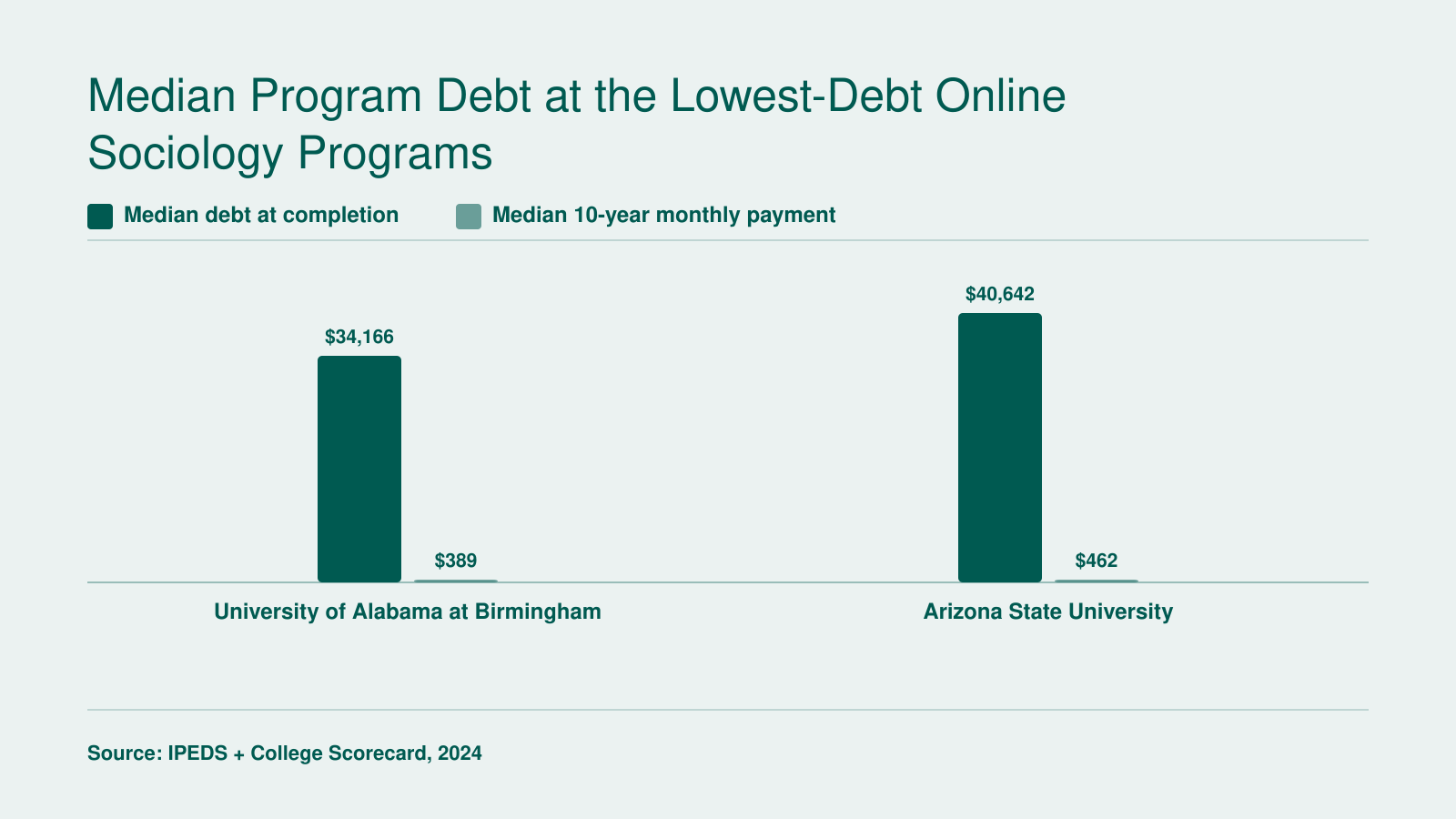
Median Program Debt at the Lowest-Debt Online Sociology Programs
A manageable monthly payment depends on how it compares to early-career earnings. For the two programs that publish program-level debt, first-year earnings range from about $44,900 to $53,300. At University of Alabama at Birmingham, the median federal debt at completion is $34,166, which produces a median 10-year monthly payment of $389. That is less than 11% of a $44,900 starting salary, leaving room for housing, transportation, and savings. Arizona State University's median debt is $40,642, with a $462 monthly payment, still under 11% of its $53,300 first-year salary. Both stay well below the 20% of income often used as a student-loan affordability benchmark. The comparison illustrates that lower total debt translates to lower monthly payments, making the least expensive program also the most affordable month to month.
How to Choose: Accreditation, State Authorization, and Fit
An accredited online degree and an unaccredited one can look identical on a transcript, but only one will hold up with employers, doctoral programs, and federal aid offices. Before comparing course lists or price, confirm that a program clears two basic checks: accreditation and state authorization.
Verify Institutional Accreditation
Sociology has no separate programmatic accreditor, so the check that matters is the institution's own accreditation. An accredited online master's in sociology comes from a college whose accreditor is recognized by the U.S. Department of Education or CHEA.1 Don't rely on a school's marketing page. Search the institution in DAPIP (the Database of Accredited Postsecondary Institutions and Programs) or in CHEA's directory, and look for an accreditor in good standing. If the status is unknown, expired, or listed under warning or probation, ask the school for an explanation before you apply.2 Accreditation also affects aid, since federal financial aid is tied to a school's Title IV eligibility.
Confirm You Can Enroll From Your State
Accreditation doesn't guarantee a school can enroll you where you live. Most online programs handle out-of-state authorization through NC-SARA, a voluntary reciprocity agreement among states (it is not a form of accreditation).3 As of 2026, 49 states plus DC, Puerto Rico, and the U.S. Virgin Islands participate, along with more than 2,400 institutions.4 Membership isn't a blanket pass, though. Member states can still restrict certain activities, programs, locations, or student circumstances, and internships or field placements may carry their own rules.3 California residents should also verify the school's authorization with the state's Bureau for Private Postsecondary Education, even when the school participates in SARA. Read each program's state authorization page before applying.
Match the Program to Your Goal
- PhD or research careers: A thesis track, often structured as an MS with heavier quantitative methods, gives you original research to show doctoral committees and research employers.
- Applied roles: A capstone or comprehensive exam track, common in MA programs, suits work in nonprofits, government, and community organizations.
- Specialized fields: If you're aiming at criminal justice or health-related work, look for a concentration in criminology or medical sociology rather than a general curriculum.
Weigh Delivery and Total Cost
Asynchronous courses let you study on your own schedule, while synchronous sessions add live discussion and more direct contact with faculty. Ask how easy it is to reach professors and thesis advisors from a distance. Finally, compare total program cost through a sociology master's program tuition comparison that includes fees and the number of required credits rather than per-credit price alone. A low per-credit rate attached to a longer program can end up costing more.
In fall 2024, 40.5 percent of U.S. postbaccalaureate students, about 1.33 million of roughly 3.27 million, took all of their courses through distance education, according to the National Center for Education Statistics' Digest of Education Statistics. Choosing a fully online sociology master's puts you squarely in the mainstream of graduate study.
Sociology programs by state
Frequently Asked Questions About Online Sociology Master's Programs
Choosing an online sociology master's means weighing cost, time to completion, and admission flexibility. These answers address common questions about affordability, GRE policies, program length, and teaching qualifications, using the details covered in this guide.
What is the cheapest online master's in sociology?
Can I get an online master's in sociology without a GRE?
How long does it take to earn an online master's in sociology?
What is the difference between an MA and MS in sociology?
Is an online master's in sociology worth it?
Can I teach at a community college with a master's in sociology?
Compare Sociology programs on the data that matters
Explore more Social Work & Social Sciences specializations or browse every graduate field.
All Social Work & Social Sciences programs