Best Master's in Sociology Programs in North Carolina
Compare 13 accredited Sociology programs in North Carolina at 7 schools, with graduate earnings, cost, debt, and completion data from IPEDS and the U.S. College Scorecard.

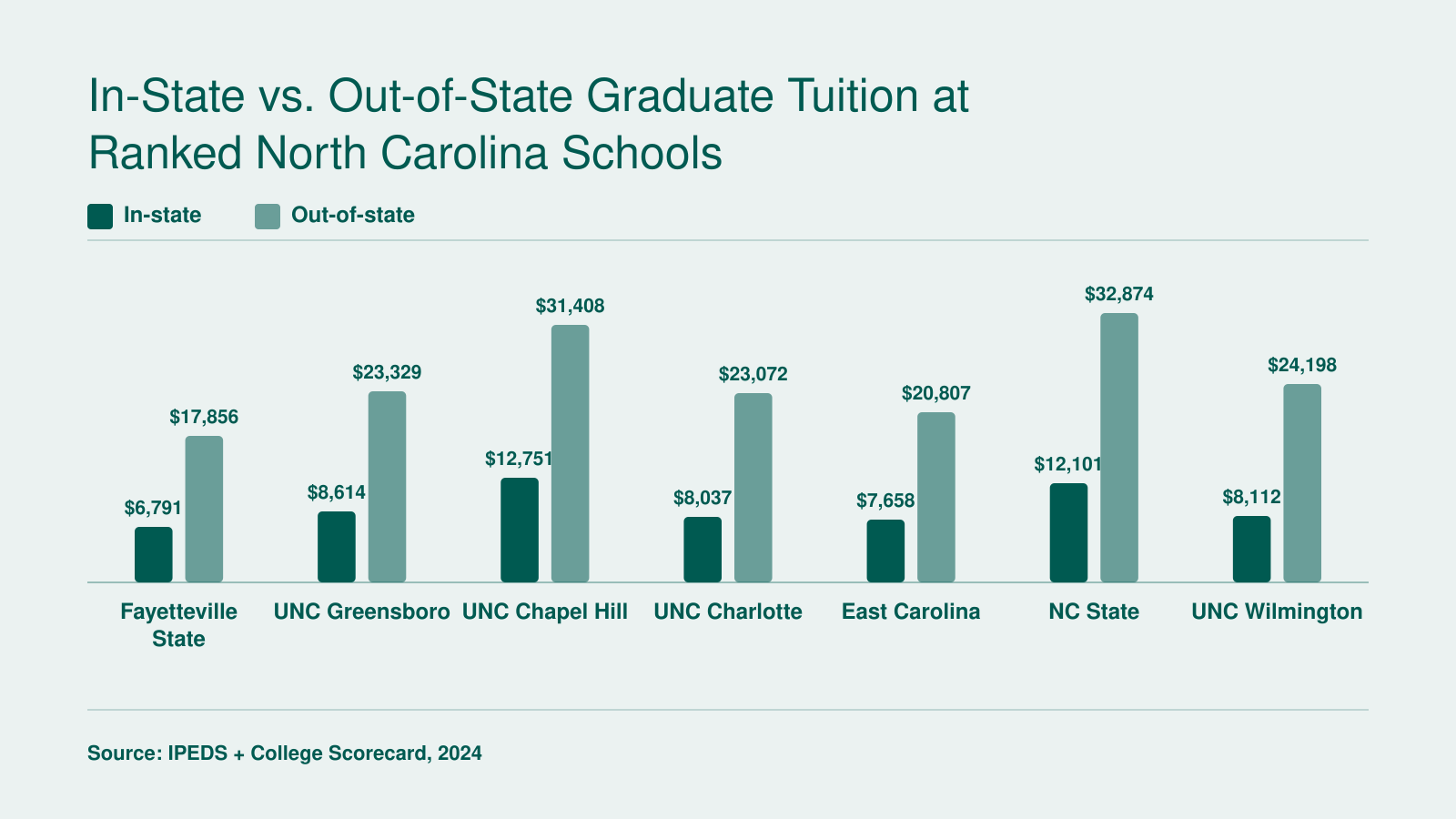
The right North Carolina sociology master's depends on cost, funding, format, and research focus more than on name recognition. In-state graduate tuition runs from $6,791 at Fayetteville State University to $12,751 at UNC Chapel Hill. Out-of-state rates run from $17,856 to $32,874.
The programs also differ in purpose. UNC Chapel Hill leans toward demography and population research, UNC Wilmington toward applied research, and East Carolina University offers an environmental sociology concentration. Fayetteville State University is the only school here with a clear online route.
Sticker price is a poor guide to what you will pay. Assistantships and tuition waivers widen the gaps between programs.
Key Points
- Fayetteville State University offers the only clearly online master's in sociology, at $6,791 in-state.
- NC State's out-of-state tuition runs $20,773 above the in-state rate of $12,101.
- UNC-Chapel Hill funds admitted M.A. students, so apply by priority deadlines for 2027 aid.
Best Master's in Sociology Programs in North Carolina: 2027 Rankings
Seven North Carolina universities returned a master's in sociology in our data, and all seven teach on campus. They range from a highly selective, fully funded joint M.A./Ph.D. track to low-cost, applied programs built for working students. Graduate tuition varies several-fold between the cheapest and most expensive options, so cost deserves as much attention as program focus.
University of North Carolina at Chapel Hill
#1Chapel Hill, NC · ~$13,000/yr (est.)
Best for: Future doctoral students seeking funded study
UNC Chapel Hill offers its sociology master's mainly as part of a joint M.A./Ph.D. pathway, so it suits applicants who plan to pursue a doctorate rather than stop at the master's. The department reports multi-year funding for admitted students, usually tuition remission plus a teaching stipend, and admission is very competitive. The university graduates about 91% of its students institution-wide, and graduate tuition is roughly $10,764 in state and $29,421 out of state. Concentrations in demography and in stratification draw on the Carolina Population Center and the Odum Institute.
- Concentration in Demography and Population
- Population studies and social stratification coursework
- Quantitative and qualitative methods training
- Carolina Population Center involvement
- Colloquium series and department workshops
- Prepares for teaching, research, and public service careers
- Concentration in Stratification and Social Inequality
- Focus on race, class, and gender inequality
- Quantitative, computational, and ethnographic methods
- Comparative historical methods training
- Odum Institute and Carolina Population Center affiliations
North Carolina State University at Raleigh
#2Raleigh, NC · $12,000 – $33,000/yr (est.)
Best for: Thesis-minded students who want research depth
NC State's M.S. in Sociology is a thesis-based, 31-credit program grounded in classical theory, research methods, and applied research. It is a good fit for students who want faculty-guided research experience, whether as a bridge to doctoral study or toward research-focused jobs. The university graduates about 85% of students institution-wide, and graduate tuition is roughly $9,837 in state and $30,610 out of state. Applicants submit transcripts, three recommendation letters, a personal statement, and a writing sample.
- 31 total credit hours
- Master's thesis required
- Core courses in classical theory, research methods, and applied research
- Electives tailored with academic committee approval
- Foundation for doctoral study or research-focused roles
University of North Carolina at Charlotte
#3Charlotte, NC · $5,000 – $10,000/yr (est.)
Best for: Career changers without a sociology major
UNC Charlotte's M.A. in Sociology is the most accessible of the larger programs: GRE scores are not required, and applicants need not hold a sociology degree if they show foundational coursework. Students finish with either a thesis or a research practicum, and the optional Applied Social Research concentration points toward government, evaluation, marketing, and nonprofit work. The university graduates about 69% of students institution-wide, and graduate tuition is roughly $4,610 in state and $19,645 out of state. All admitted students are automatically considered for assistantships.
- 35 total credit hours with 15 core credit hours
- No entrance exam required
- Thesis or research practicum option
- Applied Social Research concentration available
- Early Entry option for UNC Charlotte undergraduates
- Individualized tutorials tailor coursework
University of North Carolina Wilmington
#4Wilmington, NC · $8,000 – $24,000/yr (est.)
UNCW's Sociology and Criminology M.A. emphasizes applied research and program evaluation for students aiming to become evaluators, researchers, planners, or policymakers. Evening and late-afternoon classes suit working professionals, and full-time students can finish in four semesters. The university graduates about 71% of students institution-wide, and graduate tuition is roughly $5,278 in state and $21,364 out of state. Funding support packages are available.
- Focus on applied research and analysis
- Full-time in four semesters, part-time in six
- Late-afternoon and evening classes
- 3.0 undergraduate GPA, three recommendations, writing sample
- Thesis or research internship option
- Public Sociology concentration
- Community-based participatory research
- Policy analysis and program evaluation skills
- SPSS, data visualization, and CATI training
- Public Criminology concentration
- Applied-learning experience
- Policy evaluation and research dissemination training
- Criminological and sociological theory background
East Carolina University
#5Greenville, NC · ~$8,000/yr (est.)
East Carolina University's M.A. in Sociology offers three specialty areas: environmental sociology, the sociology of immigration, and social movements. Admission requires a minimum 2.7 undergraduate GPA and no GRE or MAT, which lowers the barrier for many applicants. Students choose a thesis, a research or teaching practicum, or extended coursework. The university graduates about 63% of students institution-wide, and graduate tuition is roughly $4,749 in state and $17,898 out of state.
- Environmental Sociology concentration
- Two semesters of quantitative data analysis
- Minimum 2.7 GPA, no GRE or MAT required
- Thesis, practicum, or extended coursework options
- Sociology of Immigration concentration
- Intensive discussion seminars
- Research-active faculty mentoring
- Financial assistance and scholarships available
- Social Movements concentration
- Sociological theory seminars
- Research or teaching practicum option
- Apply through the Graduate School
University of North Carolina at Greensboro
#6Greensboro, NC · ~$9,000/yr (est.)
UNC Greensboro's M.A. in Sociology gives a solid grounding in research methods, data analysis, and theory, with in-person classes. Students can write a thesis or take the non-thesis route with a six-credit internship, and a criminology concentration is available. The university graduates about 56% of students institution-wide, and graduate tuition is roughly $5,375 in state and $20,090 out of state. Graduates pursue doctoral study, research, administrative, and teaching roles.
- Criminology concentration
- 33 semester hours required
- In-person class delivery
- Strong research methods and data analysis focus
- Thesis option with 6 thesis hours
- Non-thesis option with six-credit internship
- Paths into social services, human resources, and criminal justice
- Prepares for Ph.D. study
Fayetteville State University
#7Fayetteville, NC · $7,000 – $18,000/yr (est.)
Fayetteville State University is the lowest-cost option on this list, with graduate tuition of roughly $3,438 in state and $14,503 out of state. Its M.A. in Sociology offers thesis and non-thesis tracks in 30 to 36 credit hours, with topics including health disparities, demography, family, and aging. The university graduates about 38% of students institution-wide, which is lower than the other schools listed, so check support services and time to completion when comparing. A written comprehensive exam is required to graduate.
- 30 to 36 credit hours depending on track
- Thesis option with 6 thesis credits and oral defense
- Non-thesis option with practicum
- Written comprehensive exam required
- Core courses include SOCI 500 and SOCI 503
- Faculty interests in health disparities, demography, family, and aging
Cost & outcomes by school
Federal data for the highest-earning Sociology programs, independent of the ranking above. Earnings are this field's master's graduates four years after completing, where the Scorecard reports them.
| School | Earnings | Tuition / yr | Debt | Grads/yr | Format |
|---|---|---|---|---|---|
| Fayetteville State University NC | — | $6,791 | — | 16 | Campus |
| University of North Carolina Wilmington NC | — | $8,112 | — | 13 | Campus |
| University of North Carolina at Greensboro NC | — | $8,614 | — | 10 | Campus |
| University of North Carolina at Charlotte NC | — | $8,037 | — | 6 | Campus |
| East Carolina University NC | — | $7,658 | — | 4 | Campus |
| University of North Carolina at Chapel Hill NC | — | $12,751 | — | 8 | Campus |
| North Carolina State University at Raleigh NC | — | $12,101 | — | 5 | Campus |
Sources: U.S. Department of Education. Tuition and graduates: IPEDS. Earnings and debt: College Scorecard, this field's master's graduates; a dash means no figure is reported.
Online and Hybrid Master's in Sociology Options in North Carolina
An online sociology master's lets you complete the same graduate coursework in theory, research methods, and data analysis without relocating. In North Carolina, only Fayetteville State University clearly offers that. Its Online Master of Arts in Sociology is asynchronous, non-residential, and non-thesis, with 30 credit hours made up of four core courses and six electives.1 The program page lists no required in-person component.
The other schools here lean toward campus delivery:
- UNC Greensboro: The MA is labeled in person. The non-thesis track adds a six-credit internship, which is a real-world placement you arrange locally.
- UNC Charlotte: The MA is on campus, with a thesis or research practicum.
- UNC Wilmington: Its listing mentions late-afternoon and evening classes, which suits working students, but that is not the same as online.
- NC State, UNC-Chapel Hill, and East Carolina University: Their program pages do not establish a hybrid or online format, so treat them as campus programs until the department confirms otherwise.
Before you apply, ask each department about in-person thesis defenses and courses that meet only on campus.
Which Ranked North Carolina Master's Programs Waive or Make the GRE Optional
A test-optional policy is not the same as a waiver: some programs are No-GRE master's programs that let everyone skip the exam, while a waiver makes you qualify to skip it. Here is what the schools publish.
- NC State: The Sociology M.S. is test-optional in the 2026-2027 catalog. Scores may be submitted voluntarily, and omitting them carries no penalty. No waiver criteria are listed because none are needed.1
- East Carolina: The program listing says no standardized tests are required, with a minimum 2.7 GPA.
- UNC Charlotte: The program listing says no entrance exam is required, but the department FAQ we reviewed never states a GRE policy.2 Confirm before applying. Its fee waivers for McNair Scholars and university employees are not GRE waivers.
- UNC-Chapel Hill: The Graduate School leaves GRE rules to each program.4 Because UNC-Chapel Hill admits only to a joint M.A./Ph.D., the General Test requirement applies to the master's as well.3 Confirm directly.
- UNC Wilmington, UNC Greensboro, and Fayetteville State: We found no published GRE policy, so we won't guess. Ask each admissions office.
Application Deadlines and Materials for Sociology Master's Programs in North Carolina
Requirements vary by school, so confirm every item on the program's own admissions page before you apply.
- Bachelor's degree and GPAUNC Wilmington lists a 3.0 undergraduate GPA and East Carolina University a 2.7 minimum. UNC Chapel Hill reports a recent average admitted GPA of 3.7, which is an average, not a cutoff.
- Statement of purposeUNC Chapel Hill requires one. Check the other schools' pages for length and prompts.
- Writing sampleUNC Chapel Hill and UNC Wilmington both list a writing sample. Confirm whether the other schools ask for one.
- Letters of recommendationUNC Wilmington asks for three. UNC Chapel Hill requires letters but the count was not confirmed.
- Official transcriptsSend transcripts from every institution you attended. UNC Wilmington specifies official copies.
- Deadline and funding dateUNC Chapel Hill's deadline for Fall 2027 is December 15, 2026, with all documents due then. Priority funding dates were not confirmed for the other schools, so ask each department directly.
Assistantships, Tuition Waivers, and Funding for Master's in Sociology Students
A funded seat and a pay-as-you-go seat can sit a few thousand dollars apart in sticker price, yet end up very different in cost. UNC-Chapel Hill is the clearest funded option. The UNC-Chapel Hill Sociology Graduate Program FAQ says admitted M.A. students receive at least four years of support, tuition remission plus a stipend, usually through teaching assistantships, and international students are eligible. The stipend amount is not published.
The UNC Charlotte Sociology M.A. Program FAQ says only a small number of assistantships are available. Recipients work 20 hours a week as teaching or research assistants and receive in-state tuition. All applicants are considered automatically. Out-of-state and international students are not eligible for in-state tuition, so they would still owe roughly $17,500 a year in added tuition plus fees.
ECU and UNCW both mention financial assistance, scholarships, or support packages, but the published pages do not confirm amounts or terms. NC State's published funding applies to its Ph.D., not its master's. UNCG and Fayetteville State do not publish funding details that I could find. None of the funding pages address online students, so confirm eligibility directly.
Among the least expensive options without confirmed funding, listed in-state tuition runs about $6,800 at Fayetteville State, $7,700 at ECU, and $8,000 at UNC Charlotte, compared with about $12,800 at UNC-Chapel Hill, where funding can cover it.
Related Articles
In-State vs. Out-of-State Graduate Tuition at Ranked North Carolina Schools
Fayetteville State University is the lowest-cost in-state option here at $6,791. NC State has the largest residency gap: out-of-state students pay $20,773 more than residents ($32,874 vs. $12,101). Residency matters most at the flagship-level research campuses, while Fayetteville State and East Carolina keep the gap comparatively narrow.
Compare Sociology programs on the data that matters
Explore more Social Work & Social Sciences specializations or browse every graduate field.
All Social Work & Social Sciences programs